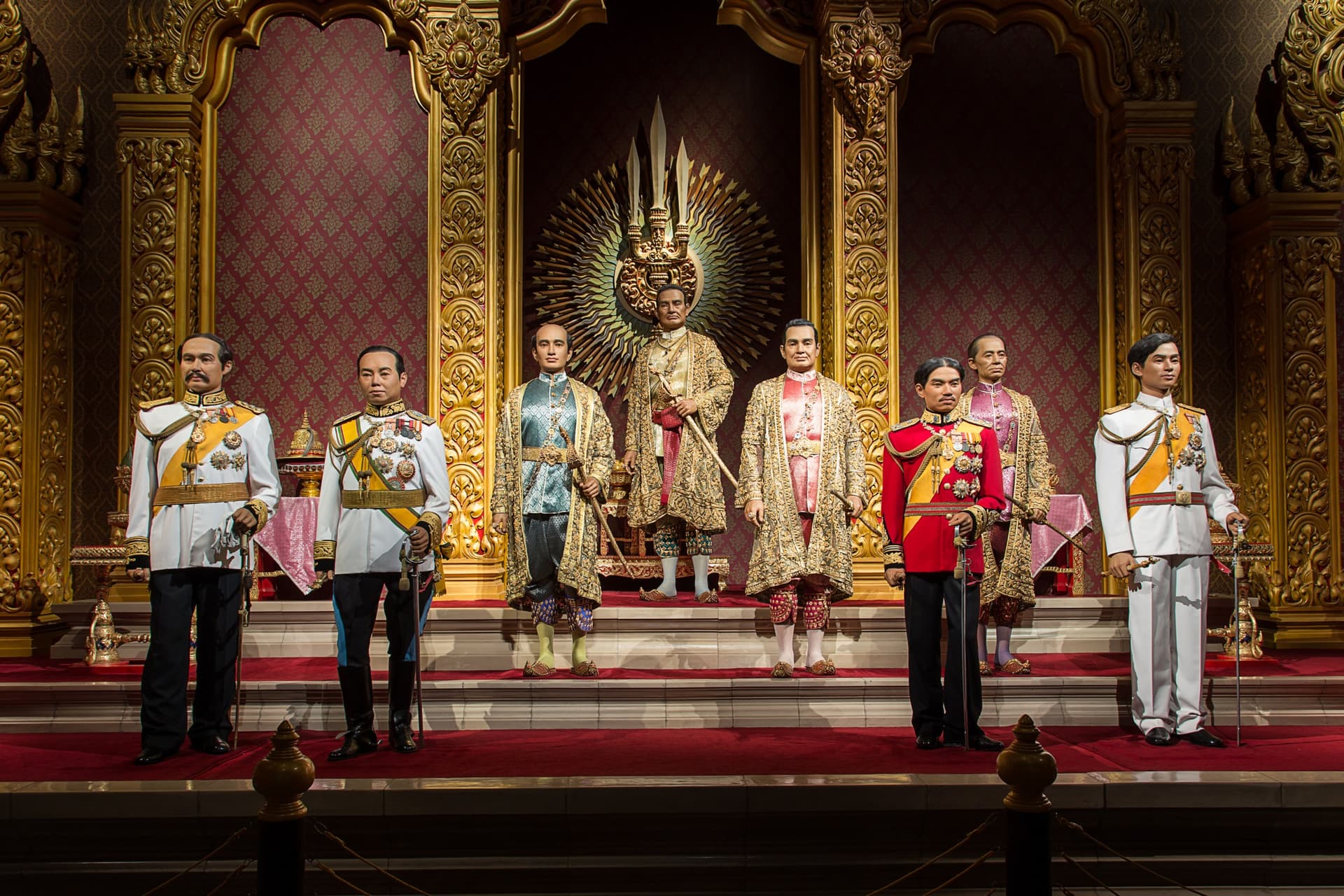
History of the Kingdom of Siam
Immerse yourself in the fascinating history of the Kingdom of Siam, the former name of Thailand. Discover how this nation, once known as Siam, became Thailand in 1939. Explore the defining chapters of its past, from its earliest capitals of Ayutthaya and Thonburi, to its present-day name. A journey through time, marked by iconic royal figures and major historical events.
Definition of the Kingdom of Siam
Before the nation adopted the name "Thailand," it was known as the "Kingdom of Siam." This name had been in use for centuries, dating back to when the territory was an influential Hindu-Buddhist kingdom in the region. "Siam" is also frequently used to describe the country's culture, history, and traditions.
The Origins of the Kingdom of Siam: The Rise of Sukhothai and the Lan Na Nation (13th-16th centuries)
The 13th century marked the decline of the Khmer Empire. Sukhothai was proclaimed in 1238 as the first independent Thai kingdom. Nakhon Si Thammarat distinguished itself in the South and became a vassal of Sukhothai. During this period, the nation flourished, developed its own cultural and political identity, and Theravada Buddhism continued to spread. However, following the death of King Rama Khamheng in 1317, the Sukhothai kingdom began its decline.
Called to the throne in 1259, King Mengrai founded his new capital at Chiang Rai, then at Chiang Mai in 1292. He established and developed the Lan Na nation. Yet numerous rivalries over succession weakened the kingdom. The 15th century was marked by endless warfare. In the mid-16th century, Lan Na fell under Burmese domination, remaining under their rule for the next two centuries until King Taksin successfully repelled the Burmese in 1774.
Ayutthaya, the Glorious Capital of Ancient Siam (16th-18th centuries)
The kingdom of Ayutthaya was founded in 1351. Ayutthaya is often associated with a golden age, renowned for its exceptionally refined architecture, painting, sculpture, and poetic expression. During the two centuries of the kingdom's existence, it expanded eastward (Nakhon Ratchasima) and northward (Sukhothai and Chiang Mai). In the mid-16th century, wars with Burma resumed, and the Burmese captured Ayutthaya in 1569. However, less than twenty years later, the kingdom had recovered its independence.
Conflicts Between the French and Siamese Kingdoms
Relations between the French and Siamese Kingdoms began in the 17th century, marked by conflicts and misunderstandings, but also by diplomatic and commercial exchanges. The arrival of the first French missionaries to Siam in 1662 opened the door to more formal relations. King Phra Narai's efforts to convert to Christianity, however, created tensions. In 1684, King Phra Narai sent envoys to Louis XIV to establish diplomatic relations, an initiative that ultimately led to conflicts. Tensions between the two kingdoms were exacerbated by the aggressive commercial policies of the Dutch Provinces, against which Siam and France allied themselves.
The Fall of Ayutthaya
In 1758, the Burmese kingdom attacked Ayutthaya. The city was razed in April 1767. Thousands of inhabitants were deported to Burma while survivors fled southward.
However, General Taksin managed to escape with a small force. He drove back the Burmese, captured Thonburi (across from Bangkok south of Ayutthaya) which he made his capital, then seized Chiang Mai, Luang Prabang, and Vientiane. In 1782, due to his deteriorating mental state, a revolt broke out against King Taksin, who was executed.
The Era of the Chakri Dynasty (18th-20th centuries)
King Taksin Succeeded by General Chakri, Commander-in-Chief of Siam's Forces
Following King Taksin's death, General Chakri was proclaimed king of Siam. He reigned under the name Rama I and undertook the restoration of "wats," Buddhist monasteries, and the construction of his Palace. This structure contained royal residences, government and judicial offices, as well as a royal chapel. Today, the Grand Palace houses, within its 260 hectares, the Wat Phra Kaeo, "the Temple of the Emerald Buddha," the most venerated representation of the Buddha in the country, and the Mint Pavilion, which contains a collection of coins in use since the 11th century, weapons, medals, and decorations bestowed by monarchs of the Chakri dynasty.
Iconic Leaders of the Chakri Dynasty
Within this dynasty, Rama IV distinguished himself particularly for saving the kingdom from colonization, signing important treaties with Europe, modernizing the military, and introducing Western medicine. Hollywood also made him a celebrity: in the film "The King and I," his character was first portrayed by Yul Brynner, then by Chow Yun-Fat alongside Jodie Foster.
His eldest son, King Chulalongkorn, Rama V, continued his work by abolishing slavery and modernizing road infrastructure (Thailand's first railway line) as well as the governmental system. The people hold a deep reverence for this king, who was also the first Thai monarch to travel to Europe. One of the major events of the Central Plains is "Chulalongkorn Day," which honors him annually on October 23.
During his reign, a conflict over Laos pitted France and Siam against each other in 1893. Laos was ultimately ceded to France, but the King of Siam succeeded in preserving his nation from colonization.
Rama VI, son of Chulalongkorn, received his education in England. He made primary school compulsory and established the first university.
Why Siam Became Thailand
Under the reign of Rama VII, absolute monarchy was abolished. Siam became a constitutional monarchy, marking the end of the king's direct intervention in political affairs.
When Did Siam Become Thailand?
It was in 1939 that Siam took the name Thailand.
On December 5, 1946, His Majesty King Bhumibol Adulyadej, Rama IX, crowned in 1950, ascended to the throne. He remains king of Thailand to this day, and his reign is the longest-lasting in the entire history of Thai royalty.
In the 1980s, the nation achieved undisputed political and economic stability. Today, after numerous coups, Thailand stands high among the rapidly expanding regional powers of Southeast Asia. It joined the ASEAN free trade zone in 1993 (Association of Southeast Asian Nations).
His Majesty King Bhumibol Adulyadej, Rama IX
The latest sovereign of the Chakri dynasty, His Majesty King Bhumibol Adulyadej is an exceptionally respected figure throughout the nation. The portrait of the royal couple is displayed in nearly every household, and the Thai people hold him in profound respect and sincere admiration. King Bhumibol Adulyadej is venerated both as the heir to the fabulous era of Sukhothai and for his personal qualities. Though his powers are limited within the framework of constitutional monarchy, he serves the essential role of unifying factor and guarantor of political and religious stability. He has notably contributed to vast initiatives supporting the nation's underdeveloped regions (particularly the Northeast), agricultural programs, and the improvement of living conditions for the northern hill tribes.
Her Majesty Queen Sirikit is also held in great esteem. She has contributed to the flourishing of traditional Thai craftsmanship by establishing the "Support" foundation in 1976.
A royal personage as venerated as the current royal couple was Her Royal Highness the Princess Mother, who passed away in 1995 at the age of 95. Known as "Mae Fah Luang" or "Royal Mother Descended from Heaven," the people hold her in profound respect, love, and gratitude, inspired by a lifetime devoted to improving living conditions for populations in isolated and disadvantaged regions.
In 1982, the bicentenary of Bangkok and the Chakri dynasty was celebrated, and grand festivities were organized in 1987 for King Bhumibol Adulyadej's 60th birthday. On this occasion, King Rama IX Park was inaugurated. This aquatic park and botanical garden located in Bangkok spans 100 hectares. A museum there offers a retrospective of the monarch's life.

