The Thai Flag
The Thai flag is far more than three colors: it bears the imprint of the nation, Buddhism, the monarchy, and a history marked by several major transformations.
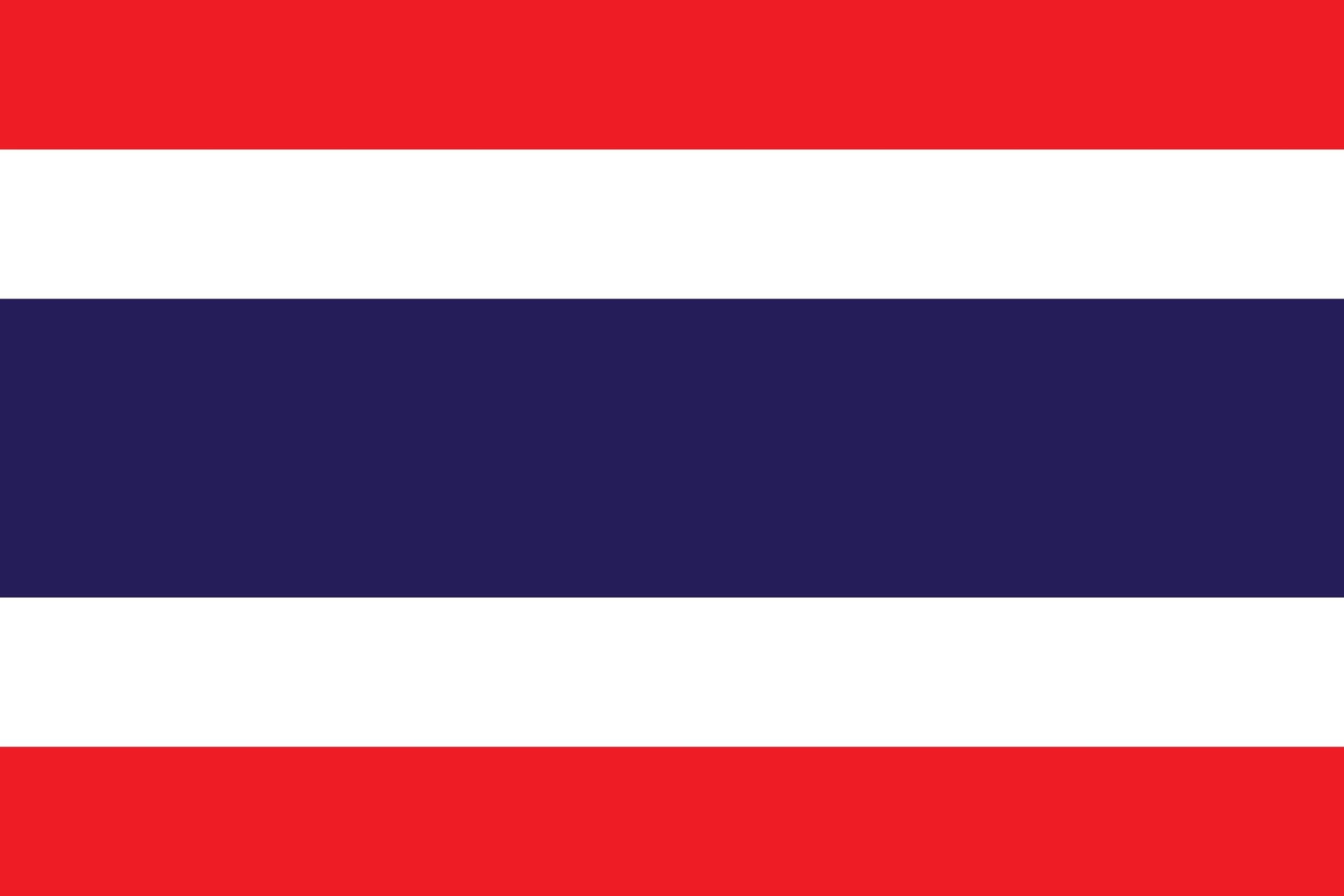
The current and official version of the Thai flag is the tricolor flag. Its Thai name is ธงไตรรงค์, Thong Trairong, meaning tricolor. The three colors are represented in five horizontal stripes.
- The red stripe represents the Thai nation and the individual's belonging to the nation
- The white stripe represents the purity of religion, that of Theravada Buddhism
- The blue stripe, the color of Rama VI, is twice as wide as the two preceding ones. Positioned at the center of the flag, it represents the Monarchy and the king, who is regarded as the benefactor of the Thai people
The blue stripe carries a dual significance. It also represents Thailand's solidarity with its allies during World War I, namely Great Britain, France, the United States, and Russia—nations whose flags all contain blue, white, and red.
The Thai flag was designed in a symmetrical manner so that it appears identical regardless of its orientation. Historians believe the inspiration behind this flag came during a flood when King Vajiravudh (Rama VI) saw the flag hanging upside down, which prompted him to create a new symmetrical flag and prevent such an occurrence from happening again. This symmetry is regarded as a symbol of the King's profound wisdom.
The Original Flag
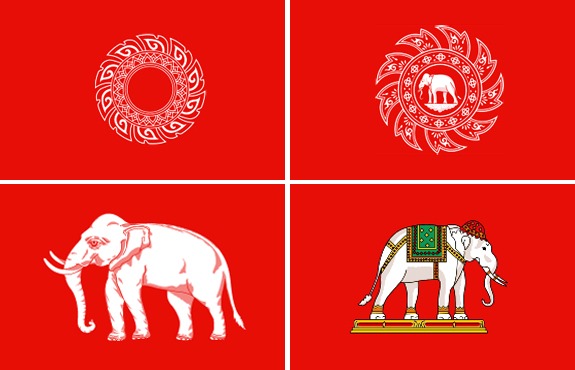
It was in the 17th century, when the international and diplomatic relations of the Kingdom of Siam with European powers, as well as with Persia, India, and China, were at their height, that the first appearance of a banner was seen. This flag is entirely red, and historians agree that it would have been hoisted in honor of a French ship sailing on the Chao Phraya River.
Red symbolized the Aristocracy at the time, and this flag was frequently used by emissaries of the Siamese king.
The Addition of the Chakra to the Thai Flag
In 1782, Thong Duang overthrew Taksin in a coup d'état, took the name Chao Phraya Chakri, and became Rama I, the founder of the Chakri dynasty, still in power today.
The name Chakri combines the words Chak and Tri, the emblems of the Chakra (disk) and the trisula (trident), two of the weapons of Vishnu with which he beheaded the forces of evil.
Rama I then decided to add the Chakra symbol to the red flag of the Siamese Empire.
The Addition of the White Elephant to the Thai Flag
In 1809, Rama II, son and successor to the throne of Siam, possessed three white elephants and decided to add a white elephant at the center of the Chakra. The white elephant has symbolized power since the 13th century under King Ramkhamhaeng. Indeed, in Hindu religion, the god Indra's mount (vahana) is a white elephant called Airavata, which is frequently depicted with three heads.
In 1851, King Rama IV decided to remove the chakra in order to focus on the overall visibility of the flag and the representation of the elephant.
In 1916, Rama VI modified the appearance of the elephant: it now wears a harness, is mounted on a pedestal, and faces away from the flagpole.
A Problem of Symmetry
However, during an expedition in the north of the Siamese Empire, when the region was struck by floods, the king saw flags hanging upside down. He decided then, in order to prevent such an error from recurring, to create a symmetrical flag, representing the same design regardless of the direction in which it appears. This marked the end of the white elephant, which was replaced by two white stripes.
The white elephant, symbol of the Chakri dynasty, now appears only on the flag of the Thai Navy.
The Current Version of the Thai Flag
On September 28, 1917, King Rama VI adopted by decree the current version of the Thai flag, with the blue stripe replacing the red stripe. It became the civil flag, the state flag, the merchant ensign, and the state ensign of the Kingdom of Thailand.
The Thai flag is similar to the Costa Rican flag, with the blue and red colors inverted.

