Thai Language and Script
Thailand reveals itself through its language: Central Thai, regional dialects, alphabet, tonal system, and practical expressions offer essential insight for better communication during your journey.
With nearly 66 million speakers, Central Thai is recognized as the national language of Thailand. Central Thai and Bangkok Thai are therefore the most widely used. Almost all Thai people understand and speak it. As the Thai people originated from southern China, the Thai language shares similarities with Chinese. Over time, it has been enriched by Khmer, Sanskrit, and Pali influences.
Thailand is home to various living languages depending on the ethnic origin and geographical location of different groups. In the northeast of the country, inhabitants speak Isaan Thai. In regions bordering Malaysia, more than 6 million people speak Dambro. The Thai Yuan people from the former Kingdom of Lanna, living in the Chiang Mai and Chiang Rai regions, communicate in the Lanna language. In certain areas of northern Thailand, some ethnic groups also use Chinese.
Within the tourism sector, English is the official language of all those operating in this field. It is widely practiced at all tourist destinations and prominently displayed on signs, government offices, and even food packaging.
Learning Thai
With its distinctive sounds, intonations, and unique alphabet, the Thai language is very different from Western languages. It is a tonal and analytical language that relies on 5 different intonations, which can radically change the meaning of a word. These include the neutral tone [˧], low tone [˨˩], high tone [˦˥], falling tone [˥˩], and rising tone [˩˦].
Since it's always pleasant to communicate or at least greet and thank in the local language, we've compiled a small list of words to know before traveling to Thailand.
Greetings
Hello = Sawat dii How are you? = Sabaïde maï? Nice to meet you = Yin dee tee daï rou djak
Shopping
How much does it cost? = Raka tao raï It's too expensive = paeng pai Do you sell...? = mii kai mai...
Wishes and Feelings
I would like to go to... = Yak paï tee... I would like = ao I don't want = may ao Very beautiful = souaille mak Thank you very much = khop khoune mak
Numbers
1 = neung 2 = song 3 = saam 4 = sii 5 = haa 6 = hôk 7 = djet 8 = bèt 9 = gaao 10 = sip 11 = sip ét 20 = yi sip
In Thailand, men always end their sentences with the word "khrap" and women with "kha." These words convey politeness and respect. To greet a man, you should say "Sawat dii khrap" and "Sawat dii kha" for a woman. You also say "Sabaydi may khrap" to ask "how are you?" to a man and "Sabaydi may kha" to a woman.
Thai Script
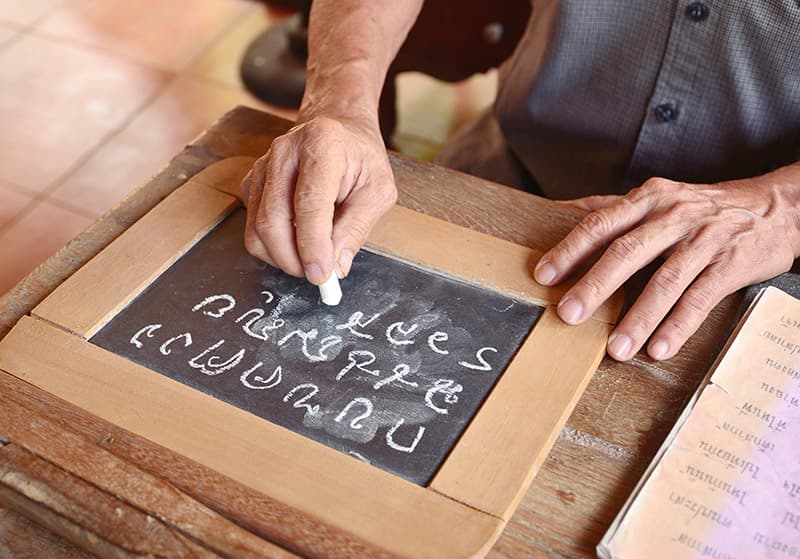
Thai script derives from the Khmer alphabet, which evolved from the Pali alphabet. It contains 44 consonants and 37 vowels, including diphthongs and triphthongs. It is written from left to right and has no punctuation marks. What truly complicates Thai writing is that certain words can be written together, and spaces are the only indicator marking the end of a sentence. Uppercase letters are not used in Thai script. Grammatically, it does not recognize gender, number, or conjugation. Verbs remain invariable regardless of tense, gender, or number. To differentiate tense, you must place the marker "lèo" after the verb to indicate the past, and the marker "dja" before the verb to indicate the future.
Transliteration
There is no universal method for transcribing Thai into the Latin alphabet. It is nearly impossible to transliterate Thai script accurately. Everyone—from dictionary publishers to travel guide writers and brochure creators—uses their own approach and transliteration system. To master the writing system, the best approach is to learn and master the Thai alphabet.