What Are Spirit Houses in Thai Gardens?
Why do spirit houses stand before so many buildings in Thailand? Learn the origins, symbolism, and customs of this still-vibrant ritual.
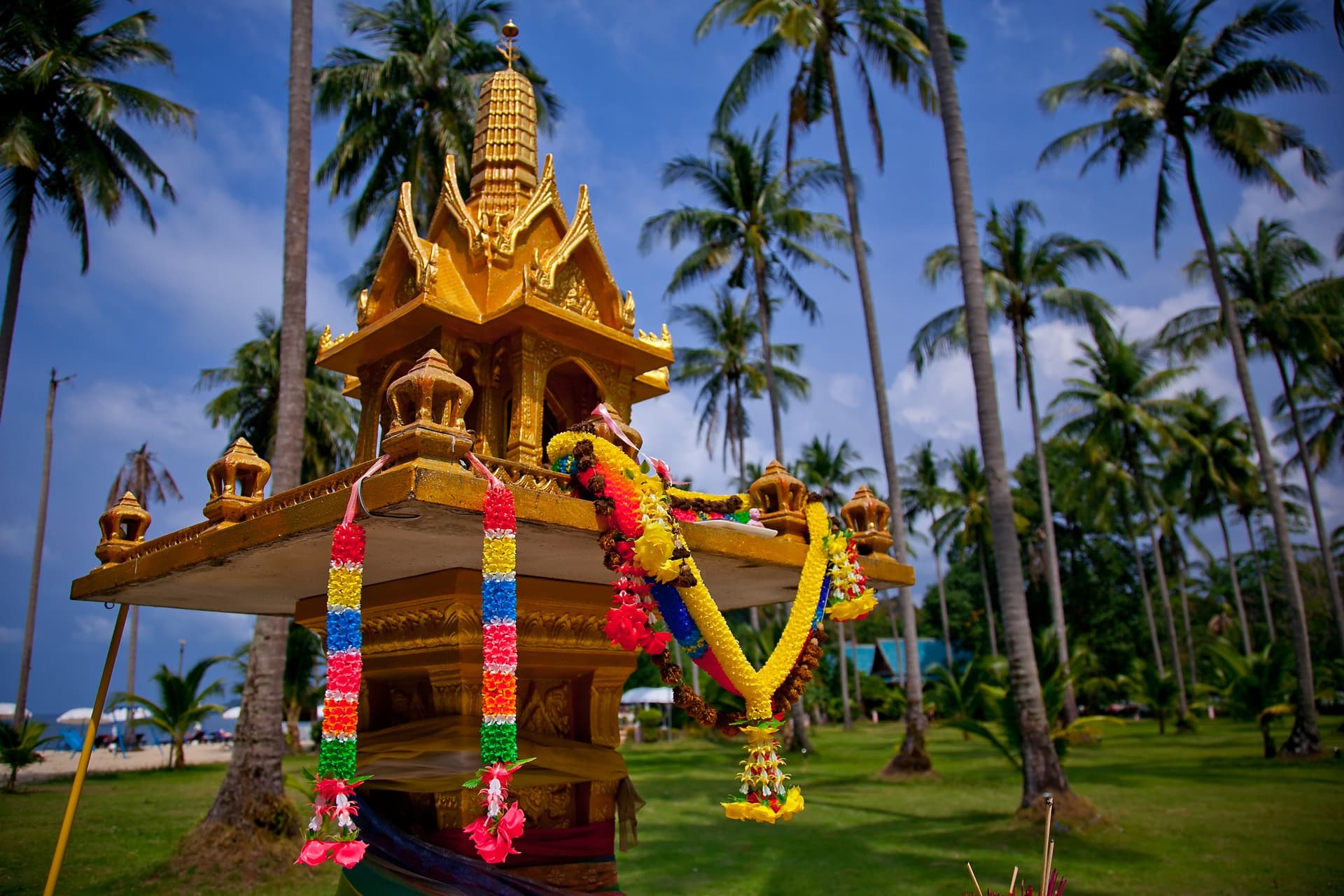
Literally translated as "dwelling of the guardian spirit of a place," the San Phra Phum or spirit house is a miniature temple found before most Thai buildings, whether private or public. You'll encounter them just as often in residential gardens as in front of banks, hotels, shopping centers, football stadiums, or even sacred trees. But what lies behind this animist-inspired ritual? Let us explain…
The Tradition of San Phra Phum
In Thailand, belief in spirits is commonplace. Those known as 'Chao thi' are protective and benevolent spirits, while 'Phi' are malevolent wandering spirits. The former are considered the guardians of soil, fields, trees, and homes. It is precisely for them that the spirit house exists. Indeed, the chao thi are tasked with keeping the phi at bay. This is why every building must provide them shelter so they can fulfill their mission.
The spirit house can take two forms:
San Phra Phom: this is the larger version of a spirit house. It is often confused with a mausoleum and includes a statue of the Hindu god Brahma.
San Phra Phum: smaller in size, it houses miniatures representing the spirits.
Regardless of its form, the spirit house varies from building to building. To avoid making spirits envious of humans, the size and richness of the spirit house must be proportional to that of the dwelling it protects. Every day, before 11 a.m., the inhabitants must offer prayers and place offerings before the spirits as a gesture of gratitude and to secure their protection. These may include incense, candles, flower garlands, food, or even beverages (which should obviously not be touched)…
A Tradition Rooted in Animism
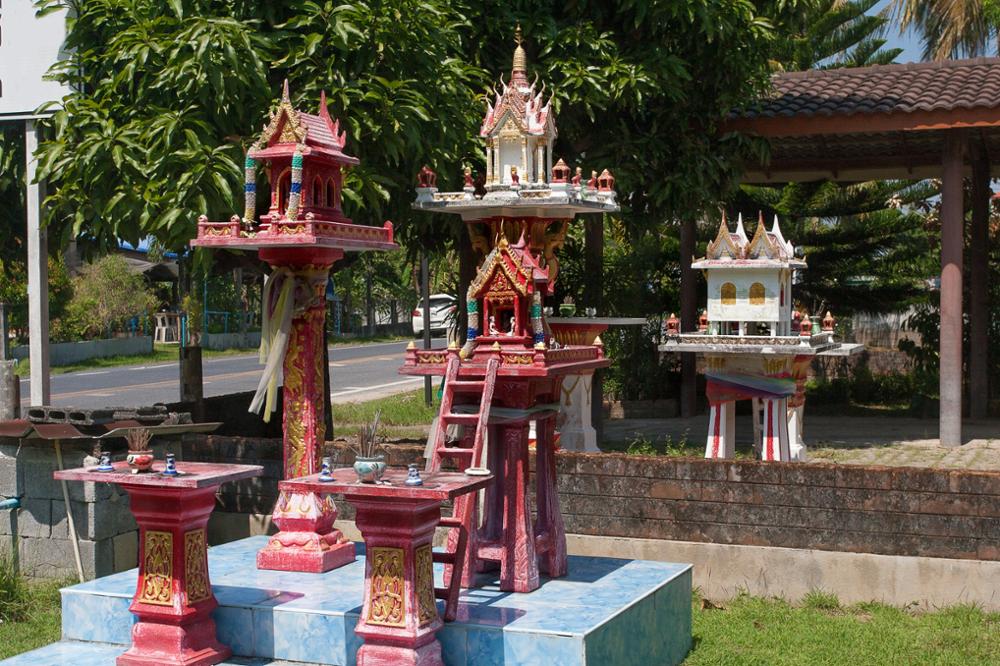
The spirit house is a manifestation of animist worship. As a reminder, animism is a belief system that attributes soul and consciousness to objects, vegetation, and animals. Though not Buddhist in origin, this practice has established itself in Thailand by blending with syncretic Theravada Buddhism. Animism thus places the chao thi at an intermediate level between humans and Hindu deities, regarding them as servants of Buddha. Thailand is not the only Buddhist nation in Asia to embrace this tradition—it is equally prevalent in Laos, Myanmar, and Cambodia.
Spirit Houses and Their Customs
Installing a spirit house in Thailand is not like arranging decorative accessories! Its placement is governed by a series of codes and rituals. To begin, installation must be performed by a Brahmin priest. During the installation ceremony, he will erect the sanctuary according to several criteria. He will determine which day of the lunar calendar is most auspicious for installation, and he will also define the location and orientation of the spirit house as well as details like the paint colors. The spirit house should ideally be positioned in an elevated spot near the main entrance. What is certain is that it must never be placed in the shadow cast by the building it protects, as this risks bringing misfortune and bad luck…
When property owners move or when old structures require extensive renovation, spirit houses must never be destroyed! It is unthinkable to leave spirits without a home. For such situations, there are dedicated places, such as cemeteries for spirit houses… This speaks volumes about how important the rituals surrounding this belief are in Thailand!
Frequently asked questions
Yes, but with respect. Avoid photographing during prayers and ask permission on private properties.
Offer your apologies respectfully. This is an involuntary gesture generally forgiven to visitors.
Most do, but it is not mandatory. It depends on the beliefs of the property owners.
Yes, similar traditions can be found in Laos, Cambodia, Myanmar, and certain regions of Vietnam, with local variations.
Costs vary depending on size and materials, ranging from several hundred to thousands of baht, not including the Brahmin priest's fees.