Green lights in the Gulf of Thailand: what are they?
From Koh Samui or by plane, the green lights of the Gulf of Thailand intrigue. Discover their origin, their use for fishing and what they reveal about the coastline.
For much of the year, when darkness falls, the Gulf of Thailand becomes studded with countless green dots. Visible from the mainland or during an aerial crossing, even from the International Space Station, these mysterious lights beg a question: what exactly are they? We explain.
What are the green lights above the Gulf of Thailand?

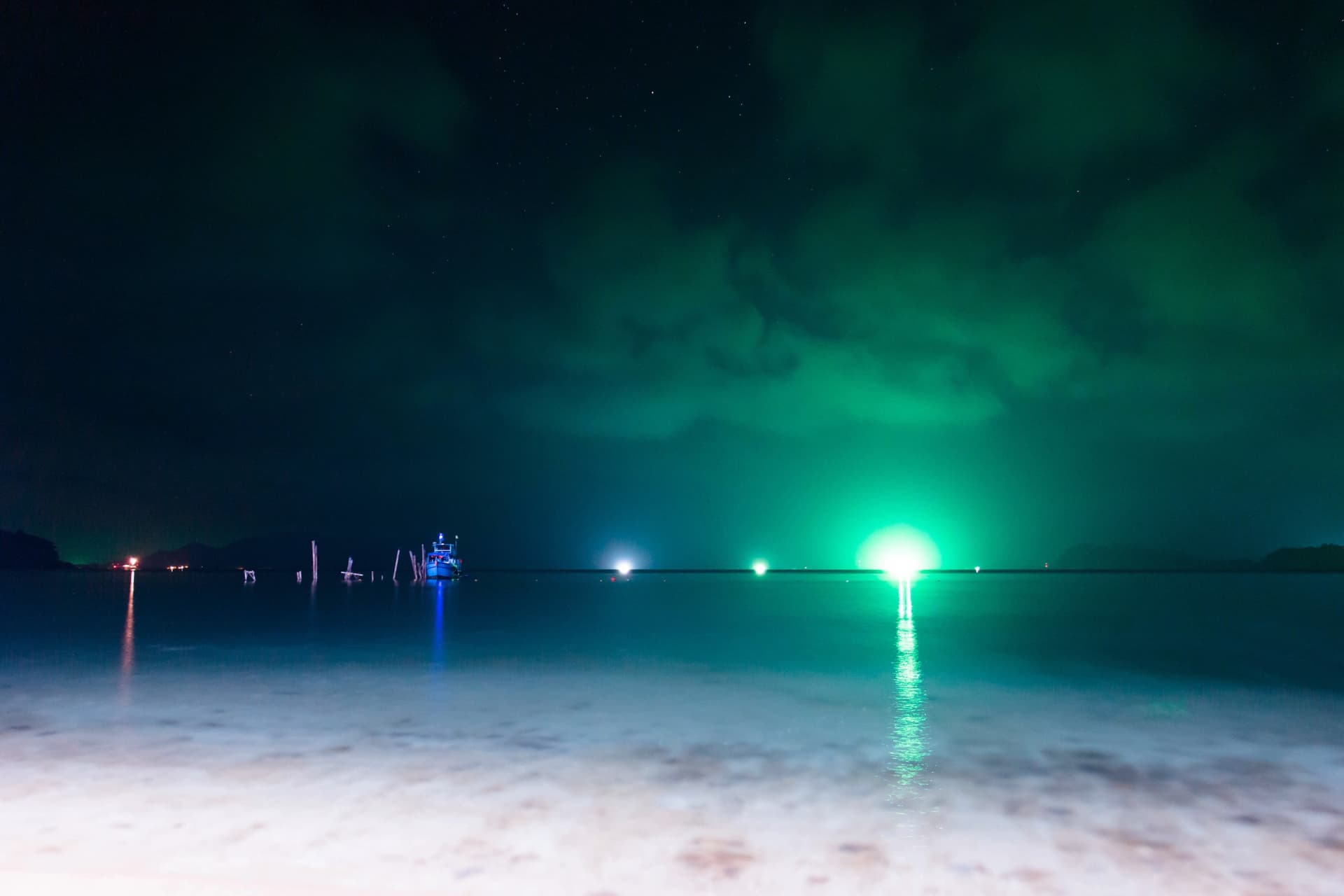
Each evening as darkness descends, an intense green glow floods the Gulf of Thailand. But what is its source? These luminous phenomena are no cosmic mystery, but rather the work of fishing boats. Fishermen deploy banks of fluorescent green LED lights to catch squid.
This strategy lures the creatures from the depths. Squid, which feed primarily on fluorescent plankton, instinctively rise from deeper waters to pursue and hunt their prey. By mimicking the light of plankton, the LED bulbs attract squid to the surface, where fishing nets capture them. The catch is then sold domestically or exported worldwide, particularly to Europe.
Green lights visible from the International Space Station
These lights are visible not only from shore and aircraft, but also from space. Scientists first documented them in the late 1970s when mapping Earth at night, and NASA has since released numerous photographs taken from the International Space Station.
As Michael Carlowicz of NASA's Earth Observatory explains: "A single fishing boat can carry more than a hundred of these lamps, generating no less than 300 kilowatts of light per vessel". With the sheer number of fishing boats operating in the area, the result is an impressive green halo stretching across kilometers.
The Gulf of Thailand: a victim of overfishing

The nighttime imagery of the Gulf of Thailand is not merely striking—it highlights a serious environmental problem: overfishing. For years, intensive fishing operations have decimated numerous fish species. The issue? Fishermen disregarded catch restrictions and designated fishing zones.
Confronted with this crisis, the European Union threatened to ban Thai seafood imports in 2015. New regulations emerged, requiring all Thai fishing vessels to be tracked by satellite 24 hours a day, with suspicious ships subject to interception at sea or inspection at port. Customs controls were also strengthened. In early 2019, the EU lifted its "yellow card" warning, citing improvements.
Yet intensive fishing persists in the Gulf of Thailand today. One need only observe the growing number of boats each year off the coasts of Koh Samui, Koh Phangan or Koh Tao to grasp the scale, or take a night flight from one of the islands to Bangkok to realize the sea is crisscrossed with green light, stretching to the horizon...
Frequently asked questions
The green lights are visible mainly during squid fishing season, typically from September to April, at nightfall.
The lights are visible from the coasts of Koh Samui, Koh Phangan, Koh Tao, or during night flights over the Gulf of Thailand.
Green light mimics the natural bioluminescence of plankton that squid feed on, drawing them toward the surface.
Yes, this LED night-fishing technique is used in other Asian countries, but the Gulf of Thailand remains one of the most spectacular examples.