Nora dance
Nora dance
A rhythmic dance of improvised chants, nora is an intangible cultural heritage of southern Thailand. Discover it fully during your next trip to the Land of Smiles.
A rhythmic dance of improvised chants, nora is an intangible cultural heritage of southern Thailand. Discover it fully during your next trip to the Land of Smiles.
Nora dance, a traditional dance form in Thailand
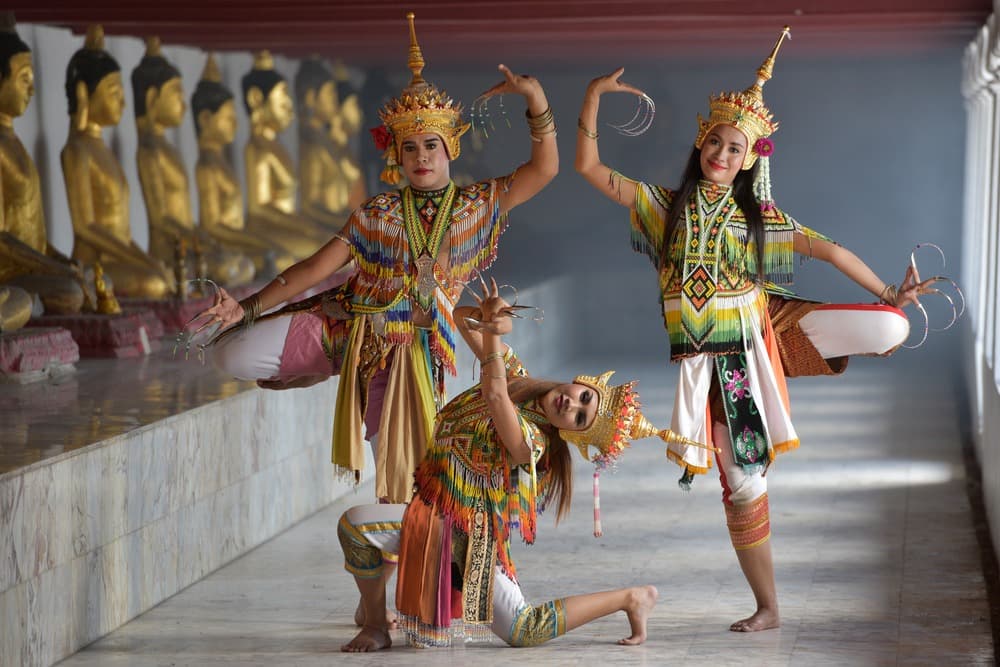
Thailand is far more than its impressive temples, its floating markets, and its sprawling mountainous rice paddies. During your stay, you can watch a dramatic traditional dance performance brought to life by local artists: nora dance. Born in the southern islands, this dance tradition was originally reserved for solemn ceremonial occasions. Yet young troupes of dancers, breaking free from academic constraints, have spread nora throughout the country. Dressed in vibrant clothing, performers enact theatrical pieces and execute intricately choreographed dance steps accompanied by drums and cymbals. For culture and folklore enthusiasts seeking to discover another facet of Thailand, this is unmissable!
The origins of nora dance
Nora is to Thais what classical ballet is to the French or flamenco to Andalusians. Originally, it was strictly codified as a ceremonial dance. Artists had to graduate from a Nora dance school. The choreographic performance took place only once a year, or even once every three to five years. It opened with an invocation of deities and ancestral Nora masters to join the ritual ceremony and accept the humble offerings of the dancers. This is "Nora Rong Khru," the original form of nora as it was created by the island peoples of the Gulf of Thailand. Dancers would perform for three days and three nights without pause, with the opening date set by school directors.
Today: a major tourist attraction
Over the past two decades, nora has modernized, gradually shedding its strict academic rules. While the invocatory prelude and the interpretation of drama or lyric comedy remain essential, performers now have the freedom to improvise rhythmic movements. Today, nora—sometimes spelled "menora" or "manora"—is an entertainment dance beloved by southerners. It thrives primarily in rural communities in Trang, Songkhla, and Phatthalung.
However, nora has spread to central and northern regions of the country. This means that regardless of their chosen destination, tourists will have the opportunity to witness this dance spectacle by booking a cultural tour in Thailand.
The artistic conventions of Nora Dance
Nora dance is a complete stage performance. It is a dance inspired by a celebrated theatrical piece, where melody marries choreography. As a rule, the dramatic work illustrates episodes from the life of Jataka. It is performed by a minimum of 2 dancers and a maximum of 5 dancers.
The nora performance can be divided into 8 stages:
Stage 1: An opening piece of music (Tang Khrueang) is played as a prelude: it invites the gods and ancestral spirits to join the performance and implores their blessing to dance nora in the venue.
Stage 2: After this invocation, the curtain opens (Hom Rong).
Stage 3: The orchestra plays the Coen Khru. This piece covers the birth and chronological evolution of nora, with tributes to virtuous men and dance masters.
Stage 4: The dance proper begins: after singing passages in verse behind the curtain, the dancers take the stage respectively in this order:
The Nang Phanak: a performer seated apart on a bench;
Wa Bot Rai Tree: another performer;
Tham Bot: he repeats excerpts from a lyric work in a contorted movement, where arms and legs move in harmony;
Wa Klon: he sings verses to demonstrate his oratorical skills, either by reciting a known poem or by improvising on the spot;
Ram Uat Mue: unlike Wa Klon, he simply dances.
Stage 5 (Ok Phran): The buffoon enters next. His role is to entertain the audience with wit and comic performances.
Stage 6 (Ok Tua Nai Rong): This is when the lead dancer who plays the principal role appears on stage. She is called Nora Yai. The role is performed by a professional artist who typically heads the troupe.
Stage 7 (Ok Phran): The buffoon announces the title of the theatrical piece to be performed.
Stage 8: Performance of the dramatic piece.
Costumes and musical accompaniment
To make a lasting impression, nora is performed in colorful costumes and carefully arranged music.
The principal character—always female—wears a vibrant shirt adorned with various motifs and pants reaching to the calf. The costume accessories include:
The kamlai plai khaen: bracelets worn at the wrist;
The kamlai ton khaen: ribbons worn on the arms;
The pik nok aen: two wings attached to the back of the costume;
A chain around the neck adorned with pendants;
The lep: nail extensions;
And pha hoi: pieces of fabric detached at the front and on both sides of the shirt.
Secondary characters and extras wear the same costumes as the principal character, except the wings, trim, and pendants are absent.
Nora is characterized by musical accompaniment. Percussion instruments are used: the thap nora is the centerpiece of the orchestra. It is a pair of drums with two distinct tones. A third drum, cymbals, small gongs, traditional oboes, and wooden sticks complete the sound.
Photos
Also discover
Give it a go!
Our local experts arrange this activity for you.