Temples of Phuket: Which Ones to Visit?
Which temples should you visit in Phuket? Find the must-see sacred sites, their history, opening hours and our practical advice for planning your discovery.
29 Dec. 2024
Passing through Phuket and looking to visit a few temples? What a wonderful idea to discover these places of spirituality where the meditative atmosphere contrasts beautifully with the hustle and bustle of the city center. We're taking you on a journey through the most sacred sites in the region with our top 5 most beautiful temples of Phuket.
1. Wat Chalong

Also known as Wat Chaithararam, Wat Chalong is the most important temple in Phuket. It's also the largest on the island. Located about 8 km from Phuket Town, it attracts thousands of visitors, both tourists and locals alike.
Built in the early 19th century, the temple was enlarged over the years. It's famous for its chedi inaugurated in 2004. Inside this 60-meter-high stupa sits a fragment of Buddha's bone. You can also admire magnificent frescoes on the interior walls and ceilings depicting scenes from Buddha's life.
Visitors can also climb to the 3rd floor to enjoy a panoramic view from the terrace. You can see the famous Big Buddha of Phuket perched on its hill in the distance. A few more steps lead up to the Buddha bone fragment, which you can admire through a glass case.
Wat Chalong is also associated with the two founding monks of the temple: Luang Pho Chaem and Luang Pho Chuang. These revered monks are known for leading the citizens of Chalong sub-district in the fight against the Chinese rebellion in 1876 and for treating the wounded using their knowledge of herbal medicine. To this day, locals still come to pay them tribute. You'll see their likenesses in the entrance hall, where thousands of thin gold leaves have been deposited by the faithful.
Practical Information:
- Free admission
- Address: 70 Moo 6 Chaofa Road (West) Chalong Phuket 83000
- Opening Hours: Open daily from 8am to 5pm.
2. Wat Khao Nakkerd (Big Buddha)
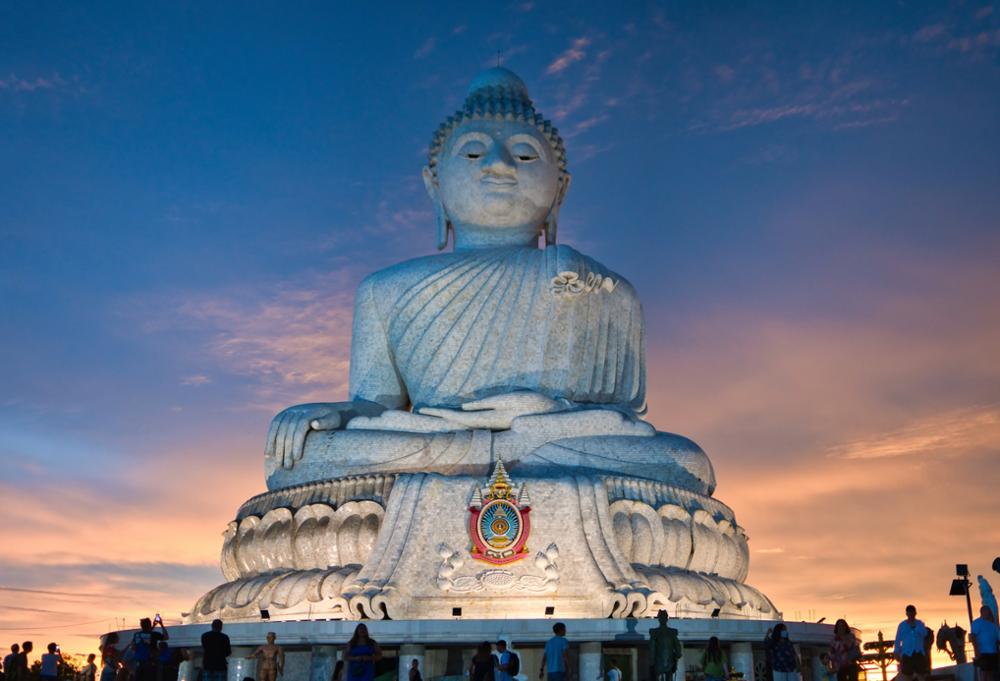
Impossible to miss—you can see it from every corner of the island. Perched atop Mount Nagakerd at 420 meters altitude, the Big Buddha of Phuket has become the city's icon. And for good reason: this white marble Buddha statue impresses with its sheer dimensions—45 meters tall and 25.45 meters wide. It's one of the largest Buddha statues in all of Thailand and Phuket's most important monument.
Belonging to Wat Khao Nakkerd temple, the Big Buddha statue was built in honor of King Rama IX. It depicts the historical Buddha performing the mudrā—the gesture of calling the earth to witness (also called victory over Māra). To support the building's construction, the temple offers visitors the opportunity to purchase marble tiles on which they can inscribe a wish.
Beyond its statue, Wat Khao Nakkerd is worth visiting for the breathtaking views of Phuket island, its surroundings, and the Andaman Sea.
Note that access to the Big Buddha is challenging. If you're not comfortable riding a scooter up the steep slope, take a taxi.
Practical Information:
- Free admission
- Address: 42/14 Moo 2, Thepkrasattri Road, Rasada sub-district, Muang district, Phuket Province 83000
- Opening Hours: Open daily from 6:30am to 6:30pm.
Attention! Following a landslide that occurred on August 23, 2024 near the Big Buddha, the temple is closed to the public for an indefinite period.
3. Wat Phra Thong

Wat Phra Thong is a temple located in the northern part of the Phuket peninsula, about twenty kilometers from Phuket Town. It's known for housing a unique and distinctive Buddha statue called Luangpho Phra Phut. This 3-meter-high statue is entirely covered in gold and has a special characteristic: it's partially buried underground. Only the Buddha's torso emerges from the soil.
According to legend, this statue was once buried beneath the earth. One day, a young boy tied his buffalo to what he thought was a post or tree stump. The boy immediately fell ill and died, as did his buffalo. Villagers came to dig around the area and eventually discovered a golden Buddha buried underneath.
According to the Thai National Tourism Office: "When Burmese invaders attempted to remove the statue to claim it in the 18th century, they were attacked by a swarm of hornets." While many individuals who tried to extract it were attacked by ants and hornets, the Buddha ultimately remained in place and a temple was built around it: Wat Phra Thong.
Beyond the Buddha statue, the structure also houses a museum containing a collection of objects and artifacts bearing witness to Phuket's history.
Practical Information:
- Free admission
- Address: 172/2 Nanai Rd, Thalang District, Phuket 83110
- Opening Hours: Open daily from 8am to 5:30pm.
4. Wat Phra Nang Sang
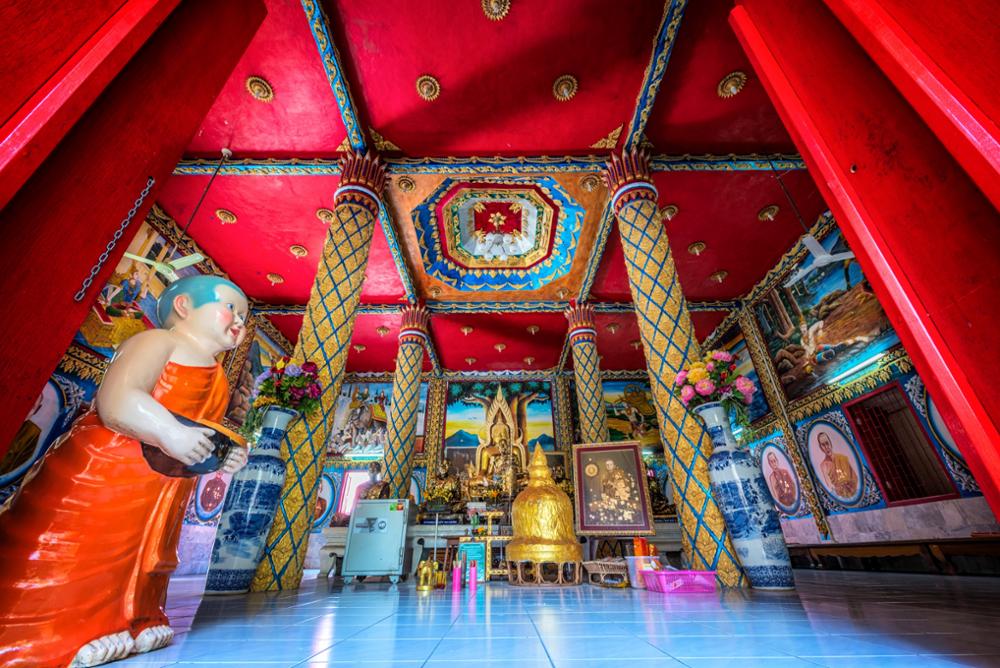
Located 20 km from the city center, Wat Phra Nang Sang is among Phuket's oldest temples—it's believed to have been built over 200 years ago.
The temple is also tied to a legend. According to local beliefs, it was built by Lady Luad Khao, the wife of the sovereign of Nakhon Si Thammarat. Wrongly accused of adultery, she reportedly made a journey to Sri Lanka to pray at the Buddha's relics before stopping in Thalang (present-day Phuket), where she had the temple built before being condemned to death. The story goes that during her execution, her blood was white. The temple owes its name to this history, as it translates to "temple built by the lady."
Interestingly, Wat Phra Nang Sang served as a Burmese military camp during the Battle of Thalang in 1785. Inside the main building, called the ubosot, are the three oldest and largest tin Buddha statues in the world. These are known as "The Three Kings."
Practical Information:
- Free admission
- Address: 148 Moo 1, Thep Krasattri Road Thep Krasattri Thalang Phuket 83110
- Opening Hours: Open daily from 8am to 6pm.
5. Wat Sri Sunthon (Wat Srisoonthorn)
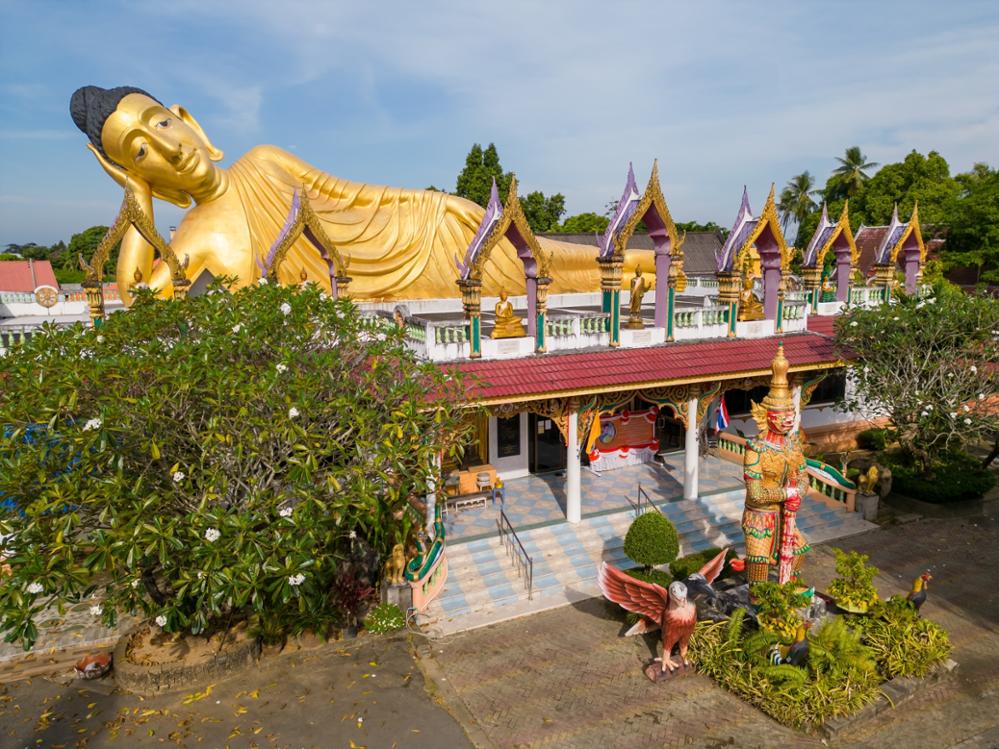
Heading north of Phuket, about 15 km from the city center, to discover Wat Sri Sunthon (also spelled Wat Srisoonthorn). Built in 1792, it was formerly called Wat Lipon before being renamed by Rama I.
The temple houses a popular attraction: a reclining Buddha statue 29 meters long. Installed on the roof of one of the complex's buildings, the bronze statue depicts Buddha in the "Pang Sai Yat" posture—the position corresponding to the attainment of Nirvana.
The temple also contains wall murals depicting scenes from Buddha's life. In the gardens, you'll find colorful animal statues as well as amusing creatures and demons from Thai culture. You might see, for example, a terrifying statue of a Phi Phret—a ghost of a person who led a blasphemous life. It's depicted with a thin but very tall body, large hands, and a tiny mouth.
While some creatures may be frightening, the statues remain amusing and make for a fun visit during a trip to Thailand with children.
Practical Information:
- Free admission
- Address: 20/4 Thepkrasattri Road, Tambon Si Sunthon, Amphoe Thalang, Chang Wat Phuket 83110
- Opening Hours: Open daily from 7am to 5pm.
Rules of Conduct for Visiting Temples in Thailand
As in all temples in Thailand, it's important to follow certain rules of conduct during your visit. Here are the dos and don'ts for visiting temples in Phuket:
- Wear respectful clothing: you should cover your shoulders and knees, whether you're a woman or a man. Short, tight-fitting, see-through, and torn clothing are prohibited in Thai places of worship. The ideal? Wear a sarong, the traditional Thai garment. If you've forgotten to cover up, know that many temples lend sarongs for a small rental fee;
- Remove your shoes before entering temples (unless otherwise indicated);
- Never step on an image of Buddha and never touch Buddha statues and other Buddhist relics;
- Never point your feet toward a representation of Buddha or any other person (feet are considered by Thais as the impure part of the body, which could be interpreted as an offense);
- Sit properly: women are invited to kneel with feet directed backward, while men can sit cross-legged;
- Never touch a monk if you're a woman (monks are not permitted to have physical contact with women);
- Always ask a monk's permission before photographing him (advice that applies to any individual, for that matter);
- Adopt a respectful attitude: remain calm and speak softly inside temples.
Also discover:
- The most beautiful beaches in Phuket
- What to do in Phuket when it rains?
- The best night markets in Phuket
- How to get to Phuket from Bangkok?
Florine Dergelet
Florine Dergelet
A web writer for over 10 years, Florine Dergelet is a traveler driven by a desire to discover the world with an open heart. Each of her articles is an invitation to slow down, to listen, to understand. Because for her, traveling isn't about checking countries off a map, but rather weaving links (often invisible yet always powerful) with places, peoples, and all sorts of creatures from the animal kingdom. Her creed? Advise travelers with ethics, raise their awareness about animal welfare, respect for cultures, and the importance of humble and sustainable tourism. Because the most beautiful memories are often born far from the spotlight, in the shadow of a trail, at the edge of a conversation, or in the quiet breath of a world we finally take the time to listen to…