Mango sticky rice: discover the authentic recipe of Thailand's most famous dessert
Want to prepare Mango sticky rice at home? Find the authentic recipe, ingredients, steps and tips to make it just like in Thailand.
Under the scorching sun of Bangkok or in the shade of a palm tree on the beaches of Phuket, there is a scent that every traveler in Thailand eventually comes to recognize: warm coconut milk mingled with the golden sweetness of mango. Mango sticky rice, or khao niew mamuang, is more than just a simple dessert: it is a cultural heritage, a symbol of conviviality and an essential part of Thai street food.
Discover the authentic recipe for Mango sticky rice and all our tips for preparing it exactly as they do in Thailand.
What is Mango sticky rice?
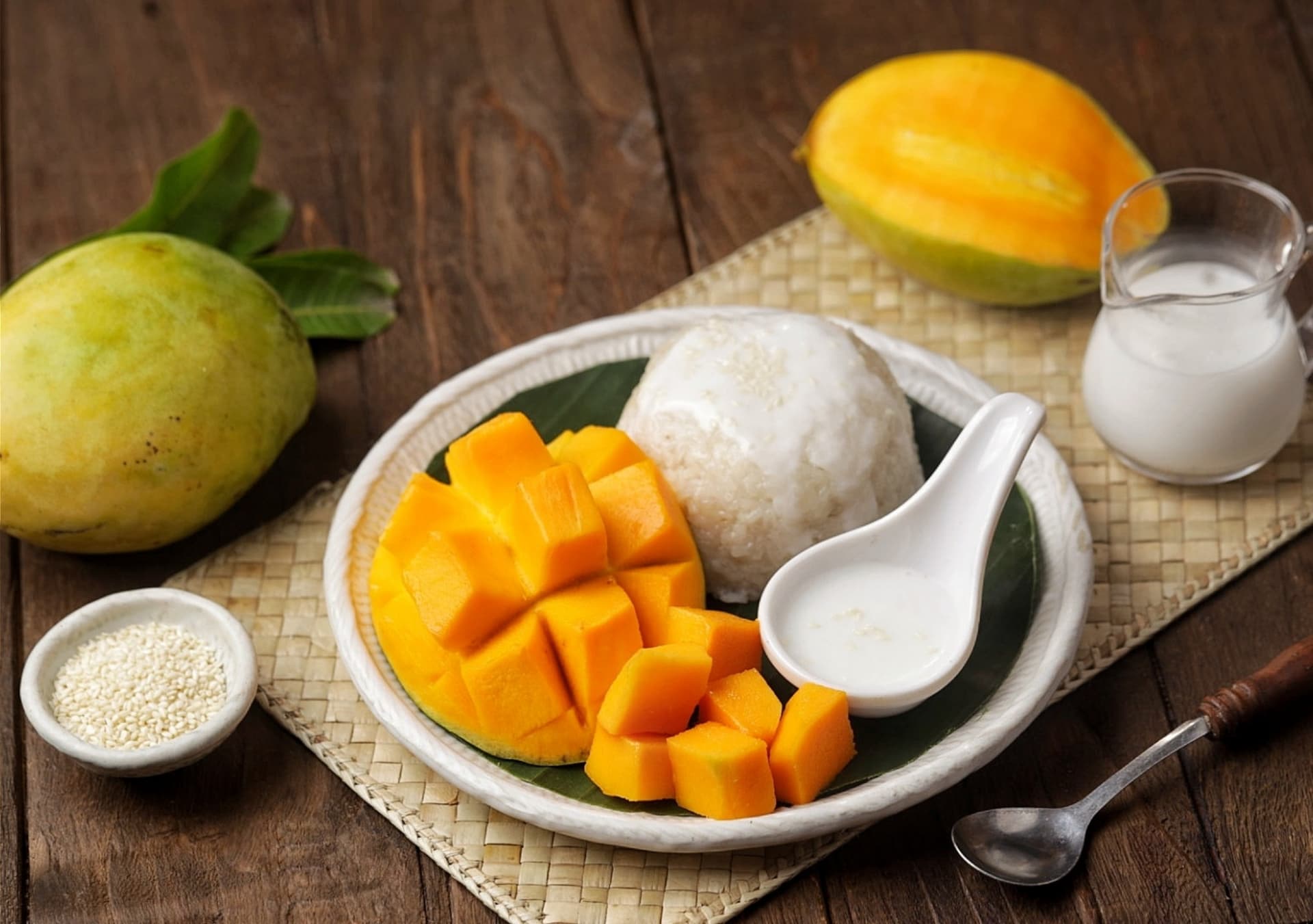
Mango sticky rice is a traditional Thai dessert made with glutinous rice steamed and then mixed with sweetened coconut milk, served alongside perfectly ripe fresh mango. Beneath its apparent simplicity, this specialty hides a perfect balance: the softness of the rice, the rich creaminess of coconut milk, the fresh tanginess of mango, plus the crispy touch of roasted mung beans!
One thing is certain: Mango sticky rice is among the street food specialties absolutely worth trying on a Thailand trip.
What is the origin and symbolism of Mango sticky rice in Thailand?
The history of Mango sticky rice goes back several centuries. Sticky rice (or khao niew) has been consumed for ages in northern and northeastern Thailand, particularly in the Isan region, where it is a staple food.
The combination of sticky rice with sweetened coconut milk, known as khao niew moon, appeared at the Siamese court during the reign of King Rama V (19th century). It was during this period that coconut milk became a flagship ingredient in Thai cuisine. The addition of fresh mango, a seasonal fruit, is said to have later given birth to the version we know today.
But beyond its recipe, Mango sticky rice holds strong symbolic value. It embodies balance and harmony: the sweetness of coconut milk counterbalances salt, the firmness of rice unites with the tenderness of fruit. In Thai culture, offering or sharing a bowl of sweetened sticky rice, like Mango sticky rice, is a gesture of friendship and generosity.
🌸 Did you know?
In 2022, Thai rapper Milli sparked a real craze for Mango Sticky Rice during her performance at the Coachella festival. On stage, she savored this emblematic dessert to the enthusiastic applause of the audience, turning this simple moment into a viral worldwide event.
This moment had immediate repercussions: sales in Thailand literally exploded. The Thai government even considered proposing Mango Sticky Rice for inscription on the UNESCO Intangible Cultural Heritage list, underscoring its importance to national identity.
The authentic Thai recipe for Mango sticky rice
Here is the authentic recipe for Mango sticky rice as prepared in Thai households.
🕒 Practical Information
⏱️ Preparation:
approx. 40 min
(excluding rice soaking)
🔥 Cooking:
15 min
👨🍳 Servings:
2 people
🥥 Mango Sticky Rice Ingredients
For the sticky rice with coconut milk:
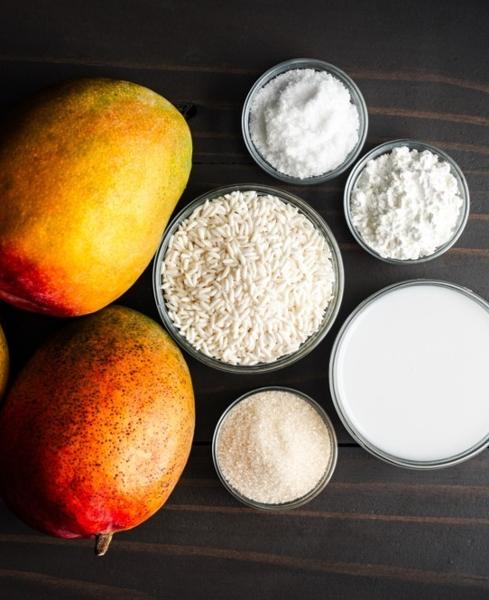
1 cup Thai sticky rice
½ cup plus ⅓ cup coconut milk
1 tablespoon sugar (or a mix of white sugar and coconut sugar)
¼ teaspoon salt
For the coconut cream (topping):
⅓ cup plus 1 tablespoon coconut milk
1 tablespoon cornstarch
1 tablespoon sugar (or coconut sugar)
A little water, if the cream is too thick
For the garnish:
2 ripe golden mangoes (preferably the Thai Nam Dok Mai variety)
1 tablespoon peeled and split mung beans
Optional:
A few dried butterfly pea flowers to naturally color the rice blue or purple
Mango Sticky Rice — Sticky rice with coconut milk and fresh mango
Preparation:
Step 1
Rinse the sticky rice until the water runs clear, then soak it in water for at least 4 to 5 hours (ideally overnight). Soaking is essential: without it, the rice will remain hard and inedible.
💡 Chef's tip: For a colored variation, use butterfly pea flowers!
For a spectacular visual touch, you can color the rice with butterfly pea flowers to achieve a natural blue hue. To do this, follow these steps:
Steep the dried flowers in hot water to extract the blue color.
Use this water to soak the rice before cooking.
Add a few drops of lime juice: the color will shift from blue to purple!
Step 2:
Drain the rice in a colander. Fill a pot with water and heat it until it simmers lightly.
Remove the rice from the colander and place a damp cheesecloth (or fine cloth) at the bottom of the colander. Place the rice back in the colander on the cheesecloth and then set it above the pot of boiling water (the rice must not touch the water) and cover with a lid.
This steaming technique allows for perfect cooking: the cheesecloth creates a soft layer that prevents grains from falling through the colander holes and helps steam circulate evenly to cook the rice perfectly.
Cook on high heat for 15 to 20 minutes, until the rice becomes translucent. Check for doneness: if the rice is not yet tender, sprinkle it lightly with water and continue for a few more minutes.
Local tips:
Cooking time depends on the rice type — allow approximately 15 minutes for 2 cups.
Do not refrigerate sweetened sticky rice: it will become hard as stone. Keep it at room temperature and reheat in the microwave if needed.
Step 3:
While the rice cooks, prepare the coconut milk mixture. In a small pot, pour the coconut milk, add sugar and salt. Heat on medium heat while stirring constantly, until the sugar is completely dissolved. Do not let it boil: simply warm and blend the mixture.
Step 4:
When the rice is cooked, pour it into a large bowl. Pour in about half of the hot coconut milk, then gently mix. Add the rest little by little until you achieve a soft texture. The rice should not be too moist: it should remain sticky, but not liquid. Cover with a kitchen towel and let the rice absorb the coconut milk for 10 to 15 minutes so it soaks in well.
Step 5:
Prepare the coconut cream for the topping. In a small pot, pour the coconut milk, sugar and cornstarch and stir until the starch is dissolved. Heat on low heat while stirring until the cream thickens slightly.
Remove from heat and let cool. This cream will top the rice just before serving.
Step 6:
Soak the mung beans in water for 30 minutes. Drain them and then dry-roast them in a pan on low heat until they turn golden and crispy. They will add a crunchy touch to the dessert.
Step 7:
Peel the mangoes, remove the pit and slice the flesh into thin, even slices. Set aside on a plate in the refrigerator until plating.
Step 8:
On each plate, arrange a portion of sweetened sticky rice. Beside it, place a few slices of ripe mango. Drizzle the rice with a few spoonfuls of thickened coconut cream, then sprinkle with roasted mung beans.
Serve right away and let yourself be transported to Thailand!
Mango sticky rice: a specialty absolutely worth tasting on a Thailand trip!
Tasting Mango sticky rice is biting into a fragment of Thailand. Each mouthful tells a story: that of sticky rice from the north, coconut milk from the south, and golden mangoes ripening under the April sun.
Want to experience immersive culinary adventure in Thailand?
With Sawa Discovery, let us guide you through the flavors, markets and traditions of Thailand. Contact our local teams to organize your tailor-made trip to Thailand and discover the secrets of the Kingdom of Siam.
Why not learn the true recipe for Mango sticky rice during a cooking class during your stay in Thailand?
Where to eat the best Mango sticky rice in Thailand?
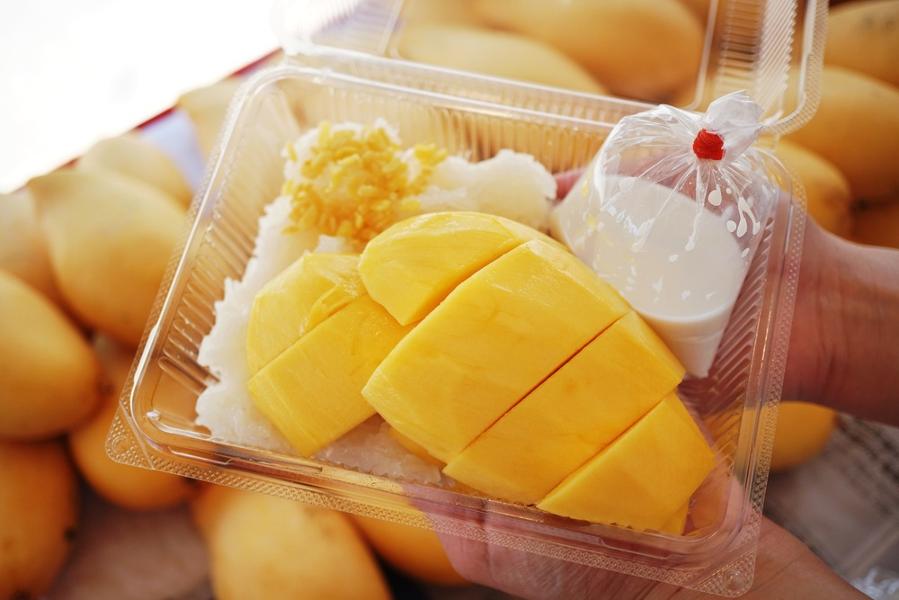
In Thailand, Mango sticky rice is enjoyed everywhere: at street food stalls and markets, as well as in elegant cafés and upscale restaurants that reinvent it poetically. But it is especially at street stands where you discover the most authentic versions, served still warm in banana leaves. Among the emblematic addresses for enjoying the finest Mango sticky rice throughout Thailand, you can find:
Mae Varee Mango Sticky Rice in Bangkok (Thonglor): an institution for over 40 years.
Kor Panich in Bangkok (Old Town): where you discover a traditional recipe recognized by the Michelin Guide.
Chom Café & Restaurant in Chiang Mai: for a modern version in a tropical garden.
Phuket Old Town Market in Phuket: where street stalls serve fresh portions, still warm, in banana leaves.
Note: the best Mango sticky rice is always prepared to order. The mango must be freshly cut, the rice still warm, and the coconut milk poured just before eating. It is in this fleeting encounter between hot and cold that all the magic of the dessert is born.
How to pronounce it or order it in Thailand?
In Thai, Mango sticky rice is said ข้าวเหนียวมะม่วง (khao niew mamuang). To order it on the street, simply say: "Ao khao niew mamuang kha" (if you are a woman) or "Ao khao niew mamuang khrap" (if you are a man), which can be translated as "I would like sticky rice with mango, please."
🍽️ To go further, also discover:
Discovering Thai cuisine 8 iconic dishes of Thailand What to eat in Thailand if you don't like spicy dishes?
Frequently asked questions
The sticky rice can be prepared a few hours in advance and kept at room temperature. Add the mango and coconut cream just before serving to preserve freshness.
Sticky rice is irreplaceable for authenticity, but you can use short-grain sushi rice as a last resort, although the texture will be different.
Use Thai sticky rice, also called glutinous rice or sticky rice. This short-grain rice becomes sticky after steaming thanks to its high amylopectin content. Be careful not to confuse it with sushi rice or jasmine rice: the texture would be completely different!
Thais favor two non-fibrous mango varieties: Nam Dok Mai mango, with golden yellow, melting, very sweet flesh, or Ok Rong mango, which is more tart. To choose them well, make sure they are fragrant, soft to the touch, but without brown spots.
The best time to enjoy Mango sticky rice in Thailand spans from March to June, the mango season. This is when the fruits are at their juiciest and sweetest. However, in major cities like Bangkok or tourist areas, it is available year-round.