Where to See the Rafflesia, the World's Largest Flower, in Thailand?
The Rafflesia, the world's largest flower, can also be discovered in Thailand. Here's where to see it, when to travel, and how to observe this rare flower without disturbing it.
Thailand is home to several species of Rafflesia, the world's largest flower. With its striking appearance and unique biological function, this flowering plant seems straight out of an animated film. No wonder it inspired a Pokémon character! Intrigued by the Rafflesia? Discover where, when, and how to see the Rafflesia during a trip to Thailand...
What is the Rafflesia and what makes this plant so extraordinary?
The Rafflesia in a nutshell...
The Rafflesia is a flowering plant of the Rafflesiaceae family. It is considered the world's largest flower. It is found in only a few Asian countries, namely Malaysia, Indonesia (particularly Borneo and Sumatra), the Philippines, and Thailand. It takes its name from the man who first discovered it in 1818: Sir Thomas Stamford Raffles.
There are 28 species of Rafflesia, all endemic to Southeast Asia. The most well-known is the one that holds the record for the world's largest flower: Rafflesia arnoldii. This species can reach up to one meter in diameter and weigh as much as 10 kg. Among the smallest species is the Rafflesia manillana, whose flower has a diameter of 20 cm, which remains an impressive size for a flower!
Finally, some species are found in only one place on Earth, as is the case with Rafflesia rochussenii, which grows only in the forests of Borneo.
What does the Rafflesia look like?
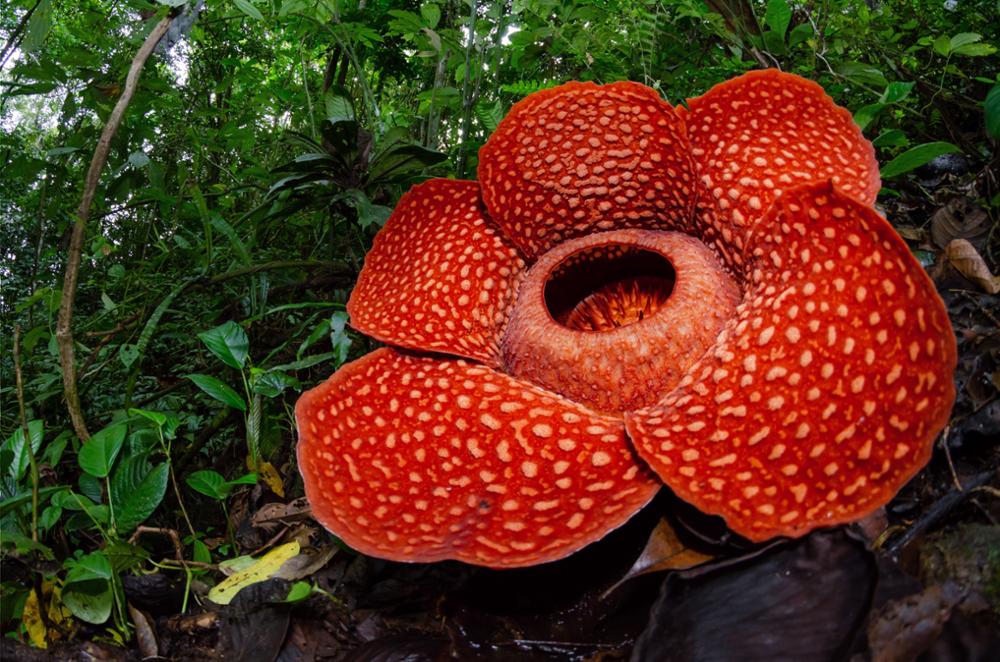
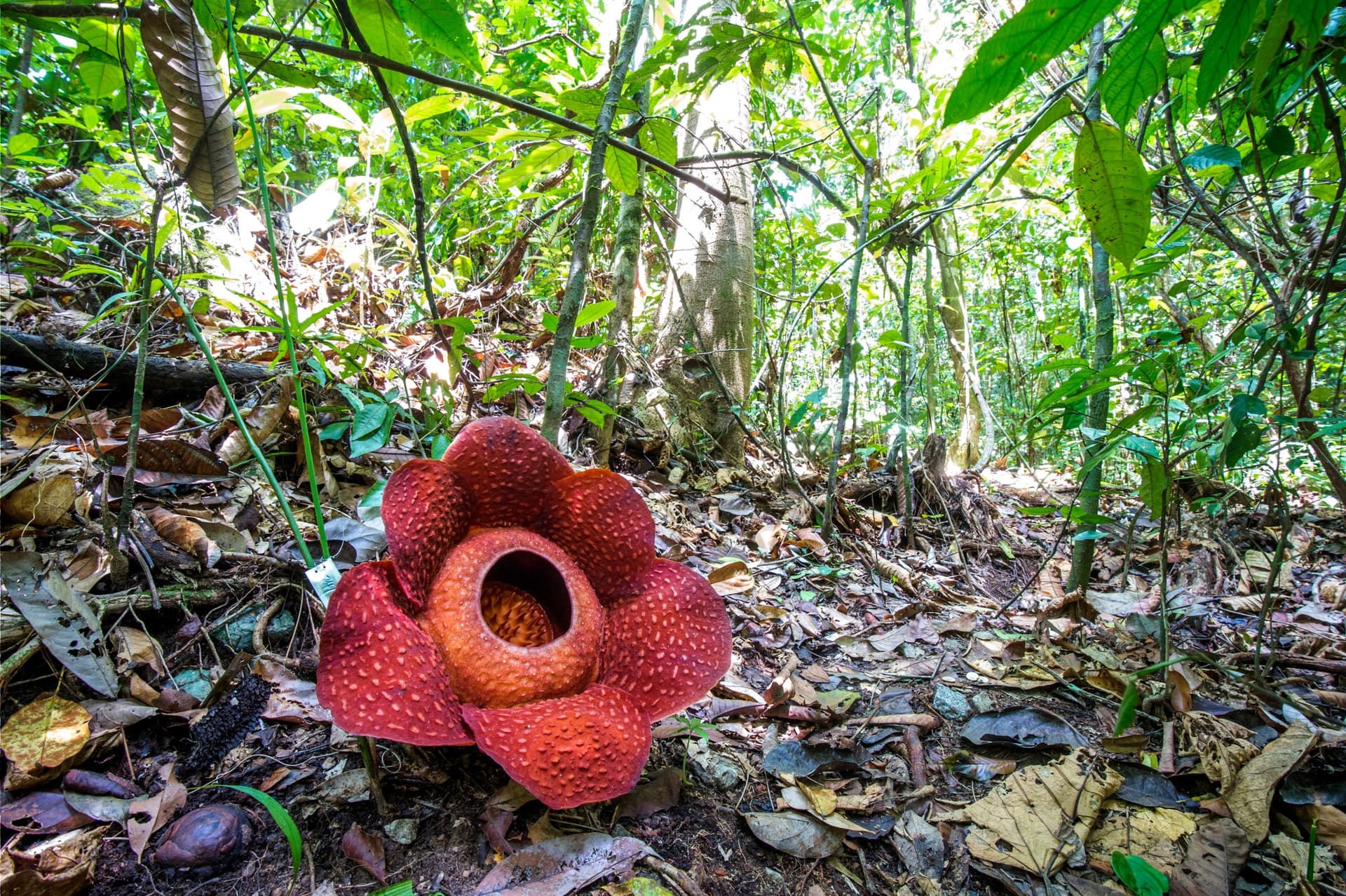
The world's largest flower possesses unique physical characteristics. Indeed, the Rafflesia has no stem, no leaves, and no roots. It is distinguished by an actinomorphic flower (meaning it displays radial symmetry) with five petals. Although various shades of darkness can be found among different species, rafflesias are generally red, orange, or brown in color and display small spots or pustules that are white or yellow on the petals.
Did you know?
The Rafflesia has such a distinctive and remarkable appearance that it even inspired a Pokémon character. It is the second evolution of Bulbasaur!
How does the Rafflesia develop?
In addition to having a peculiar appearance, the Rafflesia has an astonishing function. It is a holoparasite: it develops exclusively on a host plant, namely a climbing plant from the tetrastigma vine family. In other words, the Rafflesia is a parasitic plant that needs its host to survive. It begins by infiltrating the roots or stems of the host plant in the form of underground filaments (called mycelia), which allows it to take advantage of the host's nutrients and minerals in order to feed.
Like fungi, it is only visible from the outside during flowering. Before the appearance of buds that pierce the wood or bark of the host plant, no sign allows its presence to be detected. Once the bud emerges, it will grow for several months before the flower blooms. The flower is generally three times the size of the bud and fades quickly: it only lasts 3 to 7 days!
Why is the Rafflesia nicknamed the "corpse flower"?
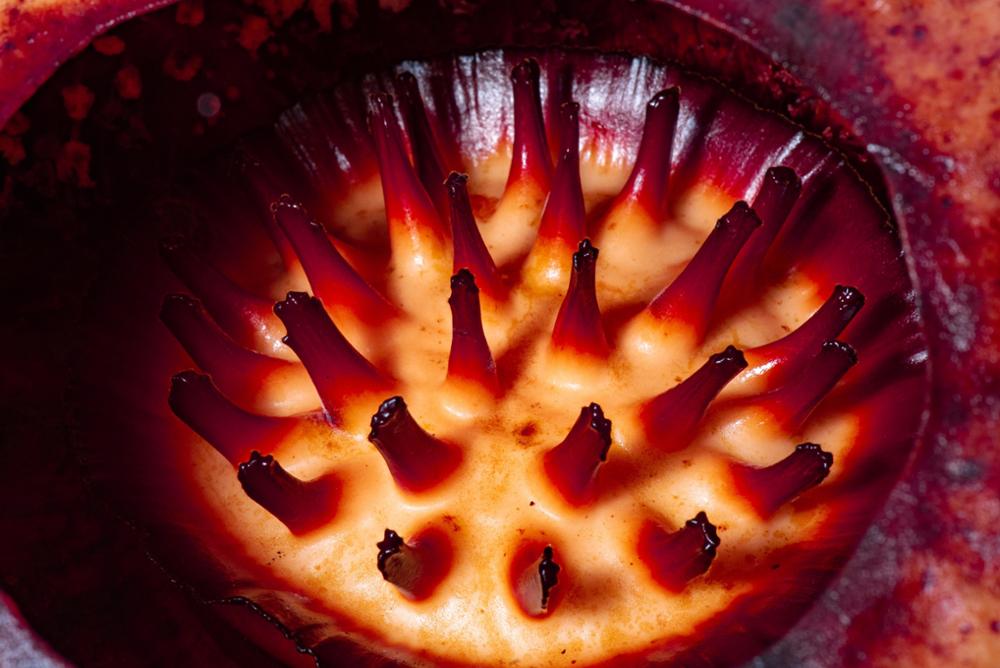
When the Rafflesia flower blooms, it emits a nauseating odor (more or less pronounced depending on the species) that is often compared to that of rotting meat or a decomposing corpse. A peculiarity that even earned it the nickname "corpse flower."
But why does the Rafflesia smell so bad? If this flowering plant emits such an odor, it is to attract flies, which are its only pollinators! Thinking it is a corpse, the flies come to lay their eggs on the flower and thereby ensure its pollination!
How long does the Rafflesia bloom?
While the Rafflesia takes time to develop in its host, its flowering lasts only a few days. It takes an average of 9 months to form buds. When the buds give rise to flowers, they only remain open for 3 to 5 days, or sometimes 7 days! Thus, Rafflesia flowering occurs only every 9 months at minimum, making it a very rare flower.
Where, when, and how to see the Rafflesia in Thailand?
Which species of Rafflesia can be found in Thailand?
There are 3 main species of Rafflesia in Thailand:
Rafflesia kerrii: found mainly in Khao Sok and southern Thailand;
Sapira himalayana: can be seen in the northeast part of the country;
Sapira poilanei: can be observed in the southeast part of Thailand.
Where to find the Rafflesia in Thailand?
The province of Trang and the regions of Nakhon Si Thammarat and Krabi are among the main places where you can see blooming rafflesias.
But if we had to choose just one place to see rafflesia flowers in Thailand, it would be the Khao Sok National Park. Located in the province of Surat Thani (of which the Rafflesia is the official flower of the province), the park is a natural gem to discover during a trip to the Kingdom of Siam. Many guided treks allow you to venture into the tropical jungle and search for traces of the world's largest flower.
To remember:
Be sure to choose the right time to go on a Rafflesia observation trek and don't be disappointed if you don't find any! The excursions in Khao Sok National Park hold many other surprises: you will see exceptional flora as well as wild animals such as gibbons and numerous birds!
At what time of year can you admire the Rafflesia in Thailand?
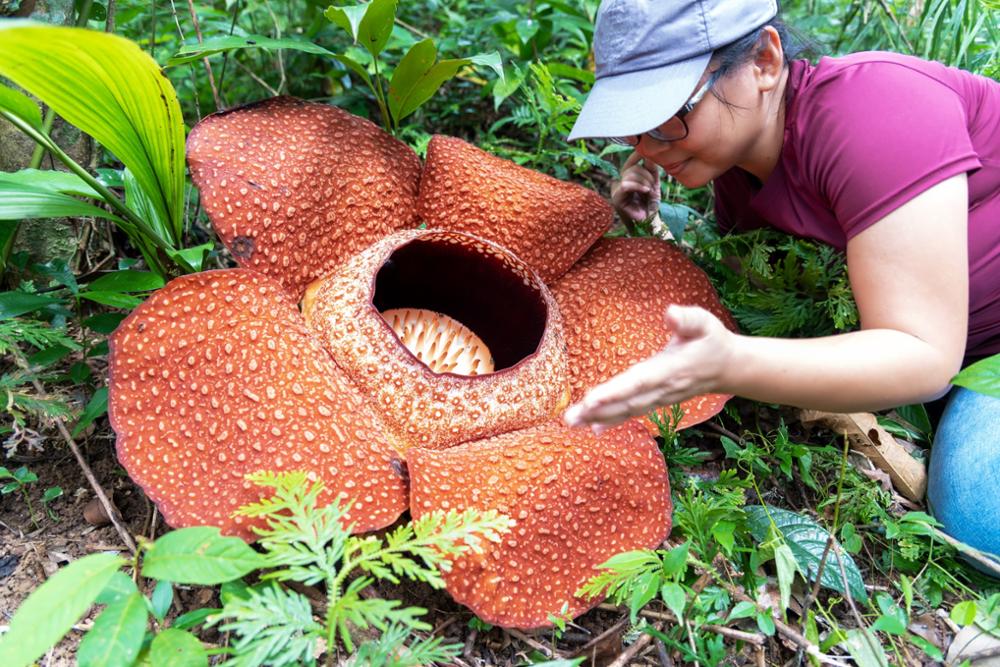
The blooming of rafflesias in Thailand extends from January to March. Note that since flowering only lasts a week at most, an encounter with the world's largest flowers is never guaranteed. To increase your chances of spotting some, hire a guide during your treks.
Rules of good conduct:
Given that the Rafflesia is a rare and fragile flower (one species, the Rafflesia magnifica, is even listed on the red list of threatened plants), it is important to adopt respectful behavior if you are fortunate enough to see one. Do not touch the Rafflesias and be careful when walking to avoid stepping on them and to avoid trampling a bud.
Would you like to organize a trek to see the rafflesias in bloom during a trip to Thailand? Contact us to benefit from the services of our English-speaking local guides who will know how to take you to the best spots!
Frequently asked questions
Prices vary depending on the tour operator, expect between 1,500 and 3,000 baht per person for a full day of guided trekking.
It is strongly recommended to hire a local guide because the flower is rare and difficult to spot alone in the jungle.
Treks at Khao Sok offer many other discoveries: gibbons, tropical birds, and exceptional flora.
February is generally the optimal month, right in the middle of the January-March flowering season.