Dunes and Palm Groves - Saharan Mosaic in Western Adrar
Following nomadic trails in the Adrâr, between golden ergs and secret palm groves of the Mauritanian Sahara.
Duration
16 days
Ideal seasons
Jan, Feb, Mar, Oct, Nov, Dec
Style
Expeditions
Comfort
rustique
Travelers
Couple, Solo, With friends
The spirit of travel
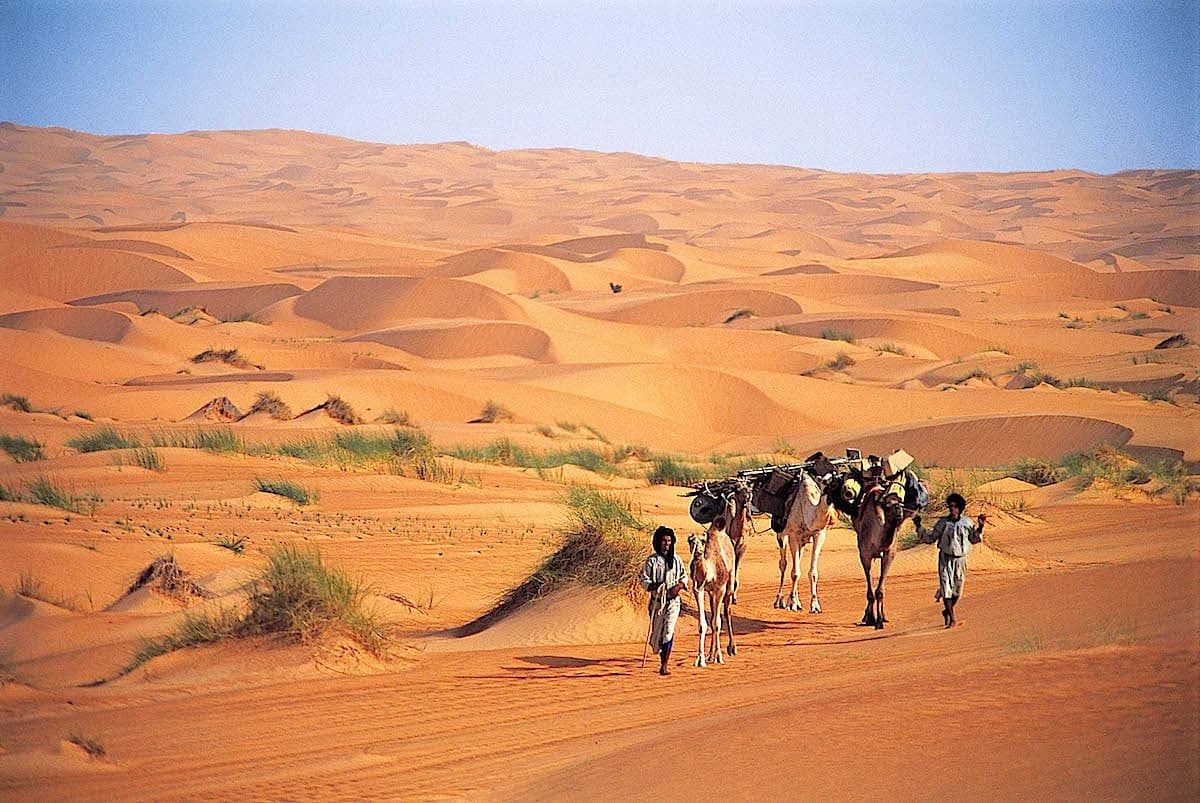
The western part of the Mauritanian Adrâr offers very great landscape diversity.
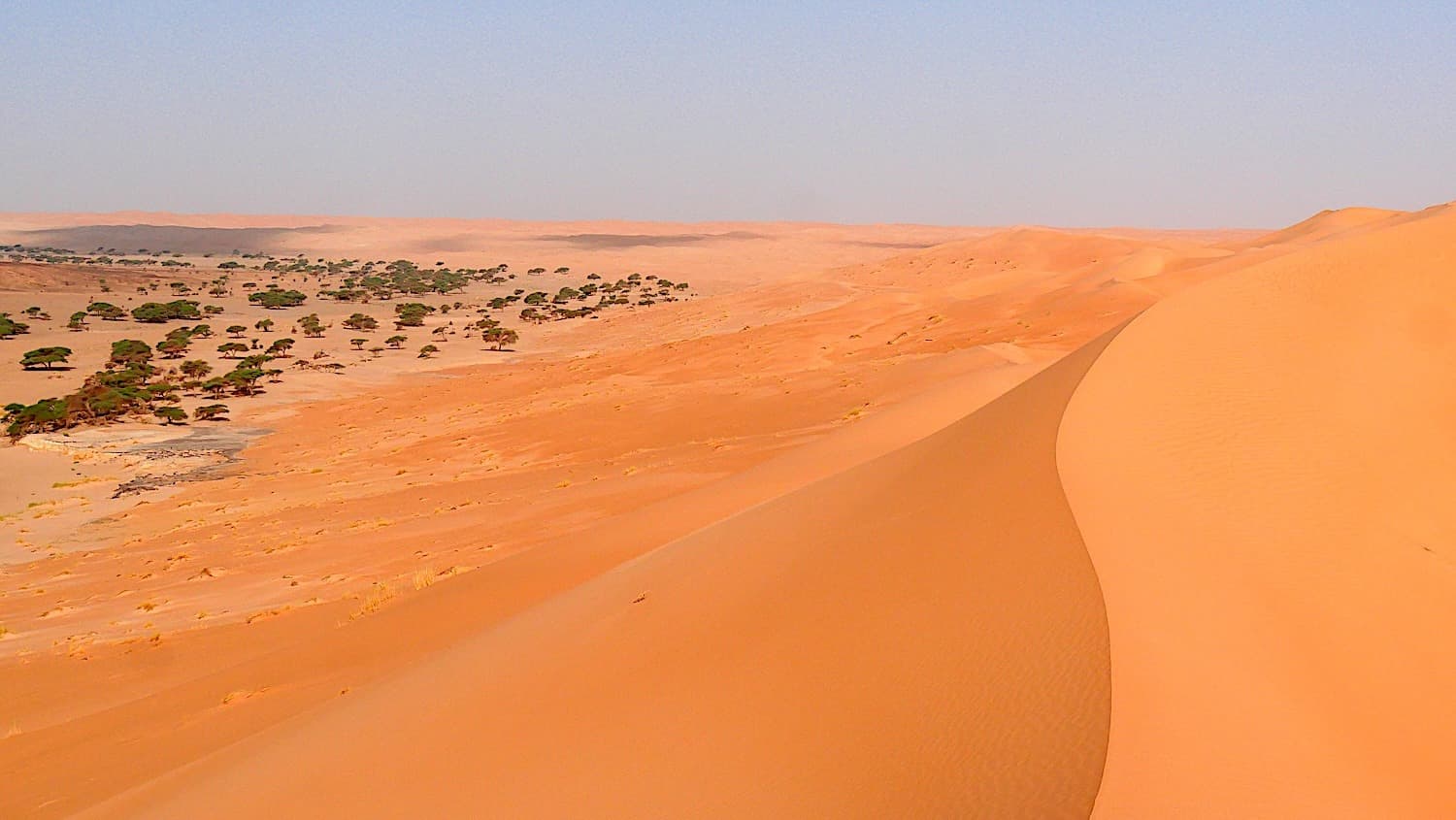
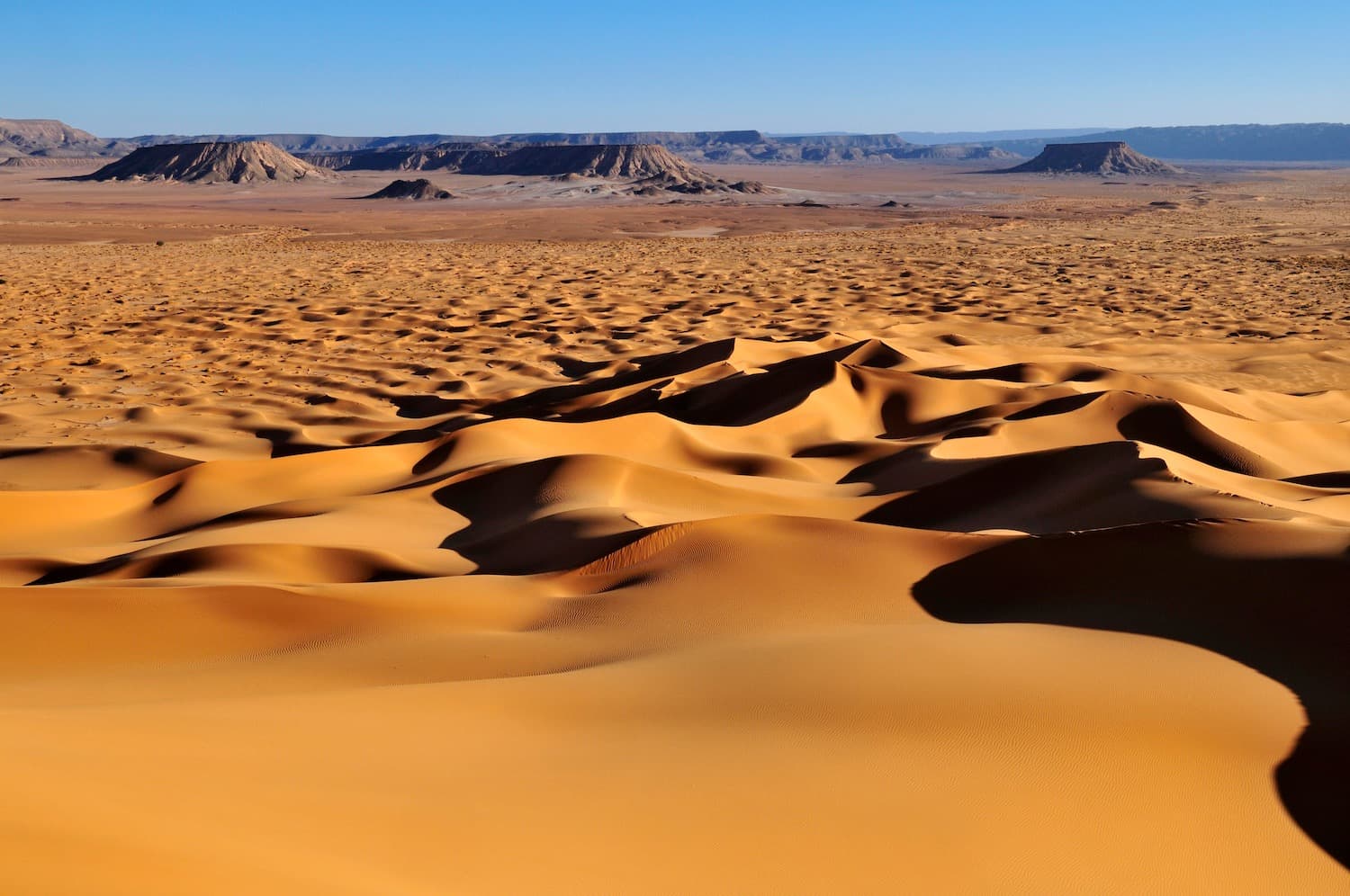
The plateau is crisscrossed by a dense network of faults of tectonic origin where wadis flow. Here the blonde ergs are predominant; they run aground against the upreared blades of black sandstone. Erosion, transforming sandstone into sand, has shaped multiple landscapes over millennia. Thus, at the bottom of the valley, the softness of small palm groves stands out from the steep and austere mountain massifs.
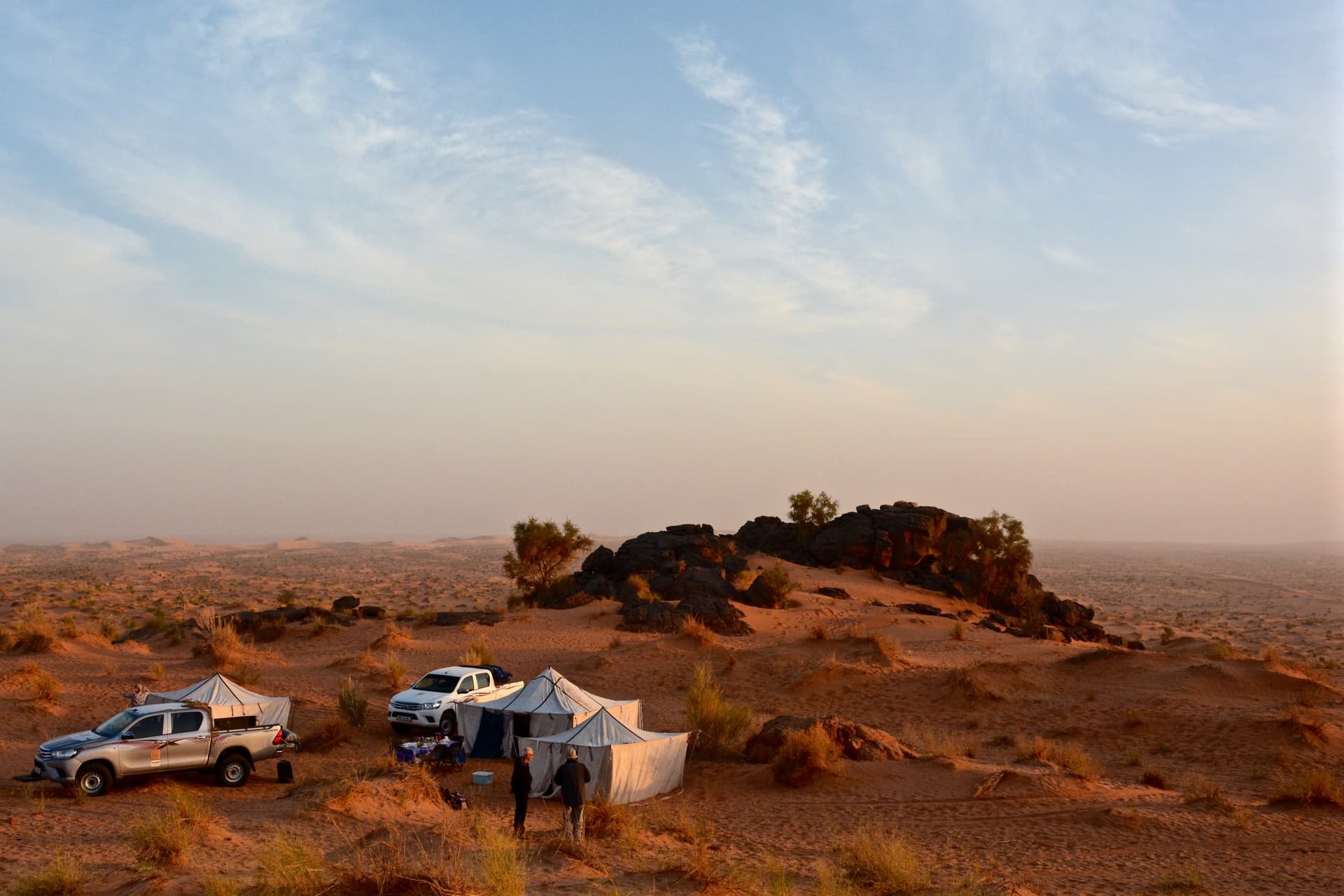
A few sedentary farmers continue their traditional life in this Sahara which can be generous. In the ergs and on the surrounding plateaus, nomads punctuate their time with long seasonal movements in search of life-saving rains. Their white or brown tents are there, sheltered from view, in the movements of the terrain. In secret ravines are set gueltasof clear waters, and wells supplying nomads and caravans.
This journey, dominated by sand, covers the most beautiful sectors of the Warane erg; it offers one of the most varied panoramas of Saharan atmospheres. The return crosses the region of the palm groves of the Oued el Abiod.
At a sustained level, this camel trek requires excellent physical and psychological fitness.
Sustained: 5 to 8 hours of walking per day. Excellent physical condition necessary as the stages can be long. You must be able to maintain this pace for several days in difficult terrain.
The stages of your journey
Highlights
Day-by-day itinerary
International flight from Paris to Nouakchott
Paris Aéroport → Nouakchott
Indicative flight proposal: Royale Air Maroc.
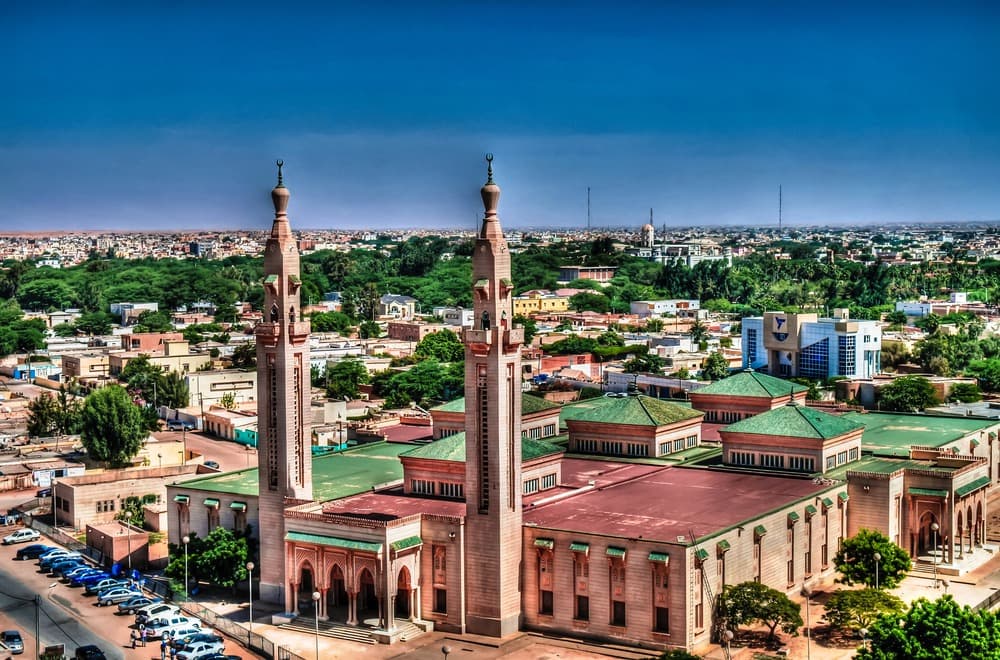
We depart late in the day for the Mauritanian capital via Casablanca in Morocco. Once formalities are completed, we welcome you in the hall of the Nouakchott airport terminal.
By a short transfer to the city, we reach our hotel in the middle of the night for well-deserved rest.
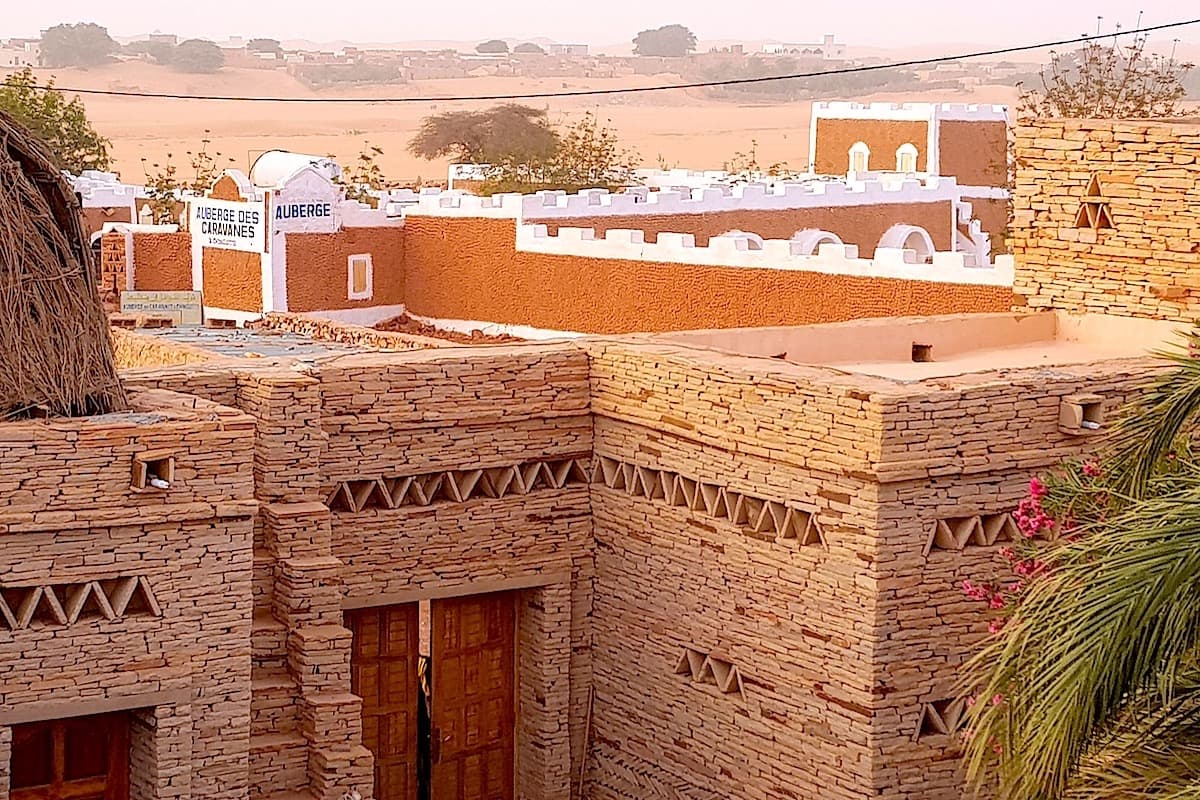
On the way to the Adrâr plateau
After leaving the city and its suburbs, we take the beautiful paved road that heads northeast towards the mining town of Akjoujt.
The Trarza region and the Atlantic coast are now behind us, the vegetation changes and becomes increasingly Saharan.
The vast sandy plains of Inchiri lead us to the somewhat surreal town of Akjoujt. Mining industry is present there and, since the Chalcolithic, Man has been extracting copper, gold and other materials.
Gradually the landscape changes. You are now driving in the Amsaga region.
In the distance, to the east, the dark barrier of Adrâr begins to emerge. You pass the great alluvial plain of Yagref and the village of Aïn Ahel Taya. The road crosses the first escarpment of Adrâr.
Transfer in 4x4 vehicles to reach the ancient city of Chinguetti (approximately 2 hours drive).
The track to climb onto the plateau (dhar) is currently in good condition, but it can be degraded by rains that occur at the end of summer.
If time permits, visit the old town: library(ies), palm groves and gardens. If not, this visit is postponed to the following morning.
The ancient city of Chinguetti
Chinguetti was founded by the Ida Ouali around 1525, upstream from Abweyr, which has since disappeared and was itself created in 1261.
The probable etymology of the toponym shingitî would be:
horse well, from Soninké: si: well + n: of + gede: horse.
Chinguetti was the most active commercial center and the most important city of the western Sahara. It was considered by Mauritanians as the 7th holy city of Islam with its 11 mosques, its 100 wells and its circle of scholars.
In 1675, a massacre perpetrated by part of the Ida-ou-Ali led to the breakup of the group whose survivors founded another ksar in the Tagant, Tidjikja.
Today only a single mosque and the memory of prosperous periods remain…
The main tribes that make up its population are the Ida-ou-Ali, the Laghlal and the Oulad Gheilan.
With their narrow and winding streets, their numerous dead ends, their low and dark houses made of local materials, their near absence of squares and communal spaces, Chinguetti and Wadâne have the structure of old ksour densely huddled around their mosques.
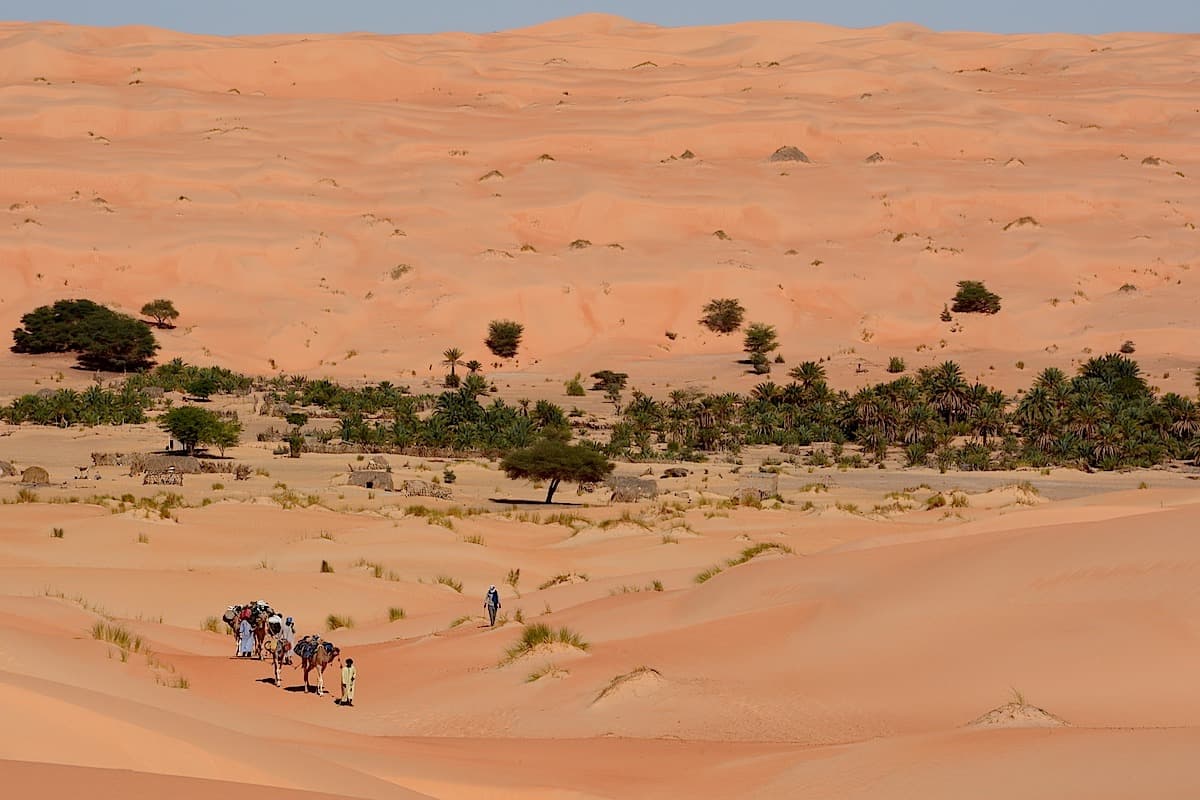
Beginning of the camel trekking, the dunes of Erg Warane
Chinguetti → Al Gheïla
Getting our caravan underway takes some time, as is the case with any large caravan.
Heading south. We are making our way to the small palm grove of Lagueila, nestled between two sand dune ridges of the M'ghalig (large dune massifs).
The itinerary described is given as an indication as it remains dependent on water sources, pastureland, atmospheric conditions or the gardens of settled populations.
The stages are subject to various influencing factors:
The extent of the rainy season having caused flooding, sandstorms or the presence of encampments near which it is impossible to set up camps, etc.
Al Gheïla → M'Ghalig Warane
Then, heading due west, we continue our journey through the dunes.
Vegetation specific to the great ergs develops such as Acacia raddiana, Balanites aegyptiaca and Aristida pungens.
We set up camp on one of the powerful sand massifs.
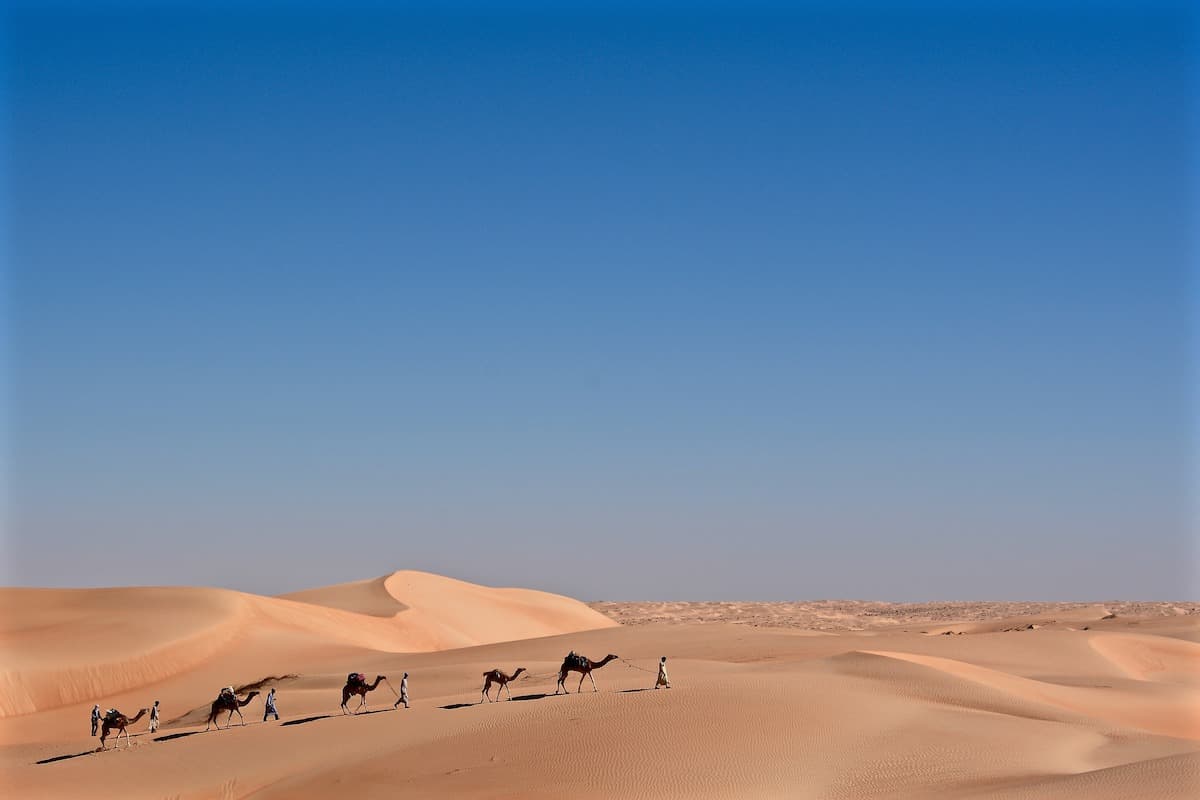
Immersion in the sands to reach the rocks of Kider
M'Ghalig Warane → Nord Kider
Following in the footsteps of the Ida-ou-ali exodus from Chinguetti, who left to found Tidjikja in the medieval period, the caravan crosses the high dunes of Erg Warane. Wells and pastures allow nomads to traverse these sandy expanses. To the south soon appears the edge of the Kider plateau; we make a slight detour to revisit the rock paintings we discovered on a previous journey; pottery shards and flint artifacts confirm occupation of the site in the Neolithic. We then head towards Amoum well. Spectacular landscapes and bivouacs to the north of the aklé, soft and chaotic dunes, difficult for camels, but very beautiful. The shade of the acacias near the well is welcome.
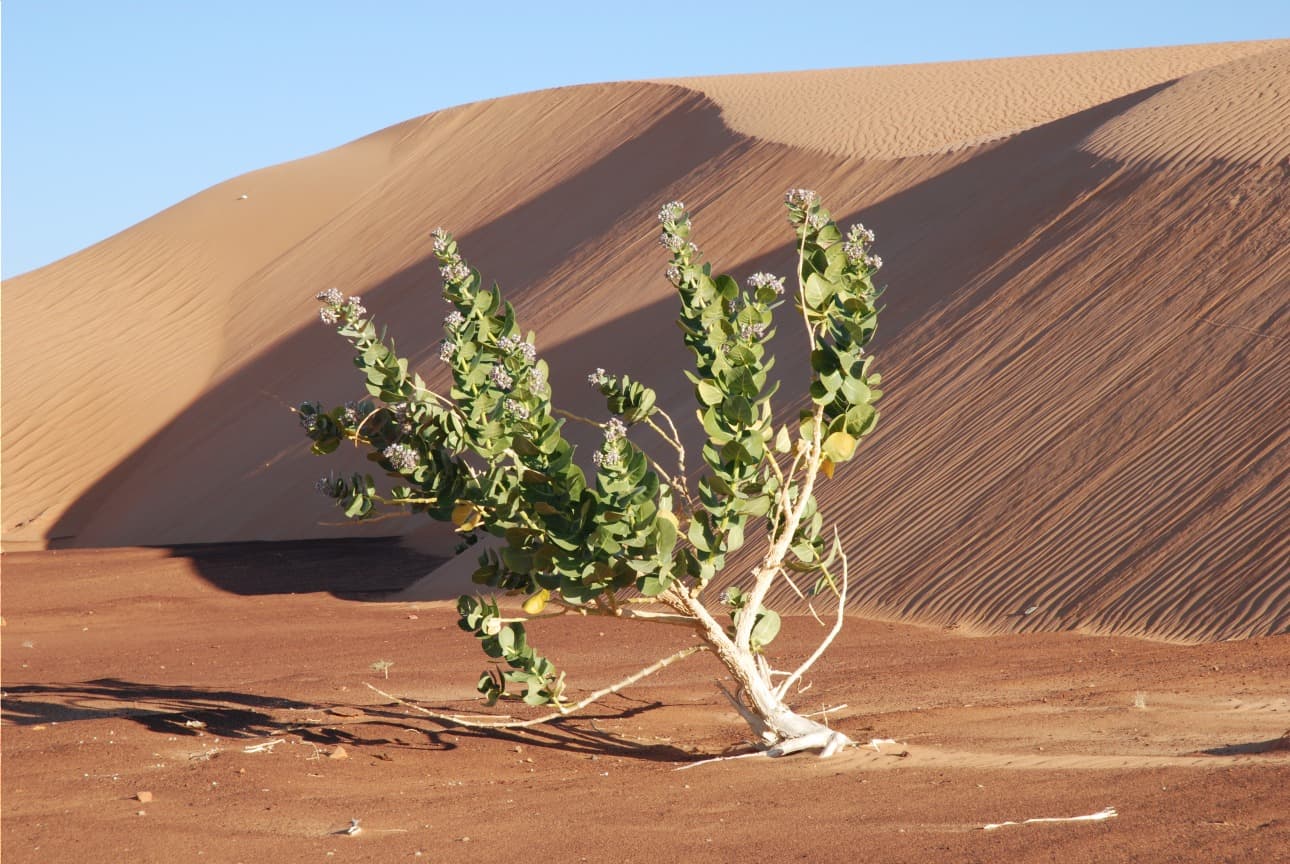
From plateau to plateau, Kider Amoum Roueissat
Nord Kider → Amoum
Amoum → Massif de Roueissat
Heading south, after crossing the aklé, we cross the tumuli zone that overlooks the Amoum well. We then go up the Amoum wadi, towards the sandstone massif of Roueïssat. We make our way between small sandstone castles, remnants of erosion over millions of years. This area, very rarely visited, offered us traces of gazelles on each of our passages. After lunch under a few acacia trees, we find the dunes that gradually invade the Roueissat plateau. We sleep on the plateau with, on the horizon, the Roueïssat erg, a golden river of aligned dunes.
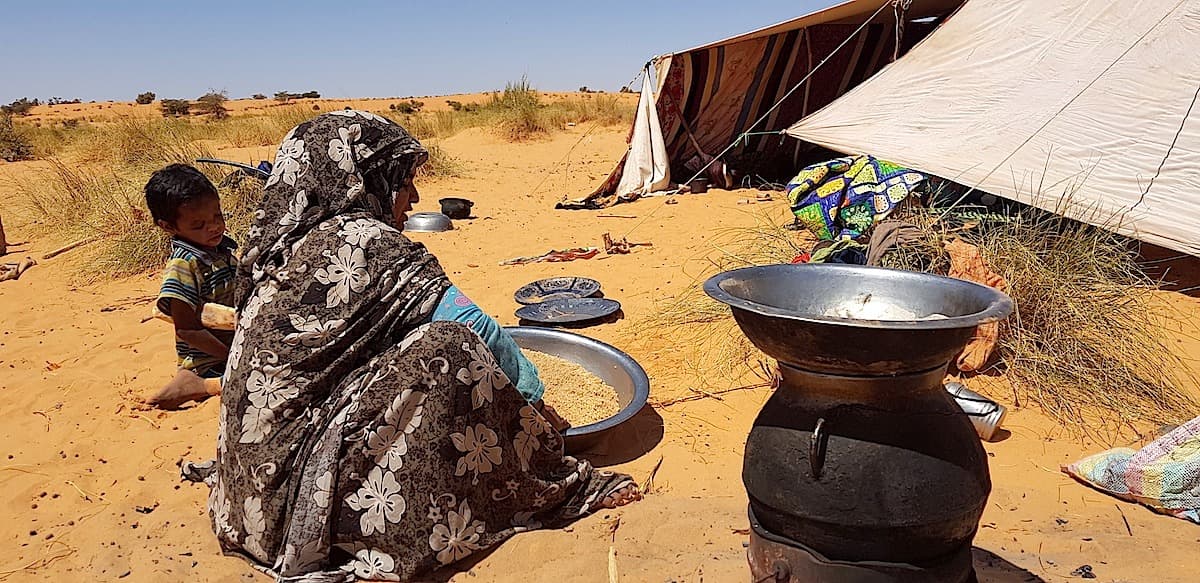
Walk in the aklé of Roueissat
Massif de Roueissat → Erg Roueissat
Vegetation gradually disappears as the dunes become denser; we zigzag through, linking the interdune corridors, with the dark and high ridge of the Tanemouj plateau on the horizon.
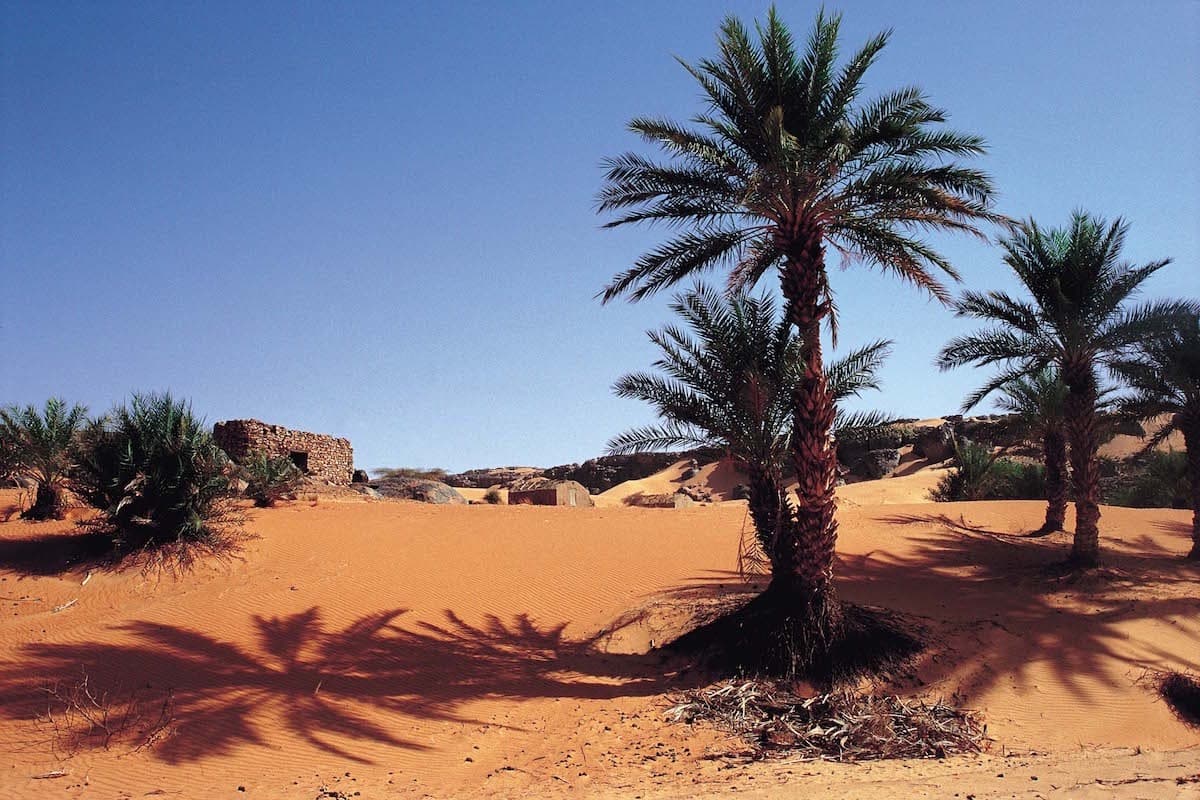
Palm groves, springs and wells near the Amjenjer basin
From Erg Roueissat
Hassi Echig → Amjenjer
At the edge of the dunes, a small ridge shelters a salt spring, attracting numerous birds, both resident and migratory, and the tracks of predators. We devote time to observing the life around this surface water point, very rare in the Sahara, since generally water is only accessible with a rope and a waterskin. Having crossed a steep dune corridor, we discover the Echig wadi, and its welcome well. On the way to our picnic at the foot of the Tenemouj plateau, we discover an ancient underground storage depot for goods, primarily salt. Then from the heights of this immense plateau, our march to the bivouac will offer us great moments of emotion above the vast sandy expanses. The plateau is perfectly flat, and the gaze is lost on the horizon, impossible to evaluate in terms of distance. It seems to recede before us, and recourse to the compass is essential. A passage, which we discover at the last moment, allows us to reach the plain; we dominate the landscape far towards the south, and at our feet the wooded valley of Amjenjer conceals somewhere our camels and our bivouac.
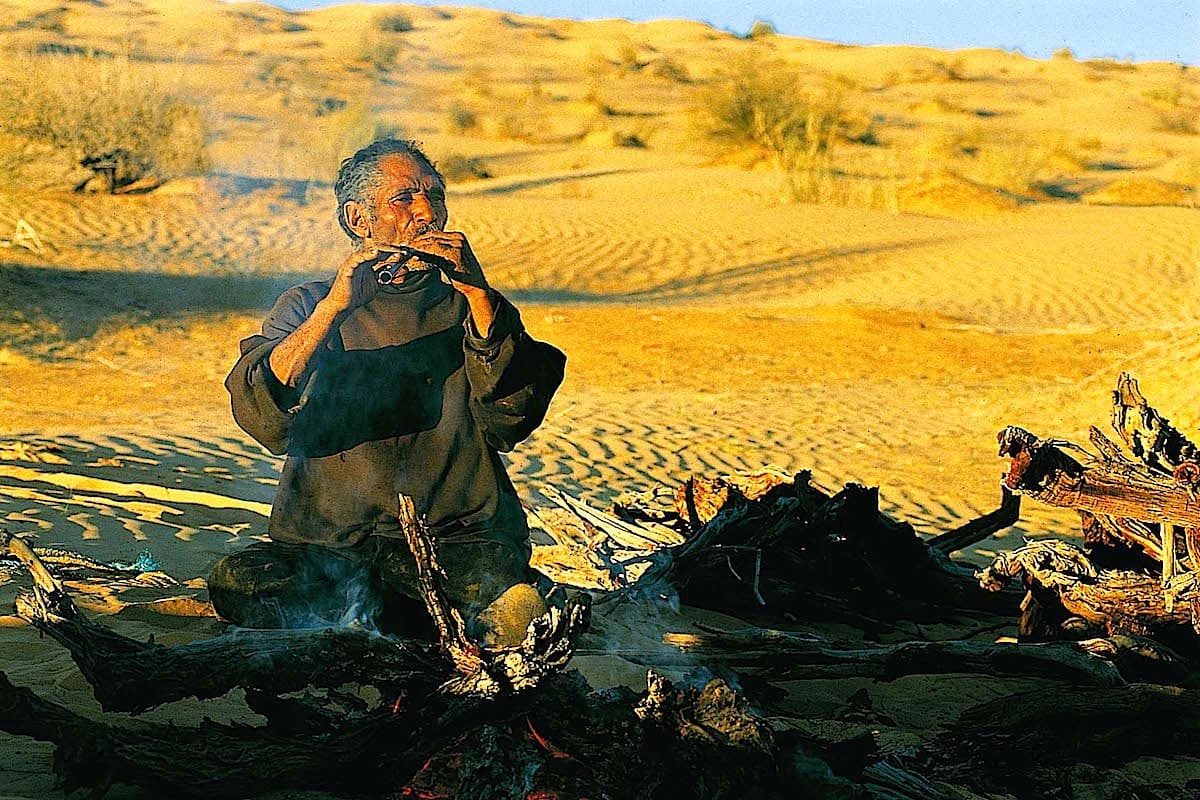
Aïn Safra village
Amjenjer → Aïn Es Safra
After crossing the Amjenjer valley and to reach our picnic on the edge of a lovely pond, we cut across the plateau, occupied by pretty orange-colored barchan dunes (crescent-shaped dunes). By the wadi or the plateau we reach the improbable oasis of Aïn Sefra ("The yellow spring"). A handful of huts seems to have been thrown onto the plateau one windy day, against which they are poorly protected. You only discover the wadi and the cluster of palm trees when you really arrive at the edge of the cliff that overlooks the wadi. We fill our jerry cans and waterskins, while all the children have left school to come and see these funny nomads. We move away from the village to camp behind a line of dunes.
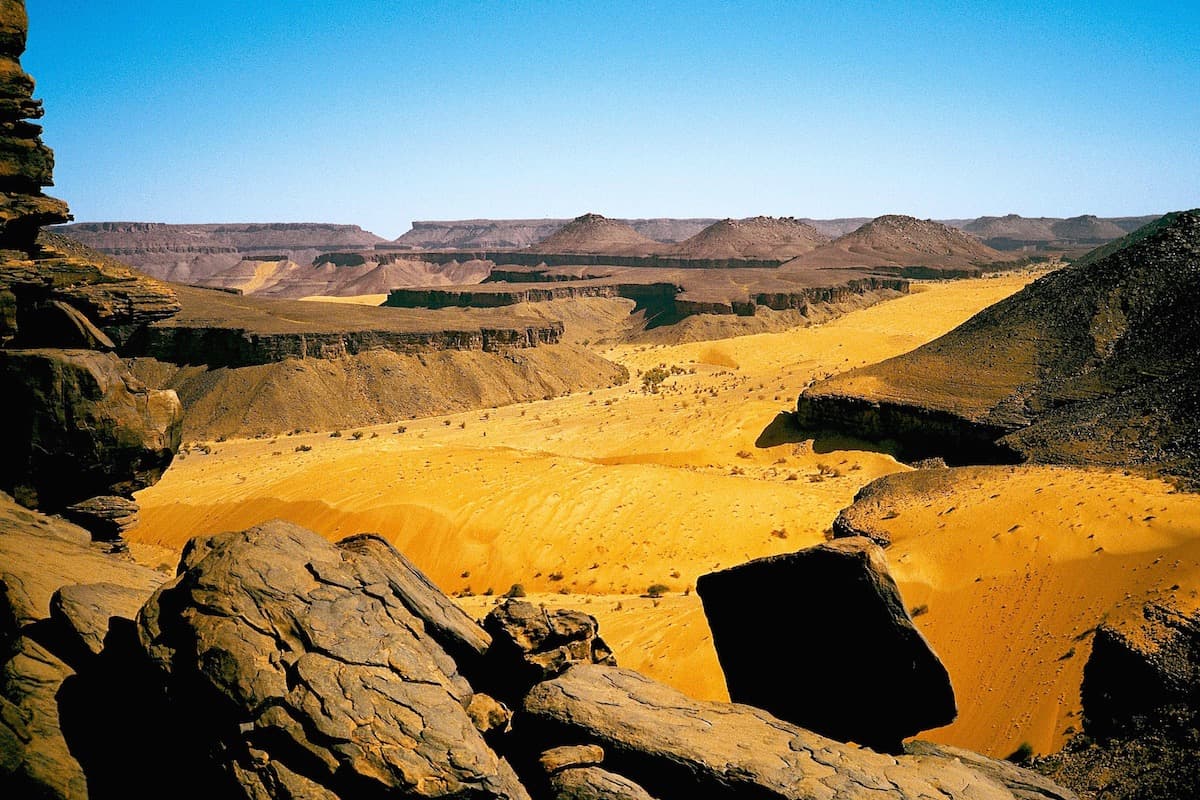
The Mysterious Valley of Aït Maoualine
Aïn Es Safra → Ait Maoualine
We now head westward and reach the nearly enclosed plain of Aït Maoualine; the pastures are generally quite rich, but reckless deforestation has wreaked havoc. No one will come to monitor this illegal activity so far from road networks. Ribbons of sand descend and climb the foothills that encircle this basin. The most common tree species are Acacias raddiana (Talha), Balanites aegyptiaca (Teichot), Boscia senegalensis (Eizine). Greenery, sand and rock make up a rich and varied landscape.
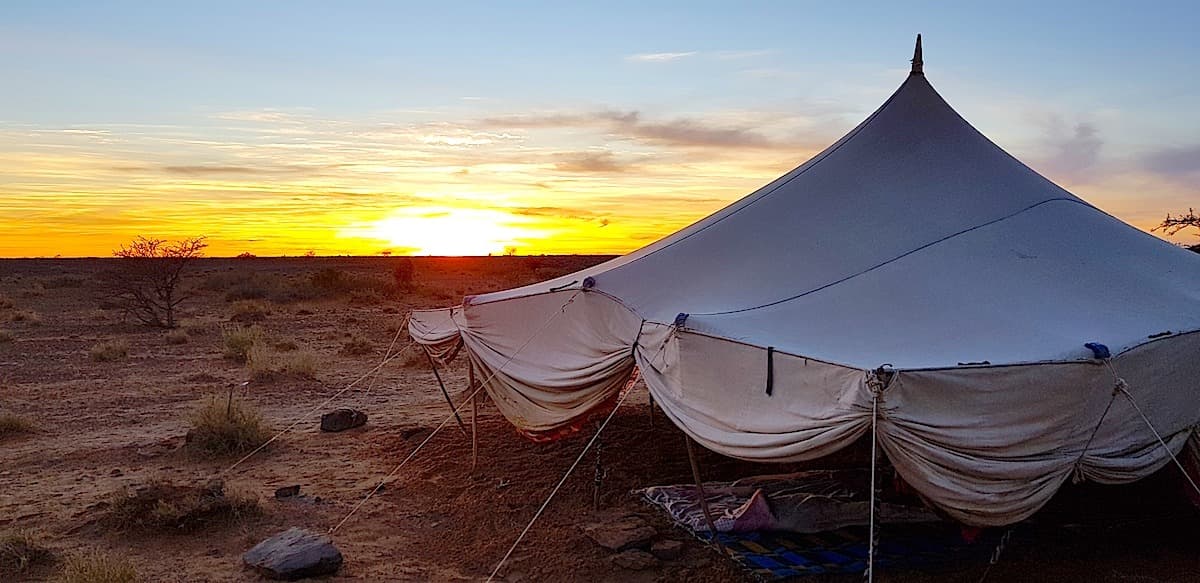
The mineral universe of the astonishing Toudouchine palm grove
Walking tour
We wind our way through the maze of more or less sandy wadis in this area of highly fractured plateaus. No straight line is possible. We reach one of the Toudouchine wells, a rallying point for the nomads and semi-nomads of the region. We enter the heart of the territory of the Oulad Sassi; they are part of the Ideichili tribal confederation, which has always enjoyed a certain autonomy with respect to the Hassan tribes and emirate authority. They were a source of almost permanent contestation against various successive powers. French penetration in Mauritanie was destabilized for a time by the death of X. Coppolani (head of the pacification mission in Mauritanie), killed in Tidjikja on May 12, 1905 by an armed band essentially composed of members of the Ideichili tribe. The palm grove of Toudouchine el Kebir welcomes us at lunch time; we will also spend the night there after a well-deserved afternoon of rest.
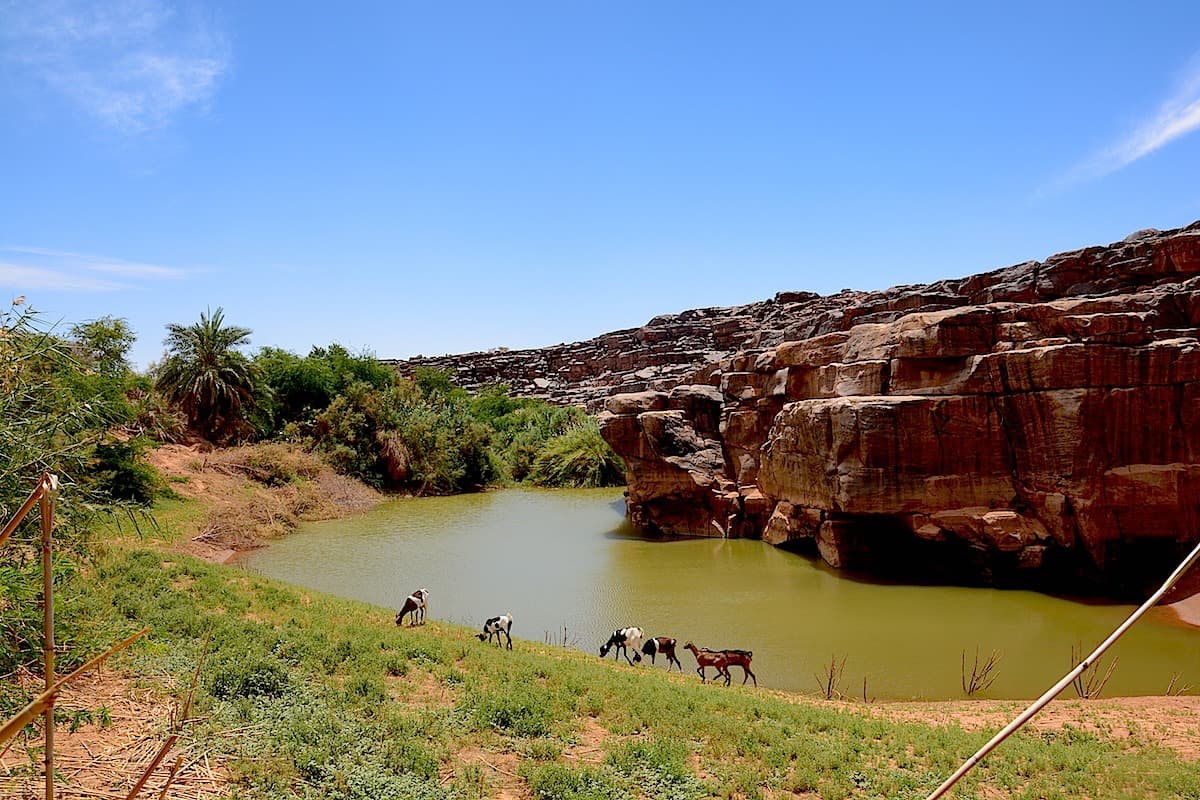
The canyons and gueltas of Sbaïa (the lion)
Toudouchine → Gueltas de Sbaïa
Always between wadis and plateaus, but in more open landscapes, we enter a beautiful tectonic fault, sheltering trees and water holes of Sbaïa ("lion's water holes"); this name refers to this feline, which could still be encountered in the 1930s-40s of the previous century. Despite regular human occupation, we sometimes observe fauna very representative of Saharan regions. The golden jackal (Canis aureus) is well represented as well as the fennec (Fennecus zerda) and the pale fox (Vulpes rueppelli). A few spotted hyenas (Crocuta crocuta) occasionally take animals (goats or sheep) from herds. The honey badger (Mellivora capensis) and the porcupine (Hystrix cristata) are also present. Among felines, we were able to observe sand cats (Felis margarita) and in autumn 1998, one or more large felines not really identified, circulated throughout the entire Adrâr arc. They could be cheetahs (Acinonyx jubatus), or more likely caracals. Their migrations were tracked thanks to the depredations they committed on the herds of donkeys in the camps. It seems they would have tracked the transhumance of the Ideï Boussat nomads from the Hodh towards the north of Mauritanie.
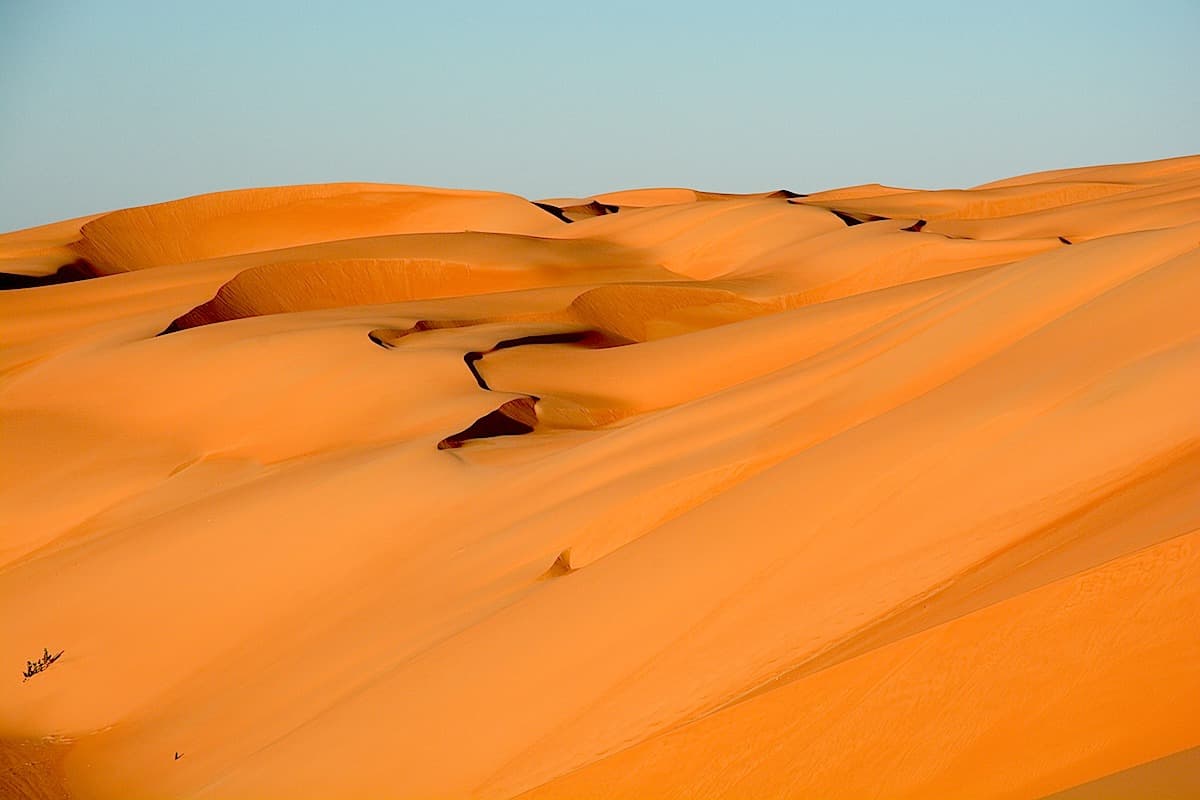
On foot always to reach the beautiful Abteïli valley
Gueltas de Sbaïa → Abteïli
A short stage takes us to the lake (when it has rained) barred by dunes, in the spillway area downstream from Abteïli. Many unexpected birds are then observable (ducks, waders, …). The mauve cliffs stand out singularly against the dense green of date palms. The white sand adds a note of softness to this picture. The Ideichili nomads are in the habit of settling in these areas of the Adrâr at the height of the dry season. With spring approaching, they often resume their migrations towards the southwest, towards the pastures of Bou Nagâ or Timassoumit, to meet the African monsoon. We take our time to reach the bivouac, meeting point with our vehicles, at the foot of beautiful cliffs.
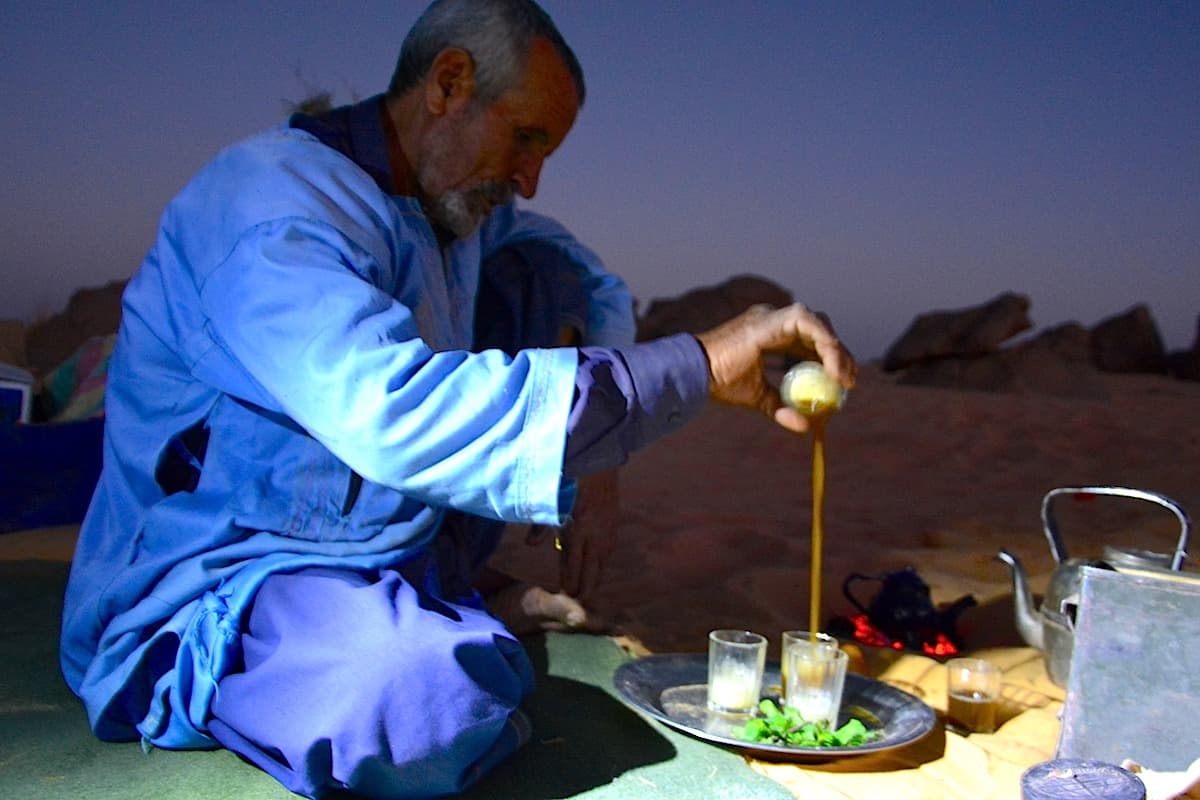
By car across the western Adrâr to reach Atar
Abteïli → Atar
Departure by 4x4 heading north. At midday, we reach wadi El Abiod, a huge rift collecting water from vast plateaus normally rich in pastures. Many small palm groves benefit from abundant and shallow water. We arrive in Atar at the end of the day. The guesthouse with simple and pleasant comfort from our local contact welcomes us for dinner and overnight accommodation.
The city of Atar founded in the 17th century in the borderland plain (bâten) that stretches north of the great cliff, is protected from sand by its geographical location.
It is the most important city in the Saharan zone. It was an emirate city in the past, a garrison city for the Americans and then the French, and finally a regional capital.
International flight for return to France
We are heading west. We leave the last plateaus of the Adrâr to reach the Yagref basin.
The black rock cones, the dune ridges of the Amatlich mark the landscapes of the Amsaga.
Then, the vast plains of the Inchiri take us to the Atlantic coast and the capital of Mauritanie.
Nouakchott → Paris Aéroport
Following your flight schedule to France, we will transfer you to the Nouakchott-Oumtounsy International Airport.
Practical Information
Registration is considered firm and final after payment of a deposit of 30% of the total price and acceptance of the specific terms of sale.
The balance must be paid no later than 45 days before the departure date.
See our specific terms of sale for full details.
In the event of cancellation by the traveller, the following fees apply:
- Plus de 60 jours avant le départ : 40 % du prix total (acompte retenu)
- Entre 60 et 30 jours avant le départ : 50 % du prix total
- Moins de 30 jours avant le départ : 100 % du prix total
We strongly recommend taking out cancellation insurance. See our specific terms of sale for full details.
Les informations ci-dessous concernent les voyageurs ressortissants de l'Espace économique européen (EEE), de la Suisse et du Canada se rendant en Mauritanie dans le cadre d'un séjour touristique. Les règles d'entrée pouvant évoluer, nous vous recommandons de vérifier les informations auprès des autorités officielles avant votre départ.
Passeport
Pour entrer en Mauritanie, votre passeport doit être valide au minimum six mois après la date d'entrée dans le pays et comporter au moins une page vierge pour les tampons d'immigration.
Le document doit être en bon état (pas de pages détériorées, déchirées ou modifiées).
Visa
Les ressortissants de l'Espace économique européen, de la Suisse et du Canada doivent en principe être munis d'un visa pour entrer en Mauritanie. Ce visa peut être obtenu :
auprès de l'ambassade ou du consulat de Mauritanie dans le pays de résidence avant le départ,
ou, selon les conditions en vigueur, à l'arrivée à l'aéroport international de Nouakchott (visa on arrival), pour un séjour pouvant aller jusqu'à 30 jours.
Il est fortement recommandé de se renseigner auprès des autorités mauritaniennes ou de l'ambassade compétente avant le départ, les modalités d'obtention du visa pouvant évoluer.
Les autorités peuvent demander :
un billet de sortie du territoire (vol retour ou continuation),
une preuve de ressources financières suffisantes pour la durée du séjour,
une réservation d'hébergement ou une lettre d'invitation.
Santé et vaccinations
Aucune vaccination n'est officiellement obligatoire pour entrer en Mauritanie, à l'exception du vaccin contre la fièvre jaune si vous arrivez en provenance d'un pays où cette maladie est endémique.
Cependant, plusieurs vaccinations sont fortement recommandées par les autorités sanitaires :
Hépatites A et B
Typhoïde
Méningite à méningocoque
Rage (selon les activités prévues)
Mise à jour du calendrier vaccinal habituel (diphtérie, tétanos, poliomyélite)
La prophylaxie antipaludéenne est recommandée pour l'ensemble du territoire mauritanien. Consultez un médecin ou un centre de vaccinations internationales avant votre départ.
Sécurité et enregistrement
Les autorités mauritaniennes peuvent exiger l'enregistrement des voyageurs étrangers auprès des services de police ou de la gendarmerie locale dans les 48 heures suivant l'arrivée, notamment en dehors de la capitale. Il est conseillé de se renseigner sur les obligations en vigueur au moment du voyage.
En raison du contexte sécuritaire dans certaines régions du pays, il est recommandé de consulter les conseils aux voyageurs délivrés par les autorités de votre pays de résidence avant le départ.
Voyage avec des enfants
Les mineurs doivent être titulaires de leur propre passeport valide couvrant la durée du séjour.
Dans certains pays européens, lorsqu'un mineur voyage sans l'un de ses parents, une autorisation de sortie du territoire peut être exigée selon la réglementation du pays de résidence.
Autres nationalités
Les conditions d'entrée peuvent varier selon la nationalité. Les voyageurs concernés doivent se renseigner auprès de l'ambassade ou du consulat de Mauritanie de leur pays de résidence.
Pour participer à nos voyages, il est fortement conseillé d'être assuré en assistance-rapatriement et frais médicaux à l’étranger.
Votre agence locale vous encourage à prendre connaissance du contrat spécifique élaboré avec notre partenaire CHAPKA ASSURANCES et AXA ASSISTANCE.
Pour souscrire à une assurance, connaître les garanties et les tarifs, suivez le lien ci-dessous.
CAP EXPLORER : La solution d’assurance complète conçue pour vivre sereinement votre voyage !
Choisissez la formule qui vous correspond le mieux:
Explorer'Multirisque
Explorer'Annulation
Explorer'Assistance
Explorer' Complémentaire Carte Bancaire
Spécifiques à nos voyages, nous suggérons fortement d’y souscrire.
Si vous choisissez de souscrire à l’une de ces formules, la convention détaillant l’ensemble des garanties et les modalités de déclaration du sinistre sont disponibles sur le site Internet de l'assureur.
Votre agence locale en aura connaissance, mais seul le participant est responsable du respect des procédures de déclaration de tout sinistre. Le participant doit donc conserver cette convention avec lui pendant toute la durée de son voyage.
Chapka — Cap Explorer
Our insurance partnerTravel with peace of mind with our partner Chapka. Cancellation, repatriation, medical expenses, baggage… All the coverage for a worry-free trip.
Travel with peace of mind — I'll handle the insuranceFrequently asked questions
Oui, un visa touristique est obligatoire pour les ressortissants français, délivré à l'arrivée à l'aéroport de Nouakchott (55 euros pour 30 jours) ou auprès du consulat. Passeport valide au moins 6 mois après l'entrée requis. Le contexte sécuritaire impose une vigilance accrue.
Rendez-vous dans la section Mes Voyages pour retrouver tous vos projets.
Vous pouvez envoyer un message à votre hôte directement depuis le Salon de Thé.
Pour un voyage sur mesure de qualité, comptez entre 180 et 300 euros par jour et par personne, incluant hébergement, repas,4x4 avec chauffeur et guide francophone. Les vols internationaux (500-800 euros A/R) sont en supplément. Le désert, le train du Sahara et les plages représentent des expériences uniques.
Vos documents sont accessibles dans l'onglet Documents de votre voyage.
Absolument. Nous adaptons chaque circuit au profil des voyageurs. Pour les familles, nous privilégions des rythmes détendus, des hébergements familiaux, des activités ludiques et pédagogiques, et des transferts privés confortables. Nos guides locaux francophones savent capter l'attention des enfants avec des anecdotes adaptées à leur âge.
C'est simple. Vous échangez avec notre équipe locale pour définir vos envies, votre budget et vos dates. Vous recevez une proposition d'itinéraire détaillée sous 48 heures. Vous ajustez ensemble chaque détail jusqu'à la version parfaite. Vous confirmez et partez l'esprit tranquille. Votre agence locale reste disponible 7j/7 pendant toute la durée du voyage.
En cas d'urgence, contactez immédiatement votre agence locale.
Le paiement s'effectue généralement en deux fois.
Notre agence fait partie du réseau Nomadays, immatriculé en France. Vous bénéficiez de la garantie APST (Association Professionnelle de Solidarité du Tourisme) qui couvre 100% de vos fonds. Paiement sécurisé, assurance rapatriement incluse, et assistance francophone 24h/24 sur place pendant tout votre séjour.
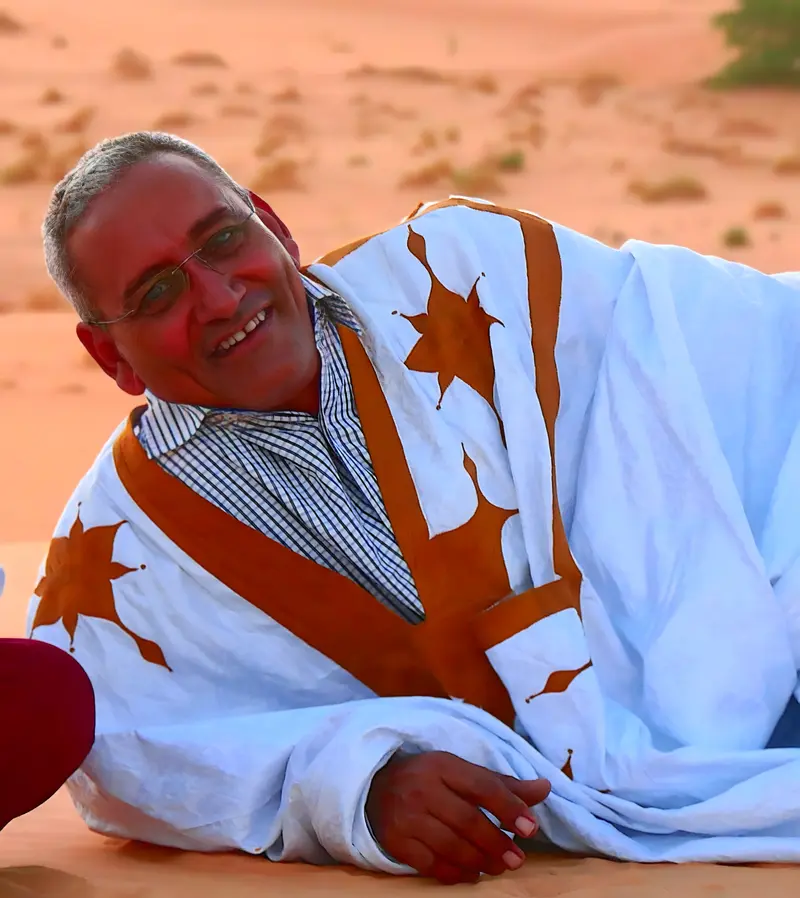
Let's talk about your adventure — Adrar
Craftsperson of journeys in the heart of Mauritania, based in Atar
Mauritania is a country that reveals itself with respect and patience. My role is to help each traveler approach it in the best conditions, with confidence and curiosity.
— Isselmou