Essential North Moluccas
At the edges of the archipelago, active volcanoes and legendary spices reveal their thousand-year-old secrets.
Duration
12 days
From
€795/pers.
Ideal seasons
May, Jun, Jul, Aug, Sep, Oct
Style
Guided tour
Comfort
budget
Travelers
Solo, With friends, Couple, groupe
The spirit of travel
The North Moluccas were, in the 16th and 17th centuries, the first "spice islands", as they were at the time the only source of supply for cloves. The Dutch, the Portuguese, the Spanish and the sultanates of Ternate & Tidore were indeed competing for control of the very lucrative spice trade.
Apart from spices, the North Moluccas are also known for their volcanoes including Gamalama, Ibu and Dukono, which are still active. This circuit therefore offers you a perfect blend of cultural discovery (many testimonies of the colonial past of these islands are still visible) and an exploration of the two main active volcanoes on the island of Halmahera (Mts Ibu & Dukono), which will instil in your journey a sense of timelessness, or even the discovery of another planet!
The stages of your journey
Highlights
Day-by-day itinerary
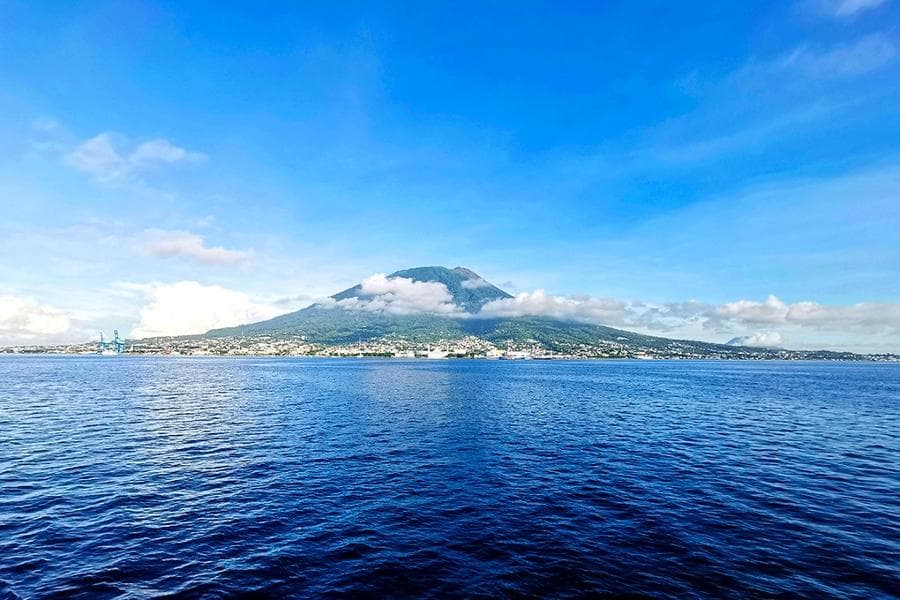
Welcome to Ternate!
Welcome at Ternate airport by your English-speaking guide and transfer to your hotel.
The afternoon is dedicated to a first discovery of the city. You will visit in particular the old Sultan's palace, transformed into a museum. Ternate was indeed the first region of the Moluccas to convert to Islam with the conversion around 1495, under the influence of the Muslim principality of Gresik in Java, of its sovereign, who took the name of Zain al-'Abidin (1486-1500).
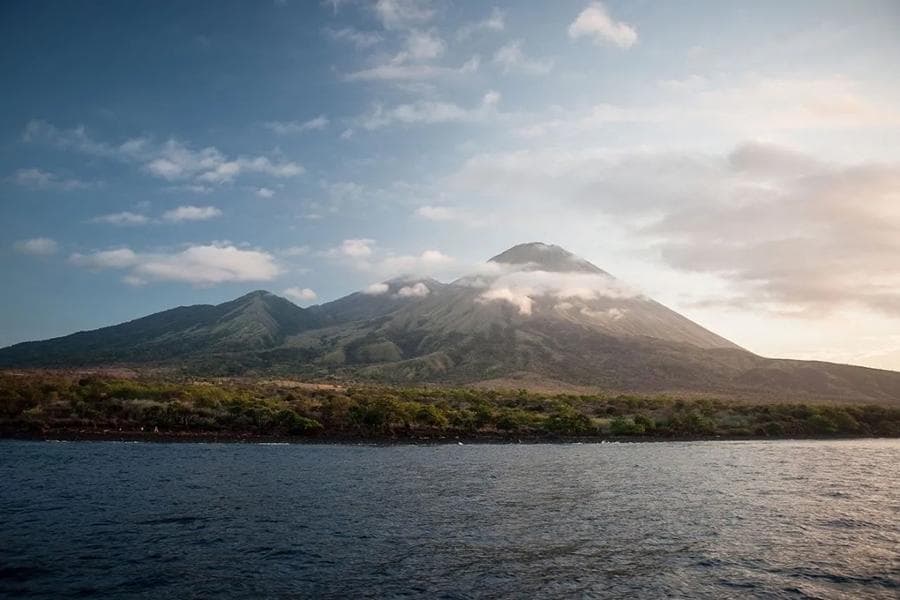
Former kingdom
Early in the morning, you begin a deeper exploration of the island dominated by the Gamalama volcano. You visit notably the Kalamata forts (built by the Portuguese in 1540), Orange (built by the Portuguese in the 16th century as well), Tolukko (built by the Spanish in 1522) and Kastela (built by the Portuguese in 1522).
In the afternoon, you approach a curious and old lava stone, which dates from a Gamalama eruption in 1673, then you stroll around the very lovely Tolire lake.
Return to the hotel in late afternoon.
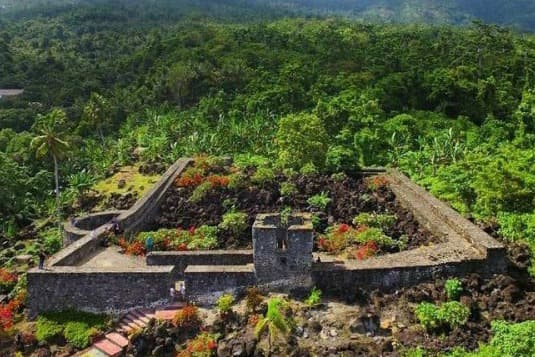
Rival Kingdom
Morning departure for the neighboring island of Tidore, once a rival, whose Sultans controlled the south of Halmahera and, at certain periods, Buru & Ambon, as well as several of the islands off West New Guinea.
The day is devoted to discovering the remnants of its past (Tahula & Tore forts), as well as its crafts (traditional forges, textiles, etc).
You will also visit the Sultan's palace.
Ibu volcano approach
Morning transfer by speed-boat to Jailolo port, on Halmahera island, from which you then head towards the foot of Mount Ibu volcano.
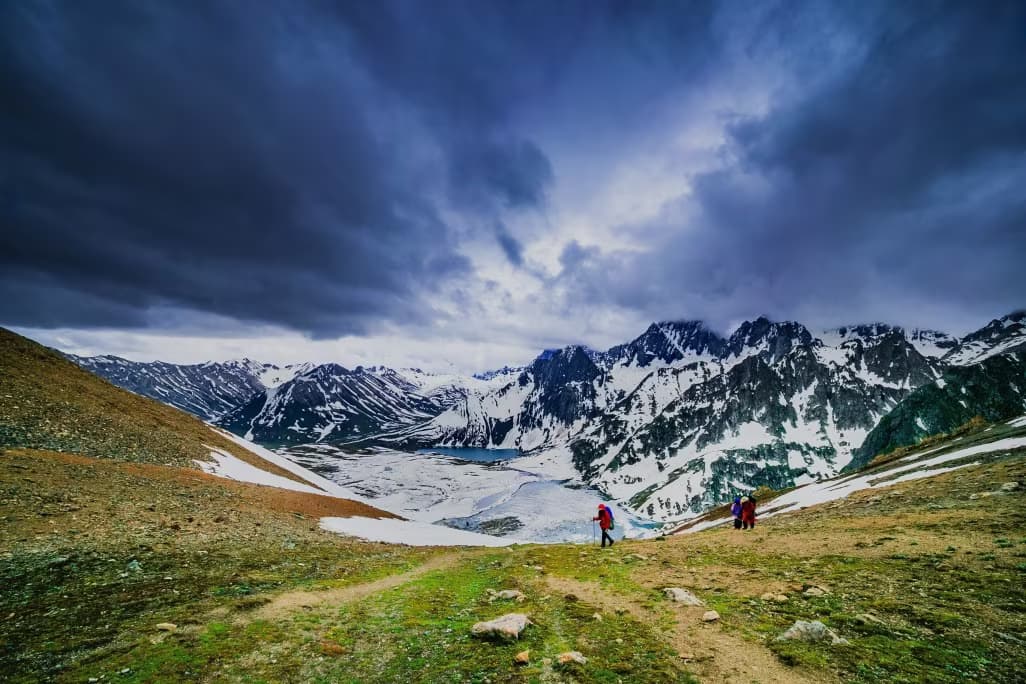
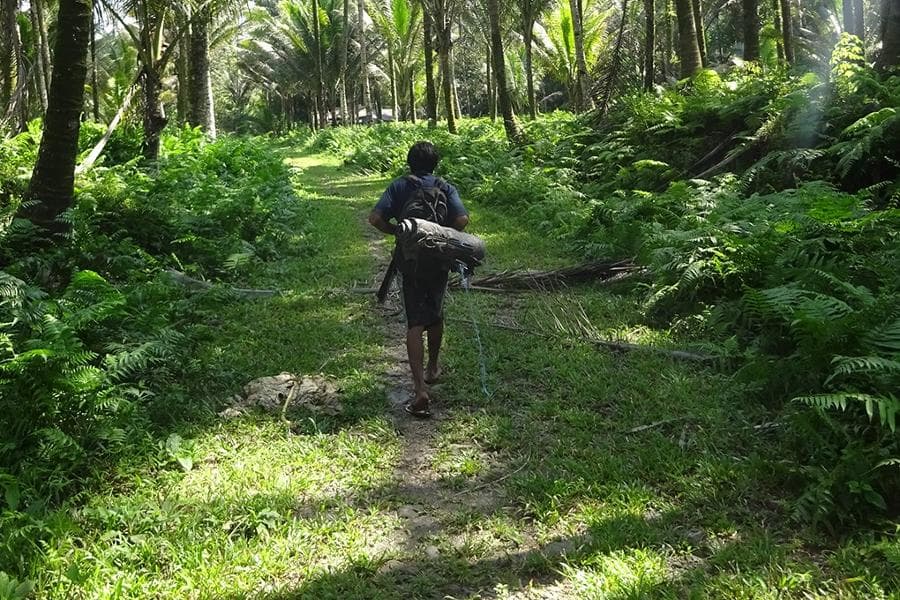
You then begin an approach hike towards the summit. The trail involves several kilometres of fairly flat walking through vast coconut plantations with many wooden shelters, and it is often possible to take motorcycles for about two kilometres up to an altitude of over 200 metres.
The trail then passes through nutmeg and clove plantations before entering the forest at around 600 metres. A pleasant wooden shelter, known as Pos 1 (675m) is generally reached after about 2-3 hours and is an excellent place to rest for a while. This was once used by wild boar hunters to prepare meat before returning to the villages below. The trail then descends into a ravine (655m) filled with black sand and rocks, and you may find a water source if it has rained recently.
Depending on volcanic activity and wind direction, it is often here that you will hear rockfalls and volcanic activity for the first time. This noise is particularly strange and remarkable at night. The trail follows this ravine for a few hundred metres before crossing to the right side and entering the forest proper (673m). A few small grassy areas soon follow, which the guides call Pos 2 (780m). The volcanological sensor station is located on the right at around 800 metres. This is where you will bivouac for the night.
Elevation gain + 670 m
Fireworks
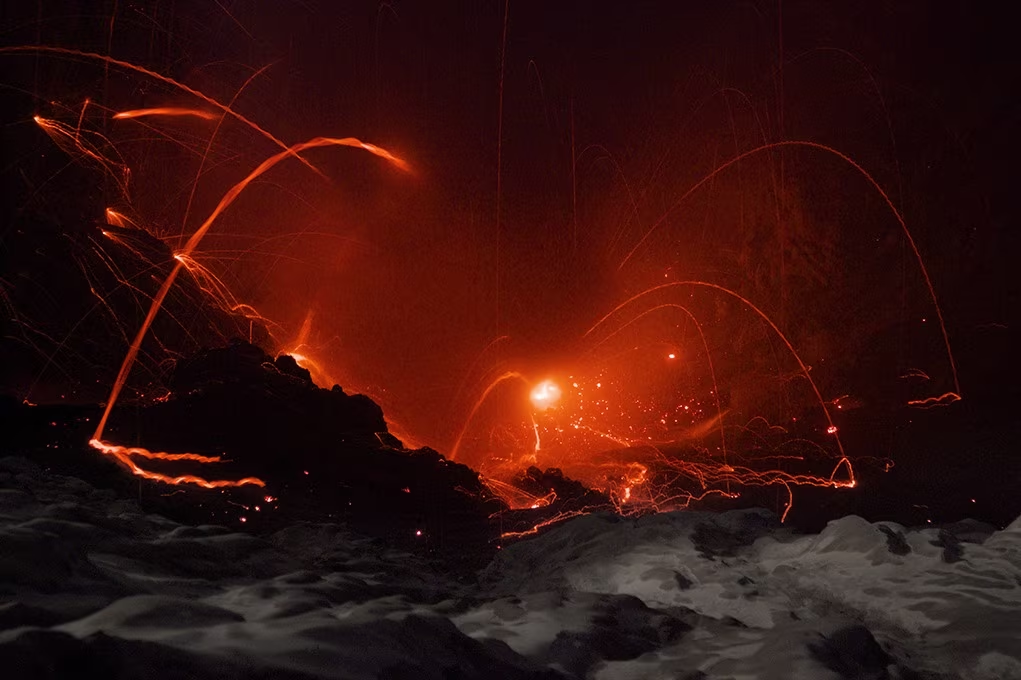
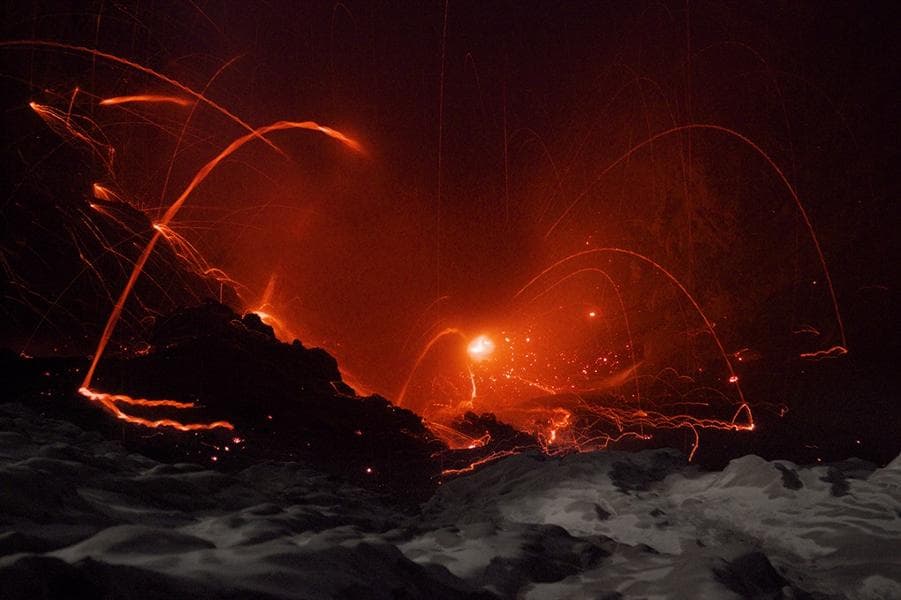
Around 3am, you resume your way towards the summit of the volcano. The trail emerges on the west side of the crater rim at approximately 1250m with spectacular views over the entire crater. Black rocks fill almost the entire crater floor. You then follow the trail as it runs along the ridge before reaching an excellent viewpoint (1,315m) in clear weather, overlooking the west coast and the Gamkonora volcano to the south. An old sign suggests this is Gunung Tabaru, 1325 m, although the name and altitude are debatable. But the views and sounds are absolutely breathtaking. The active main cone, which now dominates the scene, emits enormous plumes of smoke with a huge "whoosh" approximately every 15 minutes, with ash deposited on the surrounding forest.
At night, you can see an incredible and unforgettable orange glow each time this occurs. The outer edge of the crater has two high points, one to the west (which is apparently the summit) and a second on the east side. Currently, no hikers go beyond the viewpoint at 1,315 m, as there is no trail. What appears to be the summit is clearly visible and, if there were a trail, it might only take perhaps 20 minutes of additional hiking. But creating a trail to reach this point would probably take half a day!
Elevation gain + 550 m
Rest by the seaside
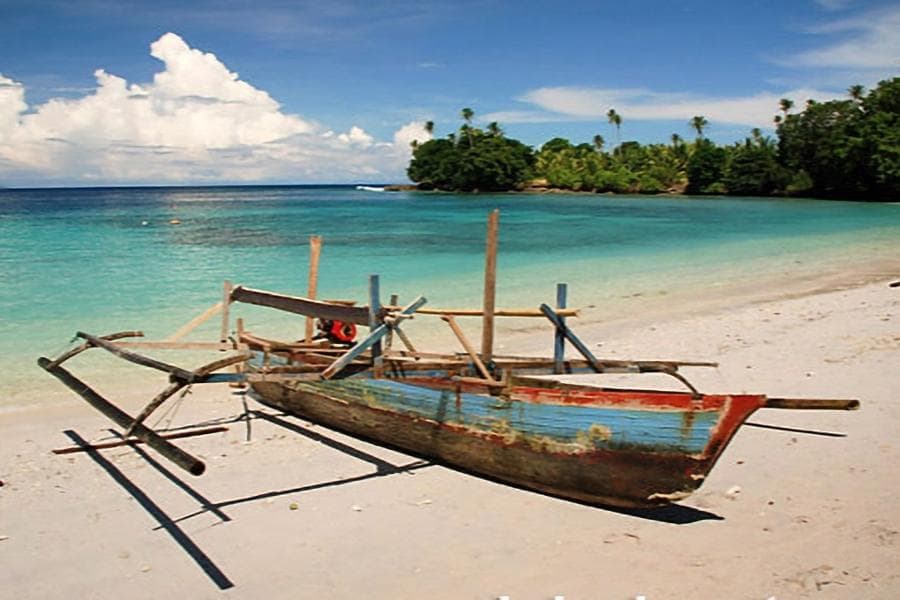
Day of relaxation and discovery: visit to Tobelo market and opportunity for snorkeling (or canoeing) off the white sand beaches of Luari, Kupa Kupa or Kumo, which offer calm and clear waters.
Transfer in the afternoon to Mamuya, where you have the possibility to swim in hot spring waters.
Return to the hotel at the end of the afternoon.
Dukono Volcano Approach
Morning transfer to the village of Ruko, where you board a three-wheeled motorcycle that takes you, through coconut plantations towards the foot of Dukono volcano.
You then begin an approach march on its flanks, starting from Pos 2 (370 m). This trekking is a steady climb to the initial crater edge (3.5 kilometers) with the exception of eight small streams/ravines to cross, notably at 647 m and 795 m where, after rain or during the rainy season, it is likely that you will find water.
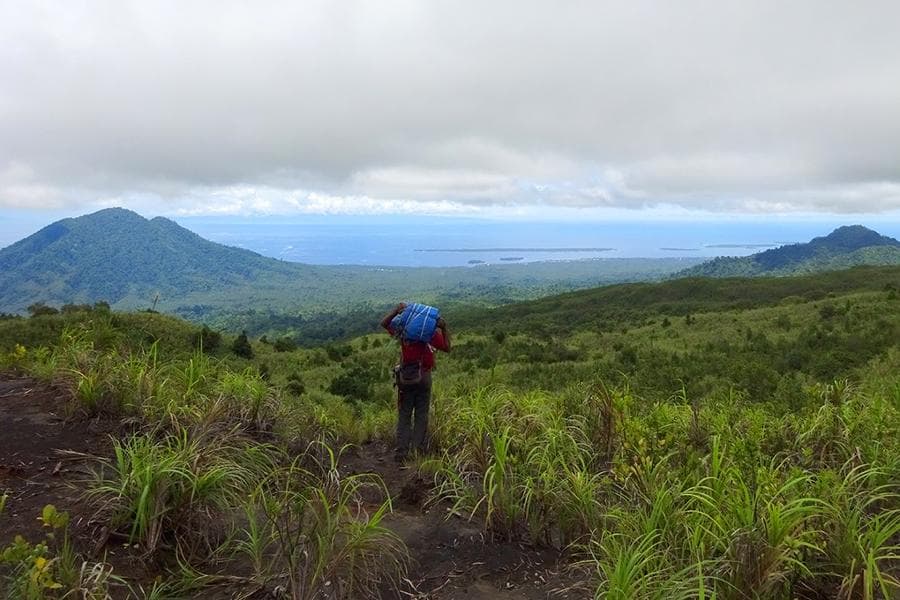
The forest zone is reached at approximately 500 meters and the dense zone of cane grass omnipresent in the mountains of Halmahera, at the interface between the forest and the bare summit of the mountain, at approximately 800 meters. Views of Mt Mamuya (933 m), smaller, and of the coast near Tobelo are possible from approximately 838 m onwards. Finally, the outer edge (940 m) is reached. On a small hill to the left, you will see volcanic detection equipment. This small summit is Mt Dilekene.
Below, a plain of black volcanic sand resembles a miniature version of the sand sea of Bromo. This outer edge is known as Tanah Lapang. Crossing it takes only a few minutes and it is from here that you get the first view of the active crater of Dukono, with its ash plumes and rumblings.
Your walk to the edge of the active crater is approximately one additional kilometer and lasts between 1 hour and 90 minutes, depending on the amount of ash. On the other side of the Tanah Lapang sand plain lies a vast expanse of ancient lava flows, jagged in places and smooth in others. When covered with very deep ash, the landscape below the active crater is completely surreal.
You establish your bivouac at the last Pos, at 946 m altitude, on the crater side of the sand plain, so that you can observe, at night, the fireworks in the active crater
Elevation gain + 575 m
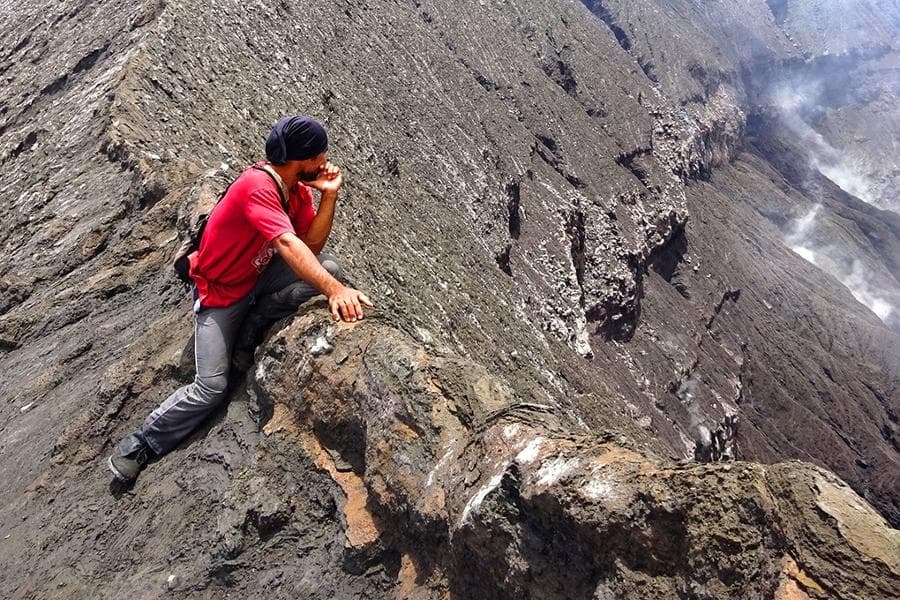
Impressive ash plumes
Walking tour
Late at night, you resume your hike towards the volcano summit. The higher you climb, the clearer the view of the peaks of Mt Gogodom (1,102 m) and Mt Bale-Bale (923 m) becomes. You should be able to spot the small islands off the coast near Tobelo and perhaps even the large island of Morotai in the distance.
Finally, you reach the edge of the Dukono crater, at approximately 1,150 m altitude. The crater is almost circular and funnel-shaped - about 400 m in diameter and 200 m deep (estimated!). It is possible, with caution, to crawl up to the crater's edge and peek inside - impressive, stunning, frightening, frightening - while the vent roars and emits huge clouds of ash.
With extreme caution, looking over the rim, you can see directly into the chimney from which eruptions emerge from the earth's depths. Ash plumes are emitted almost every minute, rising some 500 m above the rim, before being gently swept away in the direction of the wind. The sight of ash clouds emitted by the chimney below precedes the sound of the chimney's roars themselves (sound travels more slowly than light). Please also note that it is dangerous and inadvisable to reach the highest point of the ridge.
Elevation gain + 200 m
Elevation loss - 780 m
To Tobelo
After approximately one hour of observation, you head back to camp and then descend towards the village of Ruko, where your vehicle awaits to take you back to Tobelo.
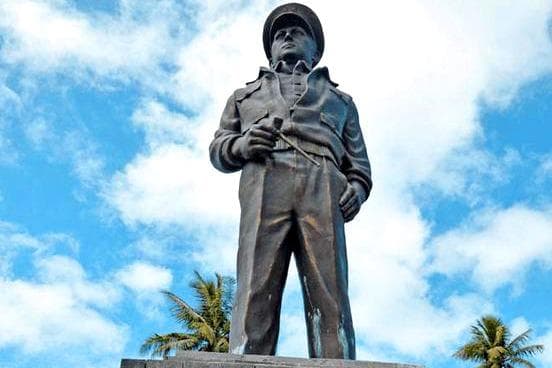
Remnants of the Second World War
Morning transfer to Morotai Island. During World War II, Morotai was a Japanese air base. American forces captured it in September 1944 and used it as a departure point for an Allied landing in the Philippines in early 1945, and in eastern Borneo in May and June of that same year. The Allies were also preparing a landing in Java for October 1945, but this was cancelled with Japan's capitulation on August 15. The day is dedicated to exploring the island.
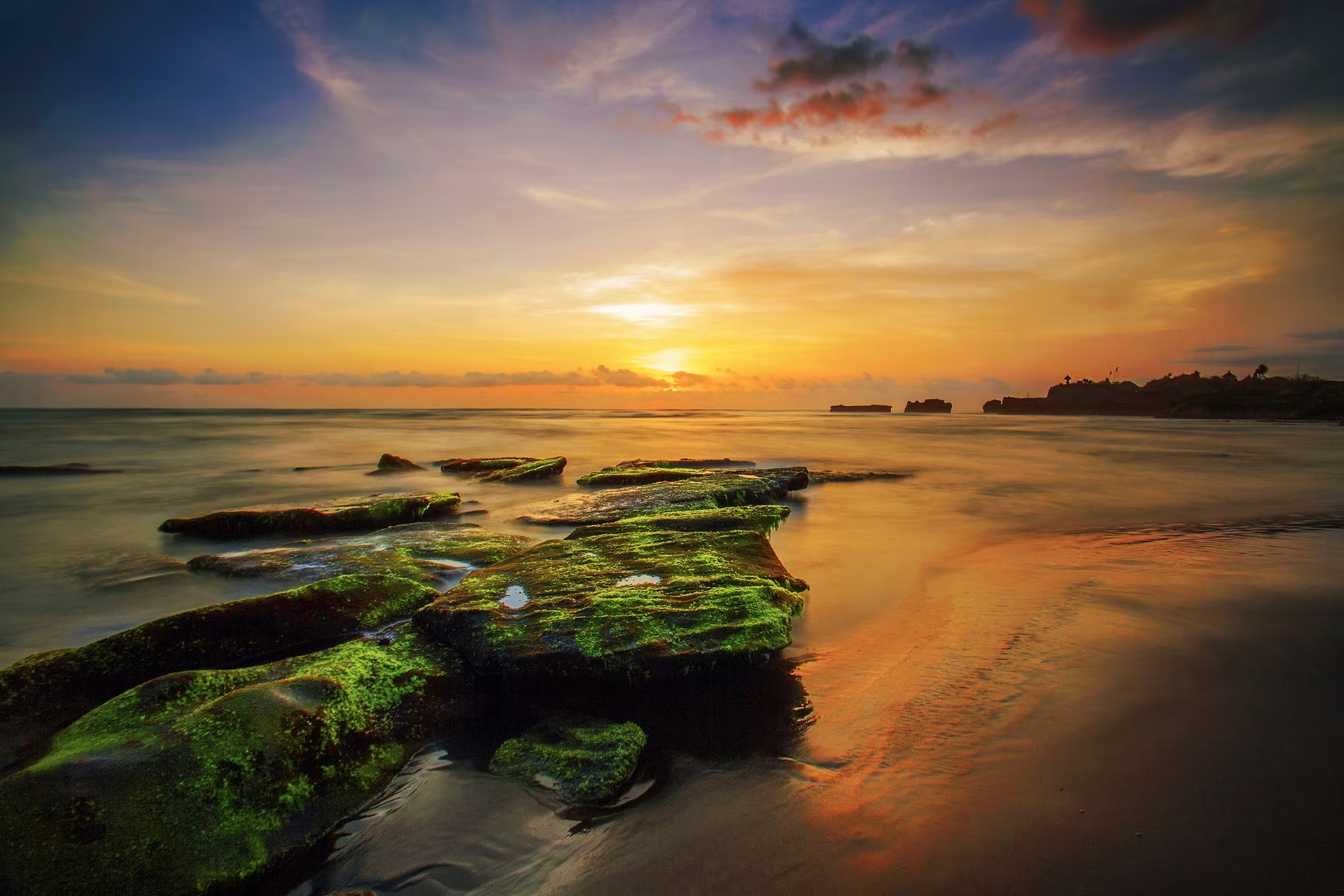
You will visit in particular the World War II museum, and pay your respects at the statue of the last combatant. You will also approach the stunning Raja waterfalls, among others, and finish with a beautiful sunset along D'Loha beach.
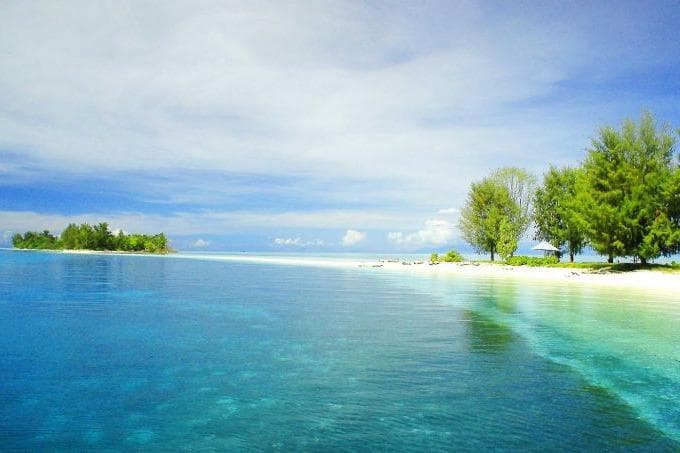
Rest in paradise
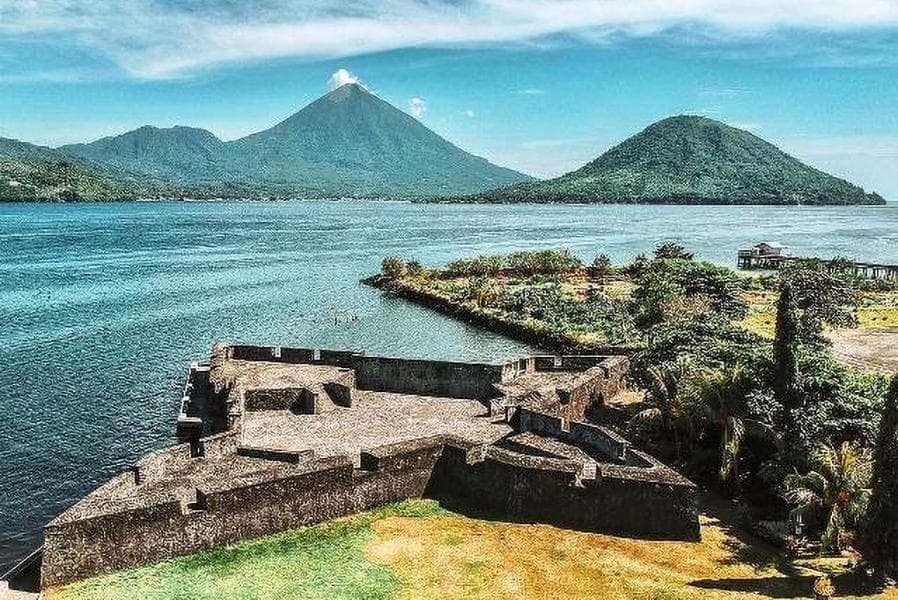
Return to Ternate
Transfer day to Tobelo, then Sofifi, and finally Ternate.
Price per person
Indicative price per person, based on double room. Each trip is customized according to your preferences.
This trip can be tailored to your preferences
This itinerary provides an excellent foundation for discovery, but it can be fully customized. Our local advisors build each trip tailored to your budget, dates and preferences.
Not included
- International & domestic flights
- Insurance & Assistance
- Visas & possible airport taxes
- Beverages, Personal Expenses & Tips
- Everything not mentioned in "Inclusions"
Included
- English-speaking guide and team of porter(s)
- Ground transfers in a private and air-conditioned vehicle
- Full board accommodations
- Site Entries, Trek Permits & Donations
- Camping Equipment
- Mineral water and energy supplement during trekking days
- Liability insurance
Practical Information
Registration is considered firm and final after payment of a deposit of 30% of the total price and acceptance of the specific terms of sale.
The balance must be paid no later than 45 days before the departure date.
See our specific terms of sale for full details.
In the event of cancellation by the traveller, the following fees apply:
- More than 60 days before departure: 40% of the total price (deposit retained)
- Between 60 and 30 days before departure: 50% of the total price
- Less than 30 days before departure: 100% of the total price
We strongly recommend taking out cancellation insurance. See our specific terms of sale for full details.
The information below concerns tourists entering Indonesia. Entry requirements may change, and we recommend verifying the information with the official authorities of your country of residence and with the Indonesian embassy or consulate before your departure.
Passport
To enter Indonesia, your passport must be valid for a minimum of six months after your entry date and must contain at least two blank pages for immigration stamps.
The document must be in good condition (no damaged, torn or altered pages).
Tourist stay without visa
Depending on your nationality, you may be eligible for a visa exemption for tourist stays in Indonesia. Entry requirements vary by nationality and should be verified with the Indonesian embassy or consulate of your country of residence.
The authorities may also request:
an exit ticket from the territory (return or onward flight),
proof of sufficient financial resources for the duration of your stay.
Formalities on arrival
Before your arrival, it is recommended to complete the online arrival declaration via the official Indonesian customs and immigration portal (e-CD, Electronic Customs Declaration).
This form allows you to transmit to the authorities certain information necessary for entry into the territory:
passport information
flight details and itinerary
address of first accommodation in Indonesia
declaration of goods and currency carried
A confirmation QR code may be requested when passing through customs and immigration controls.
Health and vaccinations
No vaccine is mandatory to enter Indonesia, except in case of transit through a country at risk of yellow fever, in which case an international vaccination certificate may be required.
As a precaution, it is advisable to consult a doctor or vaccination center before departure. Vaccinations against hepatitis A, hepatitis B, typhoid and rabies are commonly recommended for stays in Indonesia. Antimalarial treatment may also be recommended depending on the regions visited (particularly outside Bali and major cities).
Travel with children
Minors must hold their own valid passport covering the duration of the stay.
In some countries, when a minor travels without one of their parents, an authorization to exit the territory may be required according to the regulations of the country of residence.
Entry requirements by nationality
Entry conditions vary depending on nationality. Travelers should consult the Indonesian embassy or consulate of their country of residence for specific requirements.
To participate in our trips, it is strongly recommended to be insured for repatriation assistance and medical expenses abroad.
Your local agency encourages you to familiarize yourself with the specific contract developed with our partner CHAPKA ASSURANCES and AXA ASSISTANCE.
To subscribe to insurance, find out about coverage and rates, follow the link below.
CAP EXPLORER: The complete insurance solution designed for a worry-free trip!
Choose the plan that suits you best:
Explorer'Multirisque
Explorer'Annulation
Explorer'Assistance
Explorer' Complémentaire Carte Bancaire
Specific to our trips, we strongly recommend subscribing to them.
If you choose to subscribe to one of these plans, the agreement detailing all coverage and the procedures for filing a claim are available on the insurer's website.
Your local agency will be aware of it, but only the participant is responsible for complying with the procedures for reporting any claim. The participant must therefore keep this agreement with them for the entire duration of their trip.
Chapka — Cap Explorer
Our insurance partnerTravel with peace of mind with our partner Chapka. Cancellation, repatriation, medical expenses, baggage… All the coverage for a worry-free trip.
Travel with peace of mind — I'll handle the insuranceFrequently asked questions
A Visa on Arrival (35 USD) is required upon arrival, valid for an initial stay and extendable once. You can also obtain an e-VOA online before departure. Your passport must be valid for at least 6 months from your entry date. Before booking, check the conditions applicable to your nationality with the consular authorities of your destination.
Go to the My Trips section to find all your projects.
You can send a message to your host directly from the Tea Lounge.
For a quality tailored trip, plan between 140 and 230 euros per day and per person, including accommodation, meals, internal transport and activities. International flights (700-1100 euros return) are additional. The archipelago allows you to combine beaches, volcanoes, jungle and culture at attractive rates.
Your documents are accessible in the Documents tab of your trip.
Absolutely. We tailor each circuit to the travelers' profile. For families, we prioritize relaxed paces, family-friendly accommodations, fun and educational activities, and comfortable private transfers. Our local English-speaking guides know how to capture children's attention with age-appropriate stories.
It's simple. You exchange with our local team to define your wishes, budget and dates. You receive a detailed itinerary proposal within 48 hours. You adjust every detail together until you get the perfect version. You confirm and travel with peace of mind. Your local agency remains available 7 days a week throughout your trip.
In case of emergency, contact your local agency immediately.
Payment is generally made in two installments.
Our agency is part of the Nomadays network, registered in France. You benefit from APST (Association Professionnelle de Solidarité du Tourisme) guarantee which covers 100% of your funds. Secure payment, repatriation insurance included, and English-speaking assistance 24/7 on the ground throughout your stay.

Let's talk about your adventure — Moluccas
Photographer of Indonesian volcanoes and trails, based in Yogyakarta
Before drawing up an itinerary, you have to observe, walk, listen to the locals and understand the place. Only then can an adventure trip remain authentic.
— Dominic