
Frequently Asked Questions
Your questions about Namibia
17 answers prepared by our local agency en Namibia — before you go, on the ground, after you return.
The most frequently asked questions
What is the altitude of Namibia's highest mountain?
Namibia's highest mountain is Pic Königstein, which peaks at 2,573 meters above sea level in the Brandberg massif, in the country's center-west.
Read the answer 2How long does a flight from France to Namibia take?
You should expect approximately 10 hours of flight time between France and Namibia. This duration typically includes one stopover, as there are no direct flights between the two countries.
Read the answer 3How to communicate by phone and internet in Namibia?
In Namibia (country code +264), you can purchase a local SIM card at the airport to use your mobile phone. Major hotels and tourist establishments offer free wifi connection.
Read the answerAll questions
How to get around in Namibia?
The best way to get around Namibia is to rent a car, with or without a driver. Public transport is limited: the train only connects Walvis Bay, Windhoek, and Keetmanshoop, and buses serve only major cities.
Read the answerDo I need a visa to travel to Namibia?
No visa is required for stays under 90 days in Namibia. Simply present a passport valid for at least 6 months, a return ticket, and have your passport stamped upon arrival.
Read the answerWhen should you travel to Namibia?
The best time to visit Namibia is from May to October, during the dry season. Days are warm, rainfall is scarce, and wildlife viewing is optimal near waterholes.
Read the answerWhat should you pack for a trip to Namibia?
For Namibia, pack lightweight long clothing in cotton, warm clothing for cool nights, a complete first-aid kit, hiking shoes, a hat, sunglasses, and camera equipment with binoculars for safaris.
Read the answerWhat is the climate like in Namibia?
Namibia experiences three seasons: dry winter (May–September), hot dry season (October–December), and wet season (January–April). The country sees significant temperature variations between day and night depending on the region.
Read the answerWhat is the time difference between Namibia and France?
From late March to late October, Namibia is 1 hour ahead of France. For the rest of the year (November to March), there is no time difference between the two countries.
Read the answerWhat is the population of Namibia?
Namibia has approximately 2.4 million inhabitants, making it one of the least densely populated countries in the world with only 3 people per km².
Read the answerWhat is the capital of Namibia?
Namibia's capital is Windhoek, located at 1,700 meters altitude in the center of the country with a population of approximately 300,000 inhabitants.
Read the answerWhat language is spoken in Namibia?
The official language of Namibia has been English since independence in 1990. German and Afrikaans are also widely spoken, a legacy of colonial history. Many indigenous languages persist, notably the click languages characteristic of the San and Nama peoples.
Read the answerWhat is the currency and exchange rate in Namibia?
The official currency of Namibia is the Namibian dollar (NAD). The South African rand is also accepted throughout the country. Exchange rates fluctuate daily, so check with your bank before departure.
Read the answerWhat is the size of Namibia?
Namibia covers an area of 825,419 km², making it the 34th largest country in the world and the 4th largest in Africa after Algeria, the Democratic Republic of the Congo, and Sudan.
Read the answerWhat are the endemic animals of Namibia?
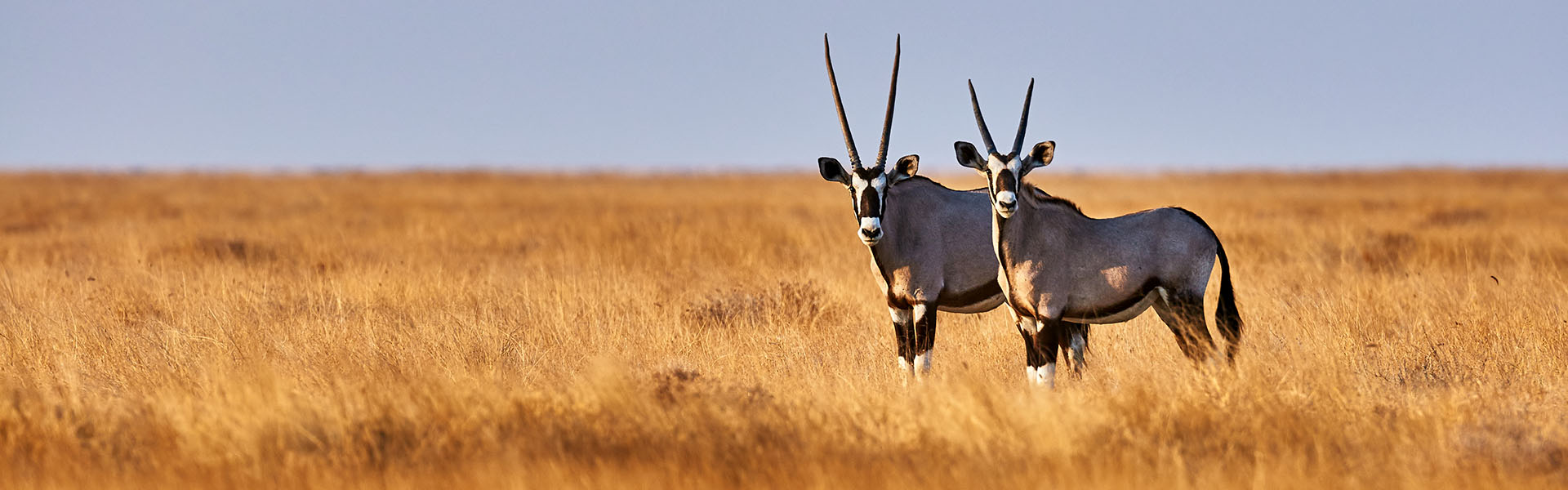
Namibia is home to several remarkable endemic species, notably desert-adapted lions thriving in arid conditions, along with rich wildlife including elephants, white and black rhinoceroses, giraffes, oryx (gemsbok), springboks, greater kudus, hippopotamuses, crocodiles, seals, and hundreds of bird species.
Read the answerWhat are the mandatory and recommended vaccines for Namibia?
No vaccines are mandatory for Namibia from France. Hepatitis A is recommended for all travelers. Depending on the length and area of stay, consider hepatitis B, rabies, and typhoid. One-third of the country presents a malaria risk requiring preventive treatment.
Read the answerWho is the president of Namibia?
Hage Geingob has been president of Namibia since 2015. He leads this southern African country within a multiparty democratic system.
Read the answerCan't find your answer?
Our local agency en Namibia answers all your questions directly. personalised questions within 24-48h. No generic form — a real expert answer.
Ask my questionWe use cookies to improve your experience and measure our site's audience. You can choose what you accept. Learn more.