Ascent of Mount Agung
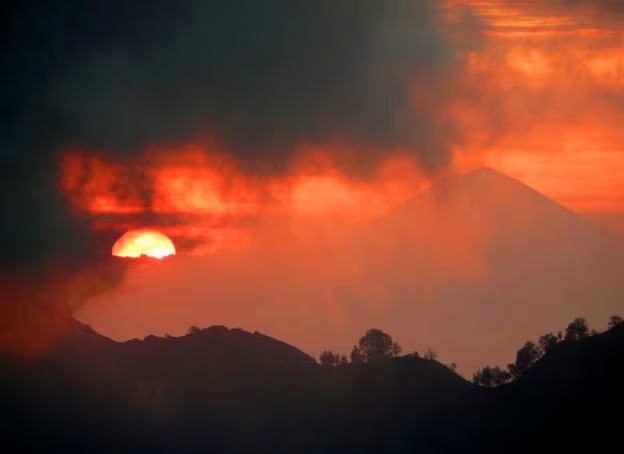
At the summit of Bali's sacred mountain, between fumaroles and Hindu sanctuaries.
Duration
1 days
From
€60/pers.
Ideal seasons
Apr, May, Jun, Jul, Aug, Sep
Style
Expeditions
Comfort
rustique
Travelers
Solo, With friends
The spirit of travel
IMPORTANT NOTE:
FROM 2017 TO 2020, MOUNT AGUNG OFFICIALLY REMAINED CLOSED DUE TO ITS HIGH VOLCANIC ACTIVITY. SINCE 2023, MANY PRESS ARTICLES SUGGEST THAT, APART FROM RELIGIOUS PROCESSIONS, ALL MOUNTAIN HIKING IN BALI IS PROHIBITED. OUR SPECIALIST GUIDES REMAIN AVAILABLE TO HELP YOU COMPLETE THE ASCENT OF THIS SACRED MOUNTAIN.
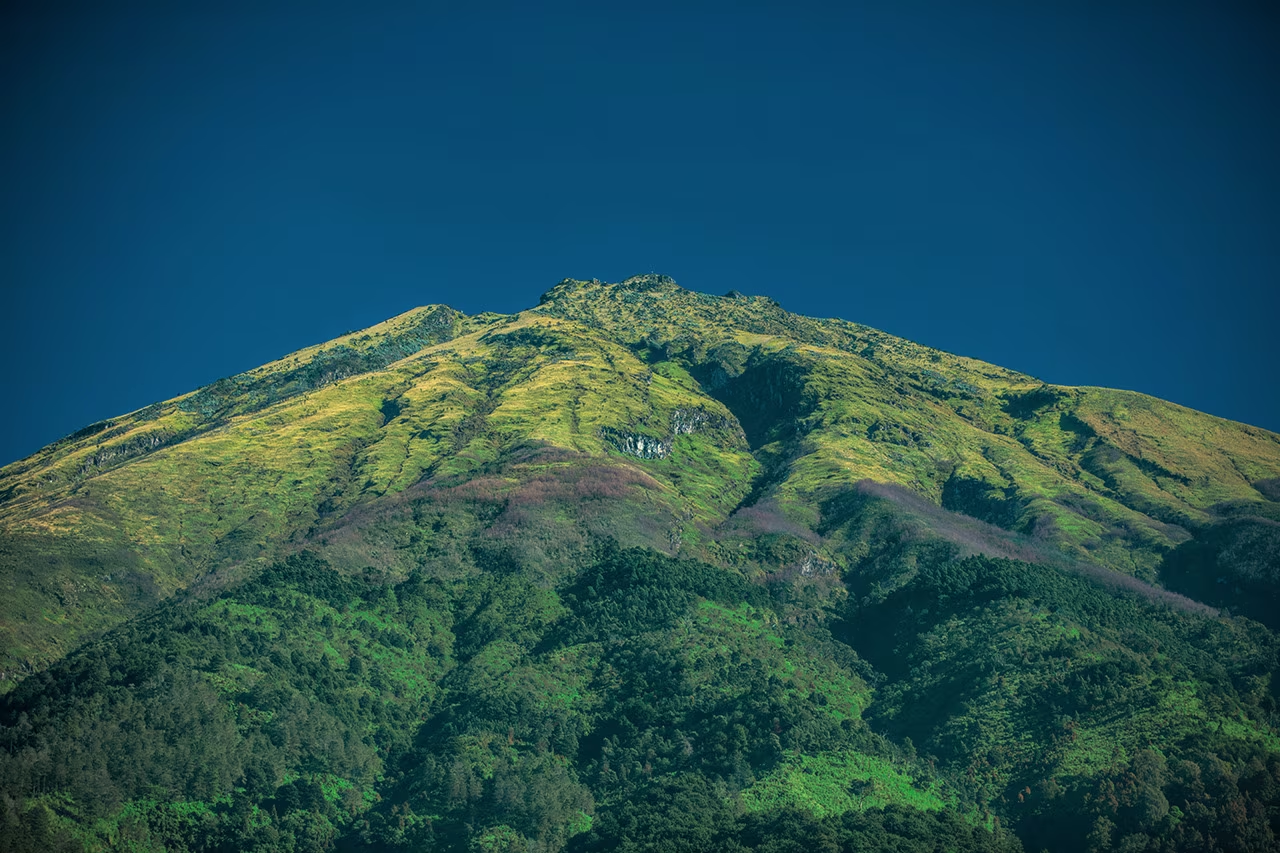
The Agung volcano is the highest point on the island of Bali and holds important spiritual significance for Balinese people. According to local folklore, when the divinities created mountains for their thrones, they placed the highest summit in the east, which is the azimuth of honor for Balinese people. In every temple, a sanctuary is dedicated to the spirit of Mt Agung. The tapered shape of cremation towers, pagodas and even temple offerings takes the form of a mountain, reflecting veneration for this sacred volcano. All aspects of Bali's geography and ecology are influenced by the imposing chain of volcanic peaks that dominates the island. They created its reliefs, periodically regenerated its soil and helped produce the torrential rains that supply the island with vital water. Balinese people recognize these geophysical facts of life, and the numerous volcanoes, lakes and springs on the island are considered sacred.
There are two main routes to reach the crater rim, departing from different locations. To reach the highest point of Mount Agung without technical climbing, you must depart from Besakih temple (1,180 m), Bali's most sacred temple. And, if you wish only to reach the sub-peak, which is located approximately 150 meters below the summit, you can begin the hike from Pasar Agung temple (1,600 m), the highest in Bali. The views from both sides are simply spectacular.
A significant increase in Agung's volcanic activity began in September 2017, shortly after hikers filmed minor fumarolic activity in the crater. Since then, an exclusion zone has extended several kilometers from the crater, meaning that no hiking has been legally permitted since then. Agung remained at the highest alert level (level 4 - AWAS) for several weeks and an eruption seemed imminent at the end of September 2017. Activity however slowly decreased and the alert level was lowered to level 3 (SIAGA - out of a total of 4 levels). At the end of November 2017, after several phreatic eruptions (water vapors, mainly), activity again increased considerably, with an actual magmatic eruption, and the alert level was raised again. Since then, the alert level has been lowered once more and the volcano now appears to be calm.
Highlights
Day-by-day itinerary
Climbing Mount Agung
Ascent from Besakih Temple
Recommended for experienced hikers
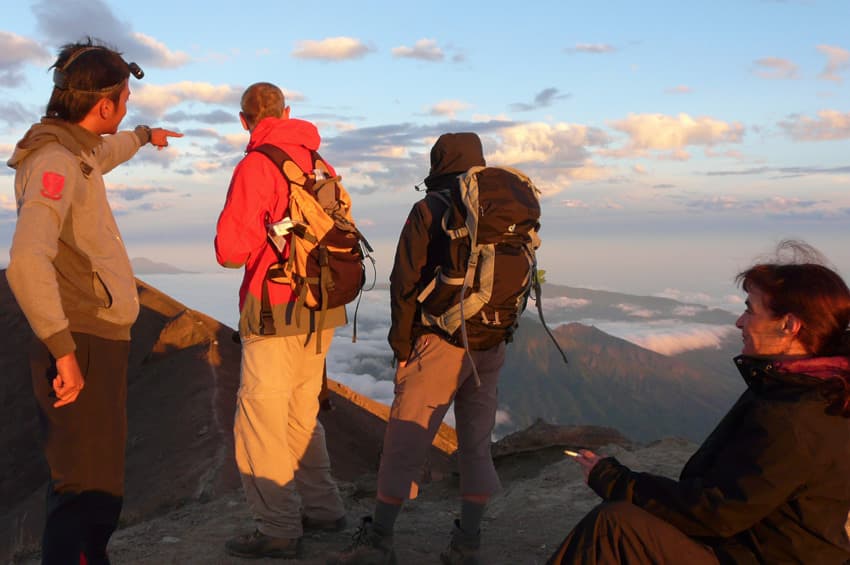
It takes approximately 6 hours to reach the summit of Agung from Besakih Temple, and many hikers climb the volcano at night to reach the summit for sunrise. Pura Besakih is actually a vast temple complex that extends across the mountainside. For most visitors, the first impression is one of hundreds of imposing meru, whose multi-tiered roofs made of black palm fiber thatch point toward the sky. Their structural core is a square tunnel cleared through which divinities, ancestors and spirits can descend during festive occasions to take their place in the sanctuaries at their base. Besakih is in a sense a landing place for the gods.
The central temple of the complex, Pura Penataran Agung, is dedicated to the god Shiva. Pura Batu Madeg (temple of the standing stone), which is approached from the rear of Pura Agung and from the left (north-west), is dedicated to Vishnu. Pura Kiduling Kreteg (temple of the South Bridge), located on a bridge and crossing a ravine to the right (south-east), is dedicated to Brahma. Nineteen other temples extend across the slopes of the volcano, each with its own function and its own ceremonial season, but the three temples dedicated to the Hindu trinity are the most important. Almost every day, groups of villagers come to pray and collect holy water which they take home for ceremonies at local temples, or to pay their respects following the complex rituals of the cycle. Each temple in the complex has its own annual ceremony and, approximately every ten years, the impressive Panca Wali Krama, a purification for all of Bali, attracts almost all the island's inhabitants to refresh their bonds with the gods.
If you wish to reach the summit a little before sunrise, plan for six hours of walking, including approximately 45 minutes of rest, which means you will start your adventure - extremely exhausting but memorable - around midnight. The first 45 minutes take you to the mother temple (927 m), then along vegetable plantations following a genuine trek used by the faithful to reach the last temple (Pura Bangpuhan, at 1,180 m) belonging to the Besakih temple complex. Once you pass this temple, you cross the parking lot, then the path descends slightly before climbing again past two recently cleared fields. This ascent lasts a good twenty minutes and ends at the entrance to the forest (1,316 meters), where things get serious.
For the next three or four hours, a good torch or, better yet, a high-quality headlamp is absolutely essential, as the dense forest prevents moonlight from reaching the trail. The first hour and a half is steep but comfortable and often interrupted by flatter passages on the ridges. This first third of the climb ends at a point called "super root", (1,723 meters) a very steep section through massive roots offering good grip.
The next two hours are very hard, steep and often very slippery. This is where you begin to understand why the Agung volcano is undoubtedly one of the most difficult volcanoes to climb in Indonesia, because the trail leads directly to the summit and does not wind along a slope as it does on most mountains in Europe. At an altitude of 2,200 meters, the forest becomes progressively less dense and the trail begins to become more rocky and often covered with loose gravel, which is an additional challenge. After four hours of slow and arduous climbing, you reach your base camp (2,622 meters). This is an area that offers very little space for two tents and is often used by local hikers as a rest point before heading to the summit for sunrise.
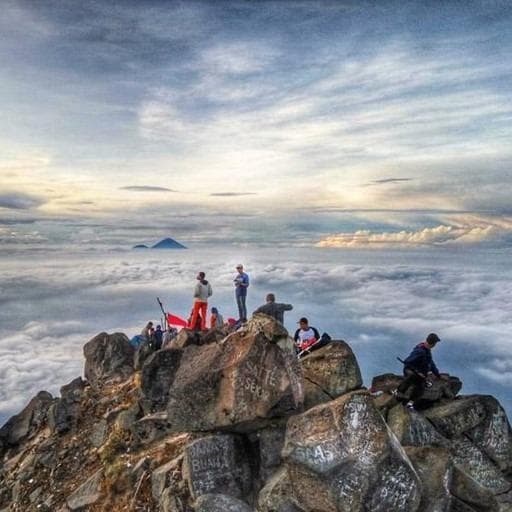
The next section, measuring 300 meters, climbs just over 100 meters in altitude and is the only part of the entire hike where the utmost care should be taken. This is the only place where you can fall off a cliff and suffer serious injury. The last hour of the ascent continues to be very steep and frustratingly slow. You reach the last cone of the volcano which is very rocky in its lower part. The last 100 meters before the first summit are no longer very steep but offer a stunning view of Agung's highest point which lies about 350 meters to the east. Once again, at this location, great care must be taken with the trade winds which can blow in gusts up to 100 km/h. There are several fissures in the ground that offer protection from these cold and icy winds. This first western summit is actually only roughly 10 meters lower than the highest point and is listed on the map as standing at 3,028 meters altitude.
The last 15 to 20 minutes along the ridge to the true summit are a genuine challenge.
Ascent from Pasar Agung Temple (to the subsidiary summit or the summit)
Recommended for experienced hikers
The ascent of Agung from Pasar Agung Temple is generally considered the easiest option to reach the subsidiary summit but not the summit. However, it is possible to reach the summit from Pasar Agung, as, halfway along the route leading to the subsidiary summit there is a junction that branches to the west towards the true summit. This route is only recommended for confident climbers.
Your guide welcomes you at the Pasar Agung Temple parking lot (1,600 m). The hike begins from the parking lot with the ascent of 297 steps to the temple. At the temple gates, the guide makes an offering to the gods to ask their forgiveness and protection for a safe ascent and descent. It is indeed customary for hikers, at this stage, to show respect by lighting a few incense sticks and placing them on one of the sanctuaries, while uttering a short prayer as a sign of respect for the Balinese people and culture.
The trail first circles the temple on the left, passing two water reservoirs from where you have a nice view of the temple. It then crosses a small opening in the woods and immediately enters a very dense and steep tropical forest. The trail climbs abruptly, narrows, surrounded by deep ravines and littered with countless roots of magnificent large trees, which must often be straddled with hands and feet. If you leave around midnight for a summit sunrise, a good torch is absolutely essential to light the trail. A headlamp is more practical as it keeps your hands free.
After about an hour, the forest gradually clears and becomes less dense. Eventually, the trail passes a small concrete dam that channels rainwater from the upper mountainous region into PVC pipes to the reservoirs located just above Pasar Agung Temple. This dam normally marks the first third of the path. Here, the path flattens out for a few meters and offers beautiful views for the return journey.
After a short flatter passage across a small ridge, the path inclines again quite steeply, but this time over the first rocky surfaces. Here, the forest is no longer as dense and each meter of altitude gained offers increasingly beautiful views of Bali below. This section can sometimes be slippery, especially after recent rains. There are several short, steep drops that require your hands for safety, but there is no need to worry. The next section will take approximately one hour of continuous, steep walking, which will end once vegetation has given way to pure volcanic rock surface.
At this point (2,425 m), many choose to continue to the subsidiary summit, which is easier to reach. The last third of the trail leading to it is very steep, rocky, sometimes very slow and often slippery, but it is only a small price to pay for the spectacular landscape that opens up before you in all directions. Two-thirds of Bali, including the coast, as well as the neighboring islands of Lombok, Nusa Lemongan, Nusa Penida and Nusa Dua, lie below you. Then, to the west, all of Bali's mountain ranges, including the imposing volcanoes of eastern Java in the misty distance. Finally, before you, a jagged summit, that of the Agung volcano on the left, separated by a deep volcanic ravine impossible to cross.
The last third of the ascent requires between 1 hour and 1 hour 30 minutes of hard work and focused high-altitude climbing. The last 75 meters are less steep and the path suddenly becomes easier, to your great relief. The view from the subsidiary summit (2,866 m) is simply breathtaking. The volcanic landscape is at its best. Your guide takes the opportunity to make offerings and prayers to the Gods. He thanks them in particular for having protected his group during this ascent, as well as for the joy felt in reaching the crater ridge.
The descent, long and difficult, requires almost as much time as the ascent.
Summit ascent (from Besakih)
Walking time Between 12 and 14 hours return trip
Elevation gain/loss + / - 1,850 m
Summit ascent (from Pasar Agung)
Walking time Between 10 and 12 hours return trip
Elevation gain/loss + / - 1,430 m
Ascent to the subsidiary summit (from Pasar Agung)
Walking time Between 7 and 9 hours return trip
Elevation gain/loss + / - 1,265 m
Price per person
This trip can be tailored to your preferences
This itinerary provides an excellent foundation for discovery, but it can be fully customized. Our local advisors build each trip tailored to your budget, dates and preferences.
Not included
- Transport* to/from the Besakih or Pasar Agung temples
- Insurance & Assistance
- Beverages, personal expenses & tips
- Everything not mentioned in "Inclusions"
Included
- English-speaking guide
- Breakfast
- Climbing permit & donations
- Walking stick & headlamp
Practical Information
Registration is considered firm and final after payment of a deposit of 40% of the total price and acceptance of the specific terms of sale.
The balance must be paid no later than 45 days before the departure date.
See our specific terms of sale for full details.
In the event of cancellation by the traveller, the following fees apply:
- More than 60 days before departure: 40% of the total price (deposit retained)
- Between 60 and 30 days before departure: 50% of the total price
- Less than 30 days before departure: 100% of the total price
We strongly recommend taking out cancellation insurance. See our specific terms of sale for full details.
Les informations ci-dessous concernent les voyageurs ressortissants de l'Espace économique européen (EEE), de la Suisse et du Canada se rendant en Indonésie dans le cadre d'un séjour touristique. Les règles d'entrée pouvant évoluer, nous vous recommandons de vérifier les informations auprès des autorités officielles avant votre départ.
Passeport
Pour entrer en Indonésie, votre passeport doit être valide au minimum six mois après la date d'entrée dans le pays et comporter au moins deux pages vierges pour les tampons d'immigration.
Le document doit être en bon état (pas de pages détériorées, déchirées ou modifiées).
Visa : e-VOA obligatoire
Les ressortissants de l'Espace économique européen, de la Suisse et du Canada ne bénéficient pas d'une exemption de visa : un visa touristique payant est obligatoire. Nous vous conseillons de le demander en ligne avant le départ (e-VOA) sur le seul portail officiel evisa.imigrasi.go.id ; il peut aussi s'acheter à l'arrivée (Visa on Arrival).
À ce jour, il coûte 500 000 IDR (environ 25 €) et permet un séjour de 30 jours, prolongeable une fois de 30 jours sur place (60 jours au maximum). Il doit être utilisé dans les 90 jours suivant son émission. Une hausse du tarif a été annoncée sans date d'entrée en vigueur : vérifiez le montant avant votre départ.
Les autorités peuvent également demander :
un billet de sortie du territoire (vol retour ou continuation),
une preuve de ressources financières suffisantes pour la durée du séjour.
Formalités à l'arrivée
Avant votre arrivée, remplissez la carte d'arrivée All Indonesia, obligatoire pour toute arrivée internationale : elle remplace la carte papier, la déclaration de douane (ancienne e-CD) et la déclaration de santé. Elle est gratuite et se remplit jusqu'à 3 jours avant l'arrivée sur le portail officiel allindonesia.imigrasi.go.id (méfiez-vous des sites payants).
Ce formulaire permet de transmettre aux autorités certaines informations nécessaires à l'entrée sur le territoire :
informations du passeport
détails du vol et itinéraire
adresse du premier hébergement en Indonésie
déclaration des biens et devises transportés
Un QR code de confirmation pourra être demandé lors du passage aux contrôles douaniers et à l'immigration.
Santé et vaccinations
Aucun vaccin n'est obligatoire pour entrer en Indonésie depuis l'EEE, la Suisse ou le Canada, sauf en cas de transit par un pays à risque de fièvre jaune, auquel cas un certificat de vaccination international peut être exigé.
À titre préventif, il est toutefois recommandé de consulter un médecin ou un centre de vaccination avant le départ. Les vaccinations contre l'hépatite A, l'hépatite B, la typhoïde et la rage sont couramment conseillées pour les séjours en Indonésie. Un traitement antipaludéen peut également être recommandé selon les régions visitées (notamment en dehors de Bali et des grandes villes).
Voyage avec des enfants
Les mineurs doivent être titulaires de leur propre passeport valide couvrant la durée du séjour.
Dans certains pays européens, lorsqu'un mineur voyage sans l'un de ses parents, une autorisation de sortie du territoire peut être exigée selon la réglementation du pays de résidence.
Autres nationalités
Les conditions d'entrée peuvent varier selon la nationalité. Les voyageurs concernés doivent se renseigner auprès de l'ambassade ou du consulat d'Indonésie de leur pays de résidence.
To participate in our trips, it is strongly recommended to be insured for repatriation assistance and medical expenses abroad.
Your local agency encourages you to familiarize yourself with the specific contract developed with our partner CHAPKA ASSURANCES and AXA ASSISTANCE.
To subscribe to insurance, find out about coverage and rates, follow the link below.
CAP EXPLORER: The complete insurance solution designed for a worry-free trip!
Choose the plan that suits you best:
Explorer'Multirisque
Explorer'Annulation
Explorer'Assistance
Specific to our trips, we strongly recommend subscribing to them.
If you choose to subscribe to one of these plans, the agreement detailing all coverage and the procedures for filing a claim are available on the insurer's website.
Your local agency will be aware of it, but only the participant is responsible for complying with the procedures for reporting any claim. The participant must therefore keep this agreement with them for the entire duration of their trip.
Chapka — Cap Explorer
Our insurance partnerTravel with peace of mind with our partner Chapka. Cancellation, repatriation, medical expenses, baggage… All the coverage for a worry-free trip.
Travel with peace of mind — I'll handle the insuranceFrequently asked questions
Yes. French, Belgian, Swiss and Canadian nationals are not visa-exempt: a paid tourist visa is mandatory. We recommend applying for the e-VOA online before departure on the only official portal, evisa.imigrasi.go.id: currently IDR 500,000 (about €25), for a 30-day stay that can be extended once by 30 days on site; it can also be bought on arrival (Visa on Arrival). Before travelling, also complete the free and mandatory All Indonesia arrival card on allindonesia.imigrasi.go.id (up to 3 days before arrival). Your passport must be valid for at least 6 months after your date of entry. A fee increase has been announced without a date: check the amount before you leave.
Go to the My Trips section to find all your projects.
You can send a message to your host directly from the Tea Lounge.
For a quality tailored trip, plan between 140 and 230 euros per day and per person, including accommodation, meals, internal transport and activities. International flights (700-1100 euros return) are additional. The archipelago allows you to combine beaches, volcanoes, jungle and culture at attractive rates.
Your documents are accessible in the Documents tab of your trip.
Absolutely. We tailor each circuit to the travelers' profile. For families, we prioritize relaxed paces, family-friendly accommodations, fun and educational activities, and comfortable private transfers. Our local English-speaking guides know how to capture children's attention with age-appropriate stories.
It's simple. You exchange with our local team to define your wishes, budget and dates. You receive a detailed itinerary proposal within 48 hours. You adjust every detail together until you get the perfect version. You confirm and travel with peace of mind. Your local agency remains available 7 days a week throughout your trip.
In case of emergency, contact your local agency immediately.
Payment is generally made in two installments.
Our agency is part of the Nomadays network, registered in France. You benefit from APST (Association Professionnelle de Solidarité du Tourisme) guarantee which covers 100% of your funds. Secure payment, professional insurance, and English-speaking assistance 7 days a week on the ground throughout your stay. Travel insurance (assistance and repatriation, cancellation) is not included: we offer it through our insurance partner and strongly recommend it.

Let's talk about your adventure — Bali
Photographer of Indonesian volcanoes and trails, based in Yogyakarta
Before drawing up an itinerary, you have to observe, walk, listen to the locals and understand the place. Only then can an adventure trip remain authentic.
— Dominic