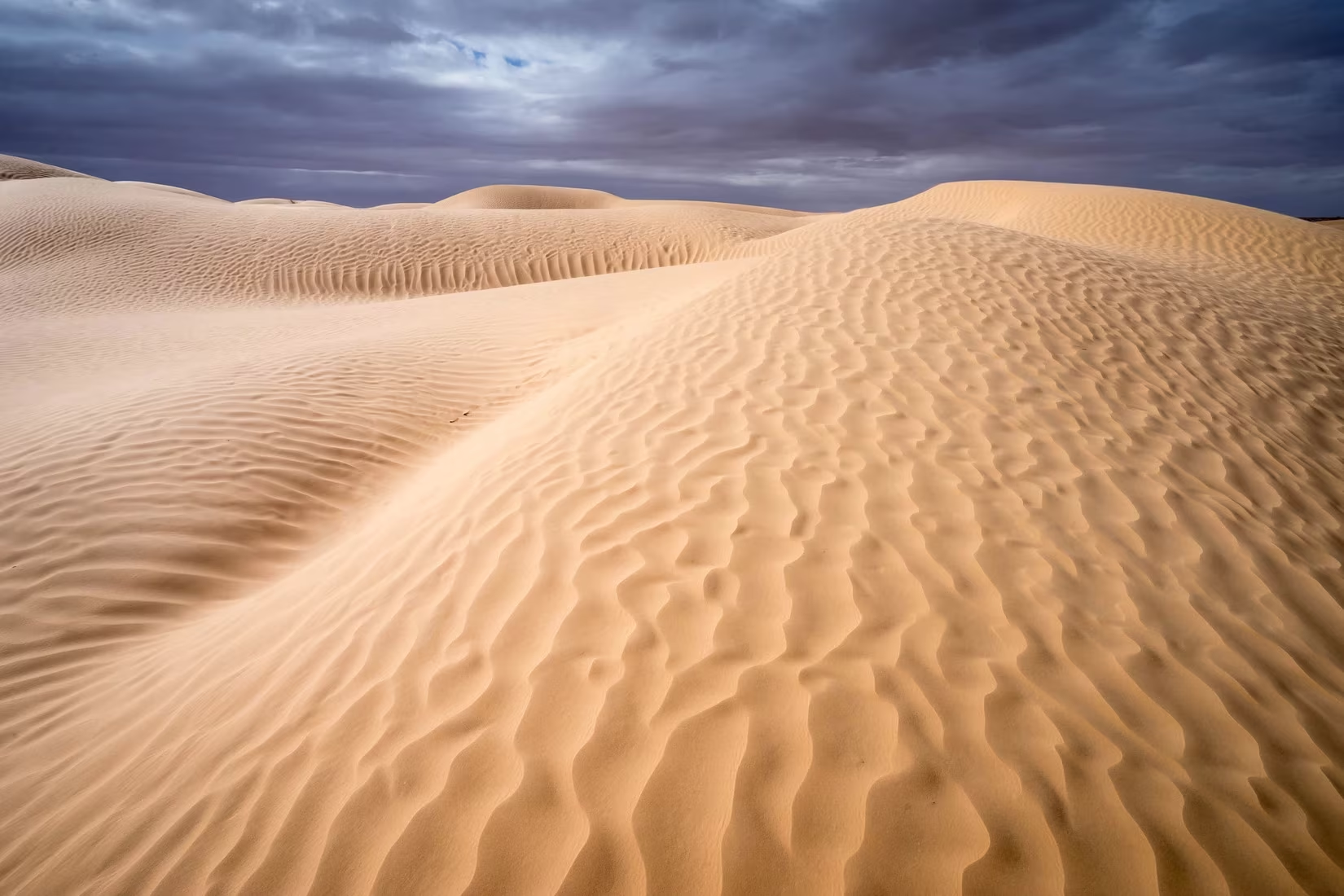
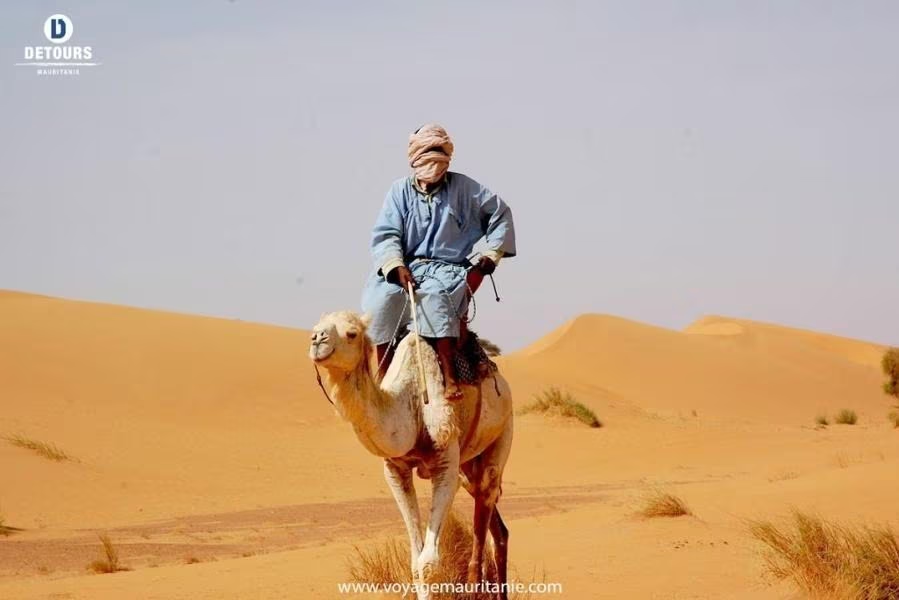
Camel trekking in the saddle in the dunes of Erg Warane and Chinguetti, variations in the sands
Ride the dunes of Erg Warane to the holy city of Chinguetti
Duration
8 days
Ideal seasons
Jan, Feb, Mar, Nov, Dec
Style
Expeditions
Comfort
rustique
Travelers
Solo, Couple, With friends
The spirit of travel
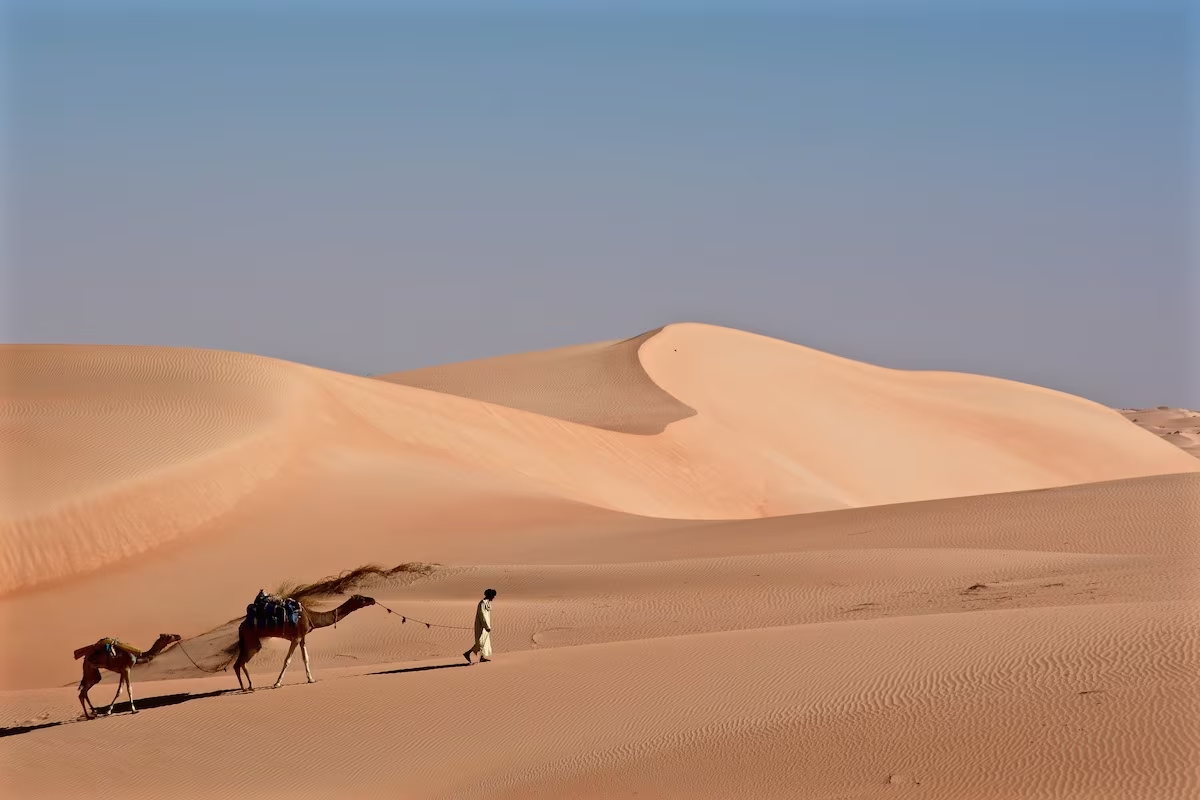
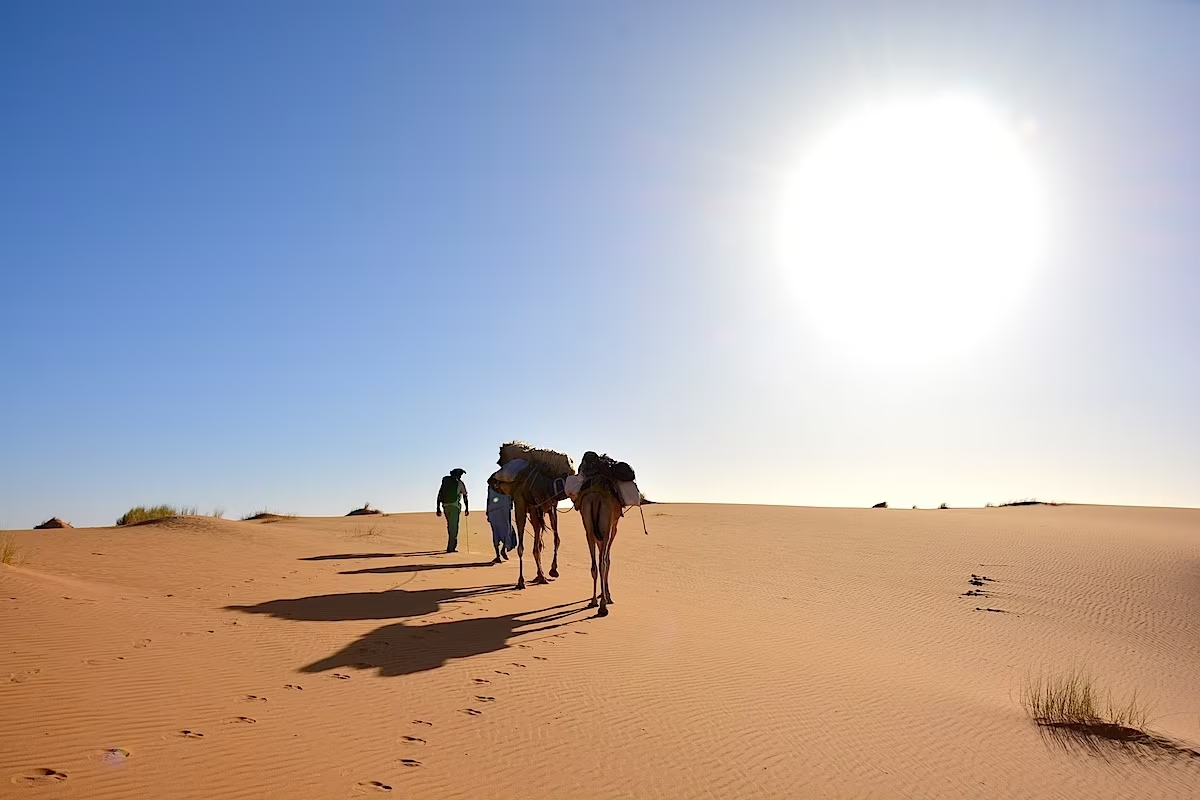
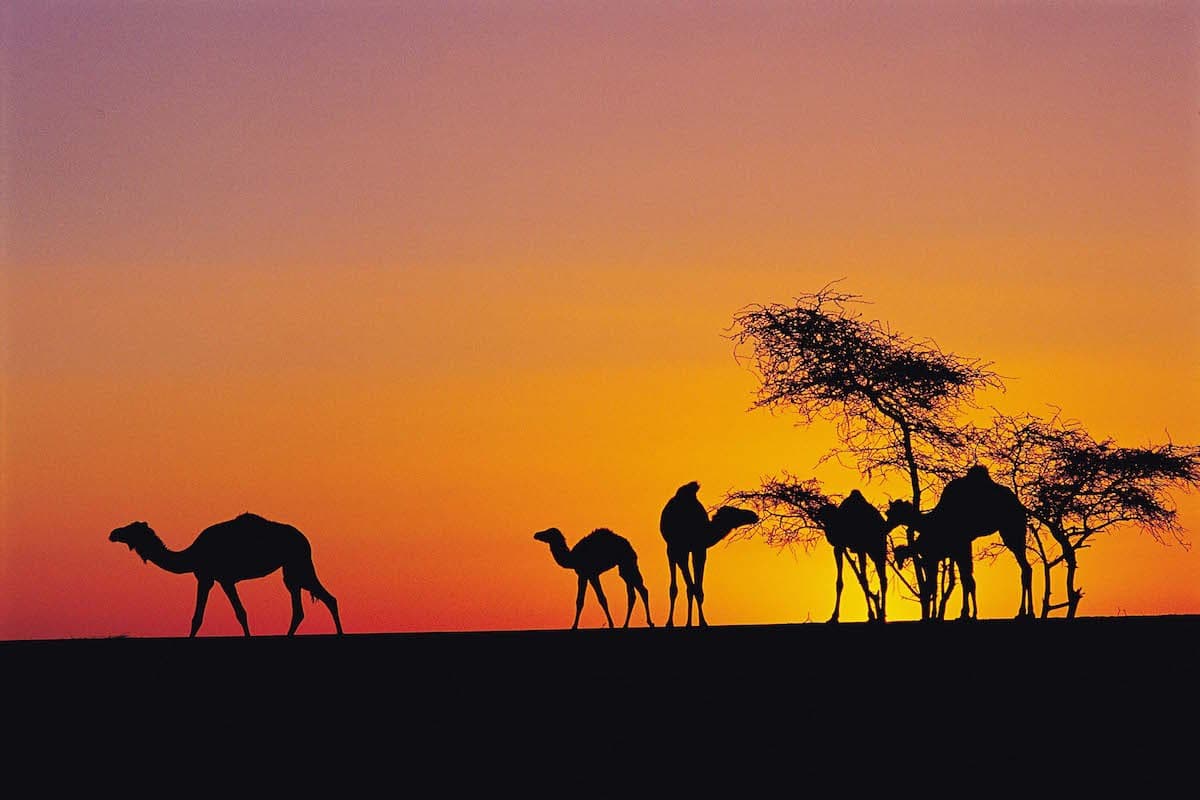
This camel trek in the Adrâr of Mauritanie allows you to alternate between riding a saddle camel and walking on foot. Whether it's an introductory trek or a long-distance journey, it is customary to walk at the beginning of the day so that the animal warms up.
In the east of the Adrâr, the terrain is perfectly suited for camel trekking. Landscape diversity, encounters, and history are all part of the experience.
The term camel trek is used to describe the act of traveling by camel, on a saddle designed for that purpose. The "rider" is then called a camel trekker.
The composition of the caravan, the relationship with the camel herders making up the team, the bond that forms with "your" animal, the joyful expressions of nomads encountered on the trail—all of these make this way of traveling a bundle of unique and rare experiences. The cohesion and complicity between the caravaniers and the animals also make this mode of travel an extraordinary human adventure.
The stages of your journey
Highlights
Day-by-day itinerary
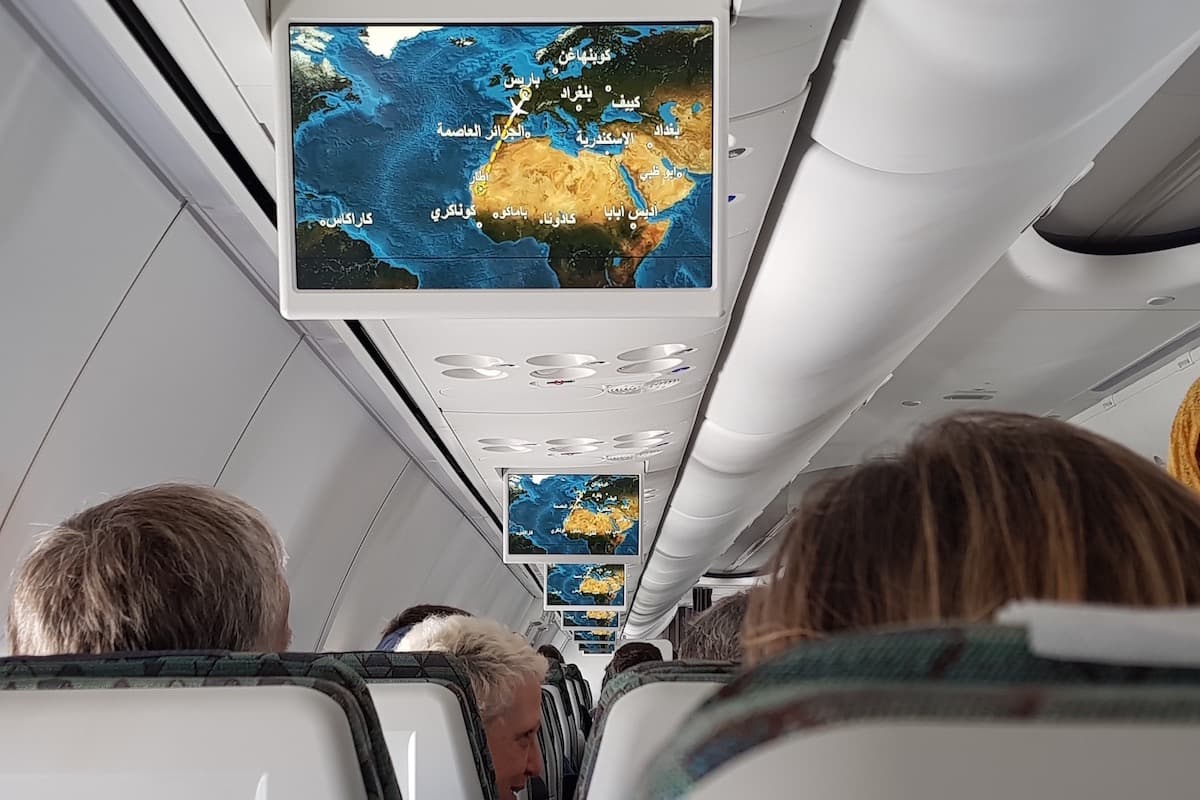
Flight departing from Paris to Atar, capital of the Adrar in Mauritania
Departure from Paris (chartered flight). Takeoff is scheduled for early afternoon with arrival in Atar in the evening. Times are given as indicative and may be changed by the airline.
After formalities and obtaining your Mauritanian E-Visa, your guide will meet you in the airport terminal.
In Atar, dinner is planned at a comfortable and pleasant inn depending on the flight schedule.
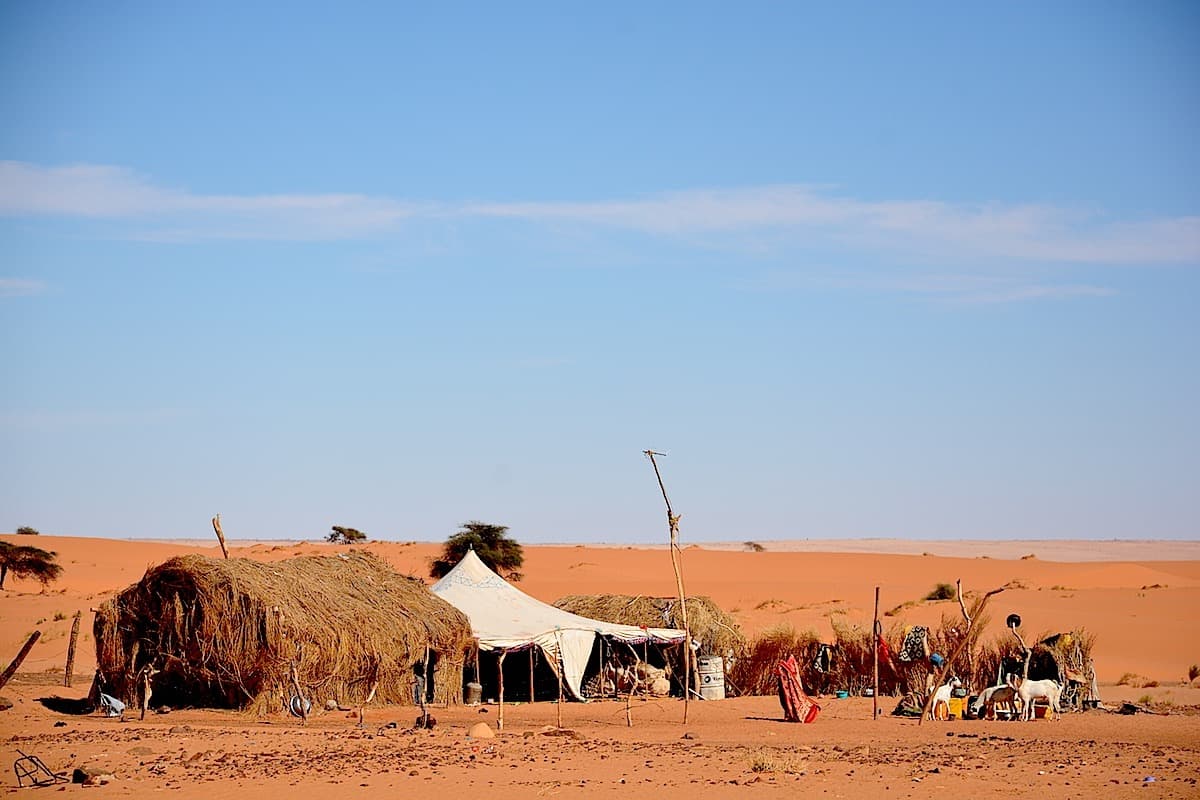
On the trail to the Adrar plateau, then on foot in the sands
After lunch, immediate departure to El Kheouiya camp.
The track to climb onto the plateau (dhar) is, to date, good but it can be degraded by rains that occur in late summer.
A small detour allows you to discover the grandiose landscapes of the Adrâr cliffs. The ruins of Fort Saganne, rock paintings, the chain of plateaus on the horizon are so many attractions …
The last third takes place along the northern edge of the sandy area.
Late morning, we reach El Kheouiya.
It is the meeting place with our Moorish travel companions with whom we share these few days. They belong to this small semi-nomadic camp.
On foot, we head towards the sunset. Multiple tents, khaïma, are laid out on the sands. Nomads particularly appreciate this region because the pastures are always more abundant than elsewhere.
We approach long dunes that develop in the direction of the prevailing wind.
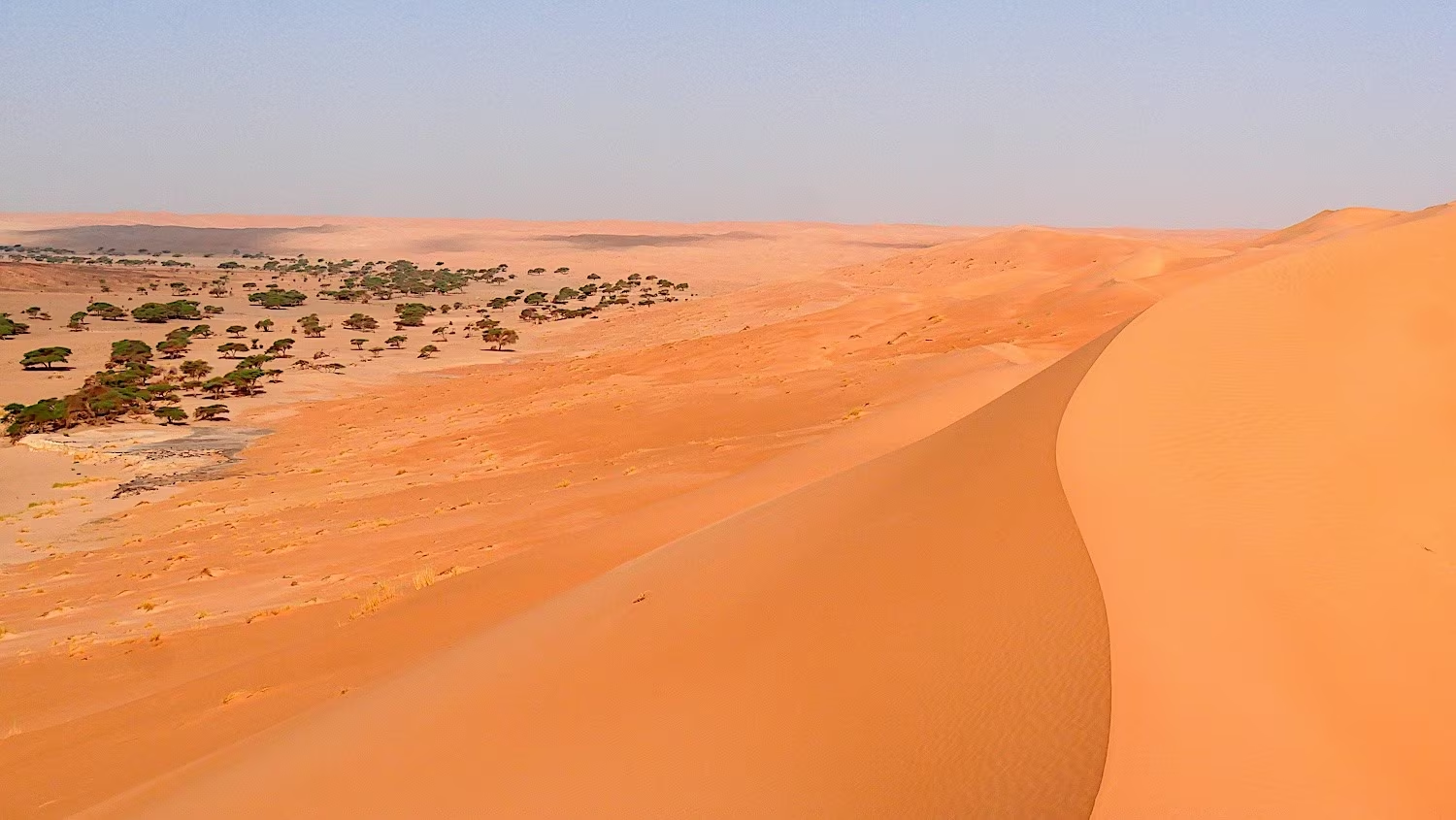
To the south, the wadi El Kheouiya is very wooded. This small Saharan forest is protected from deforestation by the fierce determination of the tribes occupying these lands.
The great dunes of Afam el Mezrougat and the Chinguetti wadi
On foot, we make our way through the dune massif of Afam el Mezrougat. The two elb making up this massif allow us to reach the Chinguetti batha. The currently dried-up river is heavily wooded and, depending on seasonal rainfall, large cultivation areas can occupy its bed. We reach the great dunes of the Warane erg on the right bank of the wadi. The bivouac is established not far from the first palm groves that mark the beginning of the inhabited zone of the Chinguetti wadi.
On foot in the Aklés of the Warane erg and Chinguetti
On foot, we make our way through the dune massif of Afam el Mezrougat. The two elb that make up this massif allow us to reach the Chinguetti basin. The river, currently dried up, is very tree-lined and, depending on the season's rainfall, large areas of crops can occupy its bed. We reach the great dunes of the Warane erg on the right bank of the wadi. The bivouac is established near the first palm groves that mark the beginning of the inhabited area of the Chinguetti wadi.
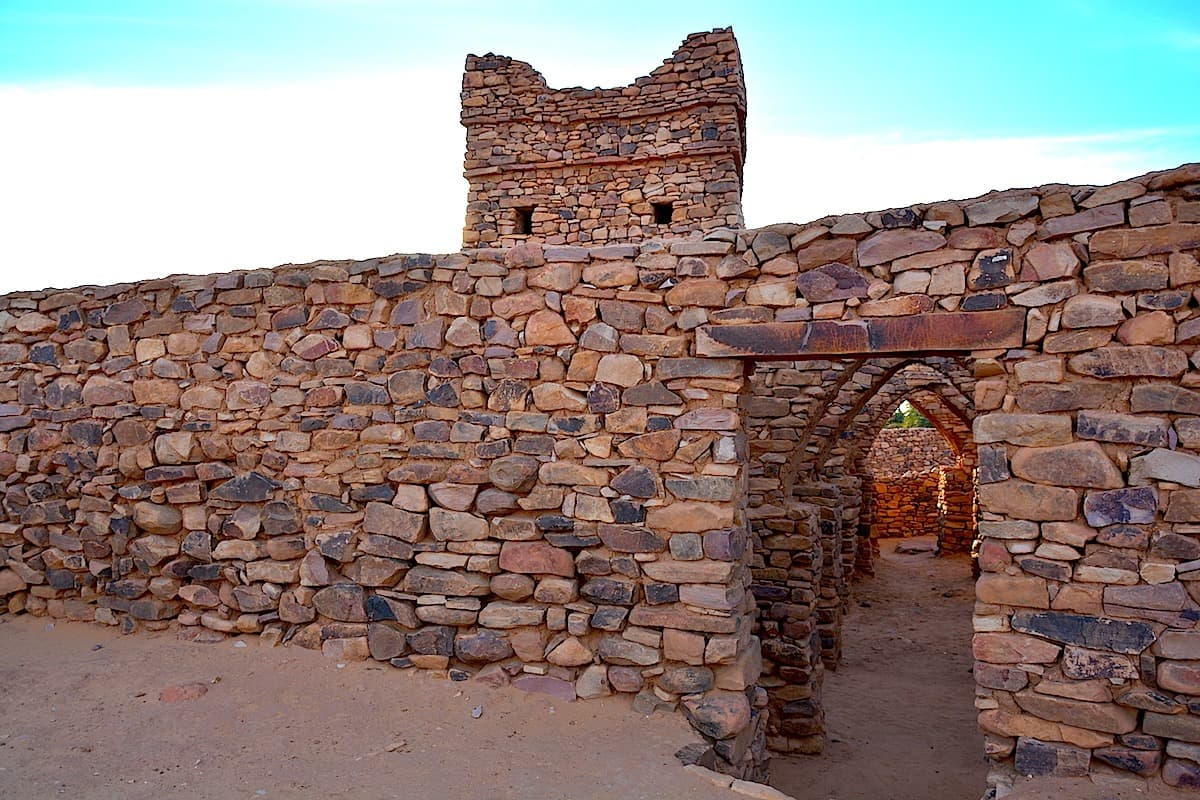
The akley of the northern edge of the Warane erg allow us to reach the ancient city of Chinguetti. We arrive in the city in the middle of the day.
The ancient city of Chinguetti
Chinguetti was founded by the Ida Ouali around 1525, upstream from Abweyr, now disappeared, which itself was created in 1261.
The probable etymology of the toponym shingitî would be:
well of the horse, from Soninké: si: well + n: of + gede: horse.
Chinguetti was the most active commercial center and the most important city in the western Sahara. It was considered by Mauritanians as the 7th holy city of Islam with its 11 mosques, its 100 wells and its circle of scholars.
In 1675, a massacre perpetrated by part of the Ida-ou-Ali led to the split of the group whose survivors founded another ksar in the Tagant, Tidjikja.
Today only a single mosque and the memory of prosperous periods remain…
The main tribes that make up its population are the Ida-ou-Ali, the Laghlal and the Oulad Gheilan.
With their narrow and winding streets, their numerous dead ends, their low and dark houses based on local materials, their almost complete absence of squares and communal spaces, Chinguetti and Wadâne have the structure of old ksour densely huddled around their mosques.
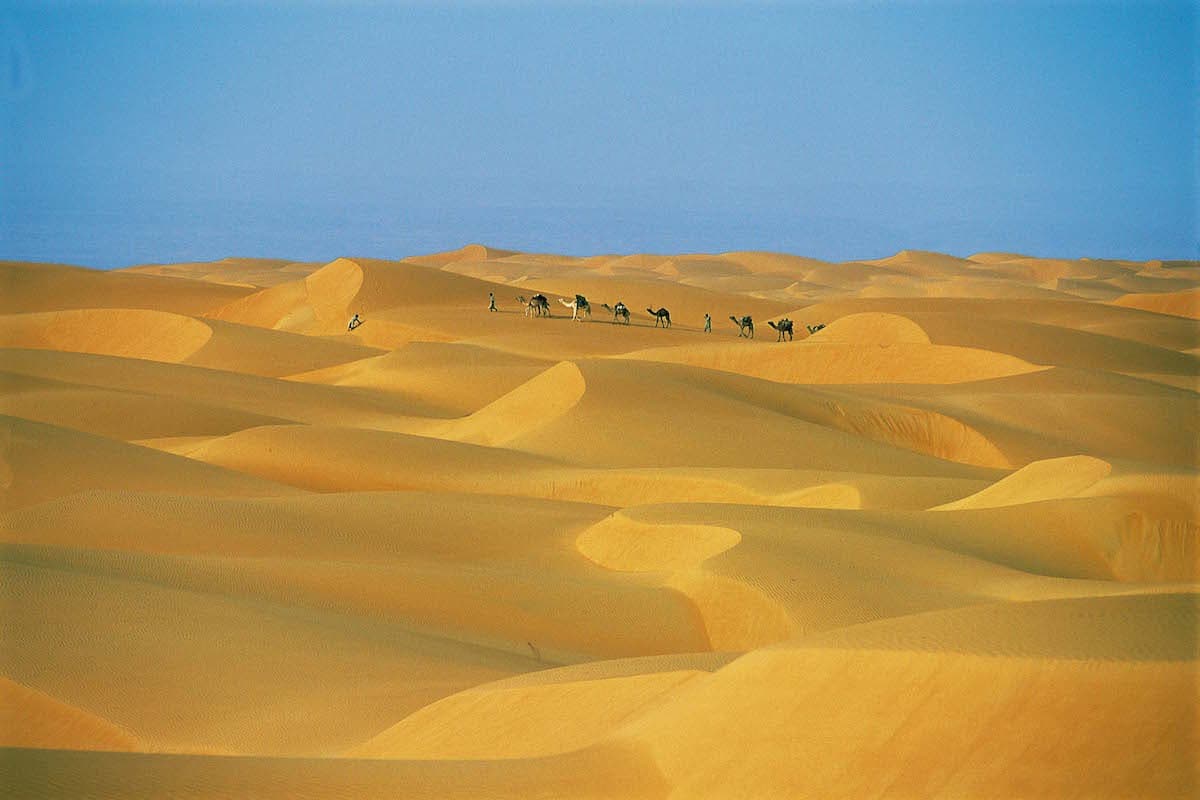
In the Heart of the M'Ghalig of the Warane
Heading toward the southwest, we face a long and beautiful series of sand mountains. These large massifs (M'ghalig), all parallel, overlook interdune valleys that have remained the traditional routes for trade caravans between north and south. It is in these zones that the rare wells are found.
The midday stop is established at La Gueïla, a small palm grove that belongs to the notables of Chinguetti.
Then, heading due west, we continue our journey through the dunes.
Vegetation specific to the great ergs develops such as Acacia raddiana, Balanites aegyptiaca and Aristida pungens.
We set up camp on one of the mighty sand massifs.
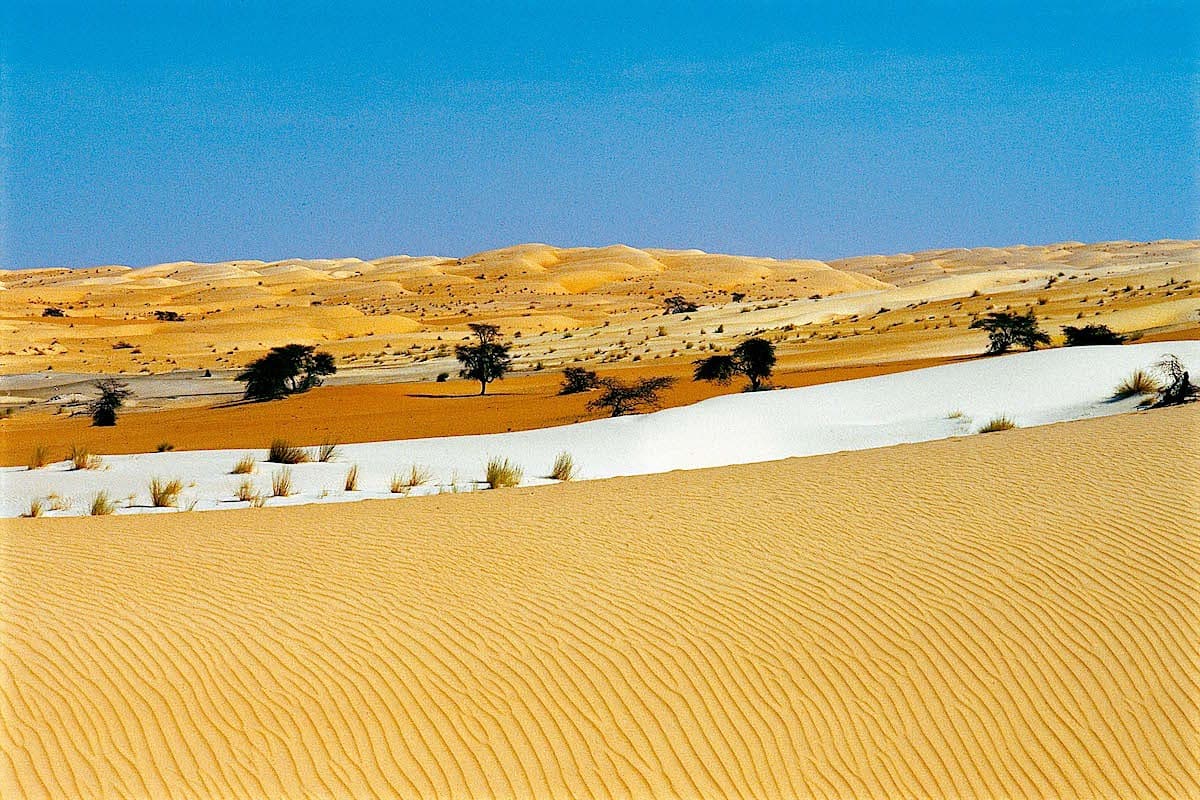
From the end of the Warane to the Tassilienne sandstone of Zerga
M'Ghalig Warane → Tinouarderit
The massifs are always imposing and, facing us, the black ridges of the mega-cordillera of Zarga begin to emerge. Tinouarderit, a small wooded wadi, marks the western part of the erg. A very shaded teïchot (Balanites aegyptiaca) welcomes us for the break.
By going up the wadi bed, we access a small area of barchan dunes. Here, the Erg Warane ends its course heading west. Under the name of Erg Amatlich, it reappears on the western edge of the Adrar, continuing its momentum toward the Atlantic.
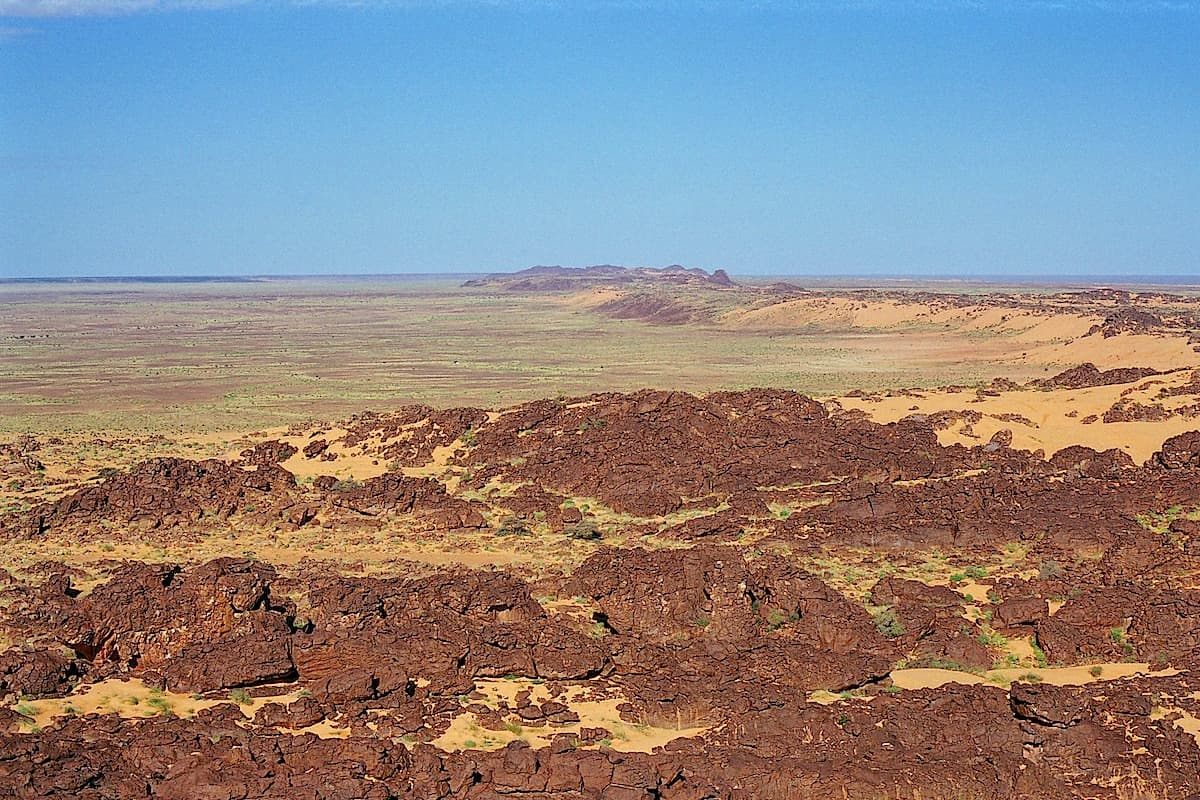
On foot in the mega-cordon of Zarga
We return to the small sandstone massif of Zarga.
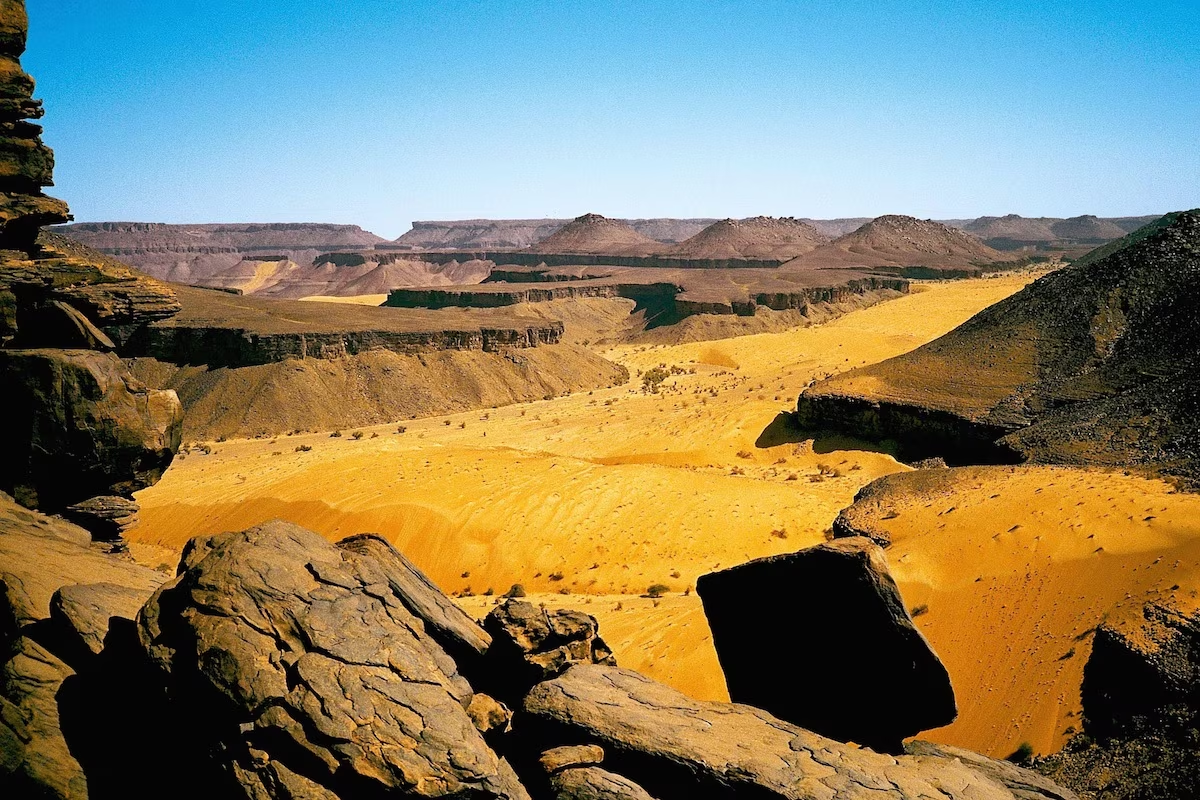
Eighty kilometers long, the Zarga ridge is the now-protruding fossil bed of an ancient glacial river.
The corridor sandstones form in places a maze of streets and rock shelters where paintings, fauna and fairly rich flora hide.
The Zarga ridge is interesting for several reasons. Its northern point and its average altitude make it an effective climatic barrier.
Atlantic disturbances and the African monsoon (F.I.T.) are blocked in their progression toward the interior of the Adrar plateau. Rainfall is significant compared to the rest of the region, and Saharan vegetation has, in places, either Mediterranean or Sudanese characteristics.
We find there among others Boscia senegalensis, Euphorbia balsamifera, Combretum aculeatum as well as some fragrant Lavandula.
Staying on the east side of the Zarga massif, we reach the Niesle well and then, via the eastern foothills, we arrive at Tichilit el Âteg.
The highest point of the Zarga massif and the third peak of the Adrar conceals a superb sand dune overlay. At its foot, a wide alluvial basin shelters crops and nomads.
We take time to savor these magnificent places that mark the grand finale of this journey between dunes and rocks.
In the afternoon, we return to Atar by a rough track.
The city of Atar founded in the 17th century in the borderland plain (bâten) that stretches north of the great cliff, is preserved from sand by its geographical location.
It is the most important city in the Saharan zone. It was formerly an emirate city, a garrison city for the Americans then the French and finally a regional capital.
Departure from Atar towards Paris
The chartered flight departing from Atar is scheduled for early morning with an arrival in Paris in the mid-afternoon.
Price per person
This trip can be tailored to your preferences
This itinerary provides an excellent foundation for discovery, but it can be fully customized. Our local advisors build each trip tailored to your budget, dates and preferences.
Not included
- International Flight from Paris - Atar - Paris
- Visa fees upon entry to Mauritanian territory (55 euros)
- Personal expenses, beverages
- Tips at your discretion
- Insurance and Repatriation
Included
- Welcome and assistance at Atar Airport
- English-speaking local guide, experienced and trained for our trips
- Transfer then 4x4 vehicle transport on D1, D7, D8
- Camel team for assistance during trekking
- Total management of drivers and a cook
- All camping equipment, kitchen and supply materials
- Full board throughout your trip in Mauritania
- Comfortable inn at Atar and Chinguetti with full board
- Entrances to houses with manuscripts in Chinguetti
Practical Information
Registration is considered firm and final after payment of a deposit of 30% of the total price and acceptance of the specific terms of sale.
The balance must be paid no later than 45 days before the departure date.
See our specific terms of sale for full details.
In the event of cancellation by the traveller, the following fees apply:
- More than 60 days before departure: 40% of total price (deposit retained)
- Between 60 and 30 days before departure: 50% of total price
- Less than 30 days before departure: 100% of total price
We strongly recommend taking out cancellation insurance. See our specific terms of sale for full details.
The information below concerns travelers who are nationals of the European Economic Area (EEA), Switzerland, and Canada traveling to Mauritania for a tourist stay. As entry rules may change, we recommend verifying this information with the official authorities before your departure.
Passport
To enter Mauritania, your passport must be valid for a minimum of six months after the date of entry into the country and must have at least one blank page for immigration stamps.
The document must be in good condition (no damaged, torn, or altered pages).
Visa
Nationals of the European Economic Area, Switzerland, and Canada must in principle have a visa to enter Mauritania. This visa can be obtained:
from the embassy or consulate of Mauritania in your country of residence before departure,
or, depending on current conditions, upon arrival at Nouakchott International Airport (visa on arrival), for a stay of up to 30 days.
It is strongly recommended to inquire with the Mauritanian authorities or the competent embassy before departure, as visa application procedures may change.
The authorities may request:
an exit ticket from the territory (return or onward flight),
proof of sufficient financial resources for the duration of your stay,
a hotel reservation or an invitation letter.
Health and vaccinations
No vaccinations are officially mandatory to enter Mauritania, with the exception of the yellow fever vaccine if you are arriving from a country where this disease is endemic.
However, several vaccinations are strongly recommended by health authorities:
Hepatitis A and B
Typhoid
Meningococcal meningitis
Rabies (depending on planned activities)
Update of your routine vaccination schedule (diphtheria, tetanus, poliomyelitis)
Antimalarial prophylaxis is recommended for the entire Mauritanian territory. Consult a doctor or an international vaccination center before your departure.
Security and registration
Mauritanian authorities may require the registration of foreign travelers with local police or gendarmerie services within 48 hours of arrival, particularly outside the capital. It is advisable to inquire about the obligations in place at the time of travel.
Due to the security situation in certain regions of the country, it is recommended to consult travel advice issued by the authorities of your country of residence before departure.
Traveling with children
Minors must hold their own valid passport covering the duration of the stay.
In some European countries, when a minor travels without one of their parents, an exit authorization from the territory may be required according to the regulations of their country of residence.
Other nationalities
Entry conditions may vary depending on nationality. Travelers concerned should inquire with the embassy or consulate of Mauritania in their country of residence.
To participate in our trips, it is strongly advised to be insured for evacuation assistance and medical expenses abroad.
Your local agency encourages you to review the specific policy developed with our partners CHAPKA ASSURANCES and AXA ASSISTANCE.
To subscribe to insurance, learn about coverage and rates, follow the link below.
CAP EXPLORER: The comprehensive insurance solution designed for a worry-free journey!
Choose the plan that suits you best:
Explorer'Multirisque
Explorer'Annulation
Explorer'Assistance
Explorer' Complémentaire Carte Bancaire
Specific to our trips, we strongly recommend subscribing to one of them.
If you choose to subscribe to one of these plans, the policy detailing all coverage and claims procedures are available on the insurer's website.
Your local agency will be aware of this, but only the participant is responsible for complying with claims reporting procedures. The participant should therefore keep this policy with them throughout their trip.
Chapka — Cap Explorer
Our insurance partnerTravel with peace of mind with our partner Chapka. Cancellation, repatriation, medical expenses, baggage… All the coverage for a worry-free trip.
Travel with peace of mind — I'll handle the insuranceFrequently asked questions
A tourist visa is required and is issued upon arrival at Nouakchott Airport or at the consulate. Your passport must be valid for at least 6 months beyond your entry date. The security situation requires heightened vigilance. Before booking your trip, please check with the consulate or embassy of your destination for entry requirements applicable to your nationality.
Go to the My Trips section to find all your projects.
You can send a message to your host directly from the Tea Lounge.
For a tailor-made quality trip, budget between 180 and 300 euros per day and per person, including accommodation, meals, 4x4 with driver and English-speaking guide. International flights (500-800 euros return) are additional. The desert, the Sahara train and the beaches offer unique experiences.
Your documents are accessible in the Documents tab of your trip.
Absolutely. We adapt each itinerary to travellers' profiles. For families, we prioritise relaxed paces, family-friendly accommodations, fun and educational activities, and comfortable private transfers. Our English-speaking local guides know how to capture children's attention with age-appropriate anecdotes.
It's simple. You exchange with our local team to define your wishes, budget and dates. You receive a detailed itinerary proposal within 48 hours. You adjust every detail together until you reach the perfect version. You confirm and travel with peace of mind. Your local agency remains available 7 days a week throughout your trip.
In case of emergency, contact your local agency immediately.
Payment is generally made in two installments.
Our agency is part of the Nomadays network, registered in France. You benefit from APST (Association Professionnelle de Solidarité du Tourisme) coverage, which protects 100% of your funds. Secure payment, repatriation insurance included, and English-speaking assistance 24/7 on the ground throughout your stay.
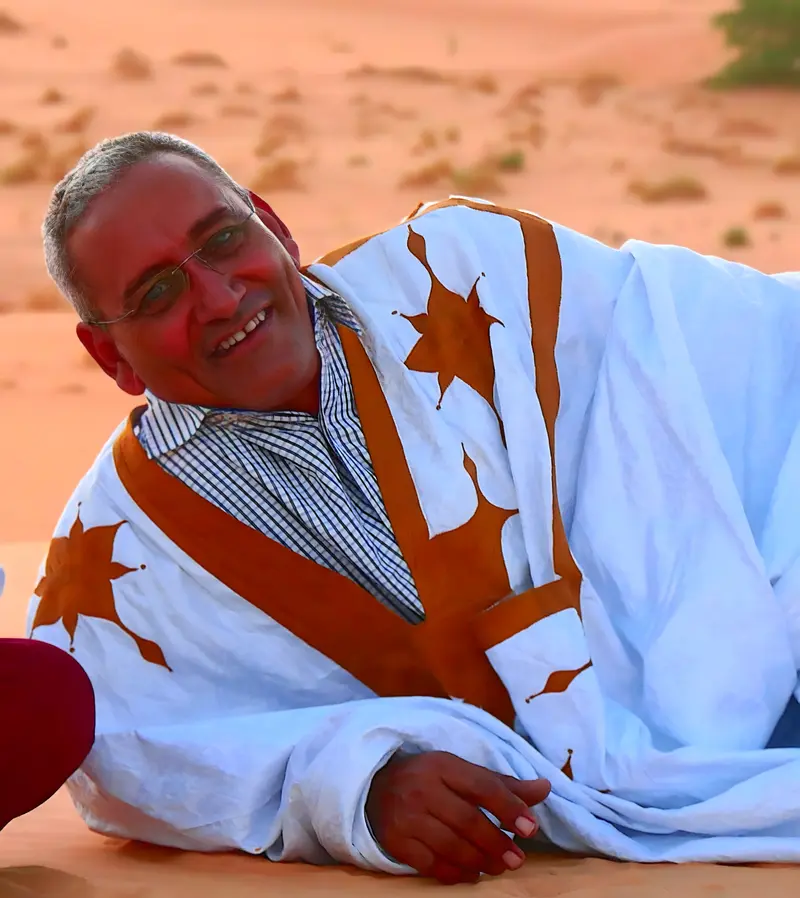
Let's talk about your adventure — Adrar
Craftsperson of journeys in the heart of Mauritania, based in Atar
Mauritania is a country that reveals itself with respect and patience. My role is to help each traveler approach it in the best conditions, with confidence and curiosity.
— Isselmou