Wat Ratchanadda (Loha Prasat)
Wat Ratchanadda houses the Loha Prasat, a tower with 37 metal spires unique in Thailand, and an authentic amulet market in the heart of old Bangkok.
Wat Ratchanadda stands in old Bangkok, just steps from Rattanakosin. Its flagship monument, the Loha Prasat ("Palace of Metal"), is a tower with 37 metal spires unique in Thailand — and one of only three such structures still standing in the world. The temple also houses a Buddhist amulet market renowned among local collectors.
Practical information at a glance
- Entry: free access to the temple grounds; Loha Prasat access is paid (modest fee)
- Recommended duration: 45 minutes to 1.5 hours depending on interest in the amulet market
- Dress code: shoulders and knees must be covered; sarongs available at the entrance
- Access: buses along Ratchadamnoen Klang; no BTS/MRT station in immediate vicinity — tuk-tuk or taxi recommended
- Accessibility: ground floor accessible, Loha Prasat climb via stairs only
What to see
The Loha Prasat dominates the complex: seven levels of teak wood galleries, crowned by 37 metal spires representing the 37 Buddhist virtues. Inside, a spiral staircase leads to a panoramic terrace overlooking Bangkok's rooftops.
The ubosot (ordination hall) preserves 19th-century murals and a principal Buddha in Rattanakosin style. Along the outer wall, the amulet market draws monks, collectors, and devotees alike — an authentic atmosphere, far from mass tourism.
History and context
The temple was founded in 1846 under the reign of Rama III, who wished to replicate a 3rd-century BCE Sri Lankan Loha Prasat. Construction spanned several decades. The site is designated a Thai historical monument and has undergone regular restoration since the 1980s.
The 37 spires correspond to the 37 dhamma (spiritual qualities) necessary for Enlightenment according to the Pali canon — each level of the tower symbolizes a step on the Buddhist path.
Highlights of your visit
Climbing the Loha Prasat
The central spiral staircase is narrow and steep. At the summit, views span Rattanakosin, Wat Saket and its golden hill, and the meanders of the Chao Phraya. Wear sturdy shoes — the steps are high.
The amulet market
Located under the arcades of the outer wall, this market is one of Bangkok's most active. Vendors offer phra khruang (protective amulets) from various periods. Even without purchasing, watching transactions between monks and collectors is worthwhile.
The ubosot murals
The frescoes illustrate scenes from the Buddha's life and episodes from the Ramakien. Their state of preservation is remarkable for a mid-19th-century structure.
Etiquette and visiting rules
- Shoulders and knees covered — sarongs are provided at the Loha Prasat entrance.
- Remove your shoes before entering the ubosot and the Loha Prasat.
- Speak softly in prayer areas; monks reside on the grounds.
- Do not touch statues or point your feet toward sacred images.
- Photography is permitted in most areas; check signs inside the ubosot.
Photography tips
Morning light (before 9 a.m.) illuminates the metal spires without backlighting. From the Loha Prasat terrace, frame northeast to include Wat Saket and its hill in the background. In late afternoon, the gilt spires catch the raking light — ideal from Maha Chai Street, opposite the main entrance.
Location and access
Wat Ratchanadda stands on Ratchadamnoen Klang avenue in Rattanakosin, Bangkok's historic quarter. It is immediately adjacent to Wat Saket and its golden hill and within walking distance of Phra Sumen Fort. From the center (Siam, Silom), allow 20–30 minutes by taxi depending on traffic. No BTS or MRT station is directly adjacent; the express boat on the Chao Phraya (Phan Fa pier) is a convenient alternative.
Nearby attractions
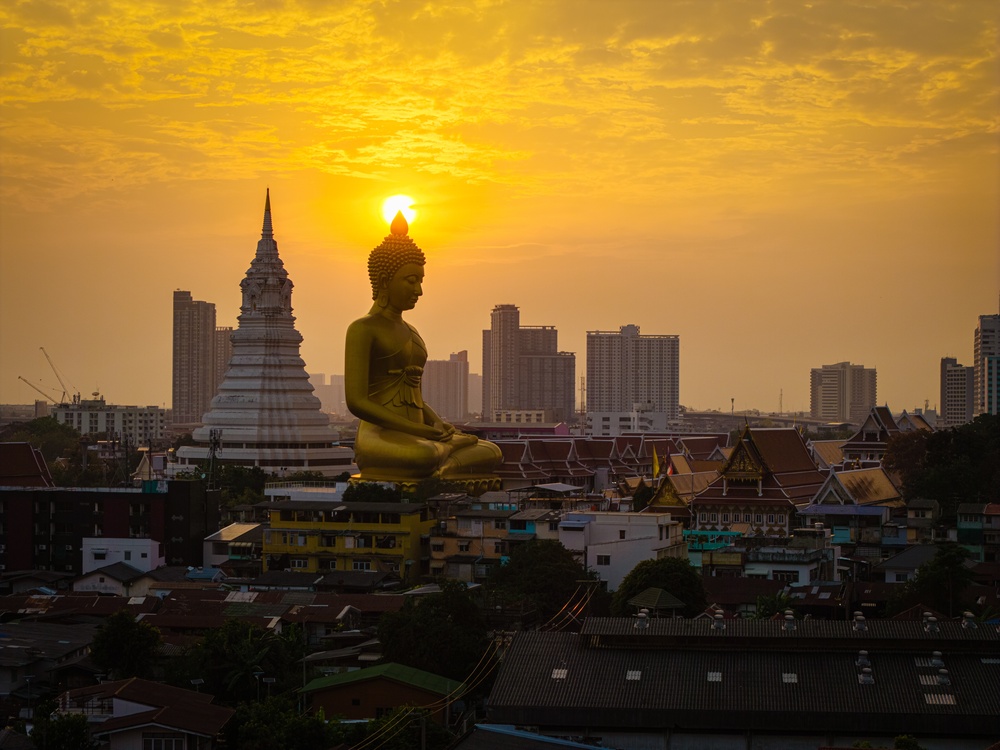
- Wat Saket (Golden Hill) — golden chedi visible from across the old city, accessible via a 318-step staircase.
- Democracy Monument — political symbol of 1932, at the center of Ratchadamnoen Klang, five minutes on foot.
- Wat Bowonniwet — royal temple where several Thai kings were ordained as monks, ten minutes on foot to the north.
- Khao San Road — lively backpacker hub, less than fifteen minutes on foot.
Frequently asked questions
Access to the temple grounds is free. Climbing the Loha Prasat is subject to a modest entrance fee, payable on site.
Shoulders and knees must be covered. Sarongs are available at the entrance if you are not appropriately dressed. Wear shoes that are easy to remove.
Yes, both temples are less than ten minutes on foot from each other. Start at Wat Ratchanadda in the morning for light on the spires, then head to Wat Saket mid-morning.
The market generally operates daily in the morning, though activity is more dense on weekdays. Vendors typically begin packing up in early afternoon.
Photography is permitted in most areas, including from the Loha Prasat terrace. Check signs at the ubosot entrance, where restrictions may apply.
The most convenient option is a taxi or tuk-tuk from Siam or Silom. The express boat on the Chao Phraya (Phan Fa pier) is a pleasant and quick option from central piers.
Nearby
Give it a go!
Our local experts arrange this activity for you.