Palm Leaf Mobile Weaving Workshop – Amphawa
In Amphawa, local artisans introduce visitors to the art of weaving palm leaves to create traditional decorative mobiles. A hands-on cultural activity to pair with the floating market.
In the narrow lanes of Amphawa, local artisans keep alive a rural Thai craft: the creation of decorative mobiles woven from fresh palm leaves. These participatory workshops teach the fundamentals of palm-weaving techniques, a skill passed down through generations in the Mae Klong delta region.
What you'll see
Palm leaves are first cut into fine strips, then woven by hand to form geometric shapes—stars, fish, birds—which are then assembled into suspended mobiles. The workshop displays finished pieces in natural plant colors, from vibrant green to straw yellow depending on the degree of drying.
History and context
Palm leaf weaving is a widespread craft in central and southern Thai provinces. In Amphawa, it is rooted in a village economy based on delta resources: coconut palms, sugar palms, and bamboo provide the raw materials. These mobiles were traditionally crafted to decorate homes during Buddhist festivals.
Highlights of your visit
Introduction to weaving
An artisan guides participants step by step. The first shapes—typically a simple fish or star—take between twenty and forty minutes. The challenge lies in maintaining even tension on the strips to achieve a symmetrical form.
Selecting the leaves
The leaves used are harvested young, still pliable. The artisan explains how to distinguish a usable leaf from one that is too fibrous. This observation moment is often as instructive as the weaving itself.
The finished mobile
Individual shapes are assembled onto a string or bamboo stem. Each participant leaves with their creation, which dries over a few days, turning a golden hue.
Photography tips
Natural light in late morning brings out the texture of the plant material. Photograph the artisan's hands in close-up during weaving—that's where the craftsmanship is most visible. Avoid flash, which flattens the relief of the weaving.
Location and access
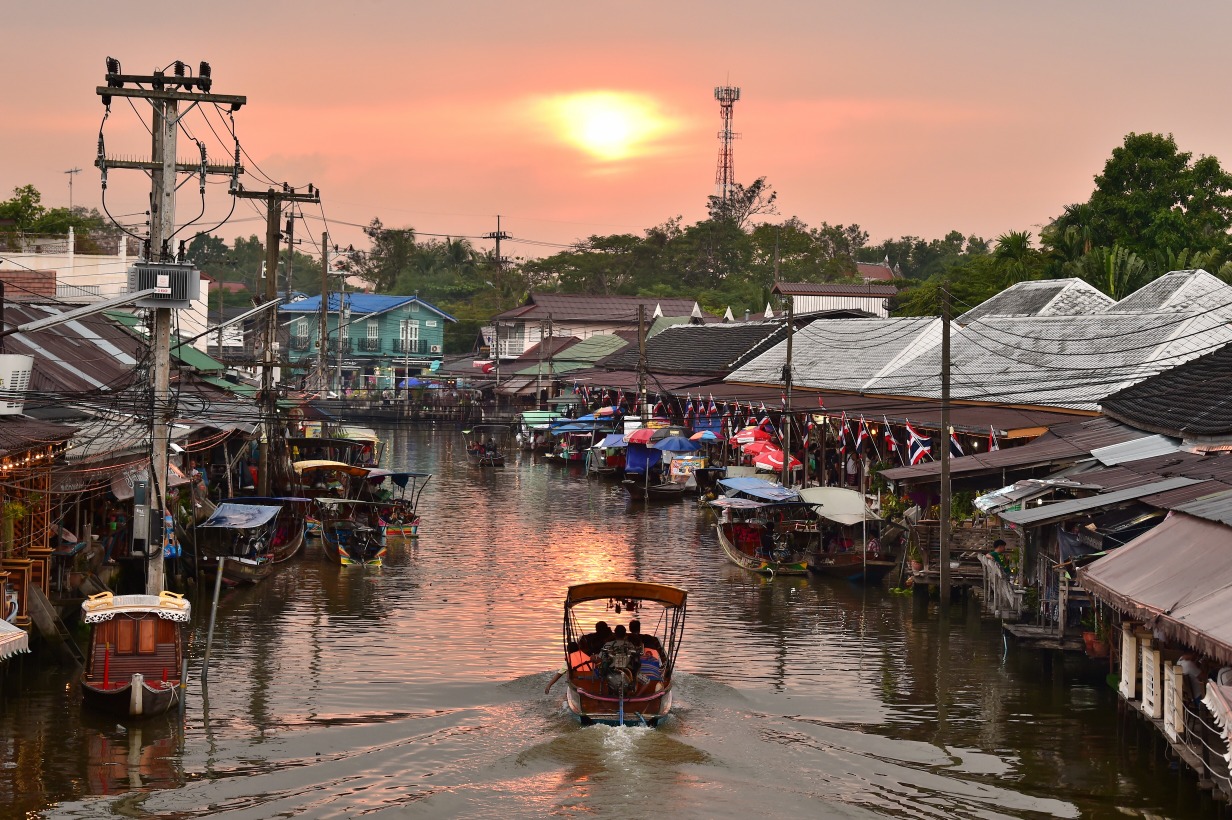
Amphawa is located in Samut Songkhram province, approximately 80 km southwest of Bangkok. These workshops are typically held in private homes or small cultural centers along the floating market canals. The Amphawa floating market is the main landmark for orientation.
- From Bangkok: minibus from Southern Bus Terminal (Sai Tai Mai) or shared van from Victory Monument.
- Accessibility: varies by workshop; canal areas feature steps.
Nearby attractions
- Amphawa Floating Market — lively weekend floating market, a few minutes' walk away.
- Wat Amphawan Chetiyaram — Buddhist temple on the canal, connected to the Rama II royal family.
- Birthplace of Rama II — museum dedicated to the poet-king, with traditional Thai gardens.
- Damnoen Saduak Floating Market — larger and more touristy floating market, accessible from Amphawa.
Frequently asked questions
Most of these workshops are informal and welcome visitors without reservation, especially on weekends during the floating market. For larger groups, it's best to contact the workshop or your local agency ahead of time.
A basic session typically runs between one and one and a half hours, depending on the complexity of the shapes chosen and the group's pace.
Simple shapes are accessible from age 8–10 with adult assistance. More complex forms require more developed manual dexterity.
A dried palm leaf mobile is lightweight and generally poses no problem for carry-on luggage. Check the phytosanitary regulations of your destination country for dried plant materials, however.
No special clothing is required. Avoid very light-colored clothing: fresh leaves can slightly stain fabrics.
Weekends (Friday evening, Saturday, and Sunday) are the most lively times. Artisanal workshops are more readily accessible on these days, at the same time as the floating market.
Give it a go!
Our local experts arrange this activity for you.