Grand tour of Éthiopie: From tribal territories of the Omo Valley to ancient kingdoms of the Abyssinian highlands
In the heart of the Omo Valley, meet the last tribes of Éthiopie before heading up towards the rock-hewn churches of Lalibela.
Duration
21 days
From
€3,530/pers.
Ideal seasons
Jan, Feb, Mar, Oct, Nov, Dec
Style
Guided tour
Comfort
classique
Travelers
Couple, Solo, With friends, senior
The spirit of travel
It is a journey through time to reach one of the last tribal regions on the planet: the Omo Valley.
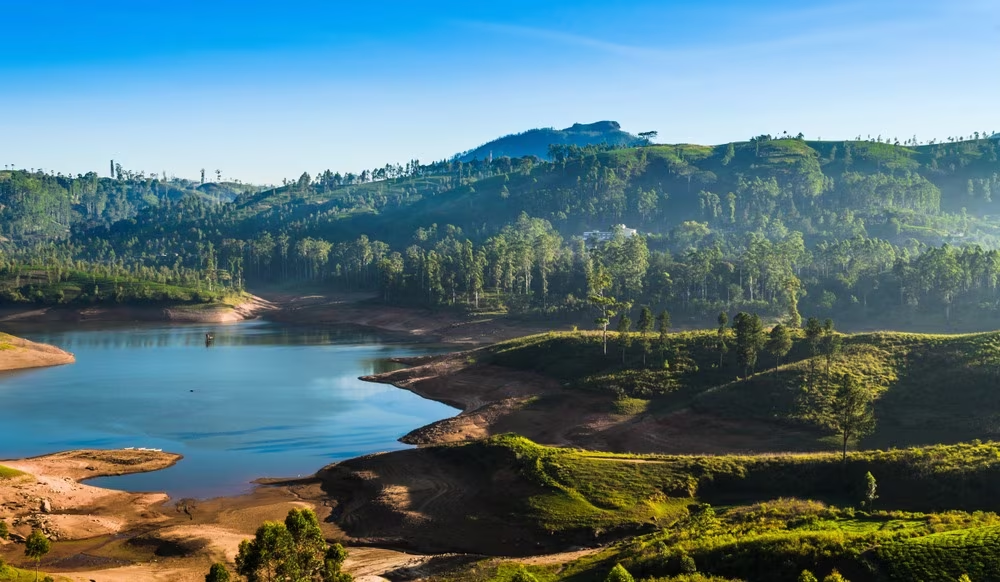
Between the Red Sea and the Blue Nile, the great African rift has given birth to landscapes as breathtaking as they are diverse, dotted with lakes populated by hippopotamuses, crocodiles, and a multitude of birds.
Arrived in the Omo Valley, cradle of humanity, set out to meet different tribes. Each tribe has its own language, its own customs, its own beauty criteria. They come together on market days, the main place of socialization
Eternal and biblical Éthiopie, a land where time has stood still, where everyone is a guardian of tradition.
This journey will transport you through breathtaking landscapes to meet local populations who will leave you with unforgettable memories.
Discover the UNESCO World Heritage sites of the churches of Lalibela, carved into the rock, the medieval castles of Gondar, the Simien Mountains National Park, the monastery islands of Lake Tana, or the sources of the Blue Nile.
The stages of your journey
Highlights
Day-by-day itinerary

Departure of your international flight to Éthiopie
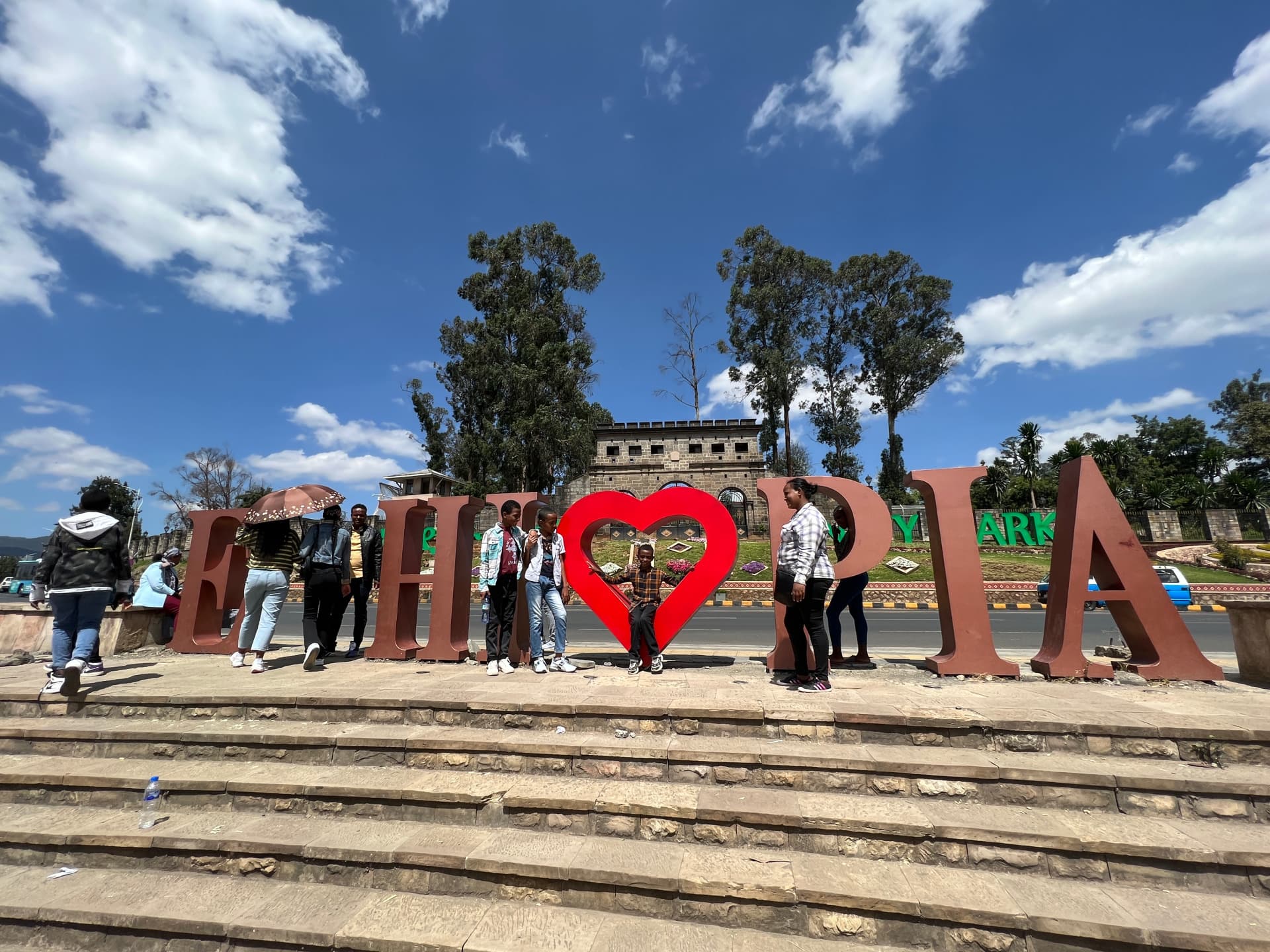
Addis Ababa, the "new flower"
Arrival at Addis Abeba airport: welcome and transfer to your hotel.
Discovery of the Ethiopian capital in full transformation: from the historic Piassa district to the latest city developments.
Drive to the Entoto mountains for a panoramic view of the city. Discovery of the Entoto Mariam church and the first palace of Emperor Menelik.
Visit to the Ethnological Museum of Addis housing the skeleton of the famous Lucy (hominid fossil from 3.4 million years ago)
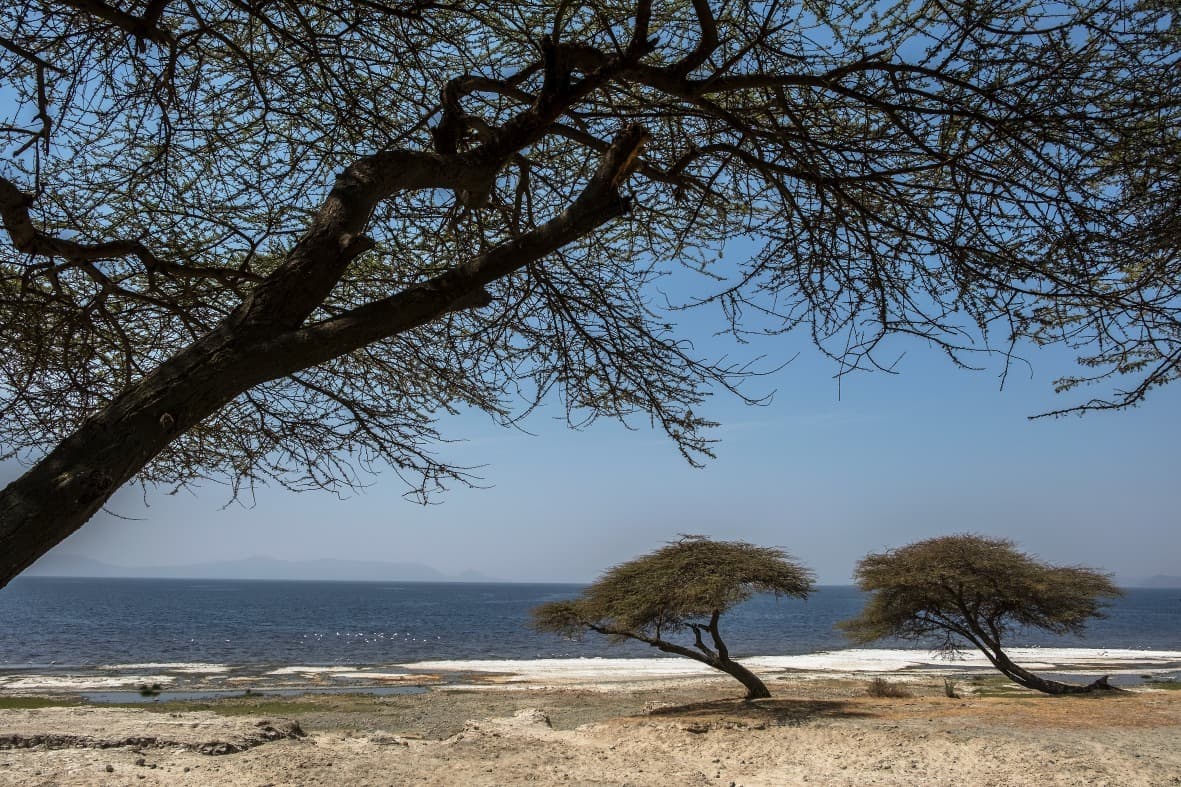
THE GREAT AFRICAN RIFT VALLEY
Addis-Abeba → Parc National Abijatta-Shalla
Route en suivant the Great Rift Valley, grande faille tectonique qui coupe l'Afrique de l'Est de part en part.
Stunning panoramas sur la vallée parsemée de nombreux lakes.
Visit to Abijatta National Park: Hiking around the crater lakes frequented by colonies of pink flamingos.
Parc National Abijatta-Shalla → Awassa
Arrival in awassa, capital of the Sidamo region, famous for its coffee.
Walk along the lakeside frequented by marabous and in Amor Gedel park and its many monkeys
The Dorze Country
We continue down the Rift Valley.
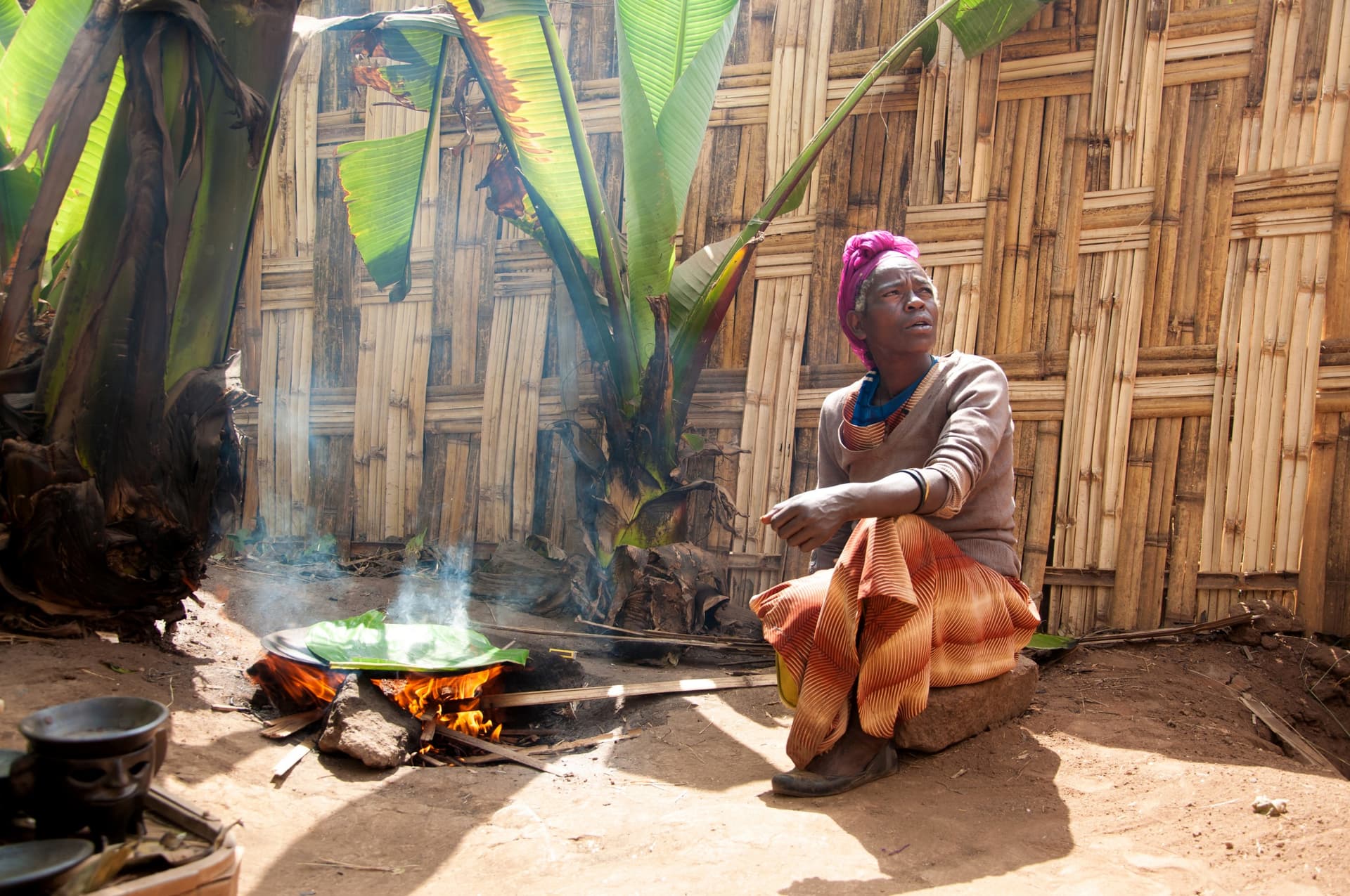
Road to the Guge Mountains, at 2700 m altitude to reach the villages of the Dorze. Formerly fearsome warriors, they have converted to weaving and the cultivation of enset (or false banana) of which they make multiple uses, from food to housing.
Discovery and visit of a village with its surprising traditional hive-shaped huts standing about ten meters high.
Panorama of two of the largest lakes in Éthiopie's Rift Valley: the Chamo and Abaya lakes which are separated by a strip of land called the "Bridge of God".
Arrival at Arba Minch, bordered by lush mountains, meaning the forty springs
The Konso Country
Road to the hills of the Konso country.
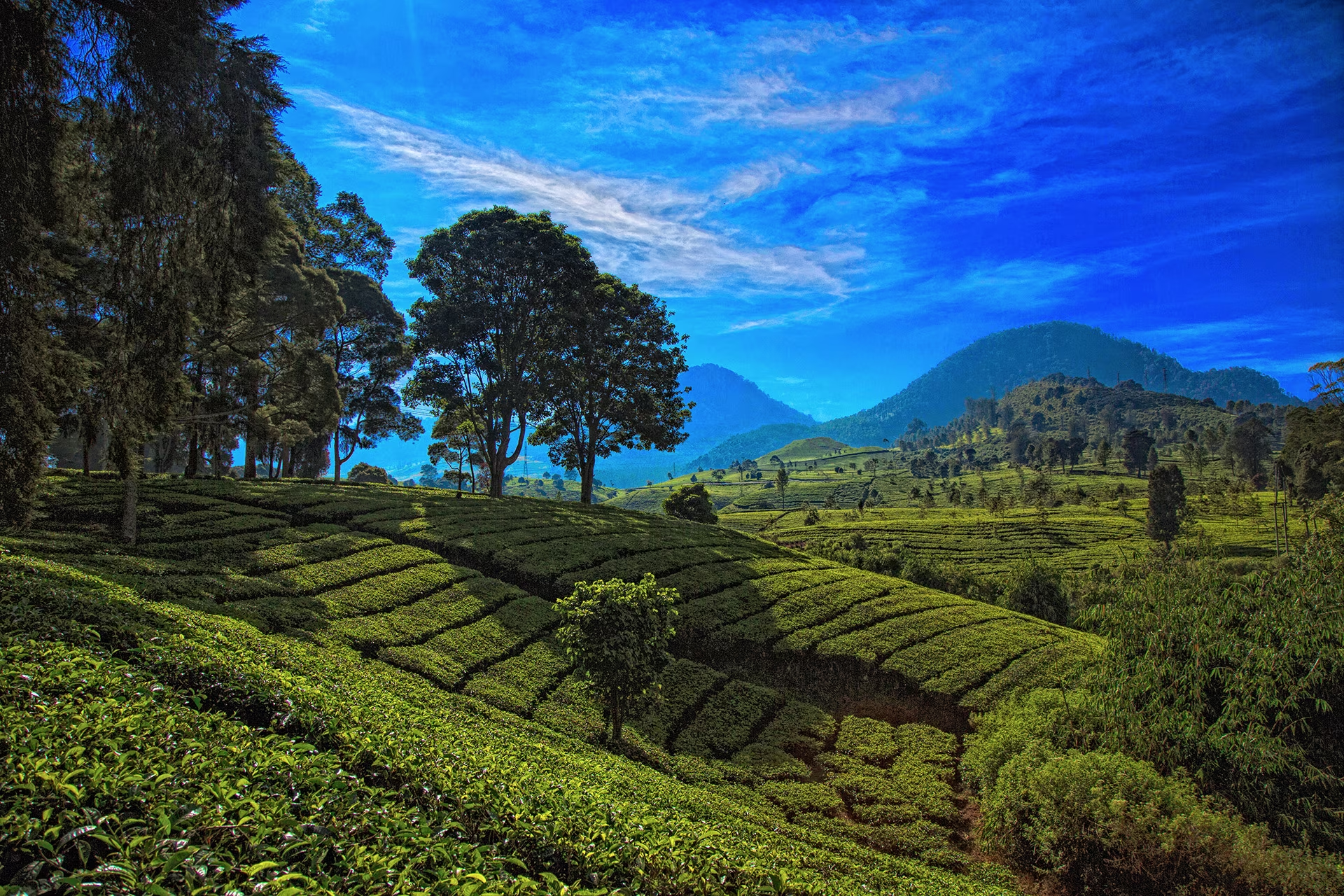
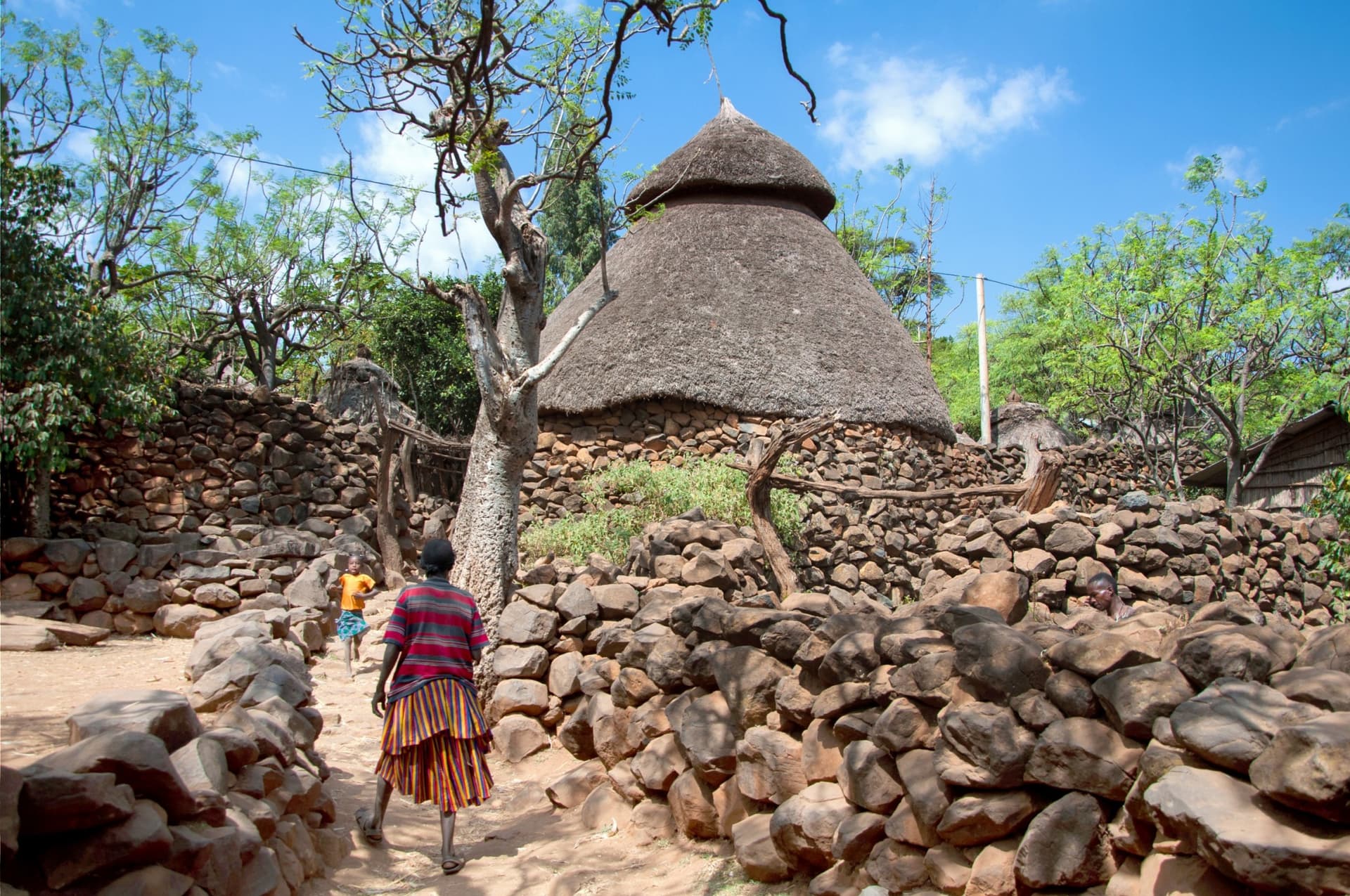
Discovery of the Konso ethnic group, sedentary farmers who have carved numerous terraces into the hillsides for their crops (millet, sorghum, cotton, maize, papaya…) with an ingenious irrigation system optimizing rainwater (landscape listed as a UNESCO World Heritage site).
The Konso are divided into nine clans, each possessing their wagas (or sculpted wooden funeral totems).
Visit to Konso villages, structured into quarters, with genuine basalt enclosure walls protecting them from wild animals and mud flows.
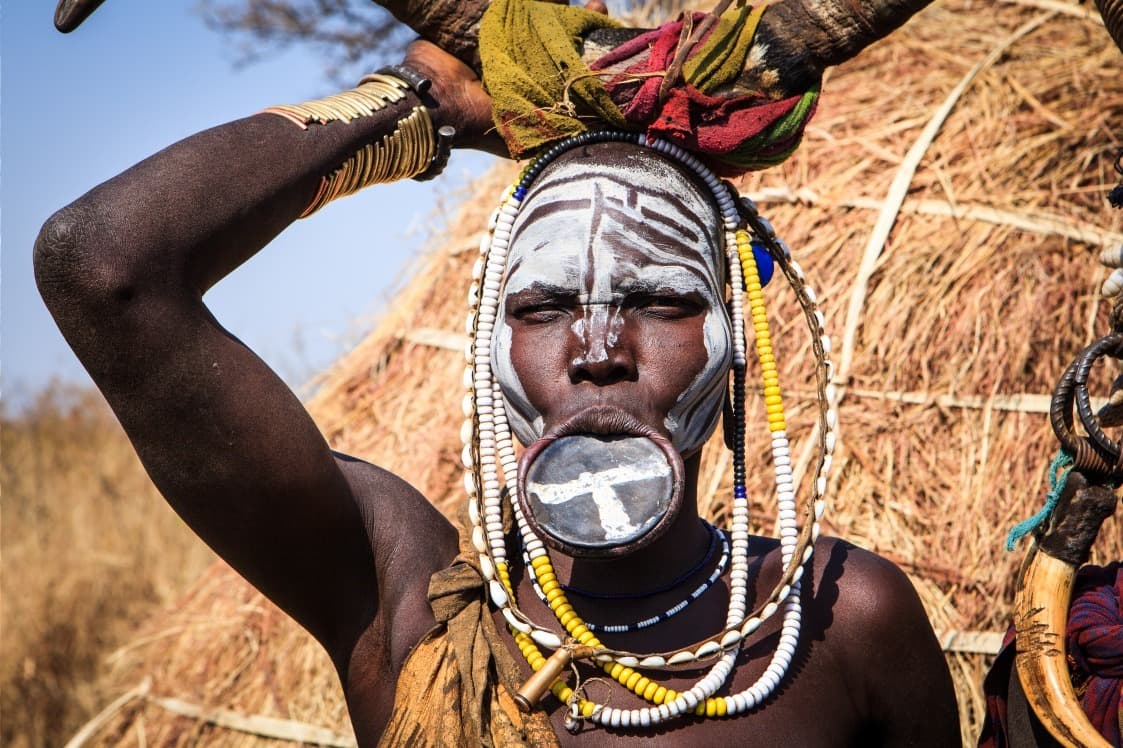
The Key Afar Market and the Mursi
Visit to the weekly market of Key Afer, a meeting point for many ethnic groups, including the Banna, Ari, Tsemay and Hamer, who often walk for several days to reach the market to exchange food, spices, butter, goats,…
Encounters with the Mursi ethnic group mursi.
Agro-pastoralists with shaved heads, pierced ears, scarified arms and torso, the men are warriors renowned for being very impressive. The women, meanwhile, wear a clay plate inserted in the lower lip, as well as ear plates (the size of the lip plate being proportional to the dowry required by the family).
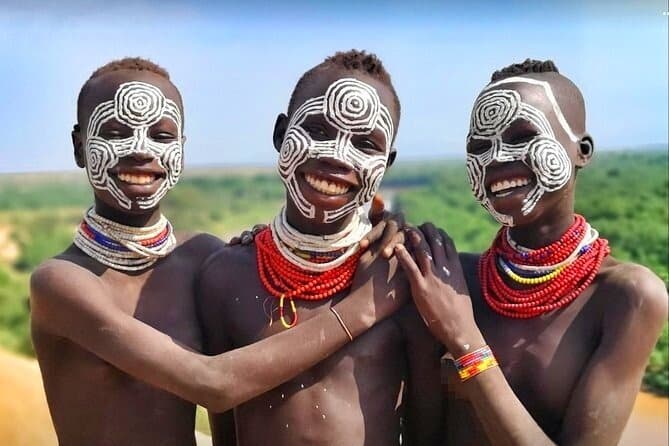
The Karo Country
Route through the savanna (hiking opportunity) where you will have the chance to observe giant termite mounds, many birds including African guinea fowl as well as mini baobabs.
Discovery of the Karo ethnic group on the banks of the Omo River.
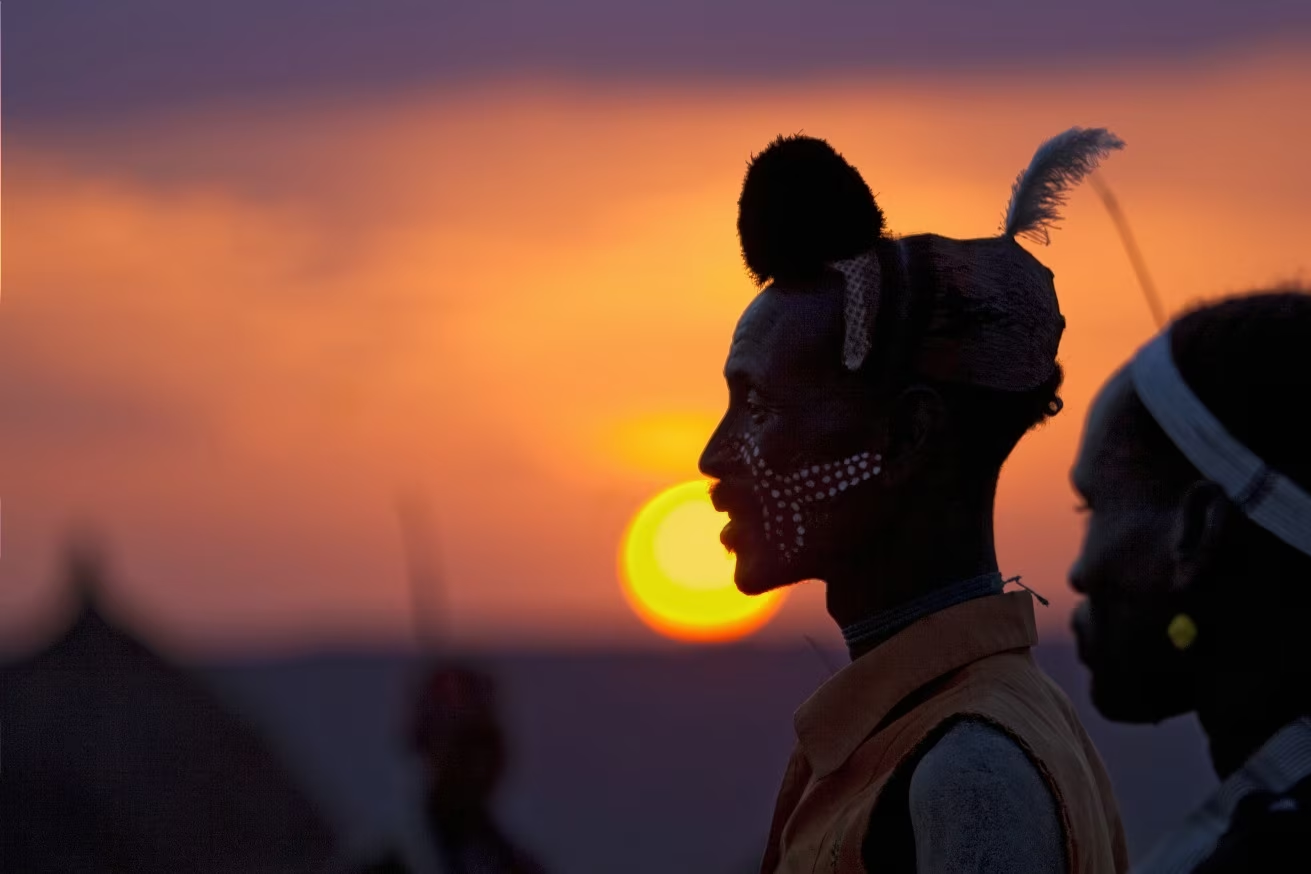
The Karo are famous for their body paintings in colored ochre, in white chalk, in yellow mineral rock or any other natural resource. The hairstyle of Karo men is very elaborate and each element has a meaning.
Route through the brushy savanna towards the small town of Jinka.
The Ari take advantage here of a green and fertile region that allows them to grow cereals, coffee and fruits.
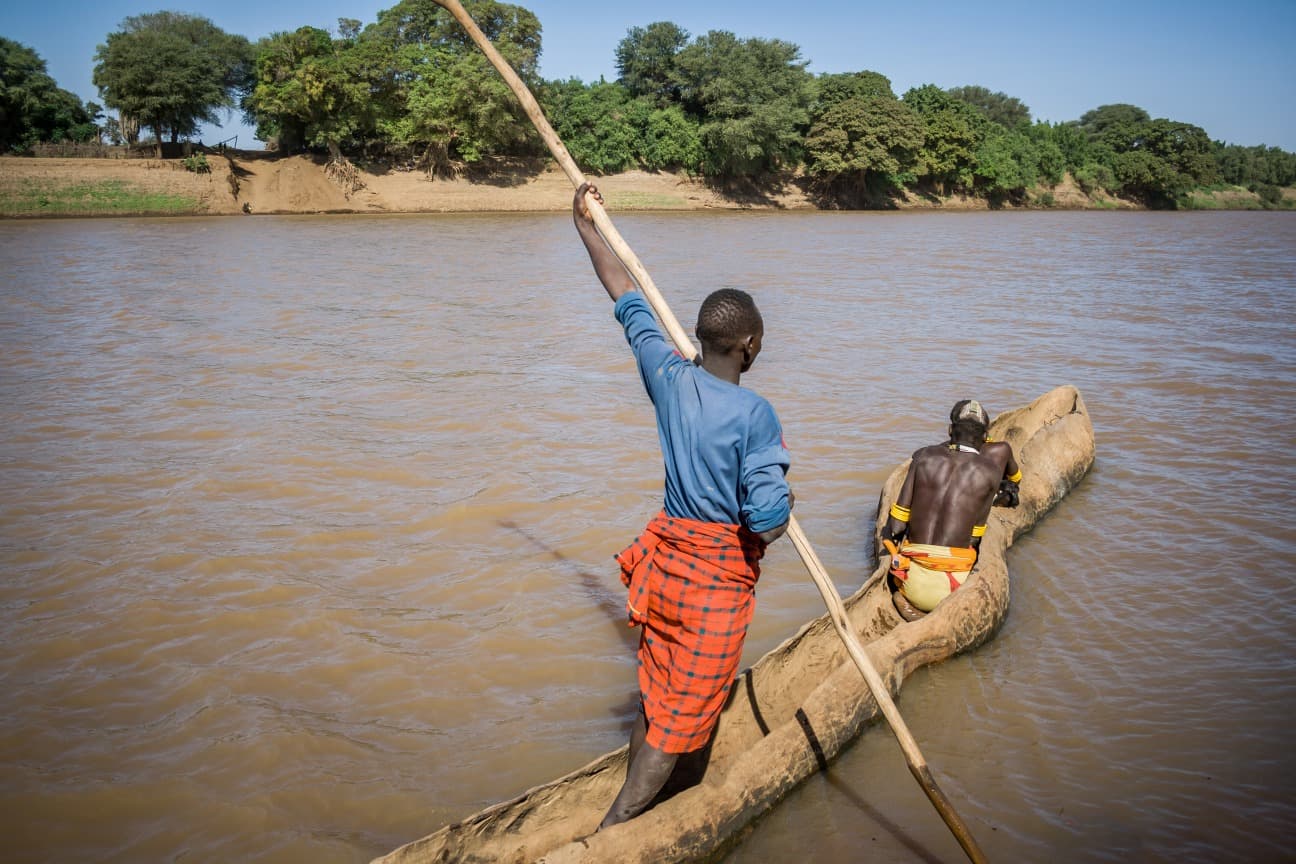
The Dasanetch Country
Route to Omorate and crossing of the Omo River by canoe to reach the Dassanetch country.
Close to the Kenyan border, this tribe far from the world takes advantage of the fertile and silty lands of the Omo River delta to grow sorghum.
This lower valley of the Omo is a major prehistoric site (listed as a World Heritage site by UNESCO), where numerous hominid fossils of essential importance for the study of human evolution have been discovered.
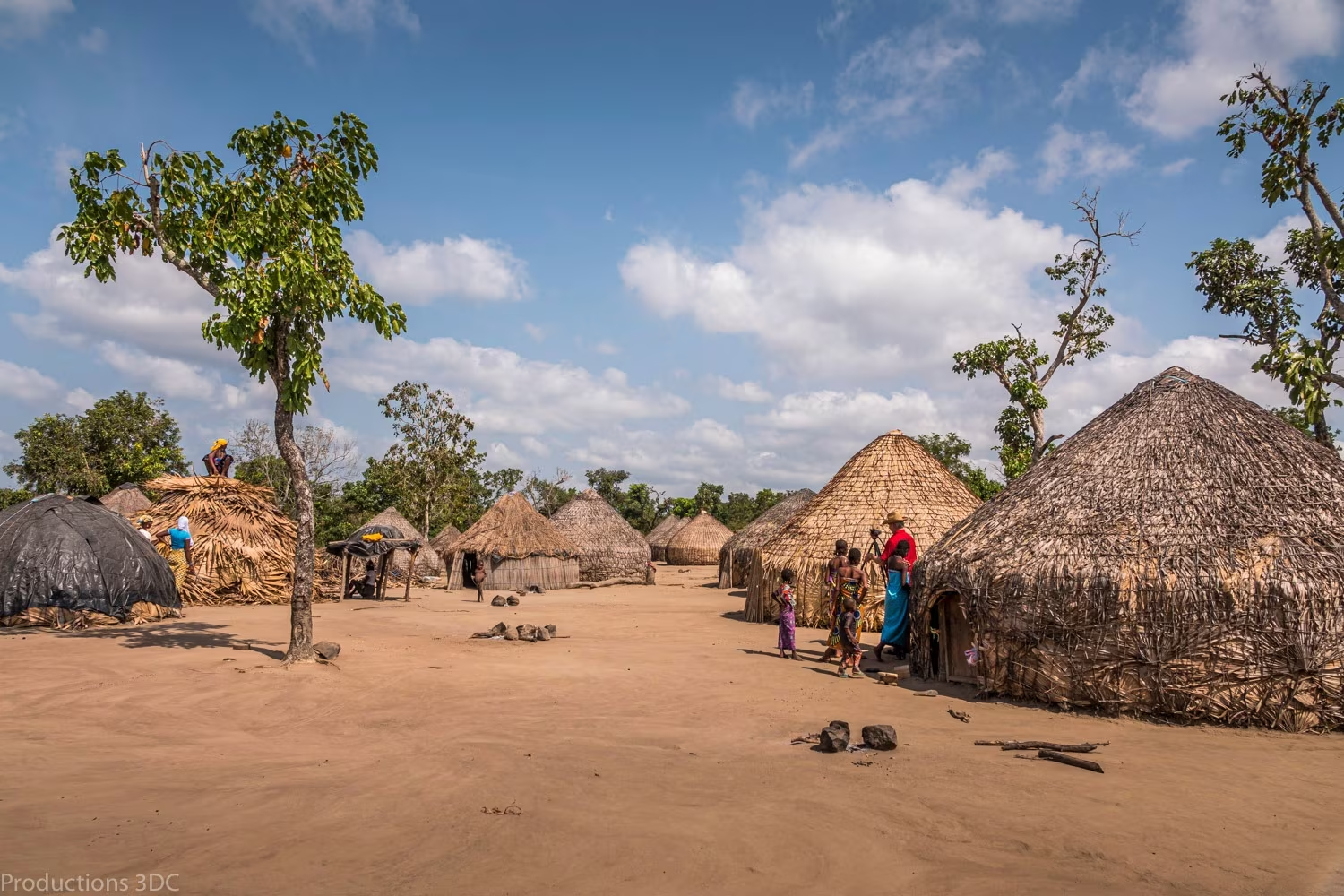
Walk along the East bank of the Omo, discovery of a traditional village composed of small huts made of branches, sheet metal and animal hides. The hairstyle of the Dassenech is very sophisticated.
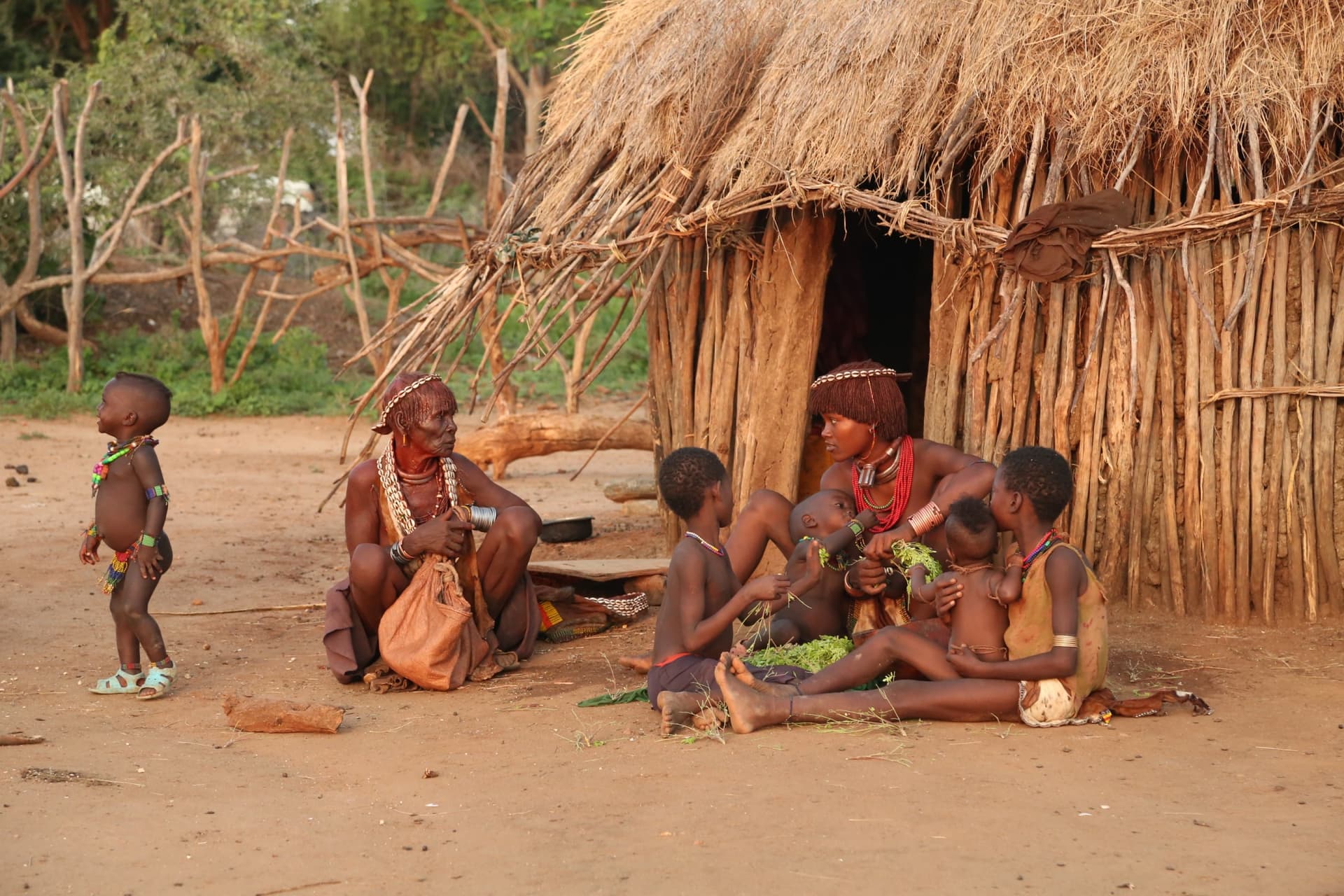
The Hamer Country
Discovery of a Hamer village and their way of life and daily activities largely devoted to caring for their herds.
Livestock is a key element of Hamer life where each boy receives the name of a bovine at birth.
Bare-chested, the women cover their hips with cow hides encrusted with colored beads and shells. They coat their hair, skillfully braided, with butter and red earth.
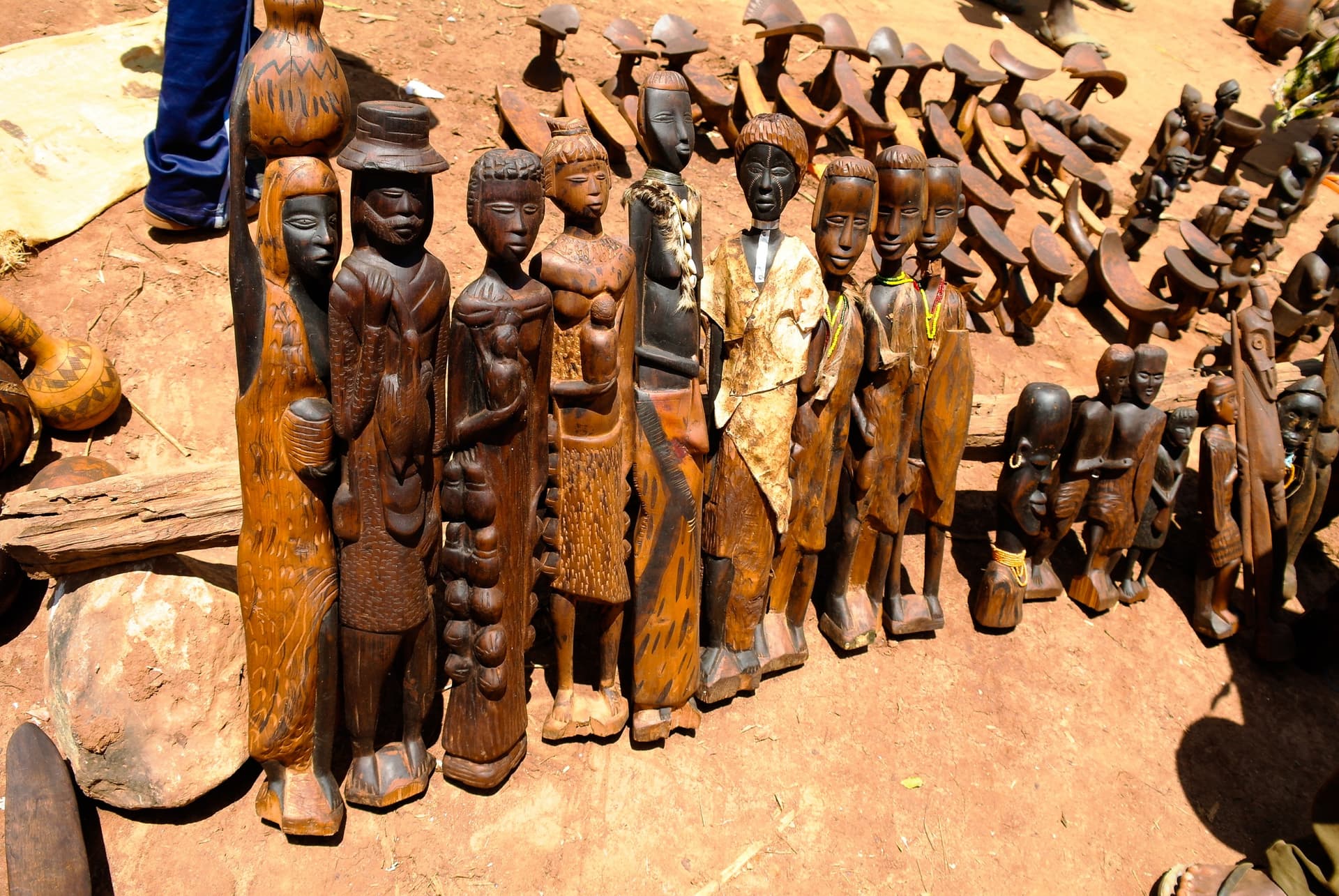
Turmi Grand Market
Visit to the great market of Turmi, where Hamer women sell vegetables, spices, butter, milk as well as traditional items such as carved gourds, stools, bracelets and goat skins, decorated with beads and shells.
Road to Arba Minch
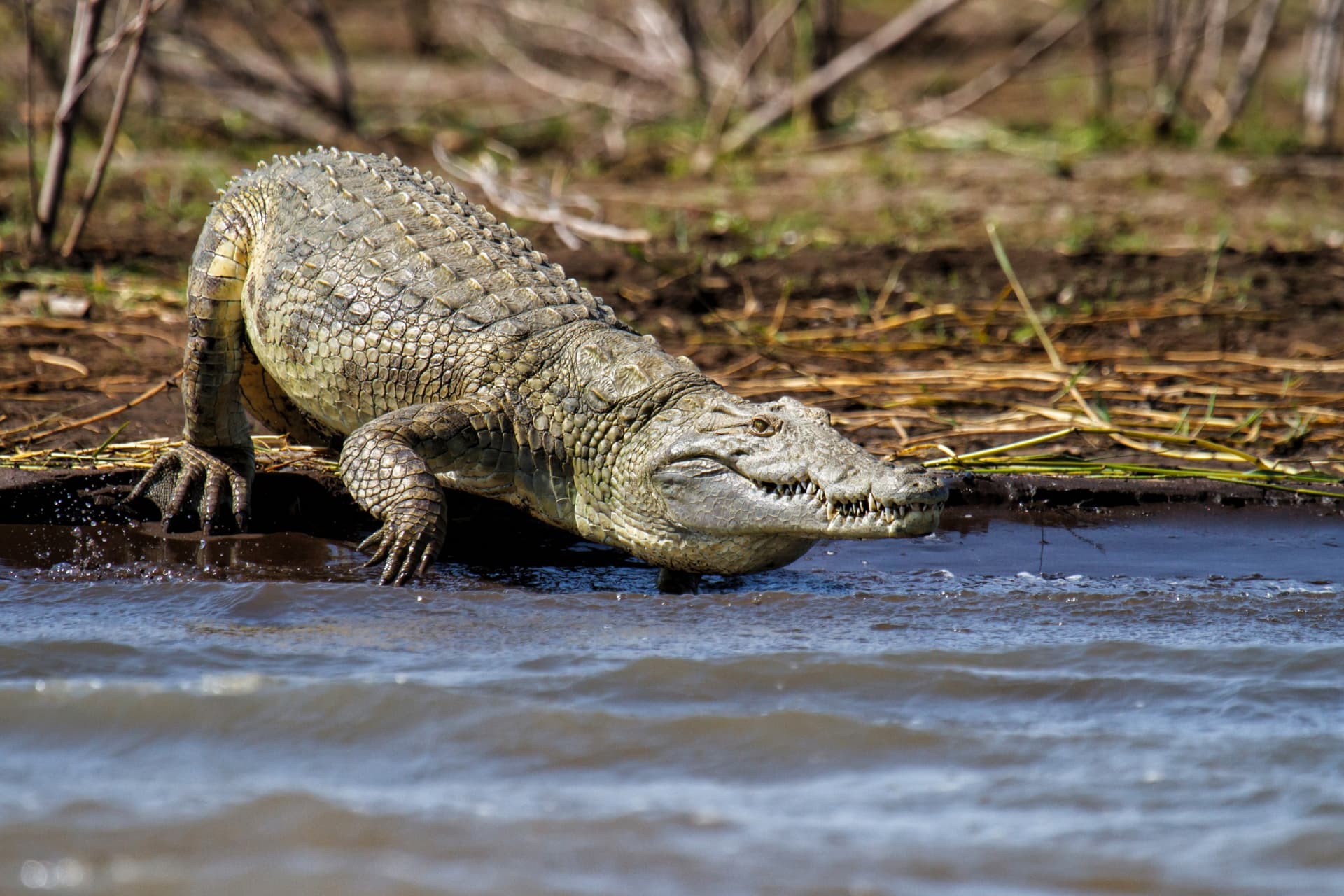
The Crocodiles of Lake Chamo
Boat excursion on the Lake Chamo to observe an incredible variety of birds as well as Africa's largest crocodiles (reaching up to 6 m in length) that coexist with hippopotamuses, pelicans and fish eagles.
Transfer to the airport for the flight to Bahir Dar via Addis Abeba.
Arrival at bahirdar airport: pickup and transfer to your hotel
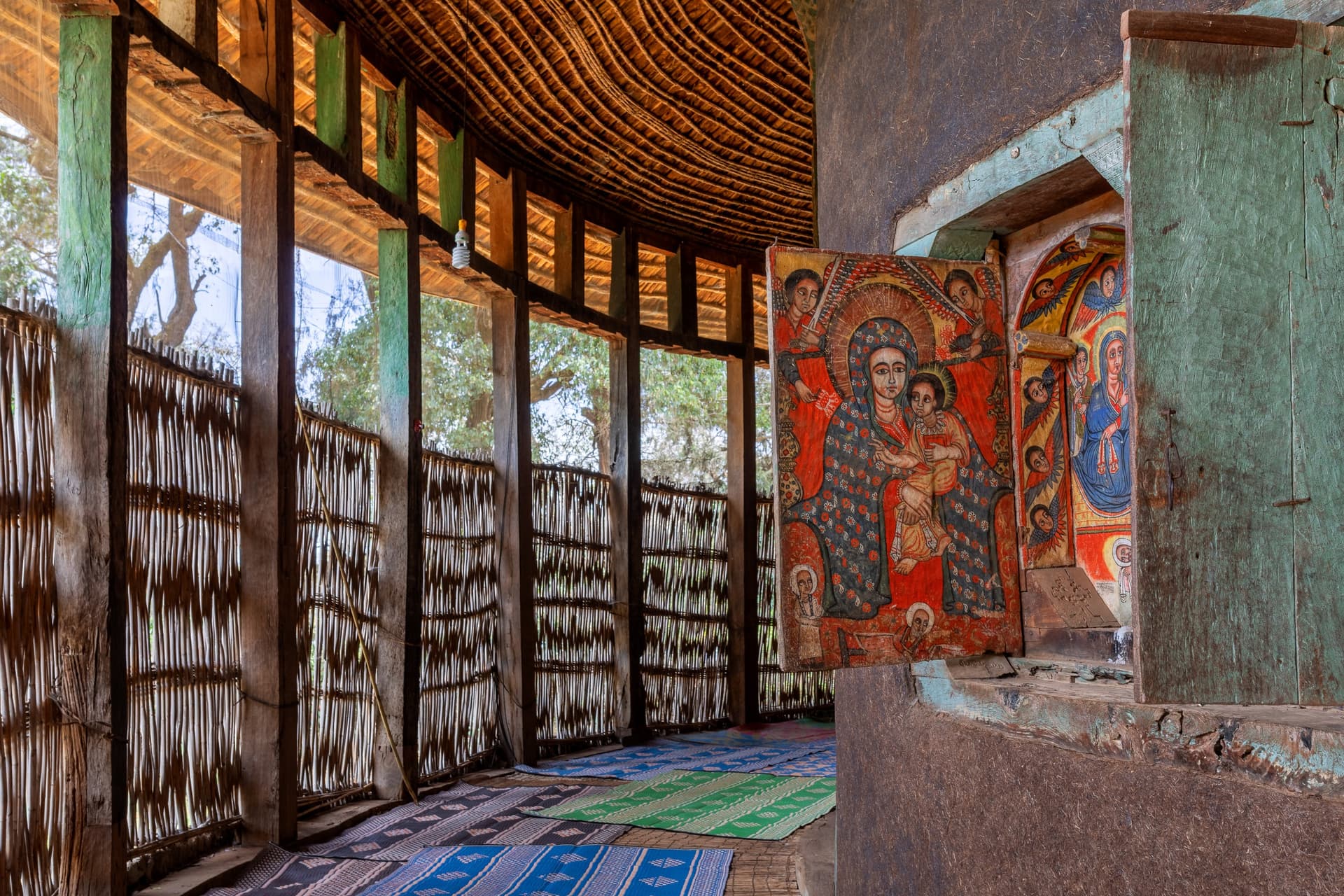
Lake Tana and Its Monastery Islands
Bahir Dar is considered the riviera of Éthiopie. With its palm-lined avenues and its immense lake, it is also the capital of the Amhara region.
Visit of the Bahir Dar market towards which all the peasants of the region converge.
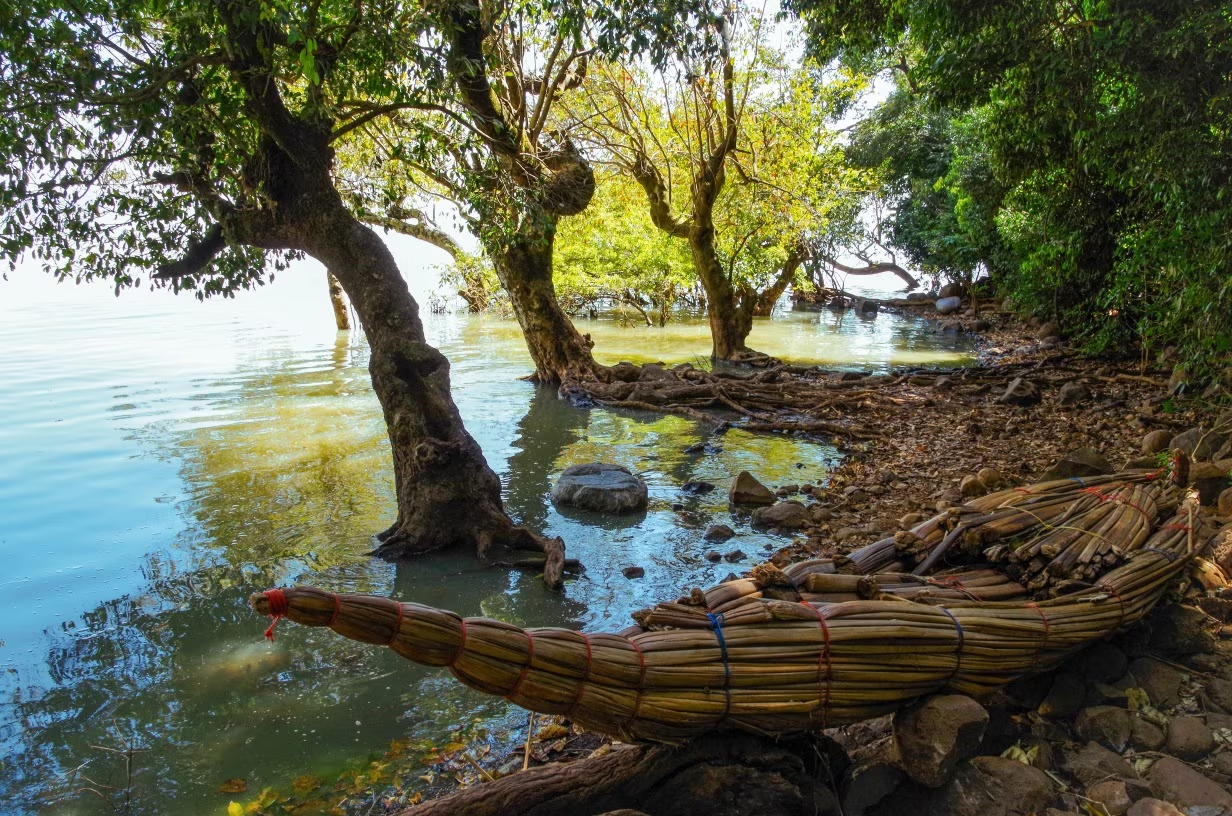
Boat excursion on Lake Tana, home to around thirty islands and as many churches and monasteries. Observation of numerous birds, hippopotamuses, and fishermen on their tankwas (traditional papyrus boats).
Visit to the Ura Kidane Meret monastery, a remarkable example of Éthiopie religious architecture and painting and its museum housing a collection of crosses dating back to the 14th century.
Stroll among the coffee plantations and mango trees to the Azoua Mariam church
Return by boat to Bahir Dar.
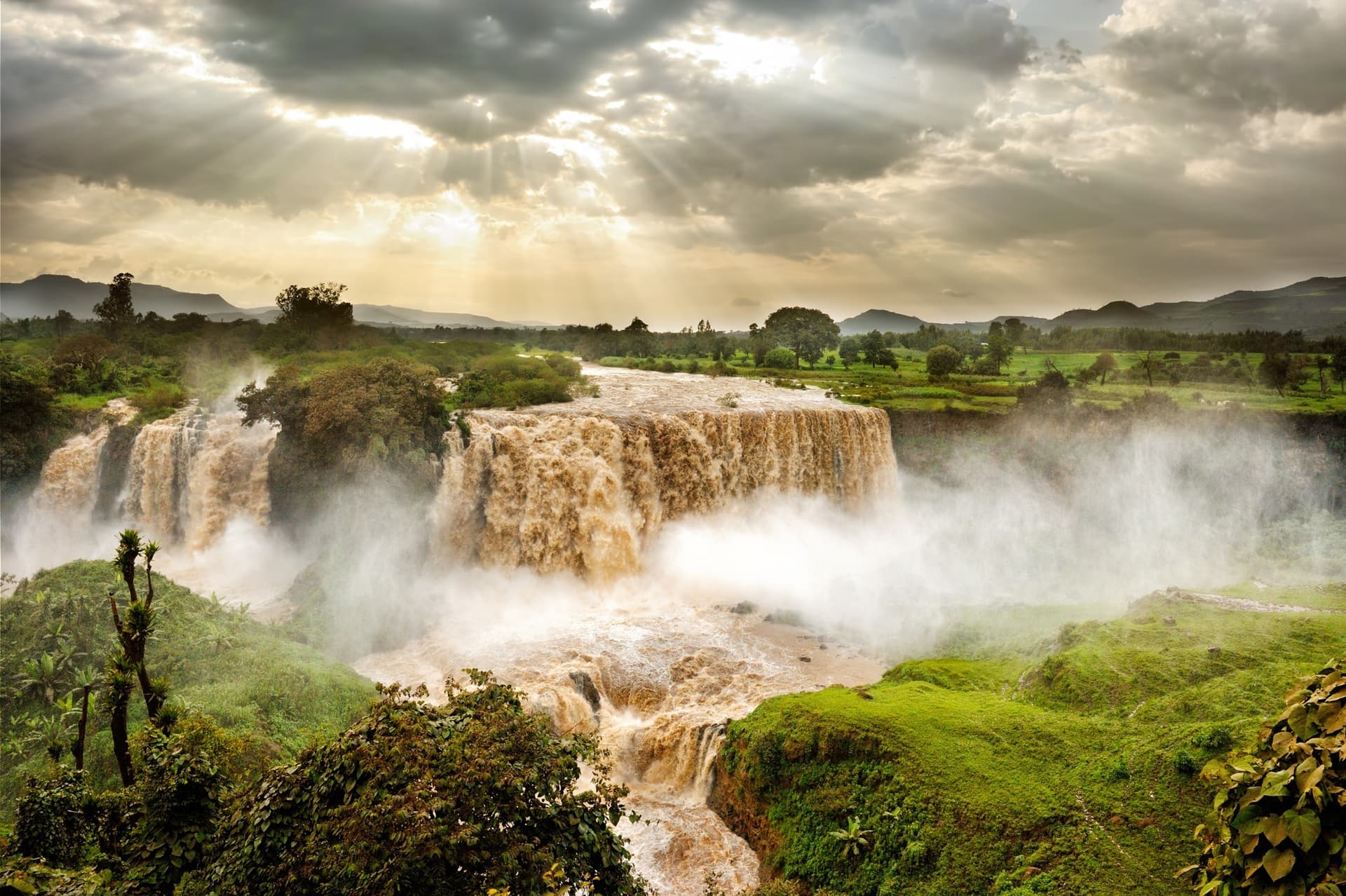
Blue Nile Falls
After crossing the Blue Nile via an old sixteenth-century Portuguese bridge, walk along a path to a superb viewpoint overlooking the Blue Nile Falls(400 m long and 45 m high) then reach the base of the waterfall after crossing a lovely suspension bridge.
Climb back up via another path and return to the other bank by boat.
Visit the village and coffee ceremony in a village house.
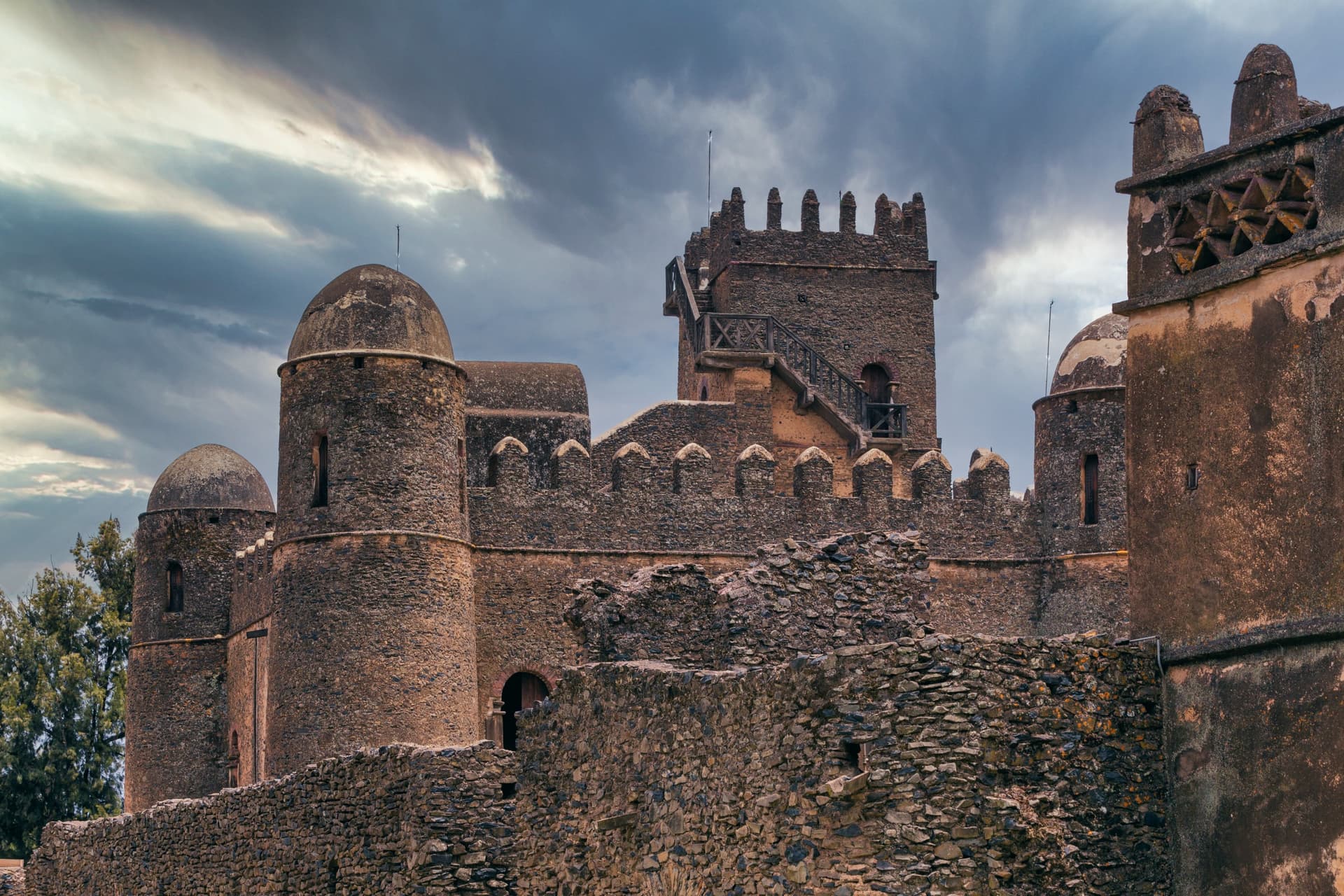
Gondar, the Medieval
Departure for Gondar by a scenic road along the eastern shore of Lake Tana.
Arrival at Gondar, capital of Éthiopie from the 17th to 19th century which holds a rich architectural heritage.
Visit of the imperial city which groups within an enclosure of 900 m, palaces, churches, monasteries, public and private buildings of a very particular style. The decoration is marked by Indian and Arab influences, and transformed by the Baroque aesthetics transmitted by Jesuit missionaries.
Visit of the Debre Birhan Selassie Church, an ancient and very famous church whose ceiling and walls are entirely painted with magnificent hundreds of faces of angels.
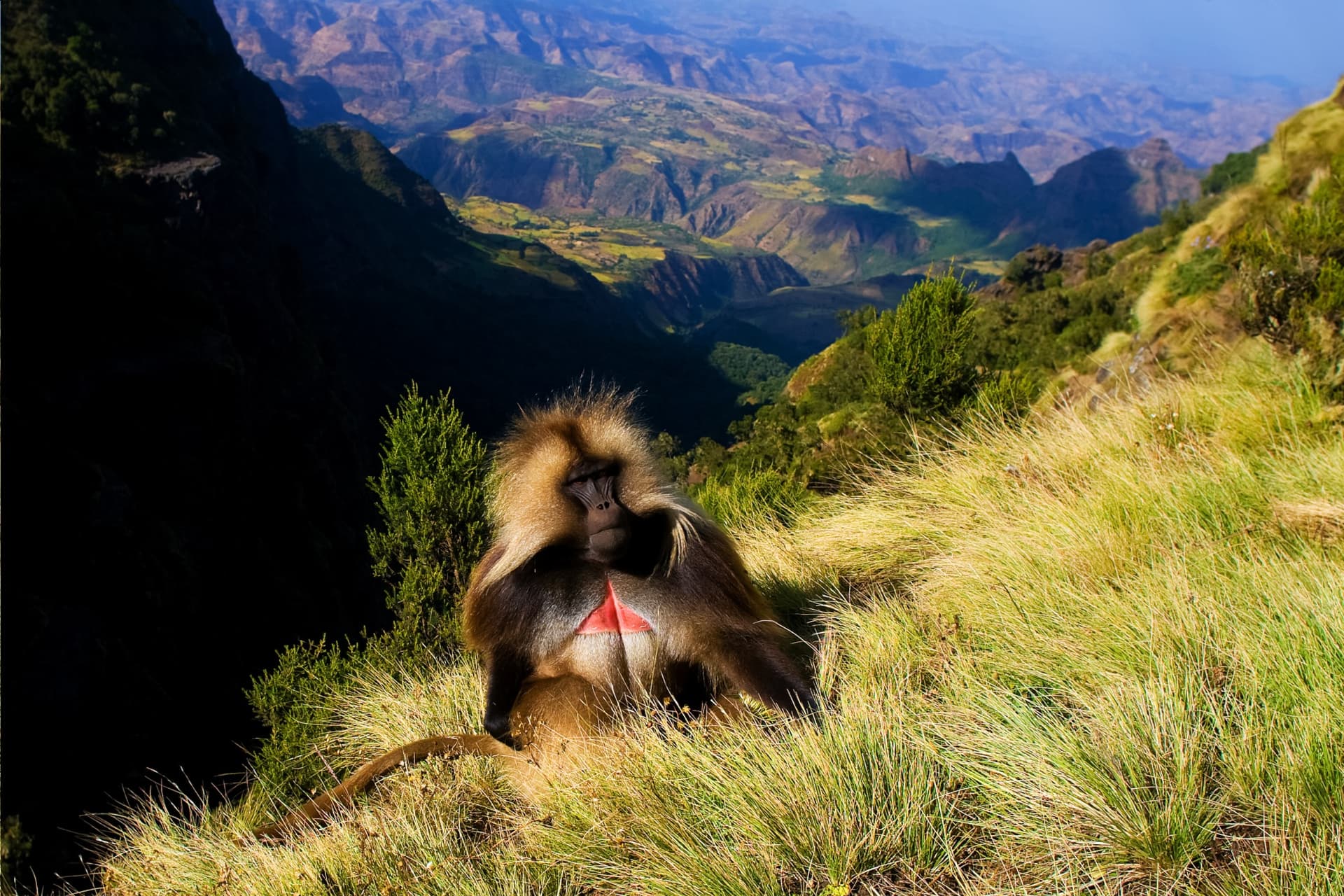
Simien Mountains National Park
Route vers Debark et Enregistrement auprès des autorités du Simien National Parket transfert jusque Sankaber
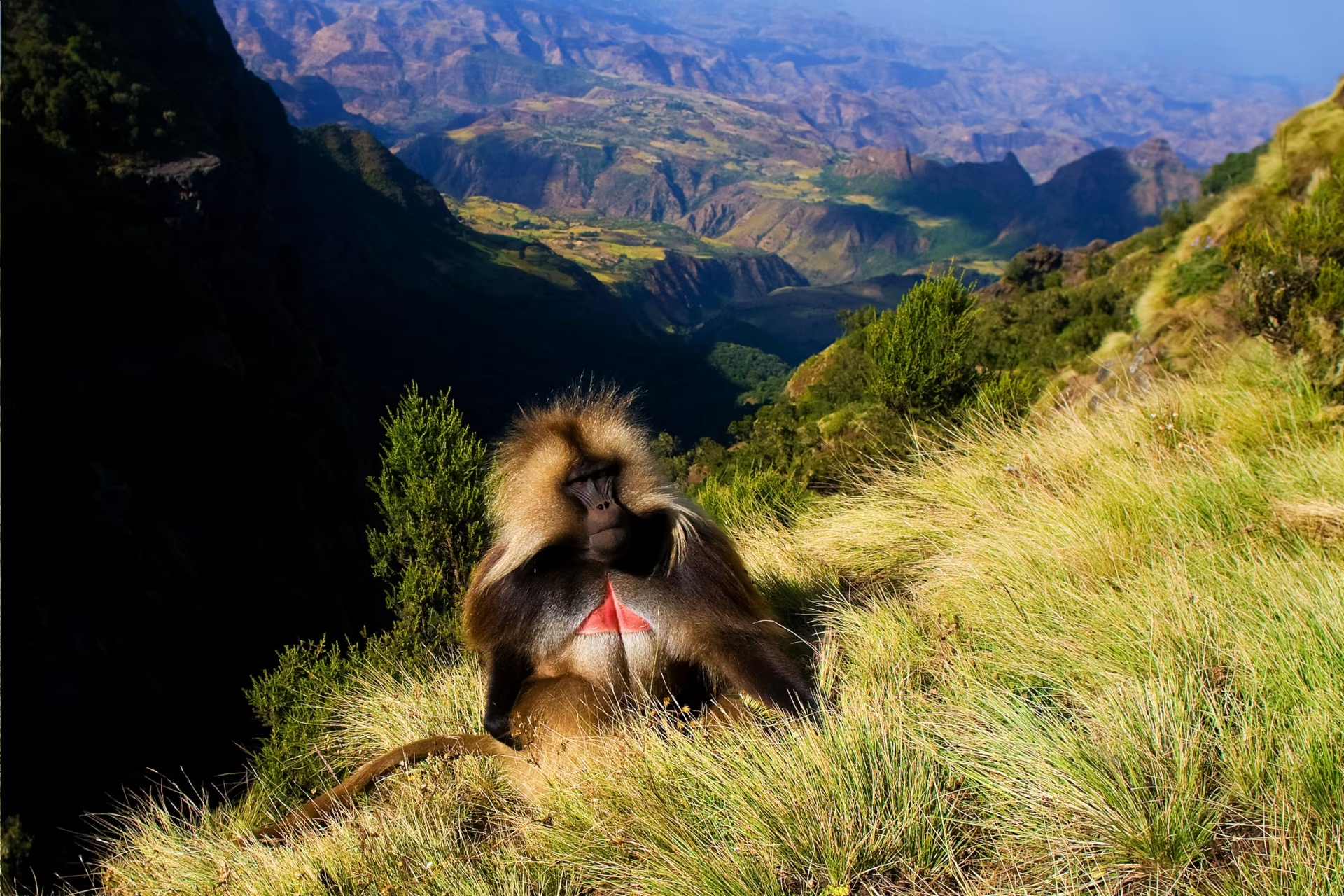
Observation of Gelada baboon colony, large primates of the Ethiopian highlands.
These baboons are vegetarian and live in groups of 200-300 with a dominant male. They spend their time grazing on grass and grooming each other. Females have a red chest.
HIKING : Sankaber (3250m) – Jinbar ; hiking time : approx. 1h 30
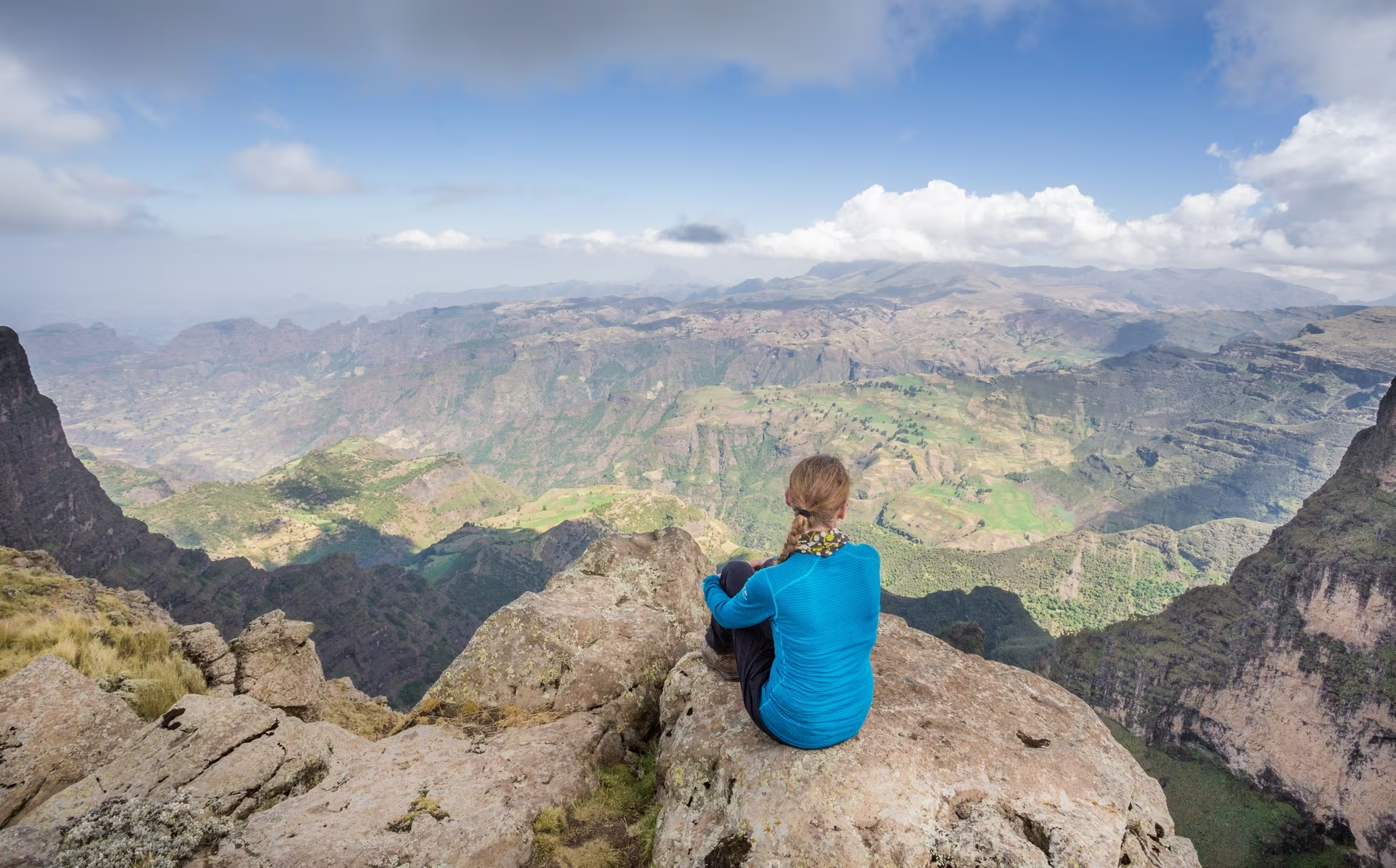
Walk on the ridge line trail among afro-alpine vegetation with magnificent viewpoints over the vertiginous canyons and surrounding peaks until the great Jinbar waterfall.
Subject to advance notice, possibility of a longer hike (approximately 4h)
Camp setup and evening around the campfire.
Upgrade option : Accommodation at Simien lodge
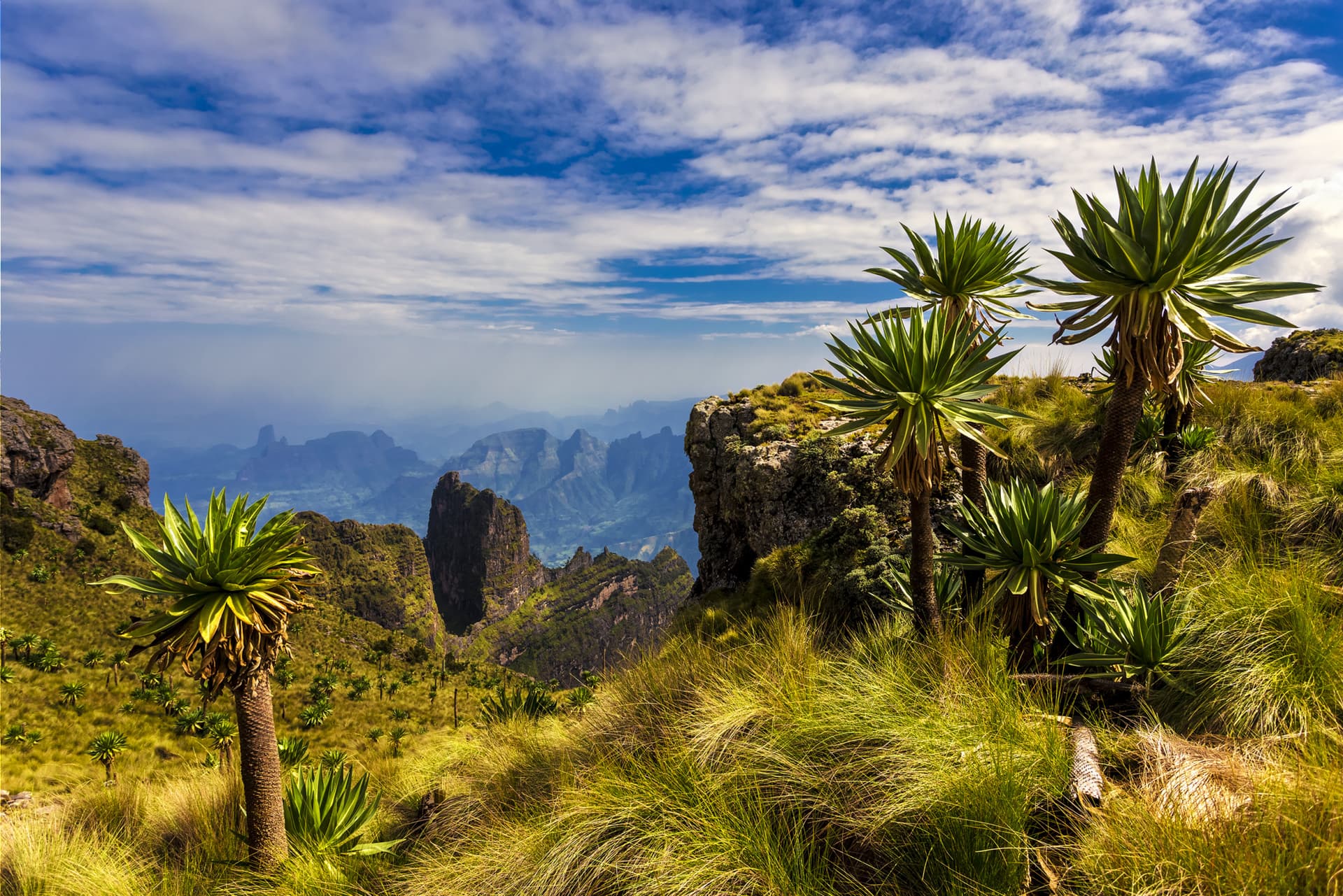
Simien Mountains National Park
Massive erosion over the years has formed on the Éthiopie plateau one of the most spectacular landscapes in the world with peaks, valleys and cliffs reaching up to 1500m in depth.
Transfer to Ambaras
Trek: Ambaras (3700m) – Inatye (4020m) – Ambaras (3700m) Walking time: approx. 4h
Gradual ascent over the vast plateau through afro-alpine grassland and giant lobelias to the summit of Inatye, a splendid viewpoint offering an exceptional view over plunging cliffs, deep valleys and small plateaus below.
Wildlife observation: walia ibex, colonies of gelada baboons, Lammergeyer vultures, or the Abyssinian wolf.
Vehicle pickup at Ambaras.
Vehicle pickup at Ambaras and return to Gondar.
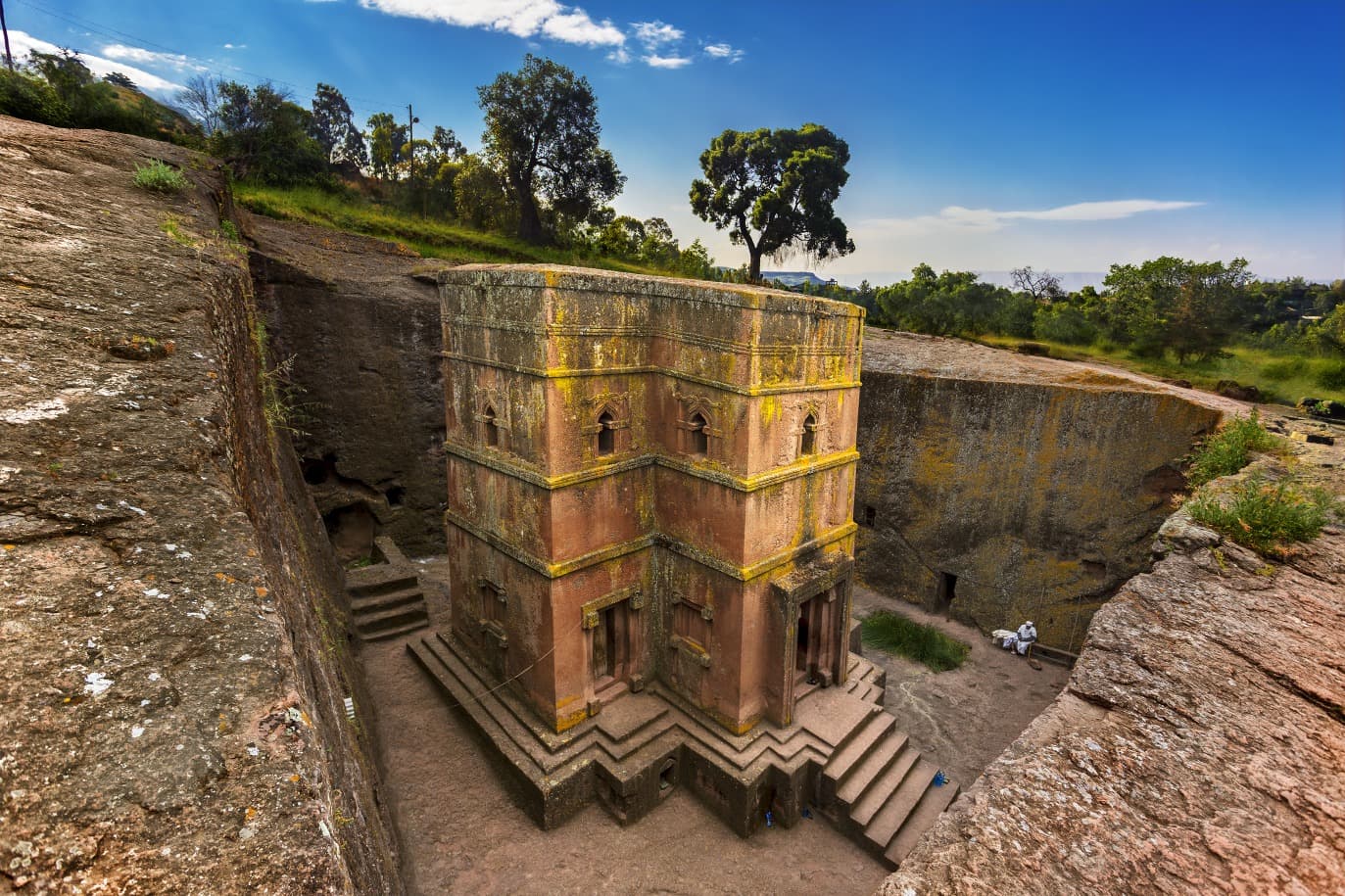
LALIBELA, the "Black Jerusalem"
Transfer to the airport for the flight to Lalibela
Arrival at the airport: pickup and transfer to your hotel
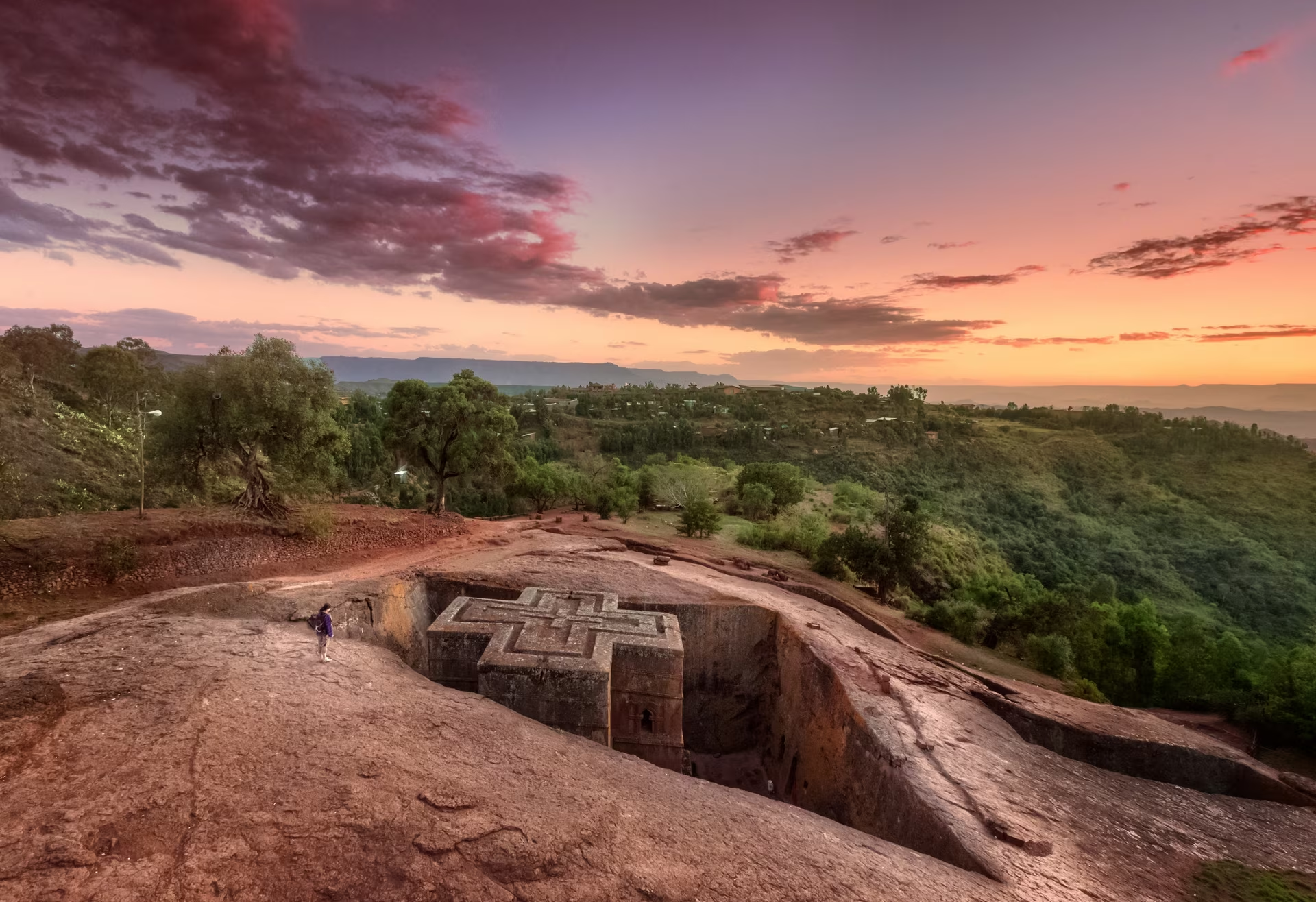
Arrival in Lalibela, the holy city of Éthiopie's Christians, listed as a UNESCO World Heritage Site. Standing at 2500 m altitude, the small town of Lalibela is the most important pilgrimage site in the country.
Discovery of the first part of the archaeological site inscribed on the UNESCO World Heritage list. By creating the city towards the end of the 12th century, King Lalibela had the ambition to make it a faithful replica of Jerusalem, hence its name of "Black Jerusalem".
It is an extraordinary gathering of buildings and underground galleries. The churches are built around a rigorous urban plan, separated by a stream that recalls the Jordan. The interiors are decorated with paintings illustrating scenes from the Old and New Testament.
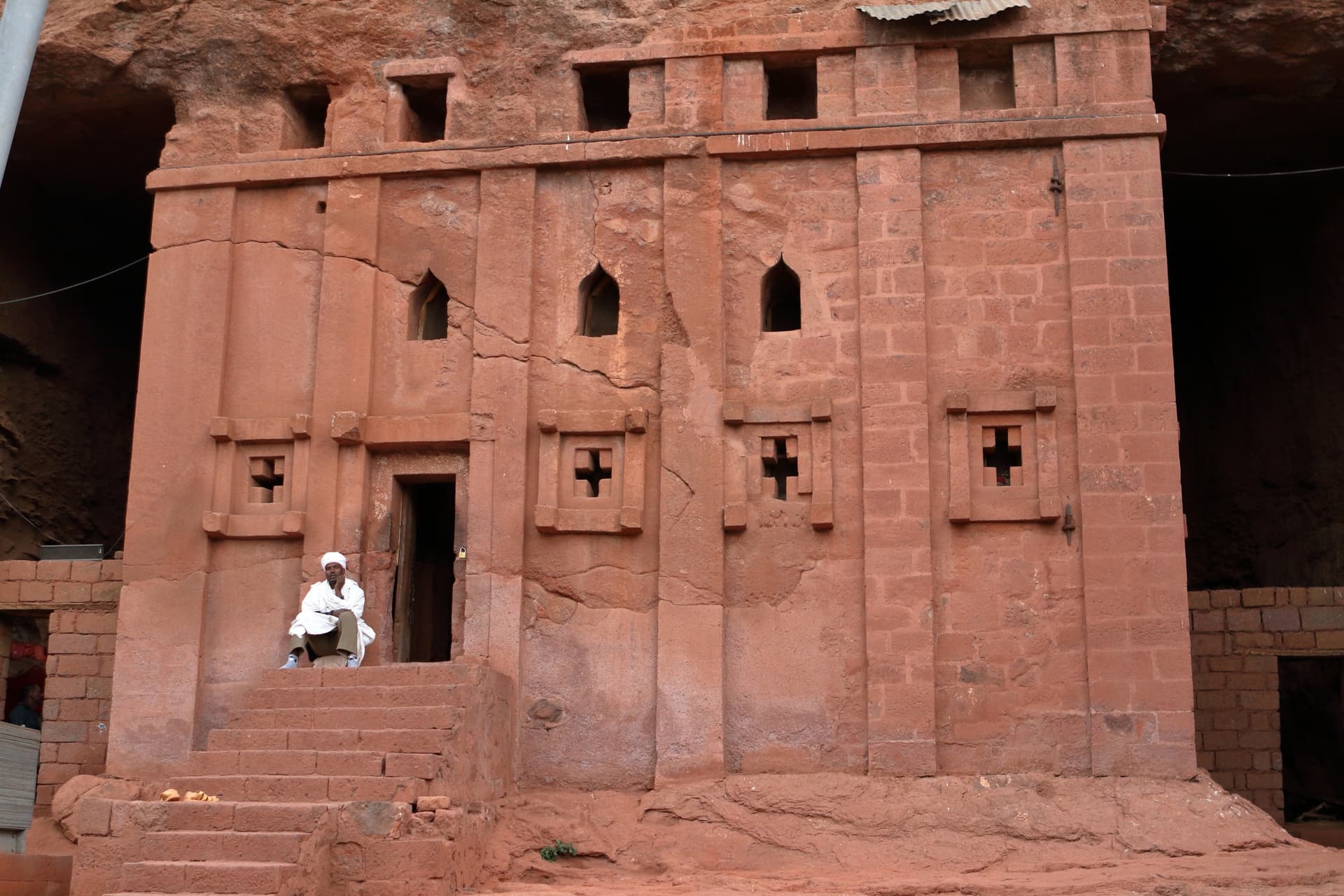
At the Dawn of Christianity
We continue our tour of the riches of Lalibela.
The churches were not built in a traditional manner, but carved into the rock in monolithic blocks. Within these blocks, doors, windows, columns, different floors, roofs, and more were then excavated.
This titanic work was subsequently completed by a vast system of drainage ditches, trenches and passages for processions with, sometimes, openings towards hermit caves or catacombs.
Also discover the brand new museum dedicated to the city.
In the evening, tasting of tedj, a kind of Éthiopie mead made from honey. Lalibela meaning "he whom the bees respect", the tedj of Lalibela is very renowned.
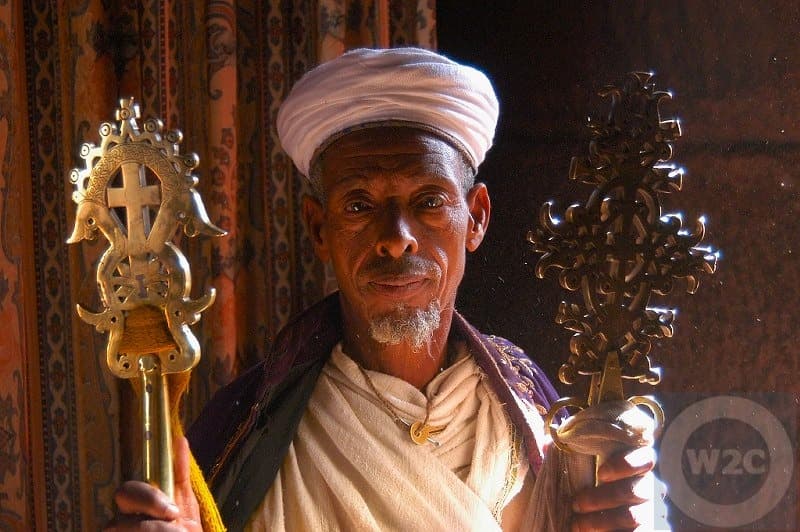
Lalibela and the village communities of the Wollo highlands
Depending on the liturgical calendar, possibility to attend a religious service early in the morning in one of the churches, lulled by the chanting of priests and marked by the rhythm of sistrums.
Walk through the surrounding countryside to meet village communities on the high plateau.
Discovery of Ethiopian gastronomy through an introduction to traditional cooking and in particular the preparation of the famous injéra, the Ethiopian flatbread.
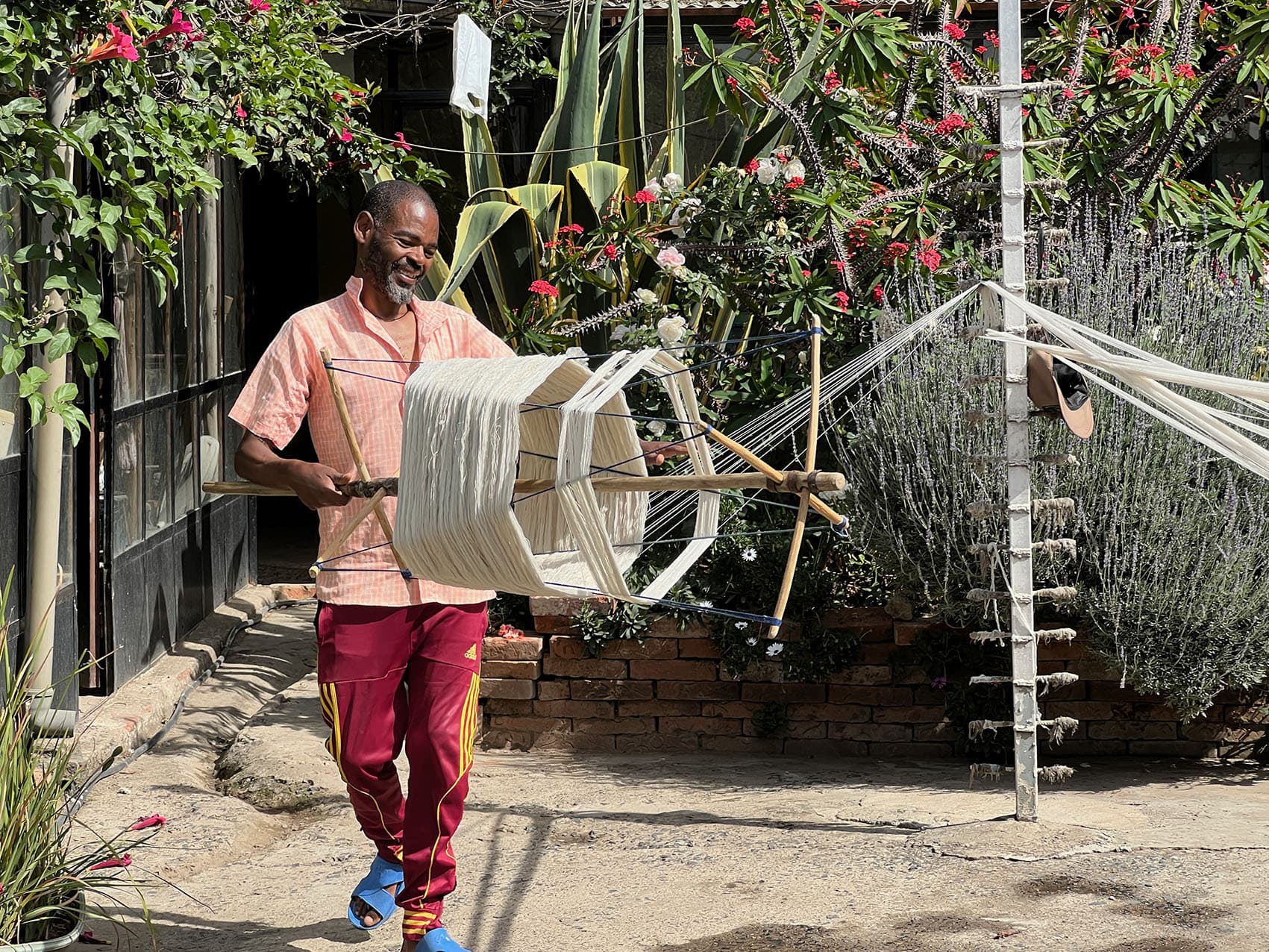
Return to the capital
Transfer to the airport for the flight to Addis Abeba.
Airport arrival: pickup
Shopping and/or visit to craftsmen's workshops and/or market
Transfer to the airport for your return flight.
Price per person
Indicative price per person, based on double room. Each trip is customized according to your preferences.
This trip can be tailored to your preferences
This itinerary provides an excellent foundation for discovery, but it can be fully customized. Our local advisors build each trip tailored to your budget, dates and preferences.
Not included
- Alcoholic beverages
- Meals not mentioned in the program
- Photo rights for tribes
- Tips and Personal Expenses
Included
- Domestic flights (based on reduced rates with an international Ethiopian airlines flight)
- Private vehicle transportation with driver
- Hotel or guesthouse accommodation with breakfast (on a double room basis)
- Lunch and dinner meals with a non-alcoholic beverage (days 2 to 11)
- An English-speaking guide throughout the Omo Valley (days 2 to 11)
- An English-speaking guide at each stage (days 12 to 20)
- The boat excursion on Lake Chamo
- The boat excursion on Lake Tana
- The 2-day trek in Simien Mountains National Park with full board all-inclusive on site (permits, accommodation taxes, English-speaking guide, cook, meals with non-alcoholic beverages, tent accommodation)
- Entries to the different sites, permits and activities as mentioned in the program
Practical Information
Registration is considered firm and final after payment of a deposit of 30% of the total price and acceptance of the specific terms of sale.
The balance must be paid no later than 45 days before the departure date.
See our specific terms of sale for full details.
In the event of cancellation by the traveller, the following fees apply:
- More than 60 days before departure: 40% of the total price (deposit retained)
- Between 60 and 30 days before departure: 50% of the total price
- Less than 30 days before departure: 100% of the total price
We strongly recommend taking out cancellation insurance. See our specific terms of sale for full details.
The information below concerns travelers who are nationals of the European Economic Area (EEA), Switzerland, and Canada traveling to Ethiopia for a tourism stay. As entry rules may change, we recommend verifying this information with the official authorities before your departure.
Passport
To enter Ethiopia, your passport must be valid for a minimum of six months after the date of entry into the country and must include at least two blank pages for immigration stamps.
The document must be in good condition (no damaged, torn, or altered pages).
Visa
Nationals of the European Economic Area, Switzerland, and Canada must have a visa to enter Ethiopia. There is no visa exemption for tourism stays.
Two main options are available:
the electronic visa (e-Visa), to be requested online before departure via the official Ethiopian immigration services portal, for entry by air, in particular at Addis Ababa International Airport;
the visa on arrival, available at certain official entry points, particularly at Addis Ababa Bole International Airport, subject to changes in access conditions.
The tourist visa is generally granted for stays up to 30 days, with the possibility of extension on site through Ethiopian immigration services.
The authorities may request:
an outbound travel ticket (return flight or onward connection),
proof of sufficient financial resources for the duration of the stay,
an accommodation reservation for the duration of the stay.
Health and Vaccinations
No vaccination is required to enter Ethiopia, except in the case of arrival from a country at risk of yellow fever, in which case proof of yellow fever vaccination (international vaccination certificate) is required upon entry.
The following vaccinations are nonetheless strongly recommended before departure:
yellow fever (depending on areas visited),
hepatitis A and B,
typhoid,
meningitis,
update of routine vaccinations (tetanus, poliomyelitis, measles).
Malaria is present in many regions of Ethiopia, particularly outside Addis Ababa. Antimalarial prophylaxis is strongly advised. Consult your doctor or a travel medicine center before departure.
Travel with Children
Minors must hold their own valid passport and an individual visa covering the duration of the stay.
In some European countries, when a minor travels without one of their parents, an exit authorization from the territory may be required according to the regulations of the country of residence.
Other Nationalities
Entry conditions may vary depending on nationality. Travelers concerned should inquire with the embassy or consulate of Ethiopia in their country of residence.
To participate in our trips, it is strongly recommended to have evacuation assistance and foreign medical expenses coverage.
Your local agency encourages you to review the specific policy developed with our partner CHAPKA ASSURANCES and AXA ASSISTANCE.
To subscribe to insurance, learn about coverage and rates, follow the link below.
CAP EXPLORER: The complete insurance solution designed for a worry-free trip!
Choose the plan that best suits you:
Explorer'Multirisque
Explorer'Annulation
Explorer'Assistance
Explorer' Complémentaire Carte Bancaire
Specific to our trips, we strongly recommend subscribing to one.
If you choose to subscribe to one of these plans, the policy detailing all coverage and claims procedures are available on the insurer's website.
Your local agency will be aware of it, but only the participant is responsible for complying with claims notification procedures. The participant must therefore keep this policy with them throughout their trip.
Chapka — Cap Explorer
Our insurance partnerTravel with peace of mind with our partner Chapka. Cancellation, repatriation, medical expenses, baggage… All the coverage for a worry-free trip.
Travel with peace of mind — I'll handle the insuranceFrequently asked questions
An e-visa is required and must be applied for online before departure. Your passport must be valid for at least 6 months beyond your planned entry date. Processing is usually quick (2-3 business days). Before booking your trip, check with the consular authorities of your destination regarding entry requirements applicable to your nationality, including visa fees and authorized lengths of stay.
Go to the My Trips section to find all your projects.
You can send a message to your host directly from the Tea Lounge.
For a tailor-made quality trip, plan between 160 and 260 euros per day and per person, including accommodation, meals, internal transport (with domestic flights), English-speaking guide and activities. International flights (700-1100 euros round trip) are additional. The Omo Valley tribe trip is a unique experience.
Your documents are accessible in the Documents tab of your trip.
Absolutely. We adapt each itinerary to travellers' profiles. For families, we prioritize relaxed paces, family-friendly accommodations, engaging and educational activities, and comfortable private transfers. Our English-speaking local guides know how to capture children's attention with age-appropriate anecdotes.
It's simple. You exchange with our local team to define your wishes, budget and dates. You receive a detailed itinerary proposal within 48 hours. You adjust every detail together until you reach the perfect version. You confirm and depart with peace of mind. Your local agency remains available 7 days a week throughout your trip.
In case of emergency, contact your local agency immediately.
Payment is generally made in two installments.
Our agency is part of the Nomadays network, registered in France. You benefit from APST guarantee (Association Professionnelle de Solidarité du Tourisme) which covers 100% of your funds. Secure payment, repatriation insurance included, and English-speaking assistance 24/7 on the ground throughout your stay.

Let's talk about your adventure — Omo Valley Southern Peoples
Weaver of encounters in Ethiopian lands, based in Addis-Abeba
Ethiopia calls for curiosity and openness. What I love is helping travelers move beyond first impressions to dive into the depth of the country.
— Anna