Temples and Valleys of Western Bhoutan
Eight days in the heart of western Bhoutan, between thousand-year-old dzongs and secret valleys where black-necked cranes settle.
Duration
8 days
From
€2,490/pers.
Ideal seasons
Mar, Apr, May, Oct, Nov
Style
Guided tour
Comfort
Charm & Character
Travelers
Couple, Solo, With friends, senior
The spirit of travel
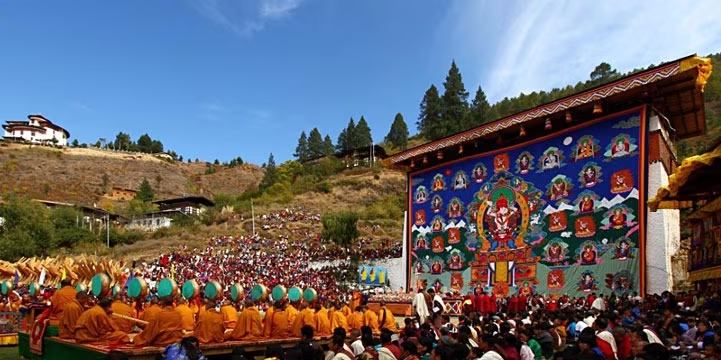
This 8-day journey invites you to discover the valleys of western Bhoutan through an itinerary combining religious heritage, nature and local traditions. From Thimphu to Paro, passing through the Phobjikha valleys, Punakha and Haa, you will explore some of the kingdom's most emblematic sites.
The itinerary includes visits to numerous temples and dzongs, witnesses to Bhutanese history and culture, as well as several accessible hikes offering beautiful views of the Himalayan landscapes. You will notably walk the Gangtey nature trail and reach the famous Taktsang monastery, better known as the Tiger's Nest. A balanced circuit to discover Bhoutan through its landscapes, spirituality and rich biodiversity.
The stages of your journey
Highlights
Day-by-day itinerary
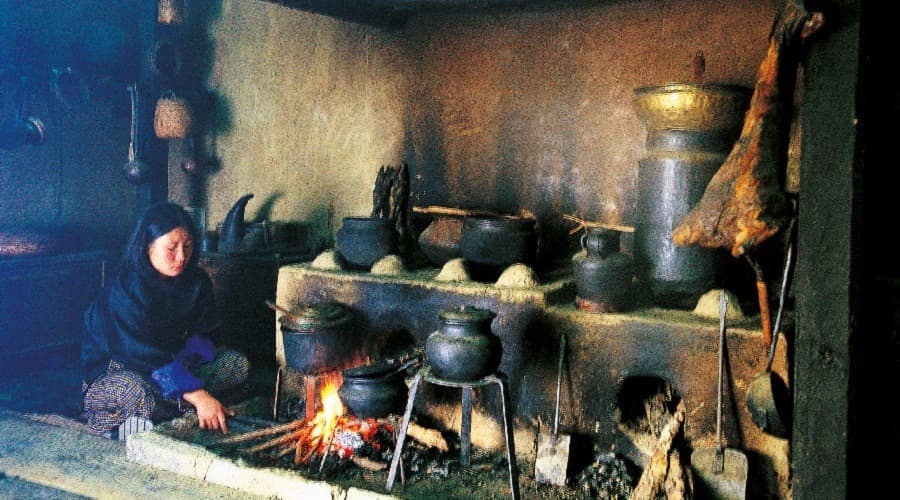
Welcome to Bhoutan
We land at Paro International Airport, after a spectacular flight offering stunning views of the mountains. At the airport we meet our guide and driver who take us through the Paro valleys and Thimphu towards Bhutan's capital, Thimphu, at 2320m altitude.
After some rest and refreshments at the hotel, we begin our city tour at the Buddha Temple, where the tallest statue of the seated Buddha overlooks the city.
The Memorial Chorten is, it is said, the "most religious monument in Bhutan". People of all ages come to walk around it reciting prayers.
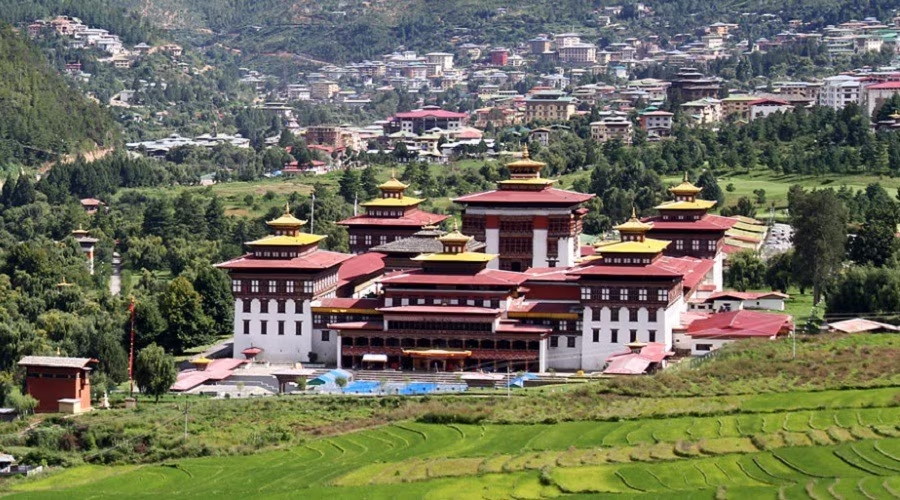
A few minutes north of the city we visit the Tashichho Dzong. Seat of the Bhutan government since 1952, it currently houses the throne room and the king's offices, the secretariat and the ministries of Interior and Finance. It is also home to the monastic body.
In the evening we take a leisurely stroll through the city and especially along the many stalls of the Artisanal Market.
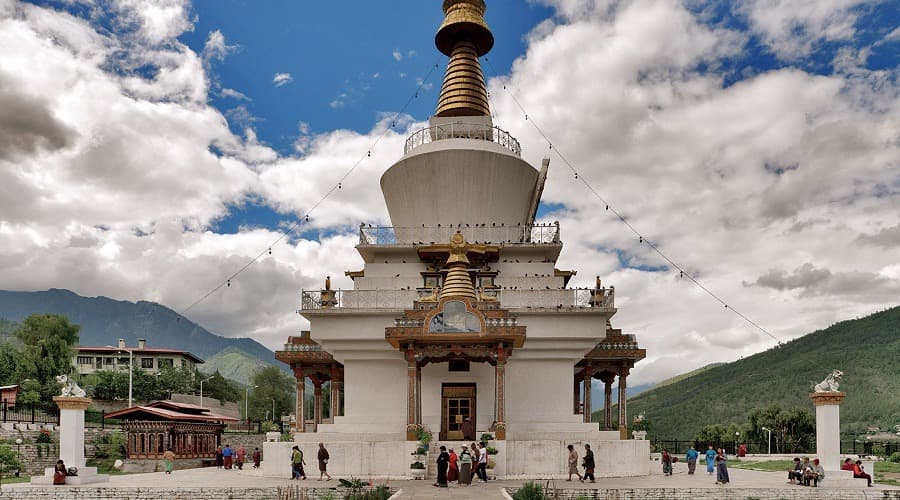
In the Bhutanese capital
In the morning, we head north of the Thimphu valley (15 km away) and enjoy a short hike of 30 to 45 minutes to the Cheri Monastery (Cheri Goemba). This monument built in 1620 by Zhabdrung Ngawang Namgyal is currently an important teaching and meditative retreat center of the Southern Drukpa Kagyu sect.
We continue our day with the learning center for Bhutanese artists: the School of Thirteen Arts and Crafts. You can specialize in one of the thirteen arts and crafts, including painting, weaving, sculpture, blacksmithing or embroidery. It is the best place to discover Bhutan's traditional arts and crafts and you can observe students learning the different techniques taught at the school.
The Textile Museum is particularly interesting for learning about the national art of weaving.
We finally stroll through the Centennial Farmers Market (open Thursday to Sunday).
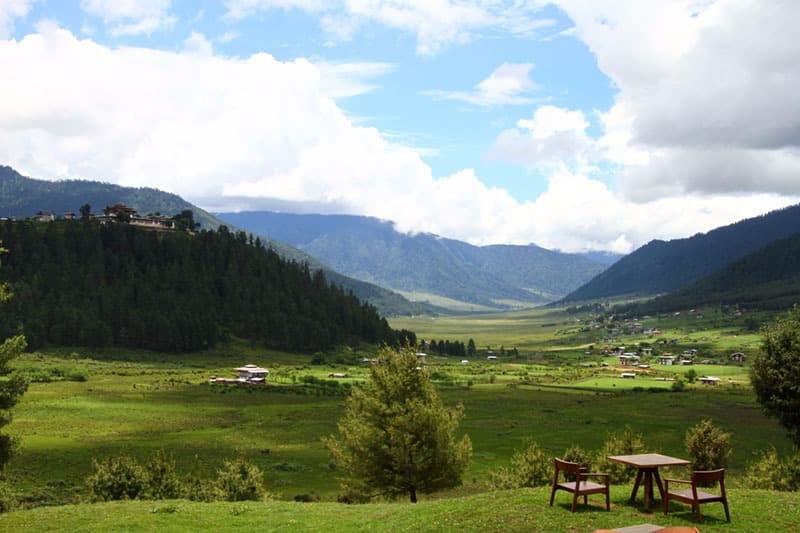
In the heart of nature in the Phobjikha Valley
After breakfast, we head towards the Phobjikha Valley, known for its vast wintering grounds that serve as refuges for black-necked cranes, rare and endangered in Bhutan.
At approximately 3000m altitude, Phobjikha is a vast valley of alpine wetland zones considered the largest and most important in the country. It is often cited for the harmonious coexistence of its inhabitants with nature and the valley also holds great cultural significance.
On the way we stop at the Dochula Pass (3150m), decorated with 108 Druk Wangyel Chortens, which were built to celebrate the stability and progress brought to Bhutan by His Majesty Jigme Singye Wangchuck, the fourth king. This pass is renowned for its spectacular views of the eastern Himalayan mountain ranges.
We go to visit the Gangtey Monastery which overlooks the wetlands dotted with farms and lush forests. We continue with a short walk on the Gangtey natural trails (duration: 1h30), considered among the most beautiful short walks in Bhutan. In the evening, we visit a traditional village house.
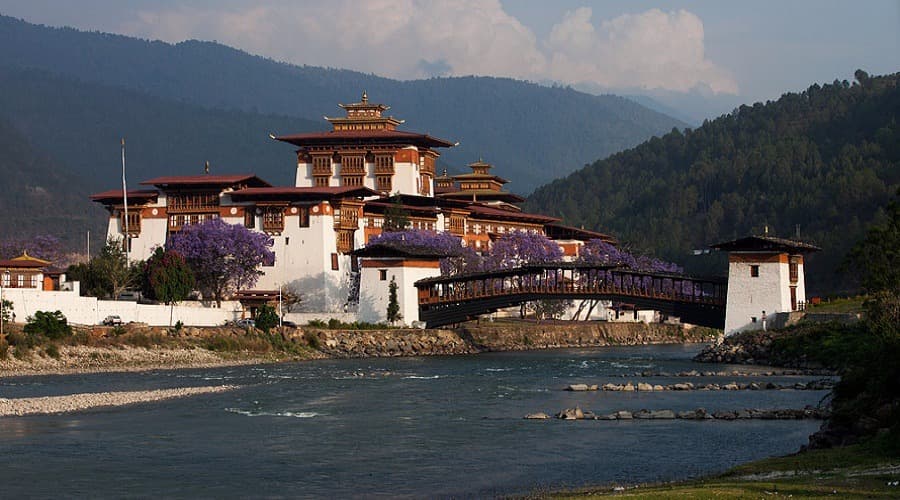
From Phobjikha Valley to Punakha Valley
This morning we explore a little more of the magnificent Gangtey valley and its typical villages.
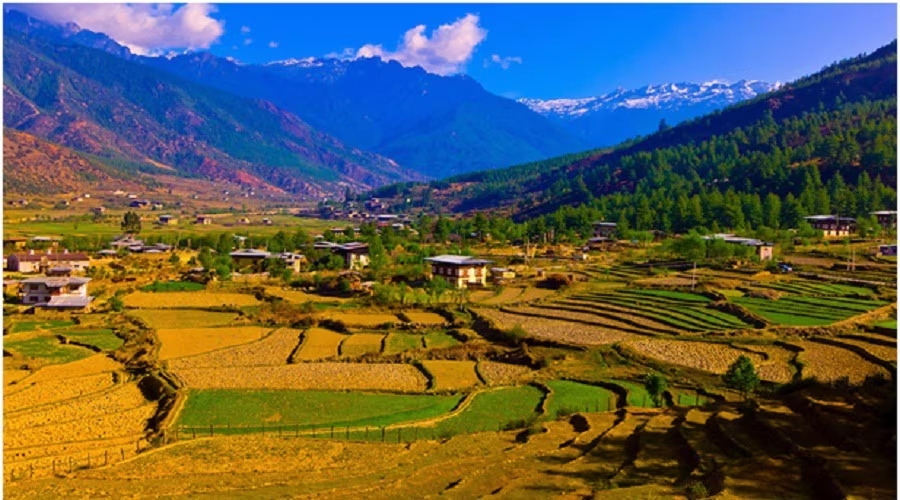
We take the road to Punakha. The Punakha valley is a relatively warm region, almost tropical.
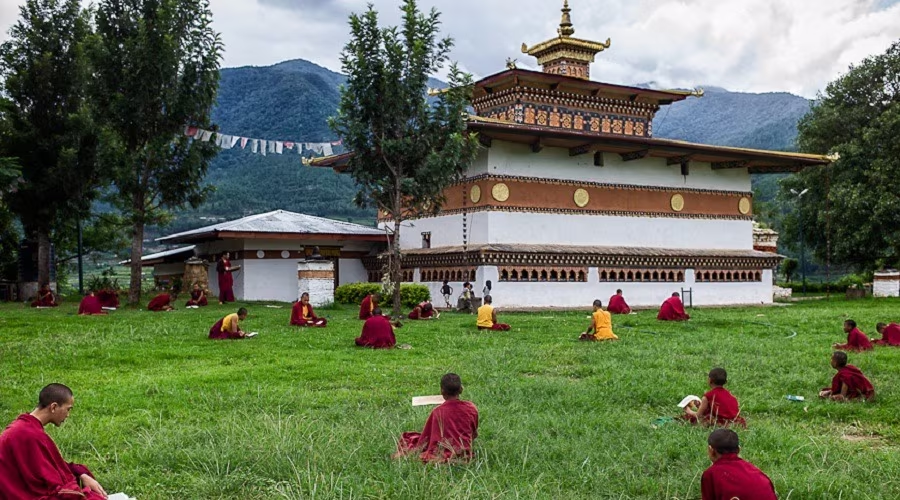
Upon arrival in Punakha, we explore Chimmi Lhakhang during a short 45-minute hike that takes us to the Temple of Fertility built in honor of the Divine Madman Drukpa Kunley whose eccentric customs and practices have inspired local folklore. It is here that we can see thousands of phallic representations!
In the evening, we visit the magnificent Punakha dzong, established at the junction of the Pho Chu and Mo Chu rivers. It was in this palace-fortress that the first king was crowned. Near the fort, the suspension bridge promises to delight thrill-seekers and photography lovers.
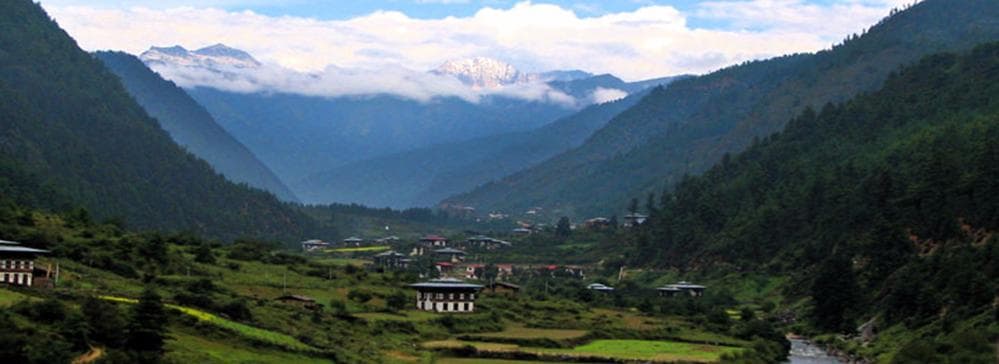
The Black and White Temples
We head towards one of the most beautiful valleys in the country, but also one of the least developed, the Haa valley.
Local legend closely links Haa's history to that of the Black and White temples: Lhakhang Nakpo and Lhakhang Karpo, which we set out to explore.
We spend the evening strolling around the town.
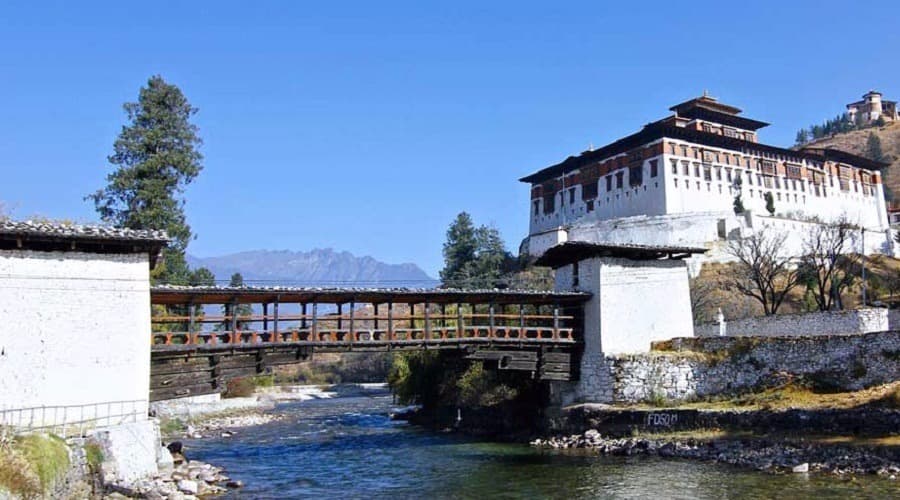
Towards Paro via Chelela Pass
After our breakfast we take the road to Paro.
On the way we explore the Chelela Pass which at more than 3900 meters altitude separates the valleys of Paro and Haa. The views of Mt Jomolhari (over 7000m) and the Tibetan border are breathtaking.
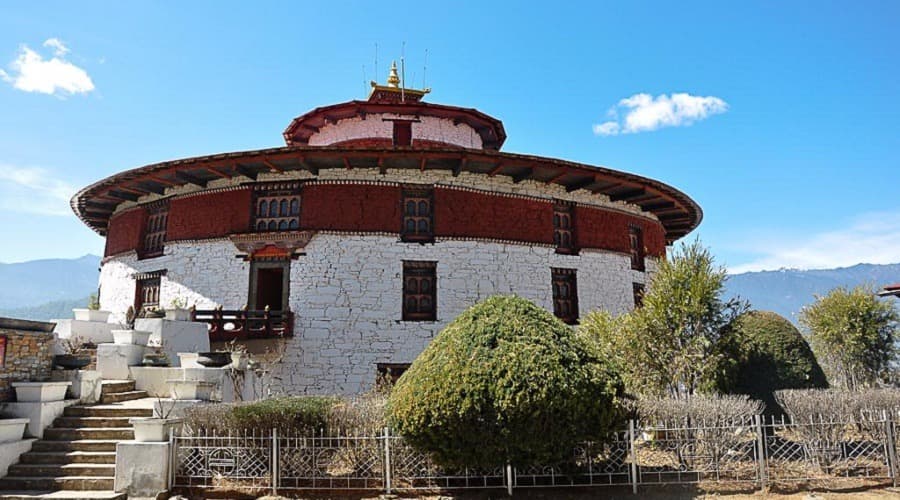
In Paro we visit the royal museum, a former watchtower converted into a national museum and overlooking Paro Dzong.
We visit the Paro Dzong, also called Rinpung Dzong. Built in 1646 by Shabdrung Ngawang Namgyal, the first spiritual and temporal sovereign of Bhoutan, the Dzong houses the monastic body of Paro as well as its administrative institutions. Access to the Dzong is via a traditional covered bridge called Nemi Zam which offers a superb view of the architectural marvel of the Dzong as well as the life surrounding it.
In the evening we have the choice between resting at our hotel or exploring the craft shops in the city and strolling through the streets.
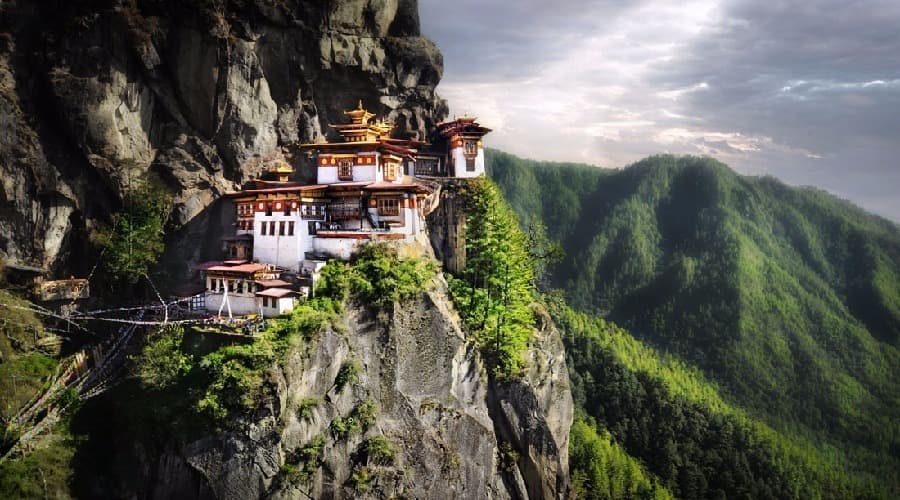
The Tiger's Nest Trek
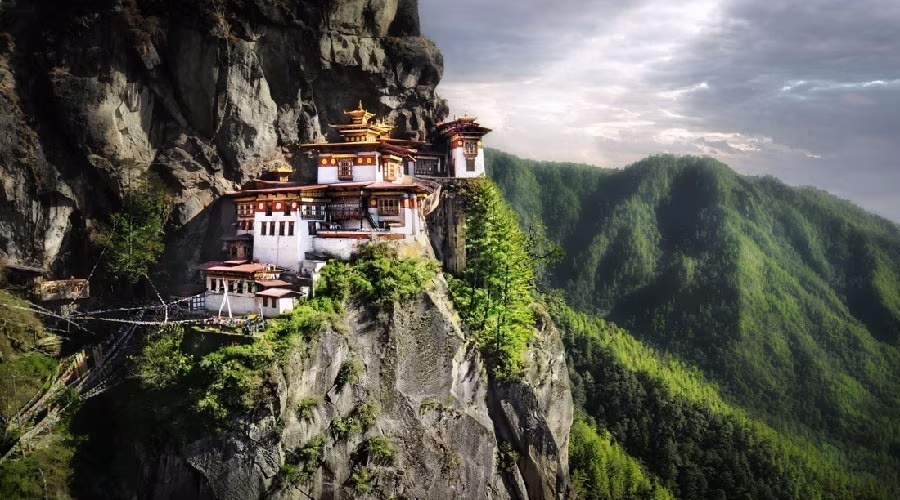
After our breakfast, we embark on quite a sporty hike to reach the Tiger's Nest. It is the most picturesque icon and one of the main attractions of Bhoutan. The Tiger's Nest of Taktshang is located on the edge of a steep cliff, 300m above the Paro Valley.
In the afternoon we pass by the Kyichu Lhakhang, one of the oldest sacred sanctuaries in the kingdom and whose creation dates back to the 7th century.
In the evening we have the choice between resting at our hotel or exploring the town's craft shops and strolling through the streets.
Thank you and have a safe return!
Last free time in Bhoutan before heading to the airport, depending on our flight schedule.
Price per person
Indicative price per person, based on double room. Each trip is customized according to your preferences.
This trip can be tailored to your preferences
This itinerary provides an excellent foundation for discovery, but it can be fully customized. Our local advisors build each trip tailored to your budget, dates and preferences.
Not included
- International flights
- Repatriation Insurance
- Travel Insurance
- Drinks not included / Alcohols
- Phone calls
- Non-mentioned transport
- Unlisted Excursions
- Everything that is not mentioned in "Included"
Included
- Accommodation in 3* hotels (based on 2 people per room)
- Full board
- Entry fees for activities
- English-speaking experienced guide (English-speaking guide as optional add-on with supplement)
- All transportation
- Government tax and other taxes
- Visa Fees
Practical Information
Registration is considered firm and final after payment of a deposit of 30% of the total price and acceptance of the specific terms of sale.
The balance must be paid no later than 45 days before the departure date.
See our specific terms of sale for full details.
In the event of cancellation by the traveller, the following fees apply:
- More than 60 days before departure: 40% of the total price (deposit retained)
- Between 60 and 30 days before departure: 50% of the total price
- Less than 30 days before departure: 100% of the total price
We strongly recommend taking out cancellation insurance. See our specific terms of sale for full details.
The information below provides entry requirements for tourists traveling to Bhutan. Entry regulations may change, and you are strongly advised to verify all information with the official authorities before your departure.
Passport
To enter Bhutan, your passport must be valid for a minimum of six months beyond your date of entry and must contain at least two blank pages for immigration stamps.
The document must be in good condition (no damaged, torn, or altered pages).
Visa
A visa is required to enter Bhutan for tourism purposes. There is no visa exemption for tourist stays.
The visa is issued exclusively through the Tourism Council of Bhutan (TCB) and only via an authorized tourism operator. Independent travel is not permitted: all tourist visits must be arranged through a certified travel agency, which will handle the visa application on your behalf.
The visa is granted for the duration of your planned stay, generally up to 30 days, with the possibility of extension upon request to the competent authorities.
Sustainable Development Fee (SDF)
All foreign visitors must pay the Sustainable Development Fee (SDF), a daily charge established by the Bhutanese government to support sustainable development and environmental protection.
The current SDF rate is 100 USD per person per night. This fee is typically included in the package offered by the authorized tourism operator and generally covers:
basic accommodation,
meals,
an authorized official guide,
internal transportation.
Payment of the SDF is a mandatory requirement for obtaining a Bhutanese visa.
Travel with children
Minors must hold their own valid passport covering the duration of the stay, as well as their own Bhutanese visa.
When a minor travels without one or both parents, a parental authorization or exit permit may be required depending on the regulations of the country of residence.
Health
No vaccinations are officially required for entry to Bhutan. However, due to the high altitude of many regions in the country, it is advisable to consult a doctor before departure to take appropriate precautions, particularly against altitude sickness. Travel and medical insurance that covers emergency evacuation is strongly recommended.
Entry requirements by nationality
Entry conditions may vary depending on your nationality. All travelers are advised to verify the specific requirements for their country by contacting the embassy or consulate of Bhutan in their country of residence, or by visiting the Tourism Council of Bhutan website.
To participate in our trips, it is strongly recommended to be insured for repatriation assistance and medical expenses abroad.
Your local agency encourages you to familiarize yourself with the specific contract developed with our partner CHAPKA ASSURANCES and AXA ASSISTANCE.
To subscribe to insurance, learn about coverage and rates, follow the link below.
CAP EXPLORER: The comprehensive insurance solution designed to enjoy your trip with peace of mind!
Choose the plan that best suits you:
Explorer'Multirisk
Explorer'Cancellation
Explorer'Assistance
Explorer'Supplementary Bank Card
Specific to our trips, we strongly recommend subscribing to them.
If you choose to subscribe to one of these plans, the policy detailing all coverage and claim reporting procedures are available on the insurer's website.
Your local agency will be aware of it, but only the participant is responsible for complying with the claim reporting procedures. The participant must therefore keep this policy with them throughout their trip.
Chapka — Cap Explorer
Our insurance partnerTravel with peace of mind with our partner Chapka. Cancellation, repatriation, medical expenses, baggage… All the coverage for a worry-free trip.
Travel with peace of mind — I'll handle the insuranceFrequently asked questions
Yes, all foreign travelers must obtain a Bhutanese visa and pay a Sustainable Development Fee (approximately 100 USD per day). The visa is obtained through an approved local agency (mandatory) before arrival. Our team handles all the formalities for you.
Go to the My Trips section to find all your projects.
You can send a message to your host directly from the Tea Lounge.
Bhutan practices high-quality tourism with strong added value. Budget between €300 and €450 per day and per person, including the Daily Tariff, accommodation, meals, transport, English-speaking guide and activities. International flights (€1000-1400 return) via Delhi or Bangkok are additional.
Your documents are accessible in the Documents tab of your trip.
Absolutely. We adapt every itinerary to your travel profile. For families, we prioritize relaxed paces, family-friendly accommodations, engaging and educational activities, and comfortable private transfers. Our English-speaking local guides know how to capture children's attention with age-appropriate anecdotes.
It's simple. You exchange with our local team to define your wishes, budget and dates. You receive a detailed itinerary proposal within 48 hours. You fine-tune every detail together until it's perfect. You confirm and travel with peace of mind. Your local agency remains available 7 days a week throughout your trip.
In case of emergency, contact your local agency immediately.
Payment is generally made in two installments.
Our agency is part of the Nomadays network, registered in France. You benefit from APST (Association Professionnelle de Solidarité du Tourisme) guarantee which covers 100% of your funds. Secure payment, repatriation insurance included, and English-speaking assistance 24/7 on the ground throughout your stay.

Let's talk about your adventure — Thimphu Capital
Keeper of Himalayan Traditions, based in Thimphu
Bhutan is a country that moves at its own pace, trying to preserve what truly matters. It's this harmony between nature, culture, and spirituality that I love sharing with travelers.
— Yangchen