The mythical camel trek from Tamanrasset to Djanet
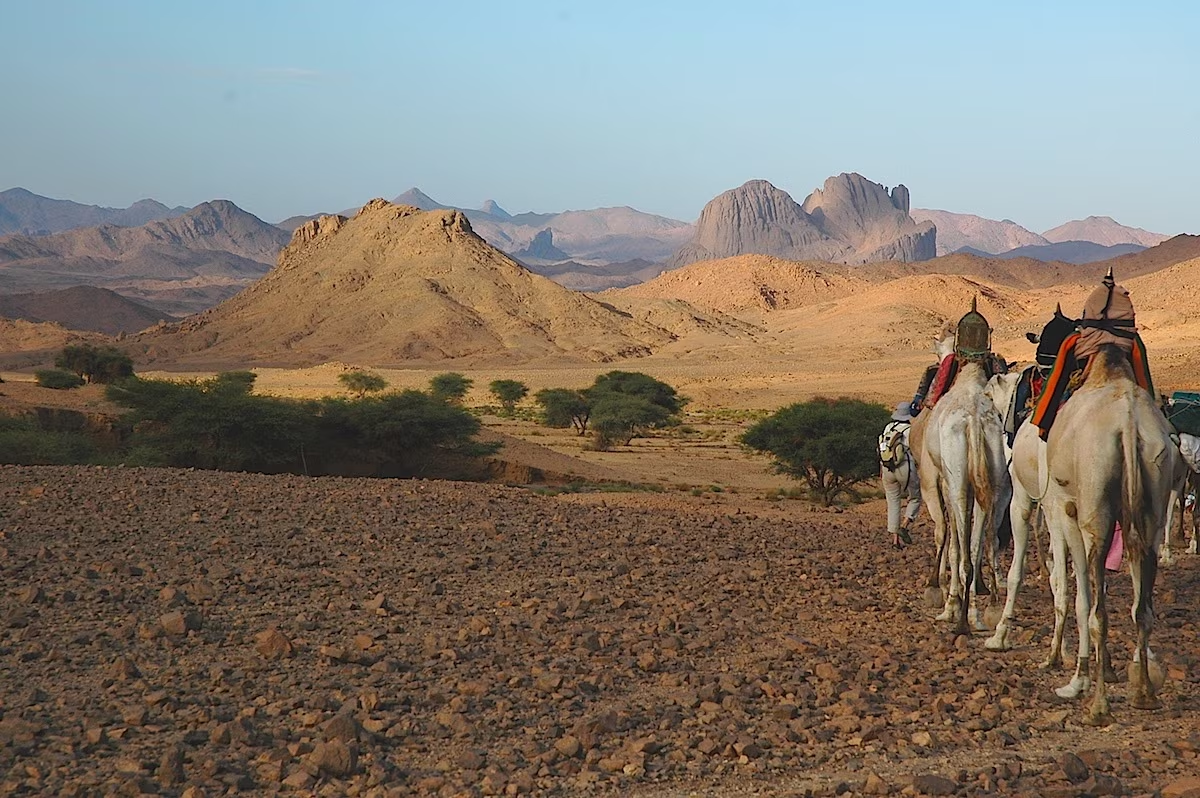
620 kilometers on camelback between Hoggar and Tassili N'Ajjer, following the paths of the central Sahara's trade caravans.
Duration
23 days
From
€780/pers.
Ideal seasons
Jan, Feb, Mar, Oct, Nov, Dec
Style
Expeditions
Comfort
rustique
Travelers
Solo, With friends, groupe
The spirit of travel
OUR TRIPS ARE TEMPORARILY SUSPENDED
Tamanrasset region, Hoggar, Tefedest, Immidir, Ahnet and Hoggar Tassili:
Since September 2025, increased restrictions (mandatory escort in Tamanrasset) limit our camel treks and meharis, preventing us from taking the emblematic routes of Atakor and Hoggar. These constraints call into question the very essence of our expeditions, founded on freedom and adventure.
We are suspending our trips, not without regret. Our itineraries remain visible online, a testament to these exceptional Saharan landscapes.
Tamanrasset, December 01, 2025
This mehari is undoubtedly the most mythical one can do in the Central Sahara. Connecting two legendary massifs, Hoggar and Tassili N'Ajjer, this mehari of approximately 620 Km completed over 20 days is intended for people with experience in the Sahara, in mehari or trekking, and absolutely certain of being able to endure and appreciate 20 days of harsh caravanning life, with all the physical and psychological constraints that entails.
Indeed, even if you have already done a mehari or camel trek of a few days in the Sahara, you should not compare this crossing to your previous experience. Tamanrasset - Djanet is not twice a "small Saharan trip"; it is really something else, a large-scale committed adventure.
This route is particularly well suited to mehari. This mehari is the fruit of our long experience and our perfect knowledge of the Sahara. We offer you an exceptional itinerary, which follows the traces of ancient trade caravans. We accompany you with our loyal and competent camel teams, who know the region and its secrets well. We assure you a quality journey, in respect of Saharan culture and environment.
It is essential that all travelers, without exception, actively participate in all the collective work required by such a crossing, such as setting up tents, preparing meals or caring for camels. This is the condition for creating a good atmosphere within the caravan and for making this exceptional journey a success.
Although we know the trail we are taking perfectly, we can only give you the itinerary in its general outline.
Indeed, the details of the route will be decided later, or even day by day, as it is currently difficult to know the abundance of pastures and the state of water points. The stages will have to be decided on site based on these two factors, to which the following factors are added: climatic conditions, watering of animals…
We are pleased to recall that this mehari is more of an adventure than an organized and day-by-day programmed journey…
Here are the four main stages of the mehari.
1/ The mountains between Tamanrasset and Tin Tarabin.
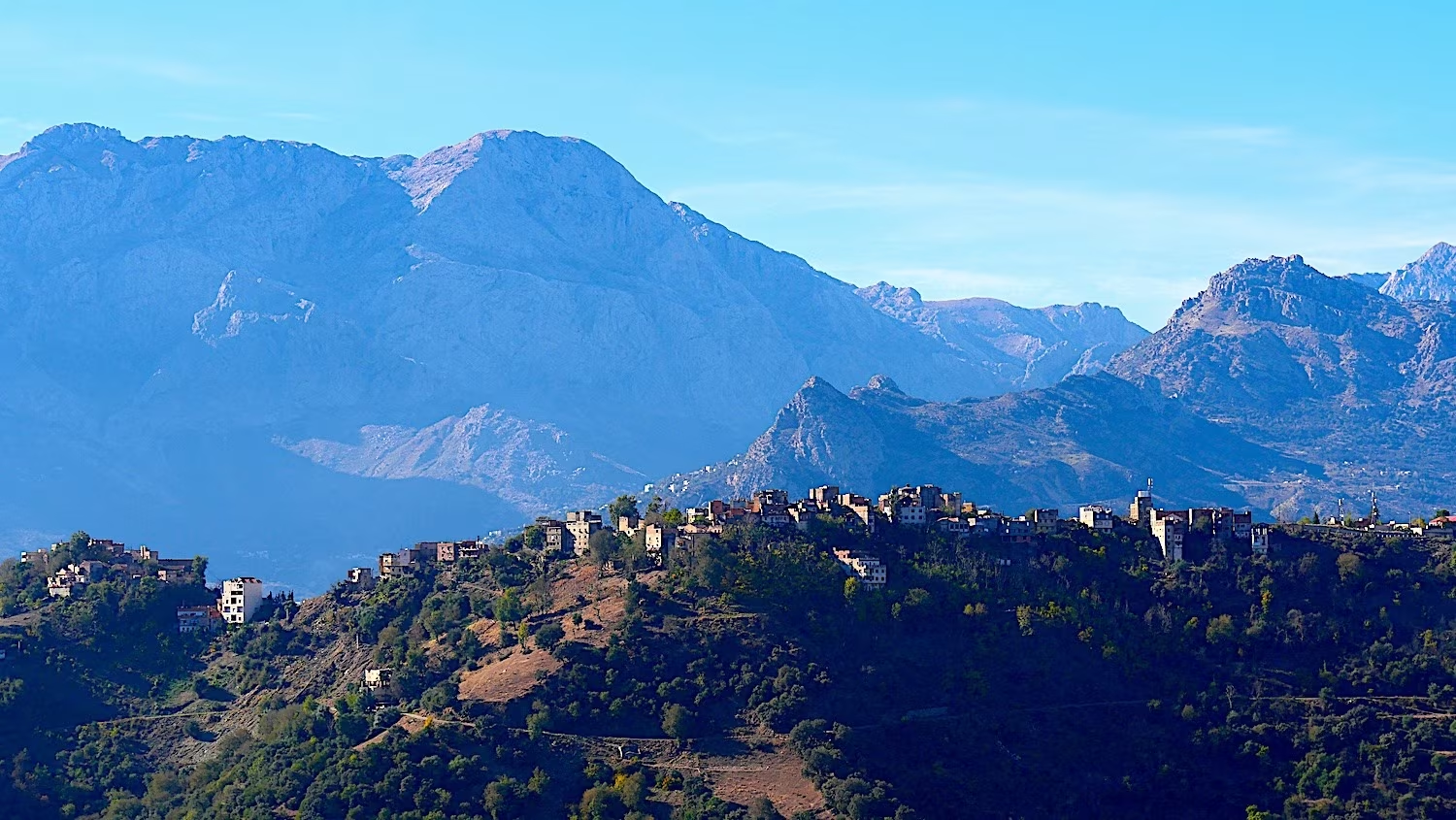
The camel trail crosses from west to east the territories of three tribes Dag Rali, Adjouh n'Téhélé, Aït Loaïen, through a succession of narrow wadis and passes. It passes north of a small town, Tahifet, in Adjouh n'Téhélé territory. This village has become an important farming center. Upstream and downstream, it is nothing but a succession of gardens irrigated using motor pumps.
2/ The great wadis and Mount Serkout 2306m.
An Aït Loaïen village, Imbilel, was created at the confluence of the Imbilel and Tin Tarabin wadis. Several large gardens are now cultivated there. We must avoid it because a foreign caravan does not cross an agglomeration belonging to another tribe (we are Dag Rali and Adjouh n'Téhélé, and the village is Aït Loaïen!).
The trail follows the Tin Tarabin wadi cluttered with tamarisk bushes and leads us to the Amajjar, Takalous and Tin Hagen wadis, to reach the gates of the vast sandy plains of the Ténéré de Tafassasset, the Anahaf mountains definitively crossed.
3/ The basins of the Tafassasset and Tasset wadis.
Taking the Tazat, the "Female Anon" (2061m), an enormous mountain dominating the plain by more than 1000m, as our target, the trail crosses the great sandy basins and vast plains that precede the Admer erg. The Tafassasset wadi is an ancient river that flowed into Lake Chad, a very, very long time ago…
4/ The pre-Tassilian border.
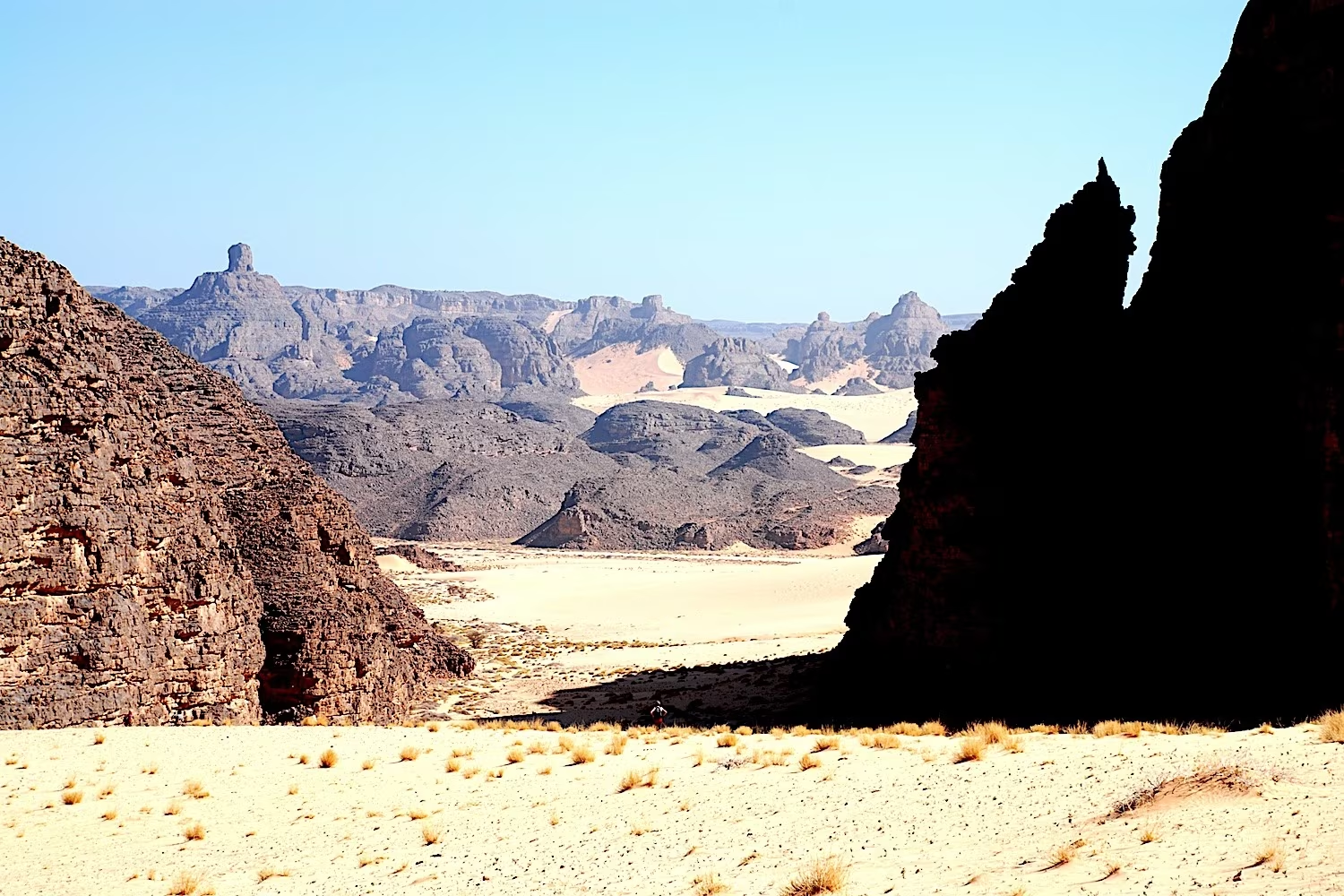
Finally, here is the Admer erg which we skirt to the north and which we have every leisure to admire for its dunes with harmonious lines. We soon enter the sand corridor that borders Tassili n'Ajjer. This cuts out on the horizon as a long jagged and irregular barrier. We penetrate it to end our mehari in the midst of canyons, rocky towers and sandy wadis that slowly lead us towards the Djanet oasis. Since the Essendilen wadi, we are on the territory of the Ajjer tribe of the Kel Medak.
The stages of your journey
Highlights
Day-by-day itinerary
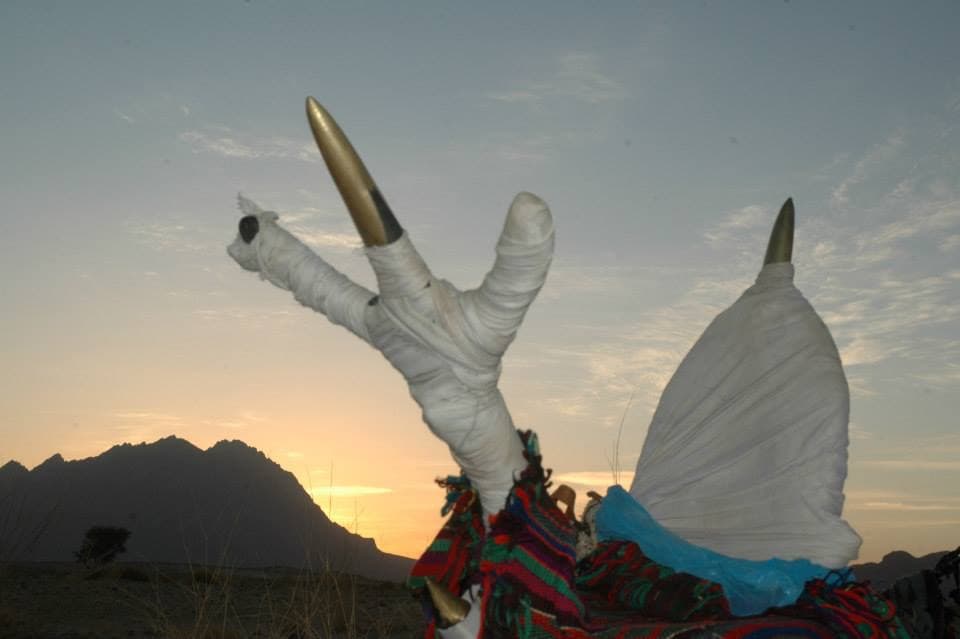
From Europe to Tamanrasset
You leave France in the evening heading to Tamanrasset, where you are expected to arrive during the night.
Upon arrival, you are welcomed by our local team, who will accompany you for your transfer to the inn.
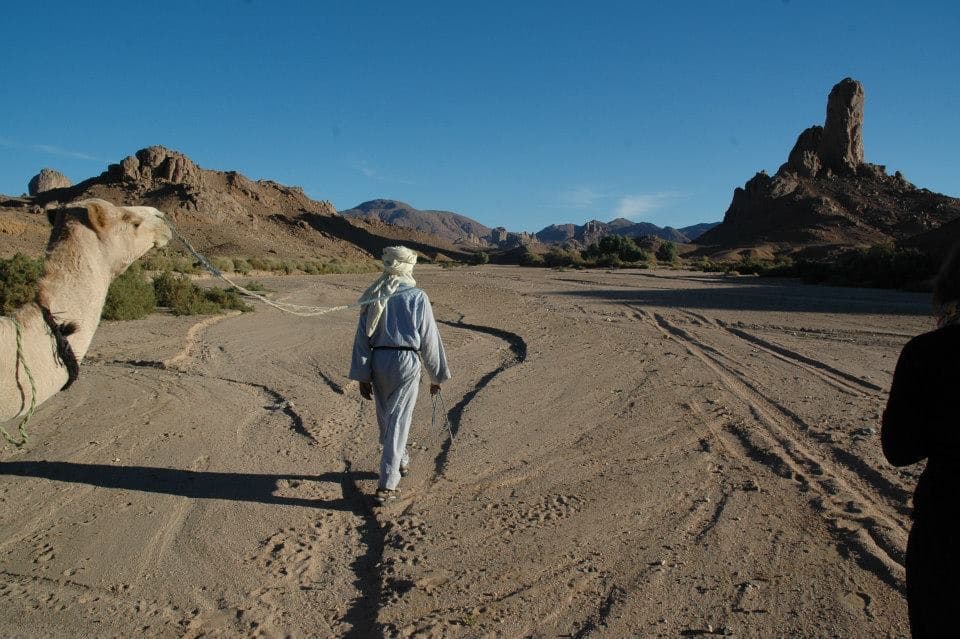
Free morning in Tamanrasset then join the caravan
Free morning. City tour. Tamanrasset (located at 1400 m) is nowadays an impressive cosmopolitan city. Only the city center, with the few remaining tamarisks, has retained some of its authenticity.
In the afternoon, by 4x4, we cross the plains of Tamanrasset and Tizelaïn. The latter is dominated, to the south, by Tin Amor (2138 m). A small pass allows us to access the Takecherwet wadi. We pass the volcanic peak Adaouda (Jacquet Peak). We skirt to the south the tabular mountain Ahounahamt (1887 m), then we reach, to the east, the meeting place with our caravan, located near the small agricultural village of Ezarnen (30 km).
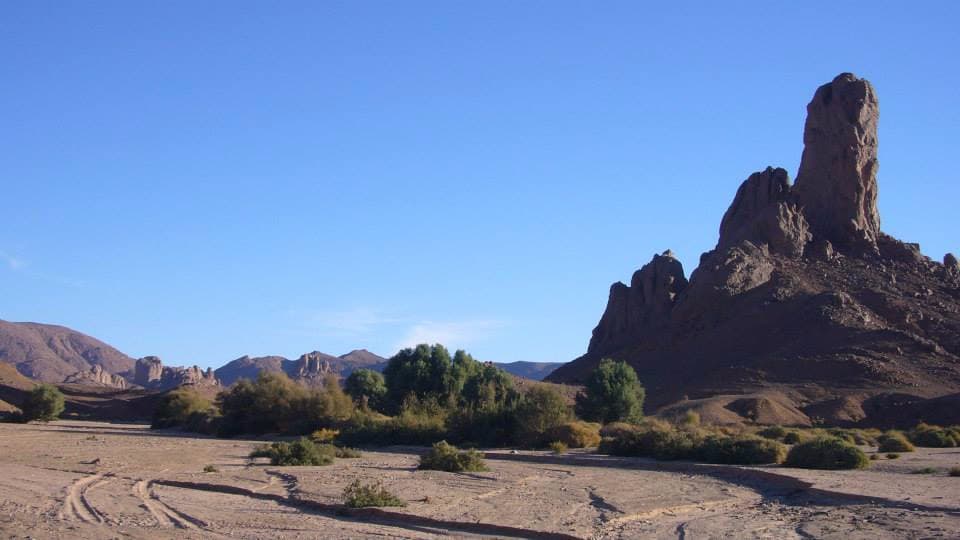
Start of the camel trek from Tamanrasset to Djanet
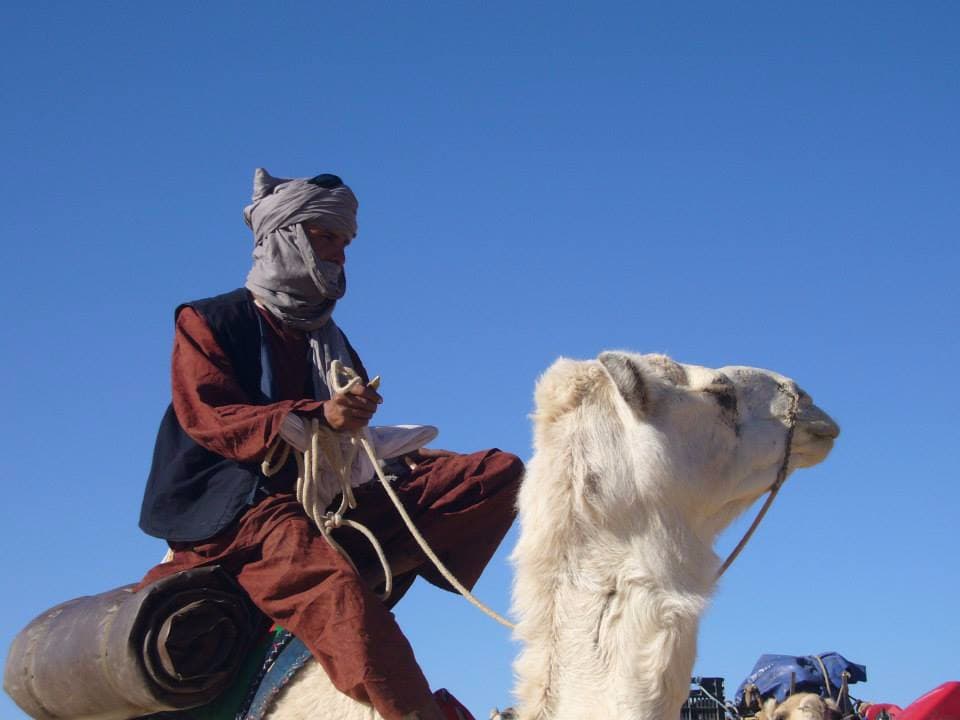
Departure preparations. We secure our saddles on the backs of the camels and load the pack animals.
The camel trek begins with a vast plateau with, to the north, the famous Assekrem plateau and the other peaks of Atakor. A pass allows you to descend into the Amezegin wadi, at the foot of the Aleheg mountain (1962m). Tineftawin and In Dalag wadis. Plain of Téhé n'Oudi. Bivouac.
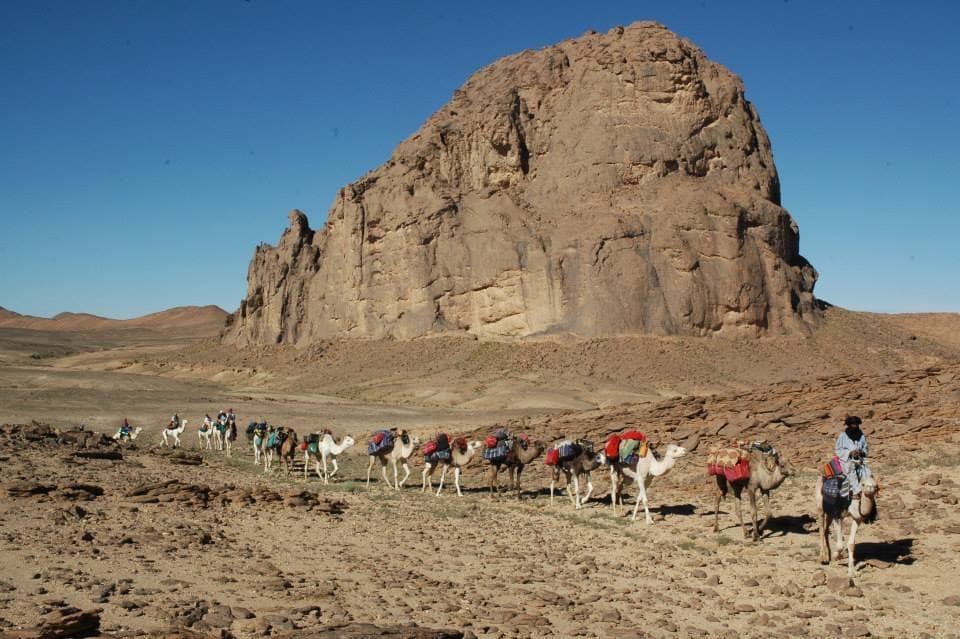
From Tahifet to Aborat
We cross the oued Tahifet and pass near the village of the same name (crops). We follow the Tahifet to Tazrouk track road for a while, then climb up the oued Azrou, before descending into the oued Aborah after crossing a small pass.
From Aborat to Wadi Touzin
We have been for the past day in a mountainous area, in the heart of the Tuareg territory of Adjouh n'Téhélé. The track keeps going up and down. Oueds Aborah, Fisfas and Tamekendout.
At the Tamekendout well, where camels are watered and water is plentiful. A pass gives access to the Touzin wadi where we are camping.
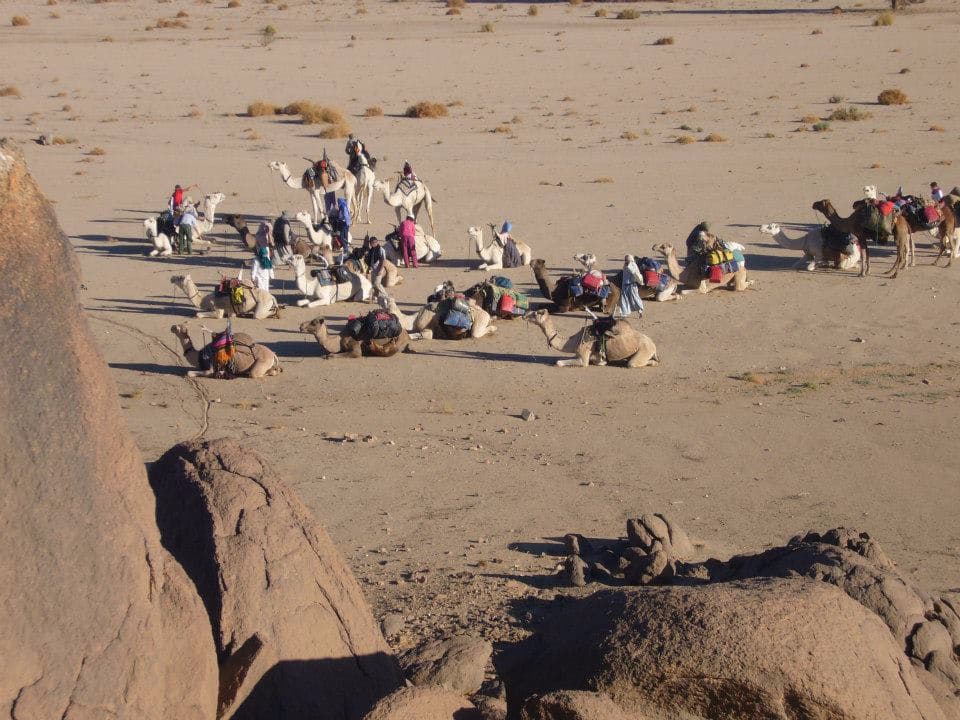
The East of Atakor and Wadi Sersouf
Long crossing on a plateau between two high mountains. Descent into the Aoudjerar wadi. Oudrak Pass which gives access to the important Sersouf wadi (tamarisks) which we descend.
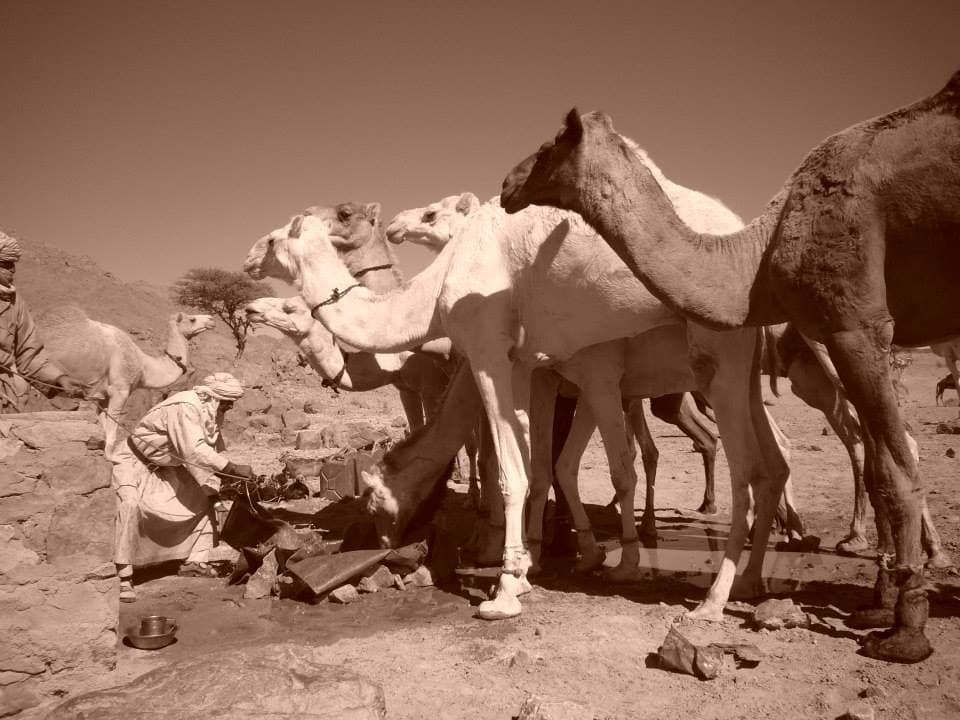
Towards the granites of Wadi Wersegenet
The mountain moves aside and we leave it to our left. Oued Tin Lalen (water point), pass giving access to the Oued Adjou, descent of the Oueds Eméharagélé and Ilefsawen. Landscape of granite boulders all the way to the Oued Wersegenet.
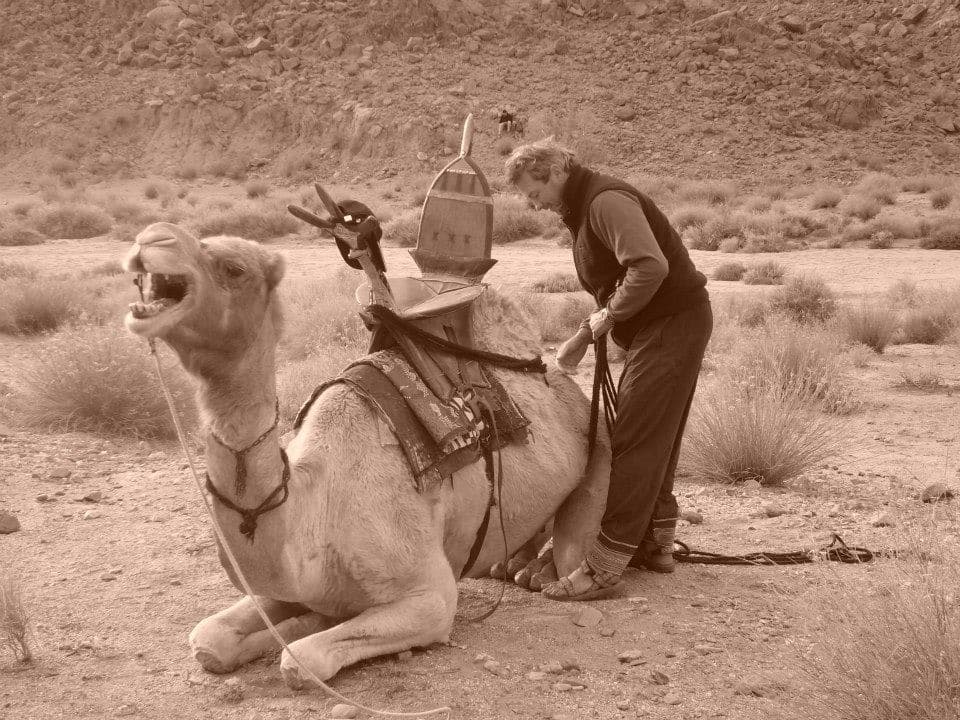
From Wadi In Debiren, Wadi Tin Tarabin to Amajjar
Wadis In Debiren, In Afegieg, Imbilel. We leave to the east the small village Aït Loaïen of Imbilel (1044 m). We soon emerge into one of the most important wadis of the Hoggar, the wadi Tin Tarabin (which means: "One of the Arab Women"). The first tufts of toulloult (grasses) appear.
Well and bivouac in the wadi Amajjar.
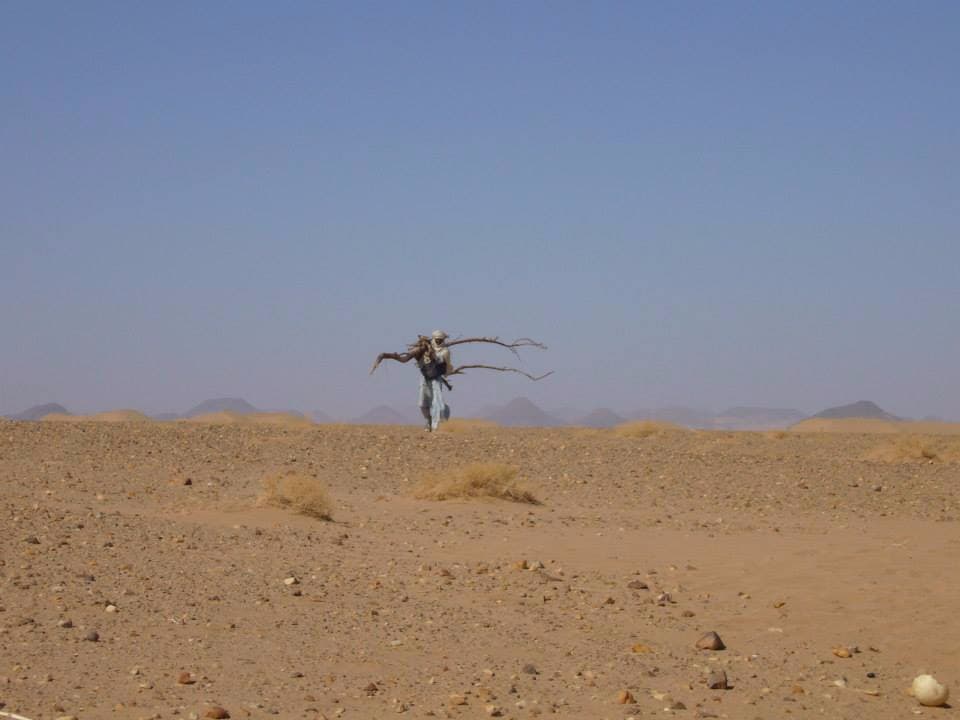
The granite massif of Serkout
Small pass connecting the Amajjar and Ernazaft wadis. In the distance stands the granitic massif of Serkout (2252 m).
Crossing of the Inouhawen wadi made famous by the ambush laid on the Flatters Mission in 1881, at the well that became "Tanout Tan Ikoufar", the Well of the Infidels. Tassiot Tan Tazabit and Takalous wadis.
Crossing of a long plateau, then descent into the Zerzerou wadi. If it has flowed, a small water point a little downstream, in its gorges. We bivouac higher up, in the wadi.
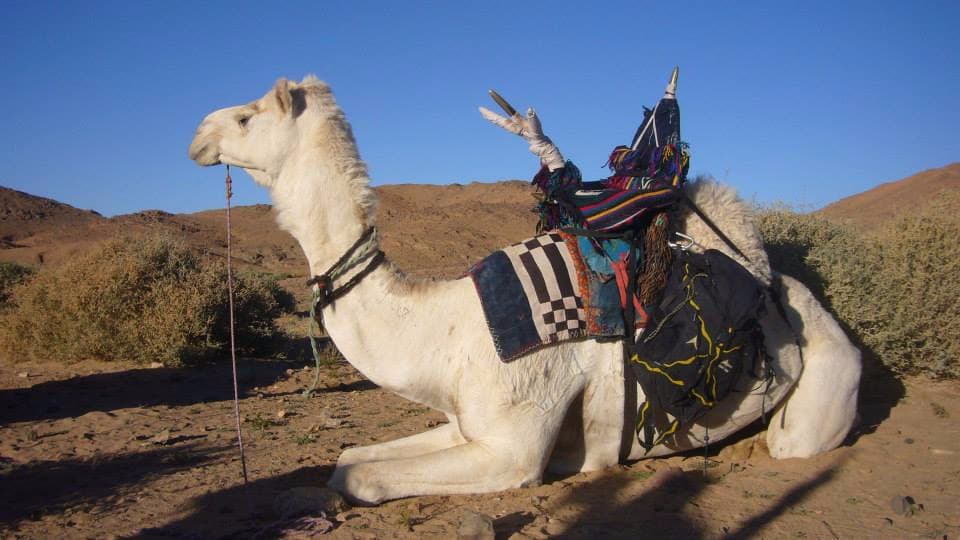
The Tadnest Well
Tadnest water point where we arrive around noon. We water the camels and fill water skins and jerrycans. Everyone participates in this important task which allows us to stock up on water for 5 and a half days.
Bivouac at Tadnest.
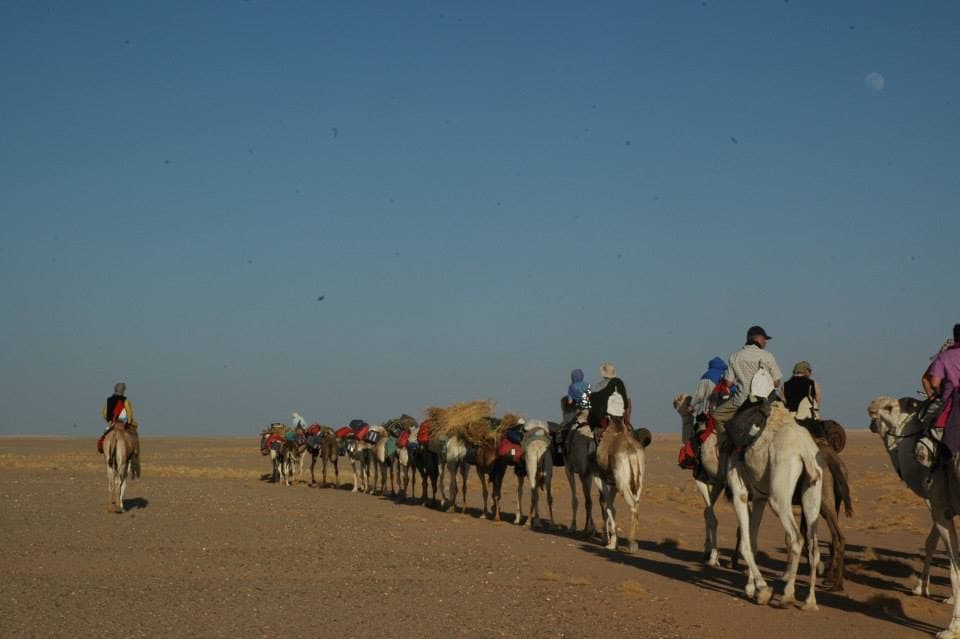
As we approach the great plains, the Anemerou wadi
Oued In Akaokan ("One of the Damans"). The mountains recede further. We first travel through an expanse of granite boulders, then through a vast plain to the Anemerou wadi where arasou bushes grow. Arrival around 1 p.m.
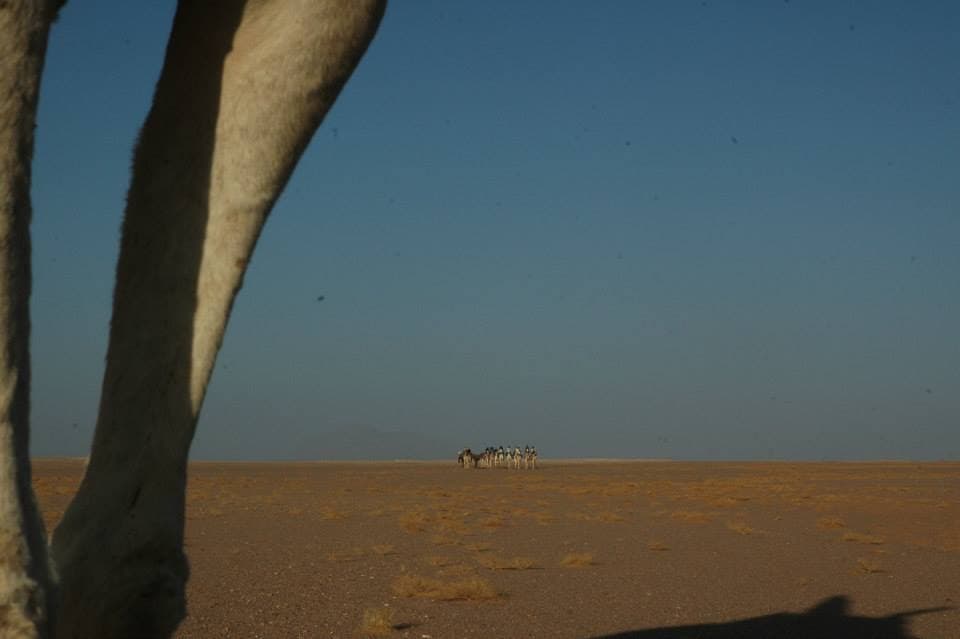
At the camel, the Anahaf chain
Today we cross a large part of the Anahaf mountain range. A pass carved into a quartz vein allows us access to a vast plateau that we cross heading northeast.
A quick stop in the middle of the day in the Amedid wadi (without shade) or, a little earlier, among granite boulders.
We head north and, after an area of hills, we descend a wide, gray wadi, without a trace of grass. A few more hills, then we camp in the In Terekfin wadi.
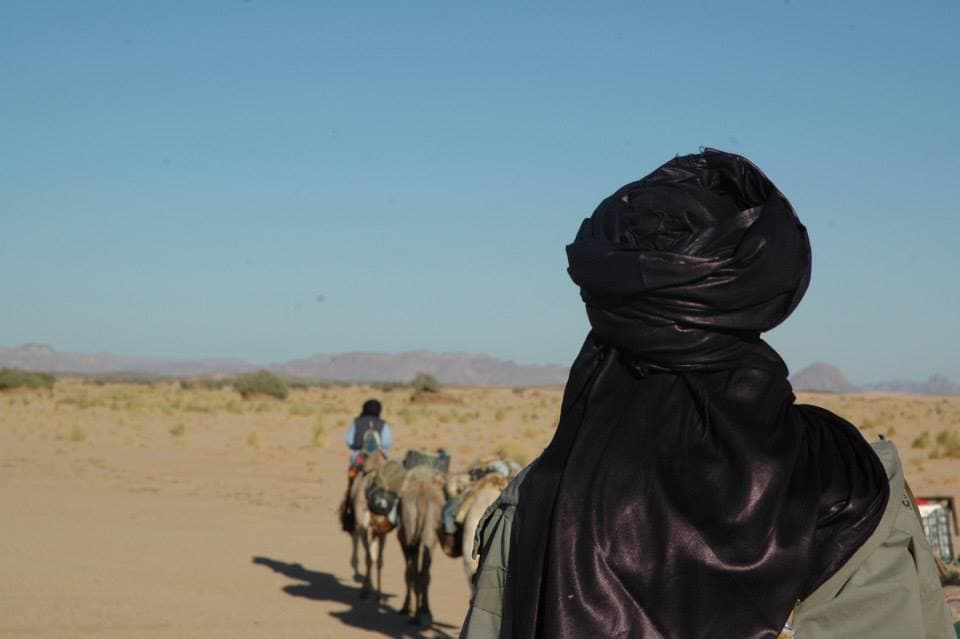
The Gates of Ténéré, Wadi Tin Hagen
The wadis become increasingly wider. We cross the Amedid wadi again (1116 m), then enter a final mountain chain that blocks the gateway to the Ténéré. On our right, on the back of a hill, we can see an immense pre-Islamic tomb in "keyhole" shape. Passage of a small pass before reaching the acacia for lunch.
In the afternoon, for several hours, we head towards the right bank of the Tin Hagen wadi cluttered with sands and toulloult. Three small peaks tower above us.
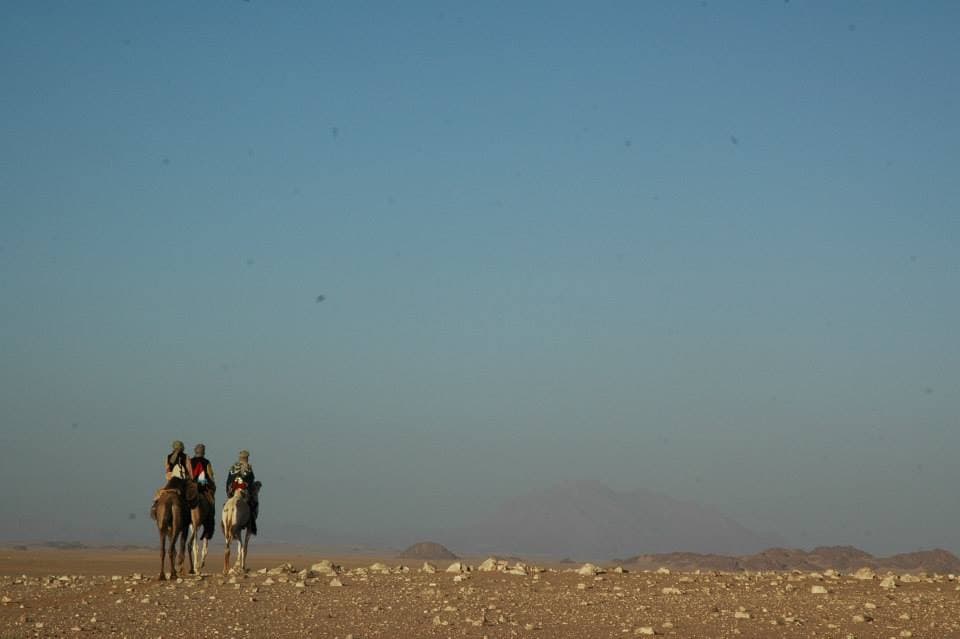
The Vast Ténéré of the Tafassasset
Departure at 5am. The immense Ténéré of the Tafassasset are before us. We cross them to the foot of the Tazat mountain (2061m) where we arrive after crossing the Tamanrasset - Djanet road track. We have just completed the longest stage of the camel trek (10 to 11 hours).
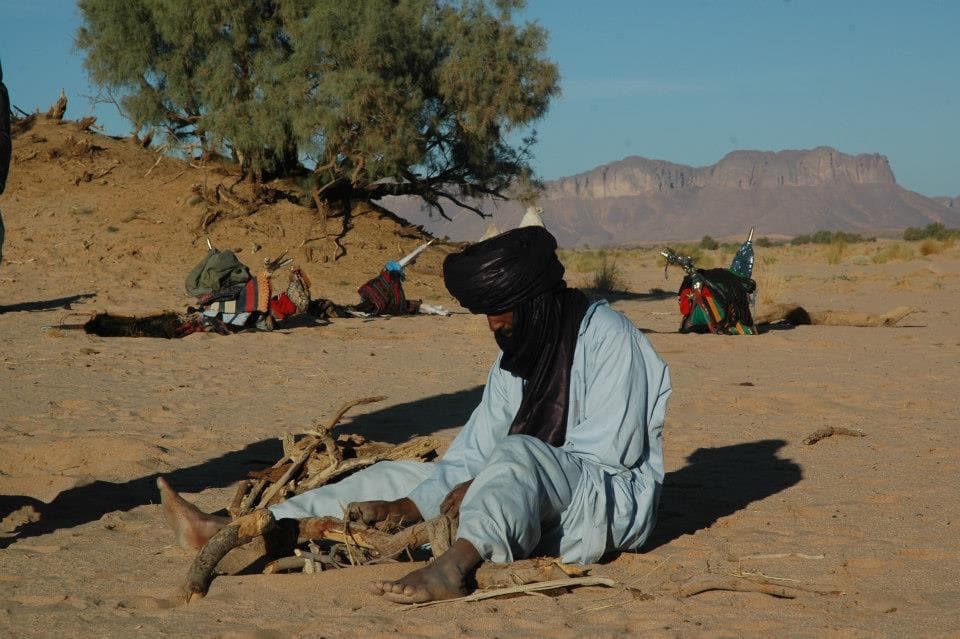
A long stage to Wadi Tabakat
Another long stage until the Tabakat wadi (Jujube tree). For much of the morning, we cross numerous wadis flowing down from the nearby mountain.
In the Tabakat wadi, we set up camp near a well, quite far downstream from the small recent village of Tabakat. We water the animals and fill the waterskins and jerrycans.
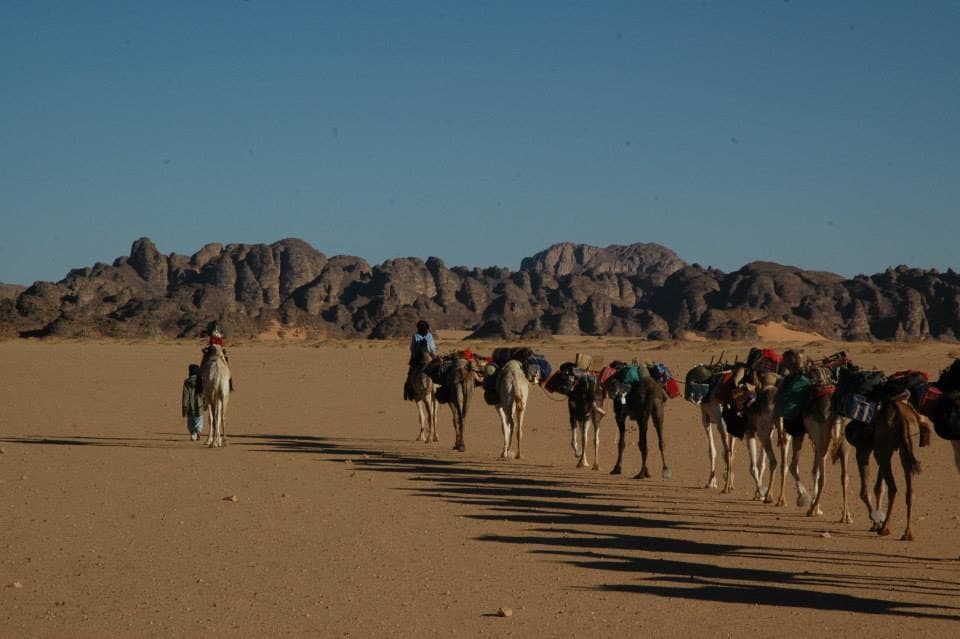
As you approach Tassili N'Ajjer
In the morning, we water the camels again and finish the water chore. Departure in early afternoon.
We rejoin the oued Zawaten'Laz. A little north of our bivouac in the middle of the tamarisks, is located the small town of Bordj El Haouas (name of Zawatalaz, former Fort Gardel).
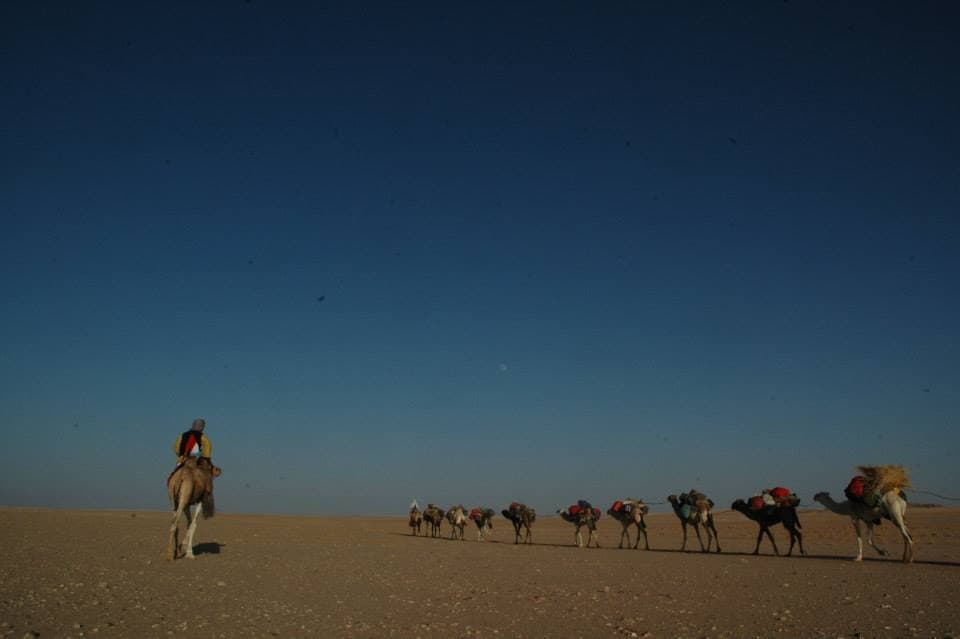
The dunes of the Admer erg
We are approaching the sandstone cliffs of Tassili n'Ajjer. To the south and east, the Erg Admer blocks our passage. We bypass it to the north. The spectacle is breathtaking.
Bivouac in the small dunes of Wadi Sersouf.
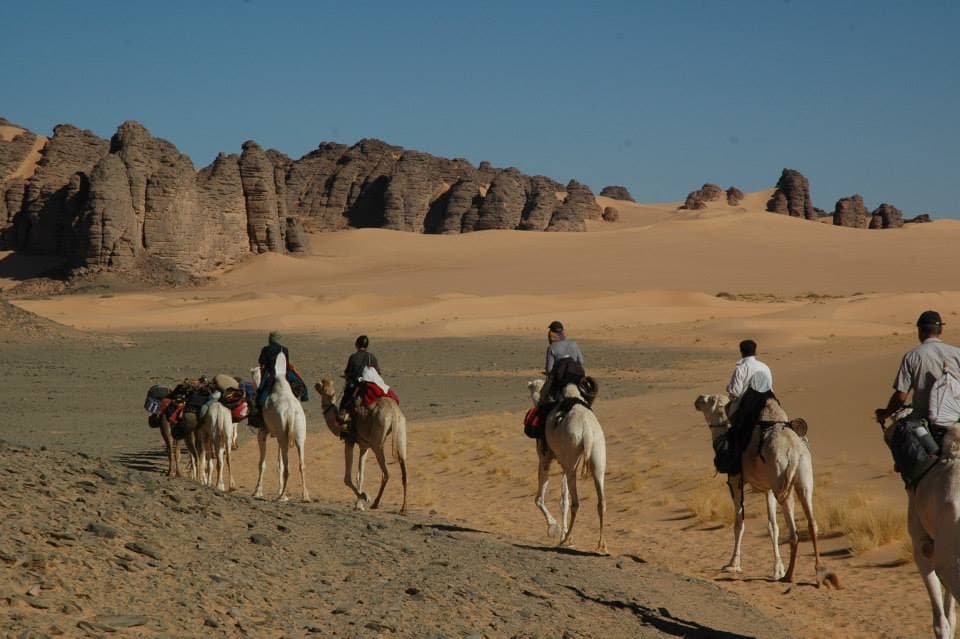
The Tassili N'Ajjer
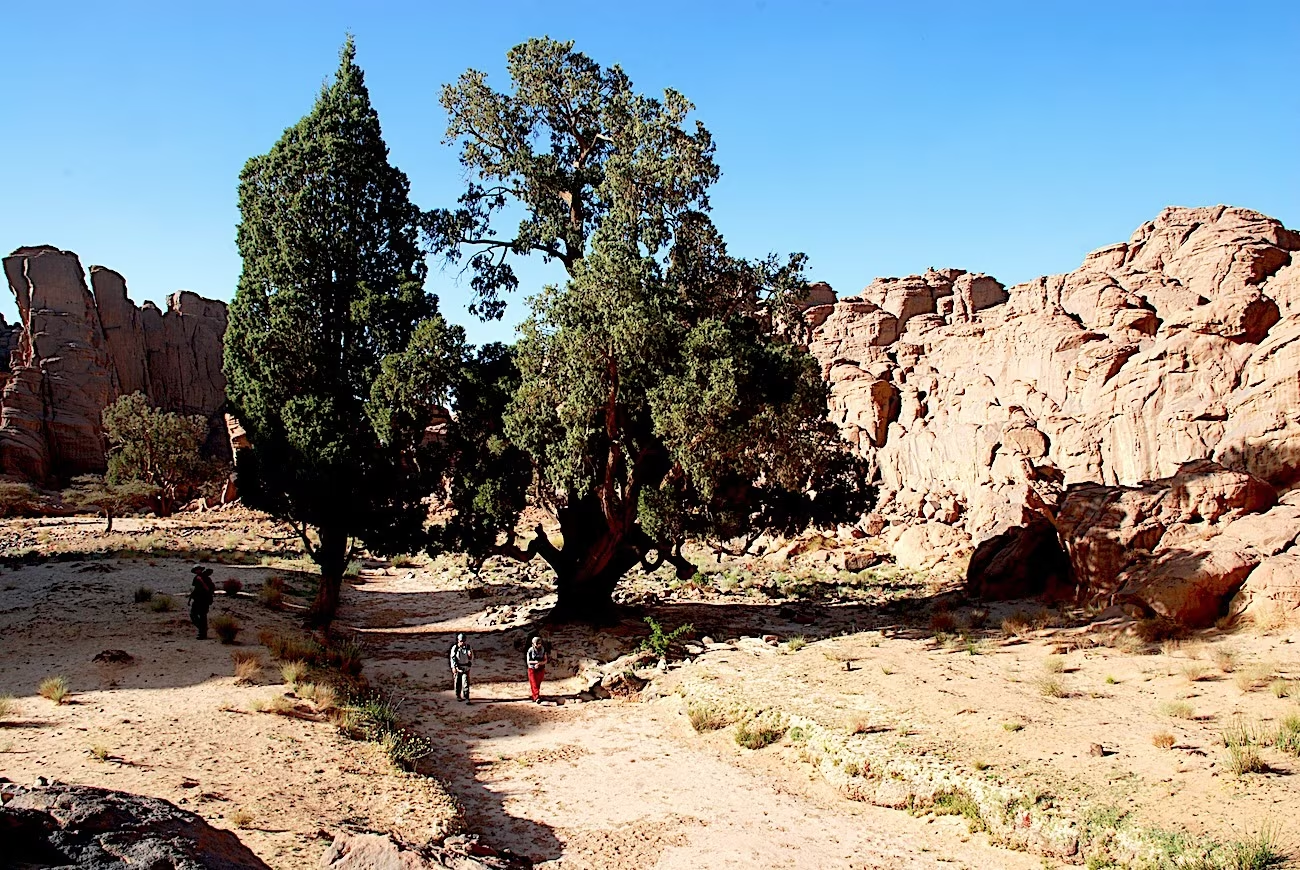
Entry into the pre-Tassili region, either via Wadi Essendilène or Wadi Hell. Canyons, cliffs, rocky towers besieged by sand will be our world for these final days of camel trekking.
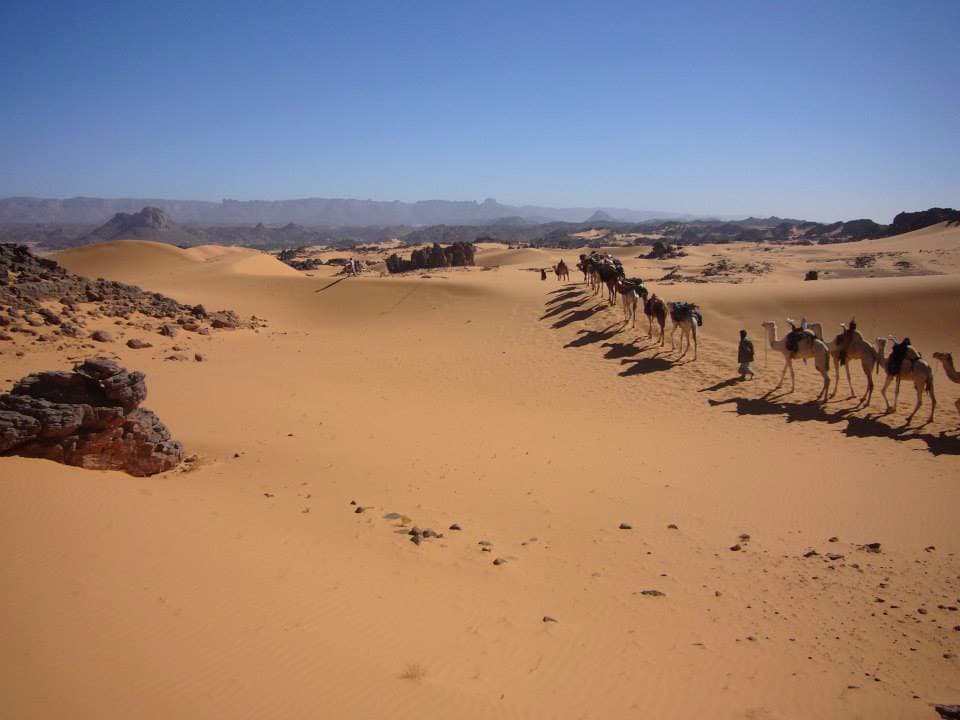
Sumptuous arrival in Djanet by camel
Arrival during the day in Djanet where we settle in the wadi. Quick visit of Djanet, which has lived up to its reputation as the "Pearl of the Tassili". It has developed and expanded enormously. The entire oasis comprises four villages: El Mihan, Adjahil, Azellouaz (at the foot of the Tim Beur mountain) and Tin Khatma.
They will leave this morning for the Hoggar. Transfer to the airport during the night.
Price per person
Indicative price per person, based on double room. Each trip is customized according to your preferences.
This trip can be tailored to your preferences
This itinerary provides an excellent foundation for discovery, but it can be fully customized. Our local advisors build each trip tailored to your budget, dates and preferences.
Practical Information
Registration is considered firm and final after payment of a deposit of 30% of the total price and acceptance of the specific terms of sale.
The balance must be paid no later than 45 days before the departure date.
See our specific terms of sale for full details.
In the event of cancellation by the traveller, the following fees apply:
- Plus de 60 jours avant le départ : 40 % du prix total (acompte retenu)
- Entre 60 et 30 jours avant le départ : 50 % du prix total
- Moins de 30 jours avant le départ : 100 % du prix total
We strongly recommend taking out cancellation insurance. See our specific terms of sale for full details.
The information below concerns travelers who are nationals of the European Economic Area (EEA), Switzerland, and Canada traveling to Algeria for a tourist stay. As entry rules may change, we recommend verifying this information with the official authorities before your departure.
Passport
To enter Algeria, your passport must be valid for at least six months after your date of entry into the country and have at least one blank page for immigration stamps.
The document must be in good condition (no damaged, torn, or altered pages).
Visa
Nationals of the European Economic Area, Switzerland, and Canada must be in possession of a valid visa to enter Algeria for a tourist stay. There is no visa exemption for these nationalities.
The visa must be obtained before departure, from the Algerian embassy or consulate responsible for your country of residence. It is recommended to apply several weeks in advance, as processing times may vary.
Documents generally required for a visa application include:
a valid passport with at least six months of remaining validity,
a completed and signed visa application form,
recent passport-sized photos complying with required standards,
a return flight ticket or booking,
proof of accommodation (hotel reservation or invitation),
proof of sufficient financial resources for the duration of your stay.
The authorized length of stay is generally 30 days, depending on the conditions mentioned on the visa issued.
Travel with children
Minors must be holders of their own valid passport covering the duration of their stay.
In some European countries, when a minor travels without one of their parents, an authorization to exit the territory may be required according to the regulations of their country of residence.
Health
No vaccination is officially required to enter Algeria for nationals of the EEA, Switzerland, and Canada. However, it is recommended to consult a doctor or vaccination center before departure and to ensure that basic vaccinations are up to date (diphtheria, tetanus, poliomyelitis, hepatitis A).
It is also advisable to take out international health insurance covering medical expenses and repatriation for the entire duration of your stay.
Other nationalities
Entry conditions may vary depending on nationality. Travelers concerned should inquire at the Algerian embassy or consulate of their country of residence.
To participate in our trips, it is strongly advised to have assistance-repatriation and foreign medical expenses insurance.
Your local agency encourages you to familiarize yourself with the specific policy developed with our partner CHAPKA ASSURANCES and AXA ASSISTANCE.
To subscribe to insurance, learn about coverage and rates, follow the link below.
CAP EXPLORER: The complete insurance solution designed for a worry-free trip!
Choose the plan that best suits you:
Explorer'Multirisque
Explorer'Annulation
Explorer'Assistance
Explorer' Complementary Credit Card
Specific to our trips, we strongly recommend subscribing to them.
If you choose to subscribe to one of these plans, the policy detailing all coverage and claims declaration procedures are available on the insurer's website.
Your local agency will be aware of this, but only the participant is responsible for complying with the claims declaration procedures. The participant must therefore keep this policy with them throughout their trip.
Chapka — Cap Explorer
Our insurance partnerTravel with peace of mind with our partner Chapka. Cancellation, repatriation, medical expenses, baggage… All the coverage for a worry-free trip.
Travel with peace of mind — I'll handle the insuranceFrequently asked questions
A tourist visa is required and must be requested from the consulate (consular fees apply, processing time 2-3 weeks). An invitation letter or accommodation certificate is required. Your passport must be valid for at least 6 months beyond your planned entry date. Conditions can be stringent. We strongly recommend verifying the rules applicable to your nationality with the Algerian consular authorities before booking your trip.
Go to the My Trips section to find all your projects.
You can send a message to your host directly from the Tea Lounge.
For a tailor-made quality trip, budget between 140 and 240 euros per day and per person, including accommodation, meals, internal transfers and English-speaking guide. International flights (350-700 euros return) are additional. The Algerian Sahara (Tassili, Hoggar) requires a specific budget.
Your documents are accessible in the Documents tab of your trip.
Absolutely. We adapt each itinerary to match your travel profile. For families, we prioritize relaxed paces, family-friendly accommodations, engaging and educational activities, and comfortable private transfers. Our local English-speaking guides know how to captivate children with age-appropriate stories and anecdotes.
It's simple. You exchange with our local team to define your wishes, budget and dates. You receive a detailed itinerary proposal within 48 hours. You refine every detail together until you have the perfect version. You confirm and set off with peace of mind. Your local agency remains available 7 days a week throughout your trip.
In case of emergency, contact your local agency immediately.
Payment is generally made in two installments.
Our agency is part of the Nomadays network, registered in France. You benefit from APST guarantee (Professional Association of Tourism Solidarity) which covers 100% of your funds. Secure payment, repatriation insurance included, and English-speaking assistance 24/7 on site throughout your stay.

Let's talk about your adventure — Great Saharan South
Pioneer of Algeria's great deserts, based in Ghardaïa / M'zab (puis Alger à partir de 2006)
The desert is not crossed with an itinerary alone. It demands listening, respect, and a certain inner availability.
— Louiza