Laya Gasa Trek
Two weeks of immersion in the Bhutanese Himalayas, from the Jangothang meadows to the hot springs of Gasa
Duration
16 days
From
€6,380/pers.
Ideal seasons
Mar, Apr, May, Oct, Nov
Style
Expeditions
Comfort
rustique
Travelers
Solo, With friends
The spirit of travel
The Laya Gasa trek is considered one of the most picturesque hikes in Bhutan, offering exceptional panoramic views of the country's well-preserved natural landscapes. Lasting fourteen days for approximately 217 km, it connects the village of Gunitsawa to Gasa, crossing alpine meadows, high mountains and dense subtropical jungles.
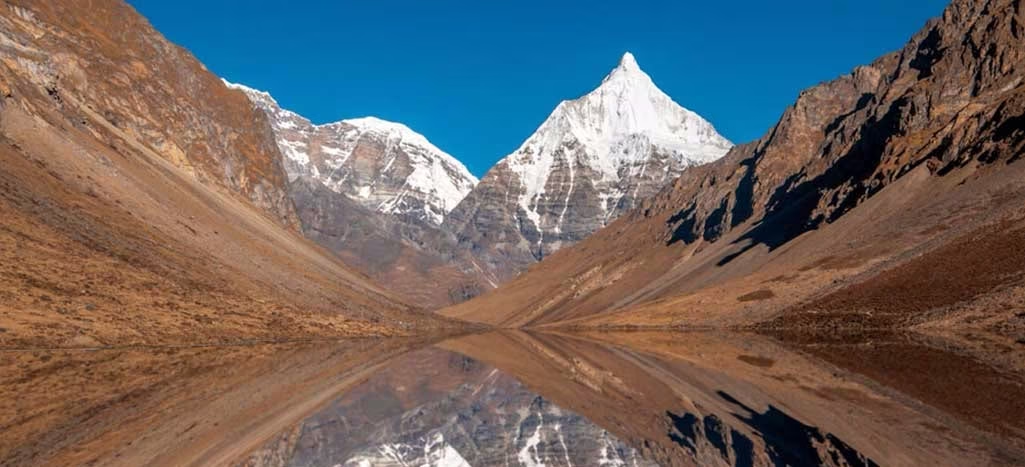
The first five days follow the same route as the Jomolhari I trek, through Jigme Singye National Park, with views of the Jomolhari, Jichu, Drake and Tsherimgang mountains. On the sixth day, the itinerary branches off towards Lingshi then Chebisa, a village known for its waterfall.
Throughout the journey, hikers may encounter endemic fauna such as the blue sheep or takin, as well as the villages of the Layaps, a people with unique traditions. A rest day is planned at the Gasa hot springs.
The stages of your journey
Highlights
Day-by-day itinerary
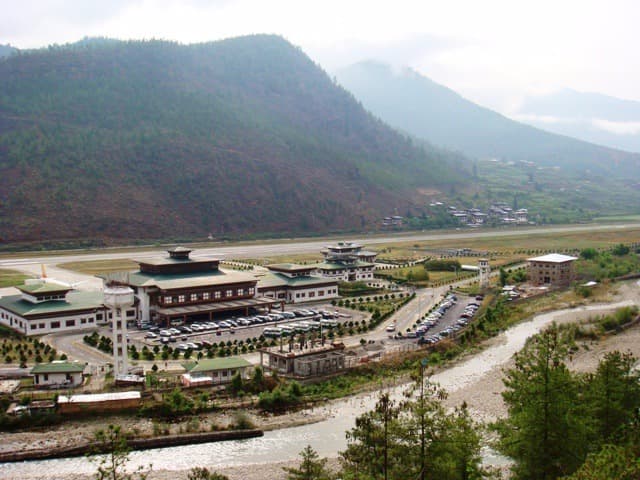
Arrival in Paro
The valley of Paro encompasses a rich culture, stunning landscapes and hundreds of myths and legends. It is home to some of the country's oldest temples and monasteries, the national museum as well as the kingdom's only international airport. Mount Jomolhari (7,314m) dominates the north of the valley and water from its glaciers plunges through deep gorges to form Pa Chhu (the Paro river). Paro is also one of Bhutan's most fertile valleys, producing a significant share of local red rice in its terraced fields.
The flight to Paro is among the most spectacular airplane experiences in the world. During landing or takeoff, you can observe Mt. Everest, Kanchenjunga, Makula as well as other high altitude peaks such as Jomolhari, Jichu Drakey, and Tsrim Gang. You will be welcomed by a guide representing the Exquisite Bhutan agency.
Hotel check-in, some free time to freshen up and stretch your legs, followed by a visit to the National Museum, Runpung Dzong, and a short tour of the town.
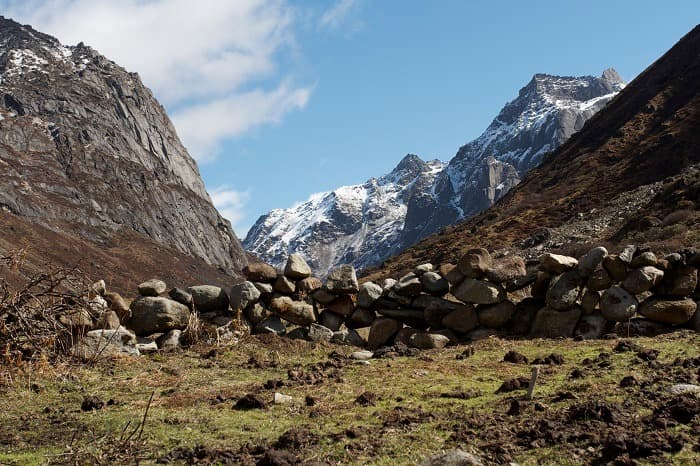
The trek begins in the village of Gunitsawa
After an early breakfast, drive to the village of Gunitsawa and its military outpost where you will be asked to present the trekking permit that we will have issued to you.
Gunitsawa Village → Sharna Zampa
Short walk to Sharna Zampa on the other side of the river.
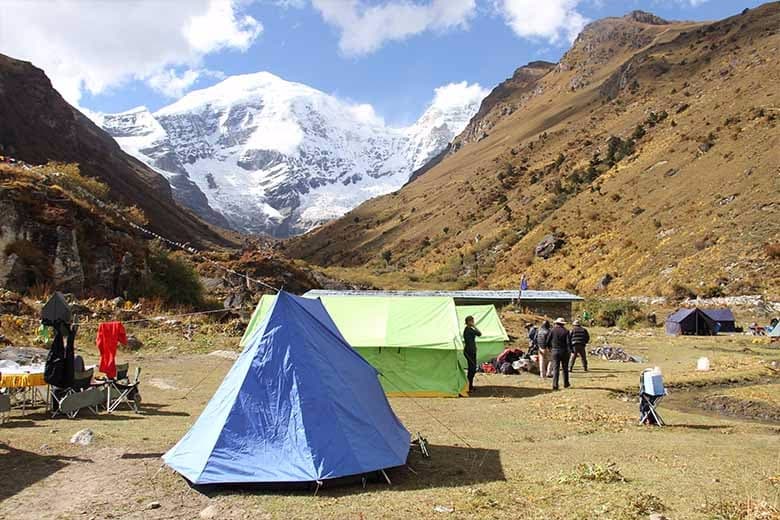
Spectacular view of Mount Jomolhari
During this long day, the trail sees a succession of moderate climbs and some flat sections. One last beautiful ascent and the valley will be reduced to a small path that descends onto a meadow where you will set up camp for the night. From this point, if the weather permits, you will enjoy a superb view of the Mt. Jomolhari.
Elevation gain: 770 m, descent: 10 m, camp altitude: 3,610 m.
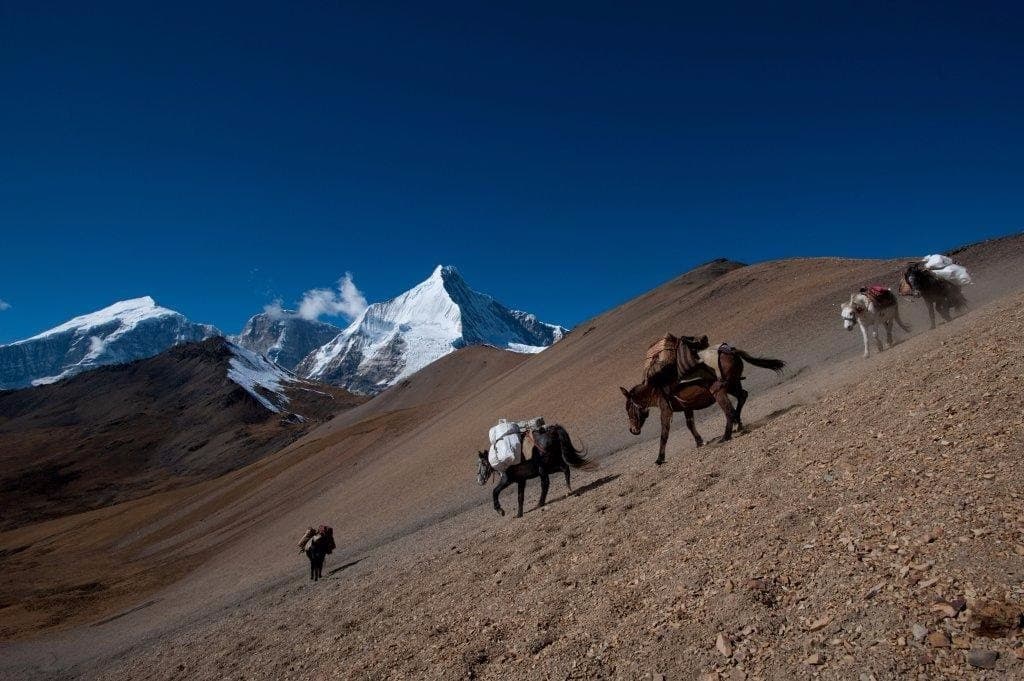
Jangothang, one of the most beautiful camps in the Himalayas
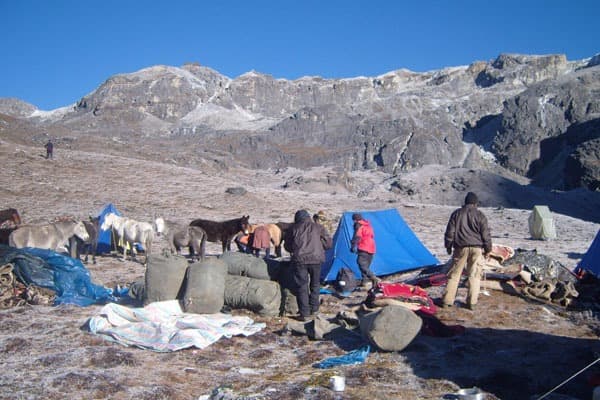
Today, we continue hiking in the valley of Paro Chhu which extends over a vast alpine meadow, in the heart of a large forest. In this part of the region, yaks and shepherd huts reshape the landscape to give it a unique character. We then visit the villages of Soe, Takethang and Dangochang. Once you reach Jangothang, one of the most beautiful campsites in the Himalayas, enjoy once again a spectacular view of Mount Jomolhari.
Elevation gain: 480 m; campsite altitude: 4080 m
Find a blue sheep in the highlands of the valley
Spending a rest day in Jangothang allows us to carry out many visits, while discovering landscapes dotted with lakes and snow-capped mountains, such as Jomolhari and Jichu Drake. Jangothang is also the ideal place to acclimatize. Take advantage of this stopover to visit Tosoh or take a walk around the area.
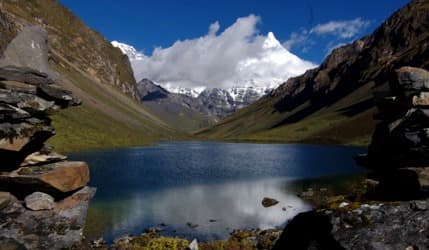
Long hiking day
Today awaits one of our longest trekking days. We cross the Nyilila pass at 4,870 m and take the opportunity to observe blue sheep grazing on the mountainsides. After lunch, we continue our hike to Lingshi, a beautiful U-shaped valley. In clear weather, the view of Lingshi dzong is breathtaking. The campsite is located just near a stone hut, before crossing Lingshi dzong.
Ascent: 840 m; descent: 870 m; campsite altitude: 4,010 m
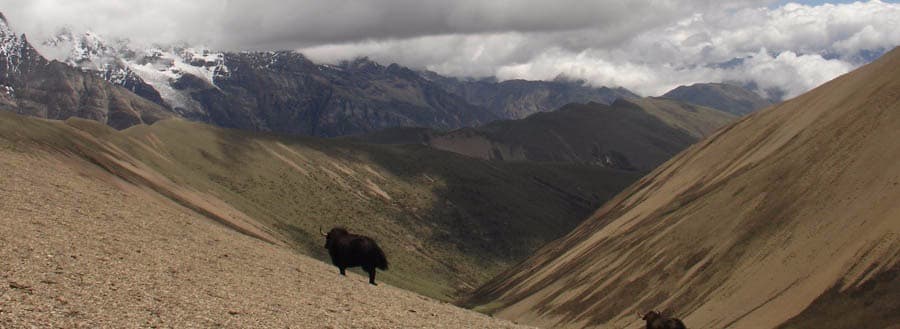
Admire the herds of blue sheep on the Lingshi ridge
Today, the hike will be shorter. We quickly reach a chorten below the dzong of Lingshi. For this itinerary, you have the choice between taking the main trail or going around the dzong of Lingshi which sits at the top of the ridge (4 220 m). After passing the dzong of Lingshi, we cross the villages of Lingshi and Goyul. The camp is located in Chebisa where we will have plenty of time to rest in the villagers' houses. Behind the village, a beautiful waterfall is worth a visit.
Ascent: 280 m; descent: 410 m; camp altitude: 3880 m
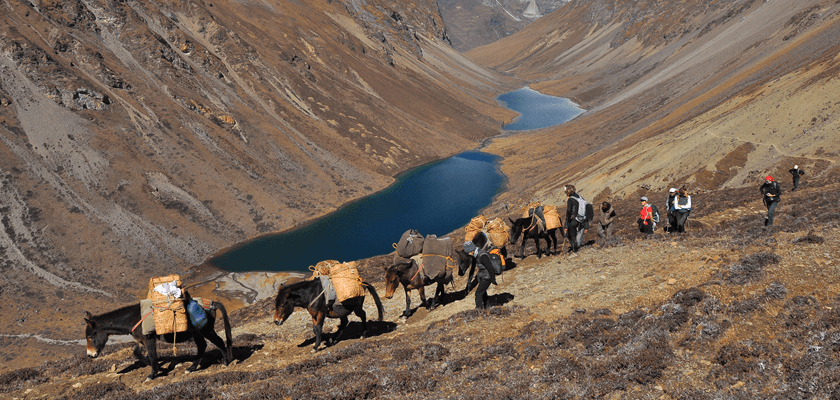
A long climb behind the village of Chebisa
The morning begins with a long ascent (2 to 3 hours) behind the village of Chebisa. We explore a vast pasture towards the Gobu La pass. After crossing Gobu La (4,410 m), we descend into the valley, then climbing again a small rise before descending at our own pace down the slope leading to Shakshepasa (3,980 m), another U-shaped valley. Continuing our descent, we finally reach Shomuthang camp, above a tributary of the Nochu river.
Ascent: 890 m; descent: 540 m; camp altitude: 4,220 m
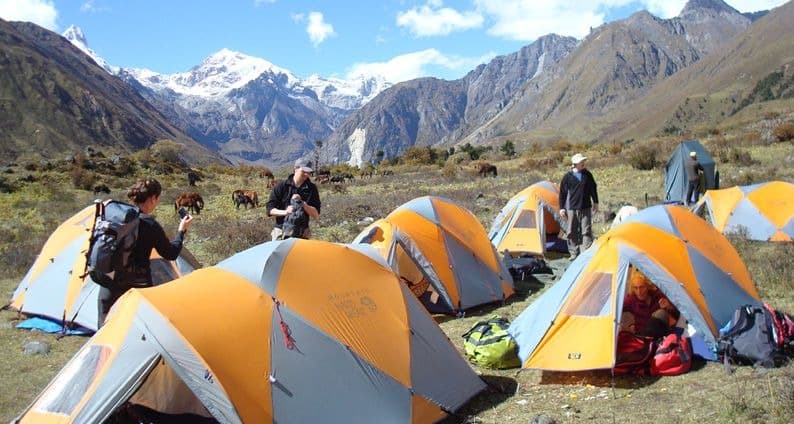
Superb viewpoint over Tiger Mountain
We begin our circuit for the day by walking through the valley in the direction of Kang Bum (6 226 m) and its beautiful edelweiss. After two hours of climbing, we arrive at Jhari La (4 750 m), from where we can see Sinche La, the pass to be conquered the next day. The great snow peak to the north is named Gangchhenta (6 840 m), better known as the Tiger Mountain. The camp near the river is called Tsheri Jathang, nestled in a remote valley.
Ascent: 700 m; Descent: 760 m; Camp altitude: 4160 m
A few lateral moraine landscapes
The trek begins with an initial ascent lasting 40 to 60 minutes, followed by a gradual climb of an hour and a half through a rocky field. We then make an ascent of approximately one hour before reaching Sinche La (5 005 m) — the final pass and the highest point of the route (if you do not intend to continue the Snowman trek from Laya). As we descend, an impressive moraine and a glacial lake at the foot of the valley reveal themselves. You will have the chance to admire some classic examples of lateral moraines, where the glacier has pushed rocks on both sides of the valley. Above the moraine, we cross the Kango Chhu to reach the Limithang campsite. The summit of Gangchhenta faces the campsite.
Ascent: 850 m; descent: 870 m; camp altitude: 4 140 m.
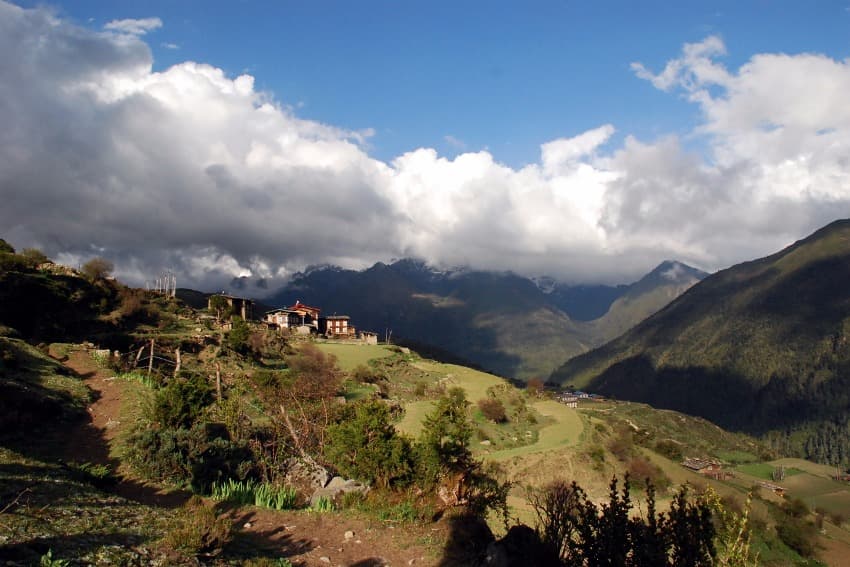
Trail towards the west side of the village of Laya
Today, the descent winds through a narrow and winding river valley. The trail takes you to the west side of the Laya village which has a community school and a basic health unit with a telephone line at its center. The campsite is located below the school.
Ascent: 60 m; Descent: 340 m; Camp altitude: 3840 m
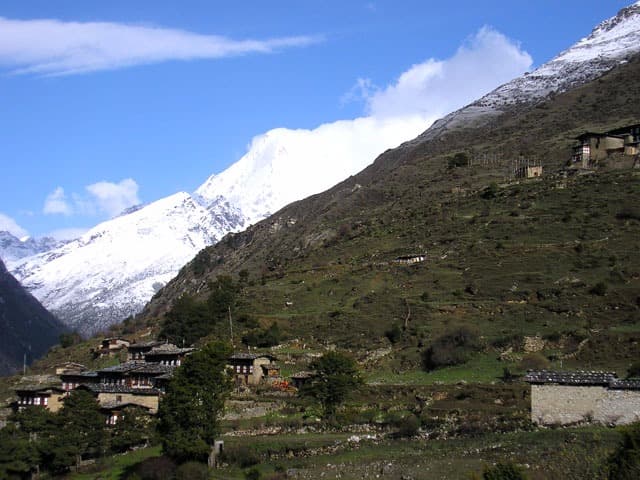
Through the Mo Chhu River Valley
The trail follows a descent along the valley belonging to the Mo Chhu river. We avoid the natural rough passages, while capturing breathtaking views of the torrential river, streams and waterfalls. We pass through slopes and descents until Kohi Lapcha at 3,300 m. The hike ends at the Koina Chhu river where we set up our camp.
Ascent: 260 m; descent: 1,070 m; camp altitude: 3,050 m
Last major climb of Laya Gasa
Koina → Gasa
Today's trek reserves the biggest climb of the Laya Gasa Trek. We cross Bari La (3,740 m) and descend to the village of Gasa (2,770 m). A campsite is located near the Gasa dzong.
Ascent: 740 m; descent: 1,500 m; campsite altitude: 2,240 m
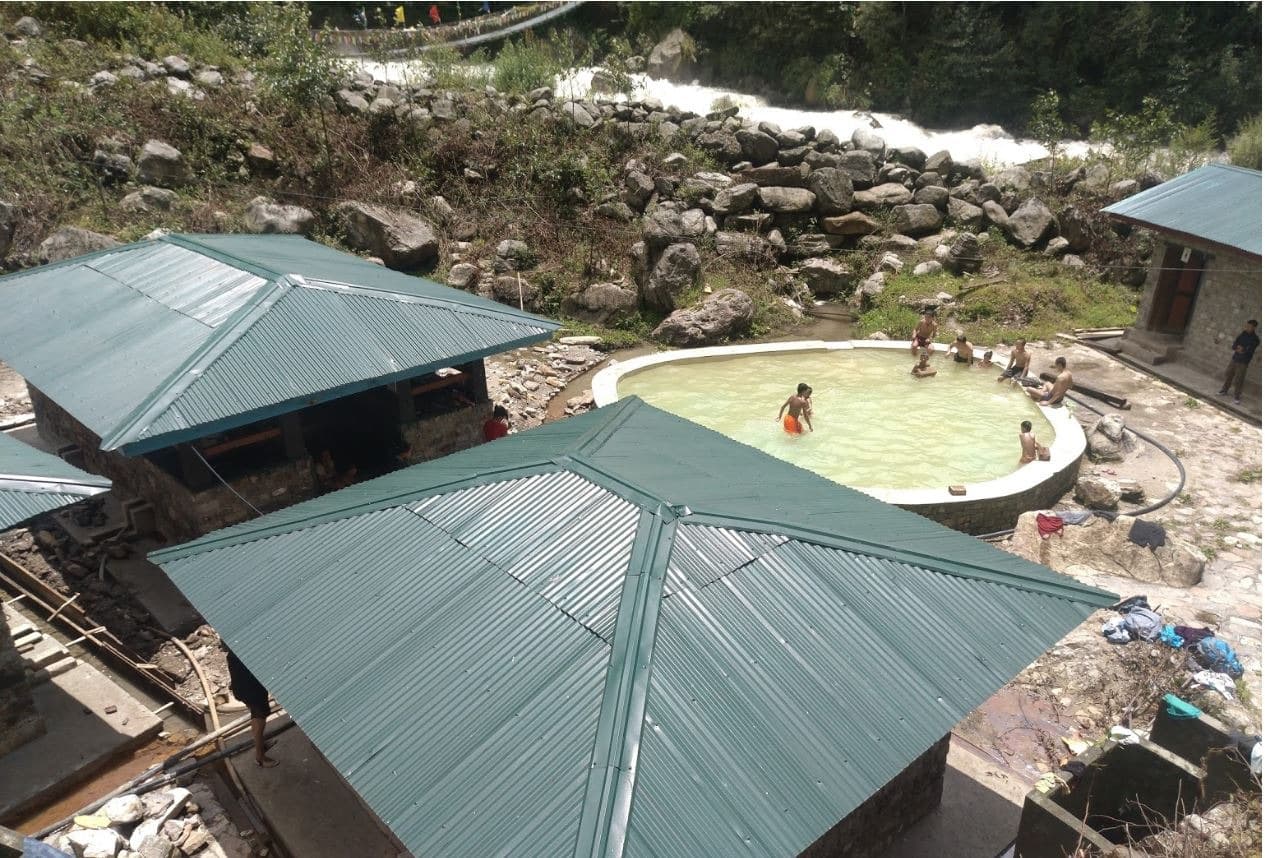
Gasa → Gasa Hot Spring
You can choose to stay in the village or head down to the Gasa Tsachu hot springs, about an hour's drive away, to relax in its mineral waters. It is one of the most popular hot springs in Bhoutan.
Thank you and safe travels back!
After breakfast, we take the road to drop you off at the airport of Paro.
Price per person
Indicative price per person, based on double room. Each trip is customized according to your preferences.
This trip can be tailored to your preferences
This itinerary provides an excellent foundation for discovery, but it can be fully customized. Our local advisors build each trip tailored to your budget, dates and preferences.
Not included
- Travel/medical/repatriation insurance
- Phone/fax
- Laundry/dirty laundry
- Tips
- International and regional flights
Included
- Accommodation (shared twin room or double room)
- Full board: meals, tea, mineral water
- All entrance fees (national parks, monuments, museums)
- English-speaking certified guide
- Transports
- Royalties and Government Taxes
- Visa fees
- Trekking Services
- Sleeping bags, ground mats, pillows
- Tents: for sleeping, meals, toilets and shower
- Walking sticks
- 3 meals per day; drinks and snacks
- Crockery / toilet paper
- First aid kit
- Hot water bottles / towels
- Cook and assistants
- Pack horses and mules
Practical Information
Registration is considered firm and final after payment of a deposit of 30% of the total price and acceptance of the specific terms of sale.
The balance must be paid no later than 45 days before the departure date.
See our specific terms of sale for full details.
In the event of cancellation by the traveller, the following fees apply:
- More than 60 days before departure: 40% of the total price (deposit retained)
- Between 60 and 30 days before departure: 50% of the total price
- Less than 30 days before departure: 100% of the total price
We strongly recommend taking out cancellation insurance. See our specific terms of sale for full details.
The information below provides entry requirements for tourists traveling to Bhutan. Entry regulations may change, and you are strongly advised to verify all information with the official authorities before your departure.
Passport
To enter Bhutan, your passport must be valid for a minimum of six months beyond your date of entry and must contain at least two blank pages for immigration stamps.
The document must be in good condition (no damaged, torn, or altered pages).
Visa
A visa is required to enter Bhutan for tourism purposes. There is no visa exemption for tourist stays.
The visa is issued exclusively through the Tourism Council of Bhutan (TCB) and only via an authorized tourism operator. Independent travel is not permitted: all tourist visits must be arranged through a certified travel agency, which will handle the visa application on your behalf.
The visa is granted for the duration of your planned stay, generally up to 30 days, with the possibility of extension upon request to the competent authorities.
Sustainable Development Fee (SDF)
All foreign visitors must pay the Sustainable Development Fee (SDF), a daily charge established by the Bhutanese government to support sustainable development and environmental protection.
The current SDF rate is 100 USD per person per night. This fee is typically included in the package offered by the authorized tourism operator and generally covers:
basic accommodation,
meals,
an authorized official guide,
internal transportation.
Payment of the SDF is a mandatory requirement for obtaining a Bhutanese visa.
Travel with children
Minors must hold their own valid passport covering the duration of the stay, as well as their own Bhutanese visa.
When a minor travels without one or both parents, a parental authorization or exit permit may be required depending on the regulations of the country of residence.
Health
No vaccinations are officially required for entry to Bhutan. However, due to the high altitude of many regions in the country, it is advisable to consult a doctor before departure to take appropriate precautions, particularly against altitude sickness. Travel and medical insurance that covers emergency evacuation is strongly recommended.
Entry requirements by nationality
Entry conditions may vary depending on your nationality. All travelers are advised to verify the specific requirements for their country by contacting the embassy or consulate of Bhutan in their country of residence, or by visiting the Tourism Council of Bhutan website.
To participate in our trips, it is strongly recommended to be insured for repatriation assistance and medical expenses abroad.
Your local agency encourages you to familiarize yourself with the specific contract developed with our partner CHAPKA ASSURANCES and AXA ASSISTANCE.
To subscribe to insurance, learn about coverage and rates, follow the link below.
CAP EXPLORER: The comprehensive insurance solution designed to enjoy your trip with peace of mind!
Choose the plan that best suits you:
Explorer'Multirisk
Explorer'Cancellation
Explorer'Assistance
Explorer'Supplementary Bank Card
Specific to our trips, we strongly recommend subscribing to them.
If you choose to subscribe to one of these plans, the policy detailing all coverage and claim reporting procedures are available on the insurer's website.
Your local agency will be aware of it, but only the participant is responsible for complying with the claim reporting procedures. The participant must therefore keep this policy with them throughout their trip.
Chapka — Cap Explorer
Our insurance partnerTravel with peace of mind with our partner Chapka. Cancellation, repatriation, medical expenses, baggage… All the coverage for a worry-free trip.
Travel with peace of mind — I'll handle the insuranceFrequently asked questions
Yes, all foreign travelers must obtain a Bhutanese visa and pay a Sustainable Development Fee (approximately 100 USD per day). The visa is obtained through an approved local agency (mandatory) before arrival. Our team handles all the formalities for you.
Go to the My Trips section to find all your projects.
You can send a message to your host directly from the Tea Lounge.
Bhutan practices high-quality tourism with strong added value. Budget between €300 and €450 per day and per person, including the Daily Tariff, accommodation, meals, transport, English-speaking guide and activities. International flights (€1000-1400 return) via Delhi or Bangkok are additional.
Your documents are accessible in the Documents tab of your trip.
Absolutely. We adapt every itinerary to your travel profile. For families, we prioritize relaxed paces, family-friendly accommodations, engaging and educational activities, and comfortable private transfers. Our English-speaking local guides know how to capture children's attention with age-appropriate anecdotes.
It's simple. You exchange with our local team to define your wishes, budget and dates. You receive a detailed itinerary proposal within 48 hours. You fine-tune every detail together until it's perfect. You confirm and travel with peace of mind. Your local agency remains available 7 days a week throughout your trip.
In case of emergency, contact your local agency immediately.
Payment is generally made in two installments.
Our agency is part of the Nomadays network, registered in France. You benefit from APST (Association Professionnelle de Solidarité du Tourisme) guarantee which covers 100% of your funds. Secure payment, repatriation insurance included, and English-speaking assistance 24/7 on the ground throughout your stay.

Let's talk about your adventure — Paro Valley
Keeper of Himalayan Traditions, based in Thimphu
Bhutan is a country that moves at its own pace, trying to preserve what truly matters. It's this harmony between nature, culture, and spirituality that I love sharing with travelers.
— Yangchen