In the land of the Kel Medak, from Sefar, Tamghit to Jabbaren
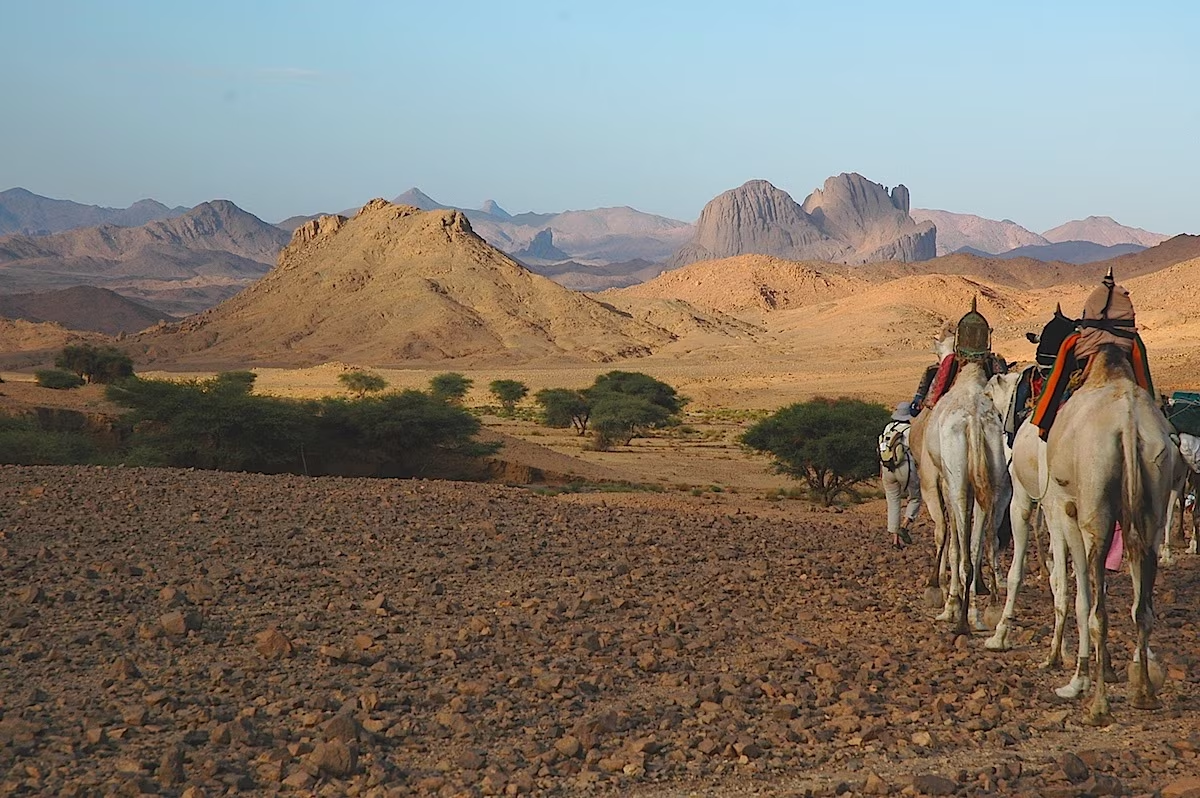
In the heart of Tassili n'Ajjer, fifteen days of camel trekking with the Kel Medak following the trails of Neolithic pastors.
Duration
15 days
From
€1,250/pers.
Ideal seasons
Jan, Feb, Mar, Oct, Nov, Dec
Style
Expeditions
Comfort
rustique
Travelers
Solo, With friends, Couple
The spirit of travel
This camel trekking is designed to live "in the Saharan way". Accompanied by our Tuareg guides and camel drivers, we discover the western slope of Tassili n'Ajjer, and we lead with them the ancestral life of nomads.
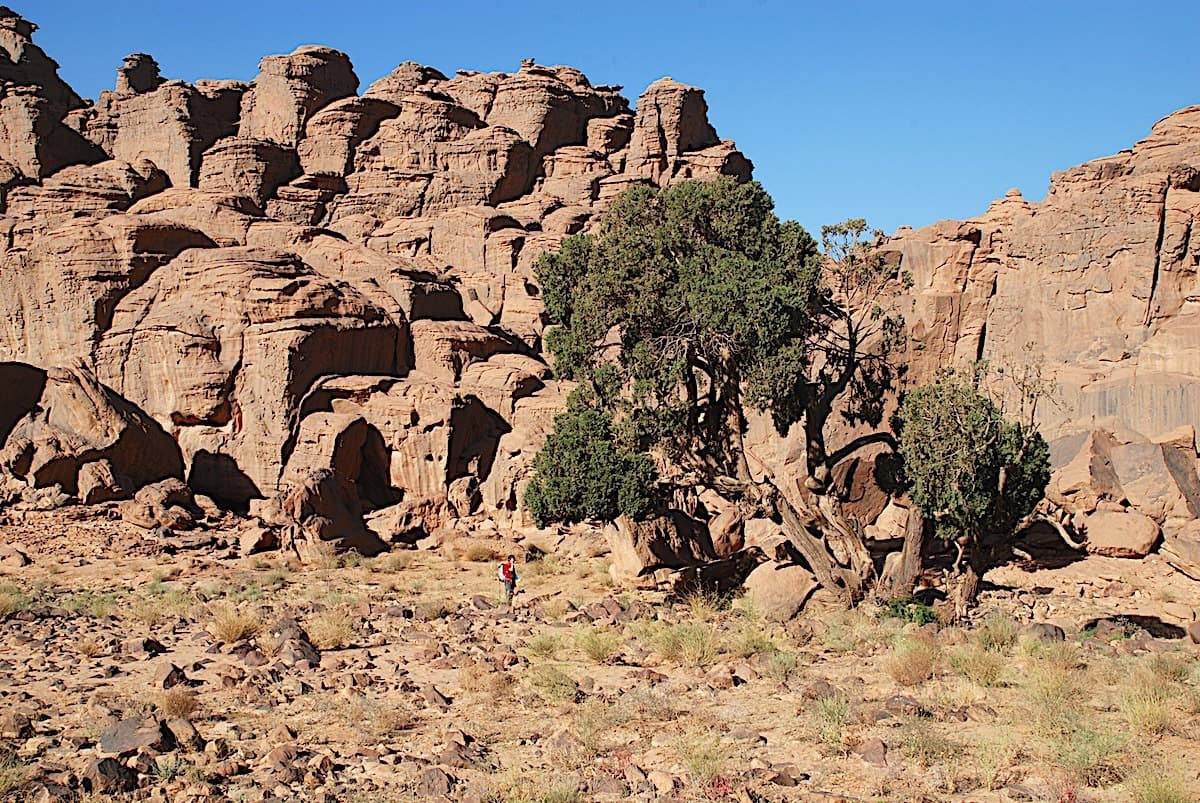
On the traces of Neolithic herders and painters, this long trek allows us to cross, from north to south, the highest region of Ajjer (1852 m), east of Djanet (1050 m), and to visit the richest Neolithic sites and the most famous ones for their rock paintings.
If this vast plateau, which slopes eastward towards Libya, has been practically deserted by nomads, it is because it now presents numerous challenges that we ourselves must face: scarcity of pastures, wood and water that must often be planned for almost the entire route.
The route is very varied, as in most traditional Tassili landscapes:
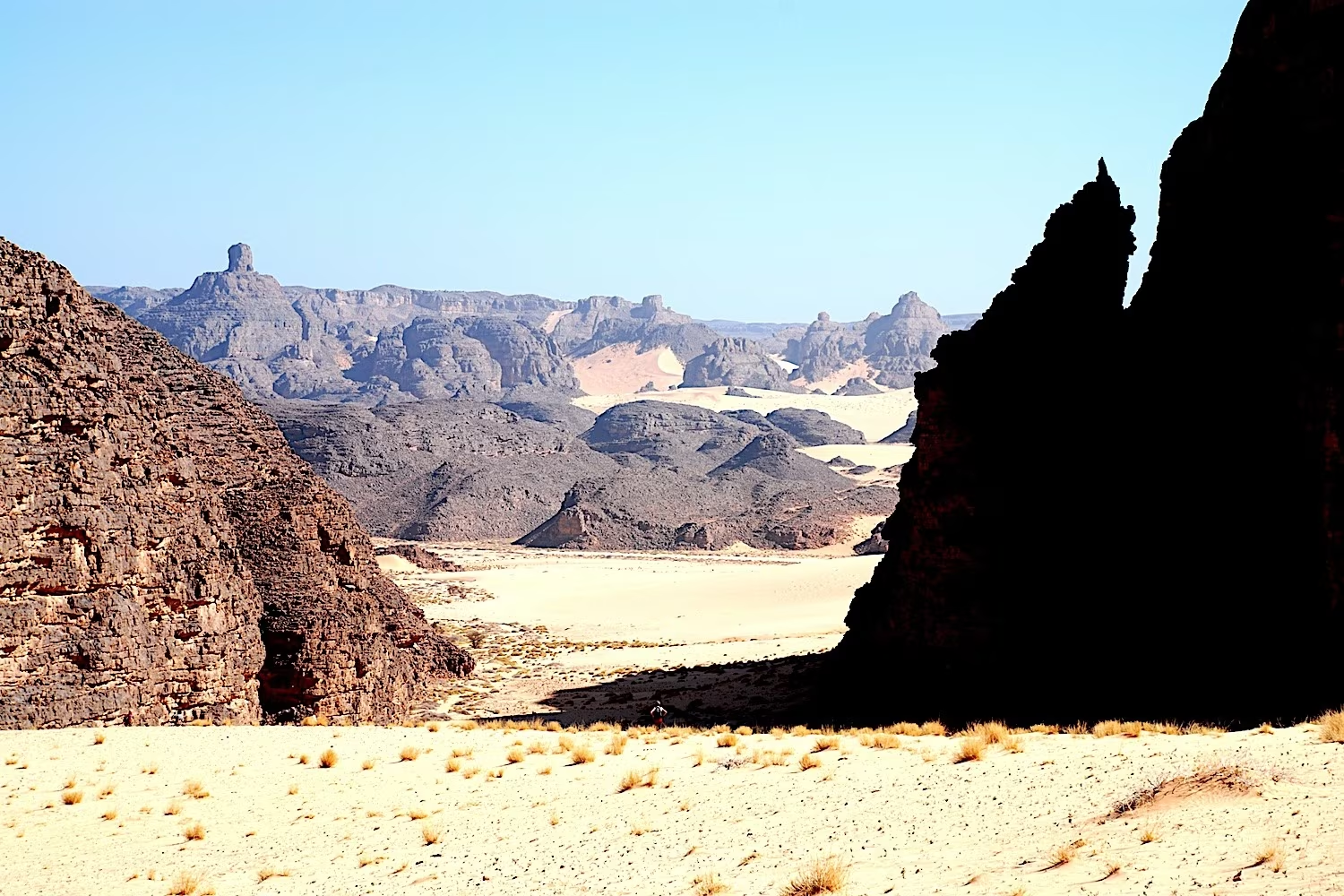
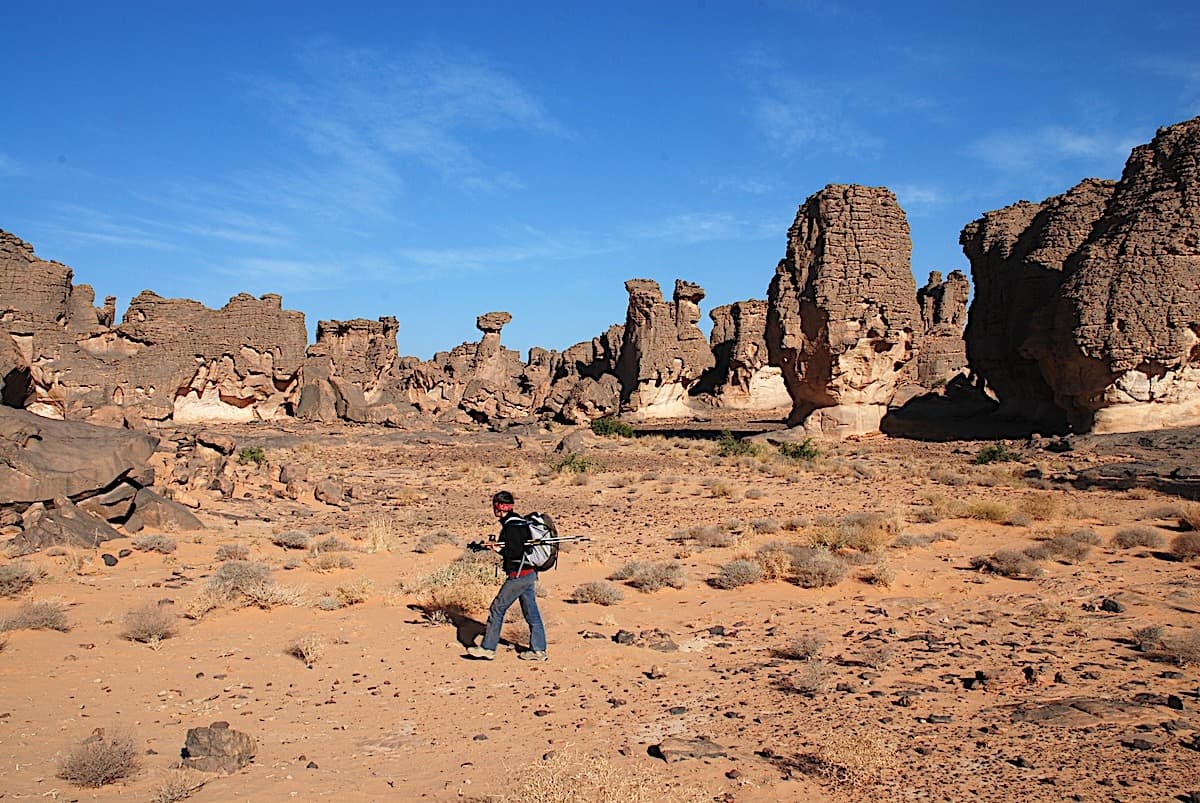
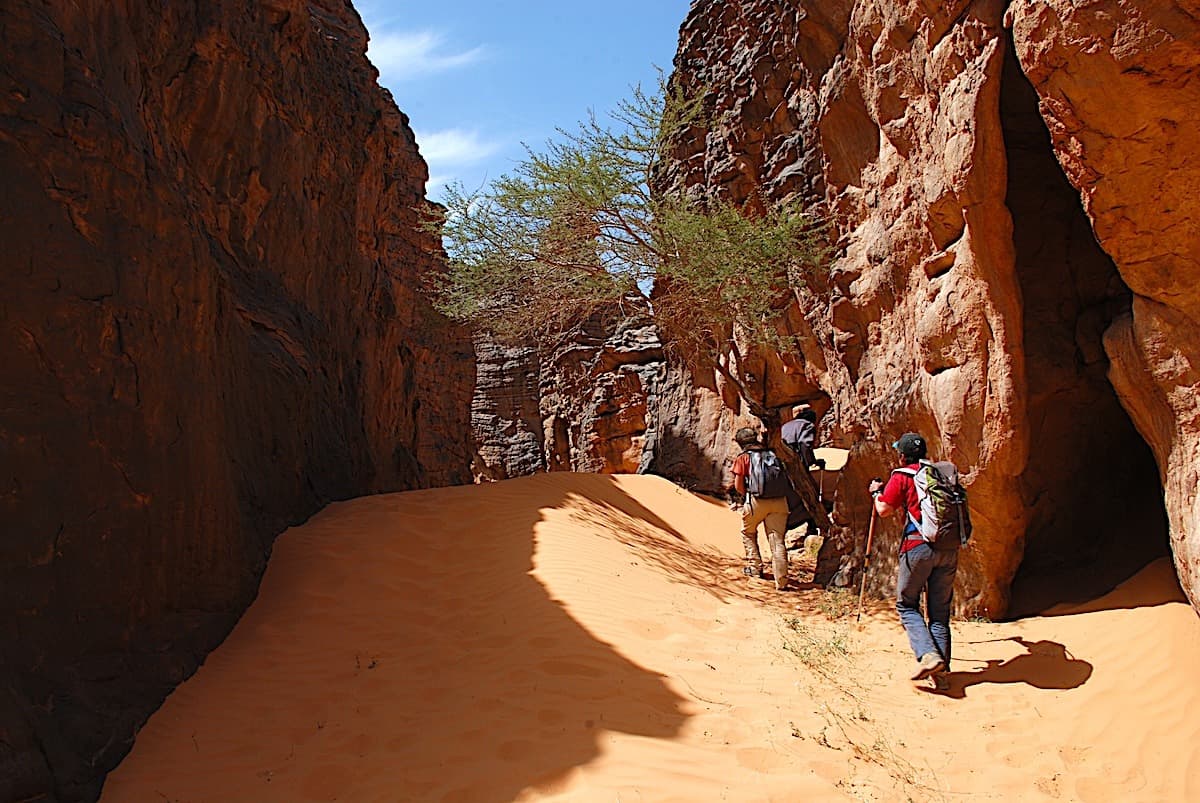
Bare plateaus and jagged sandstone where wadis wind through, stone forests and labyrinths, shelters and caves carved at the foot of rocks.
A collection of isolated dunes between rocks, sand flows filtering through the middle of sandstone towers.
Secret guelthas embedded in stone.
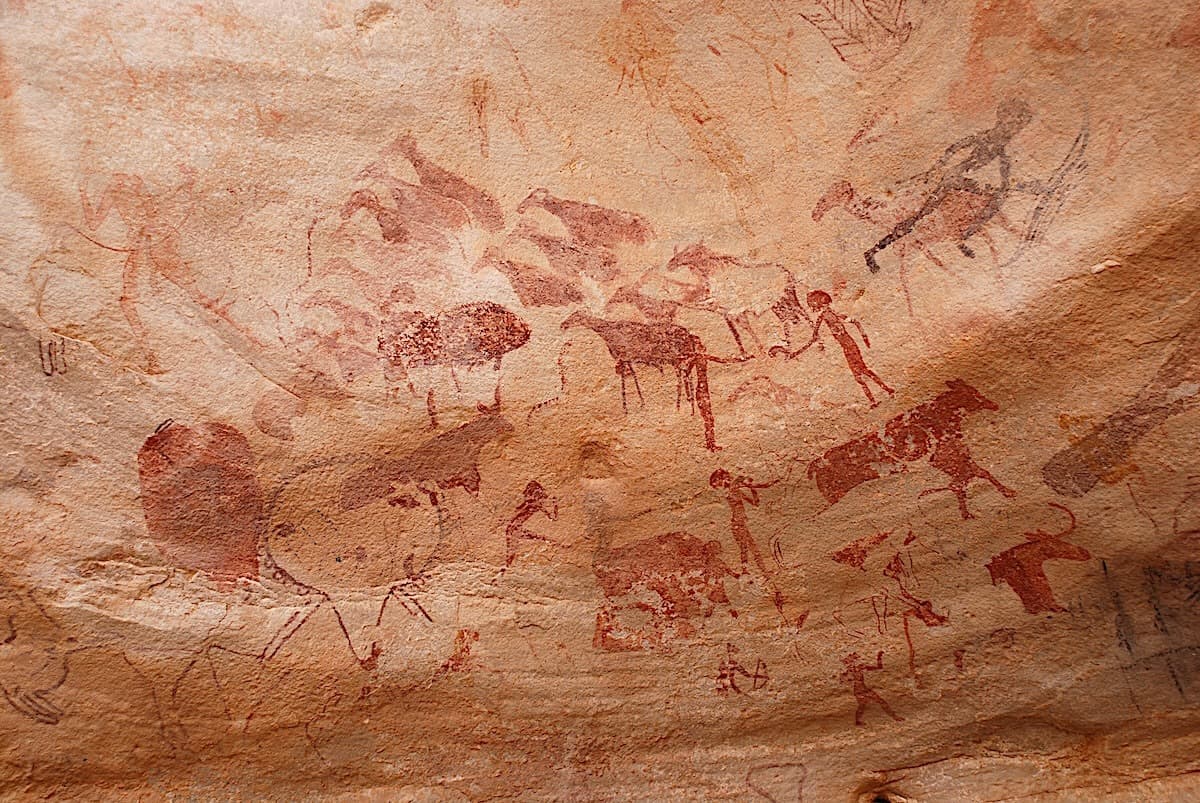
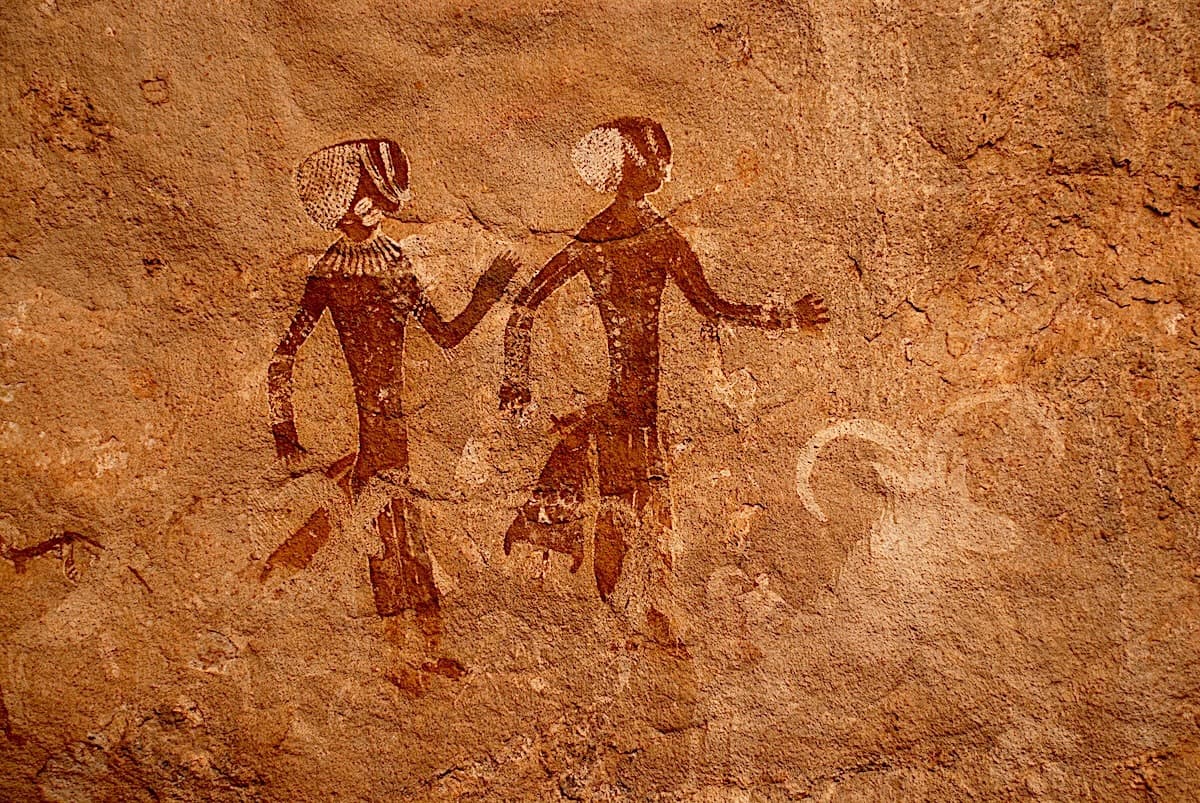
Rock paintings and engravings that testify to the presence of numerous populations and animals, in very ancient times, and to a climate that was once much more humid.
This itinerary is given as an indication and can be done in either direction. It depends on the season, atmospheric conditions, pastures and water points. Before departure and even on site, itinerary variations can be proposed taking into account the wishes and physical capabilities of the groups.
The stages of your journey
Highlights
Day-by-day itinerary
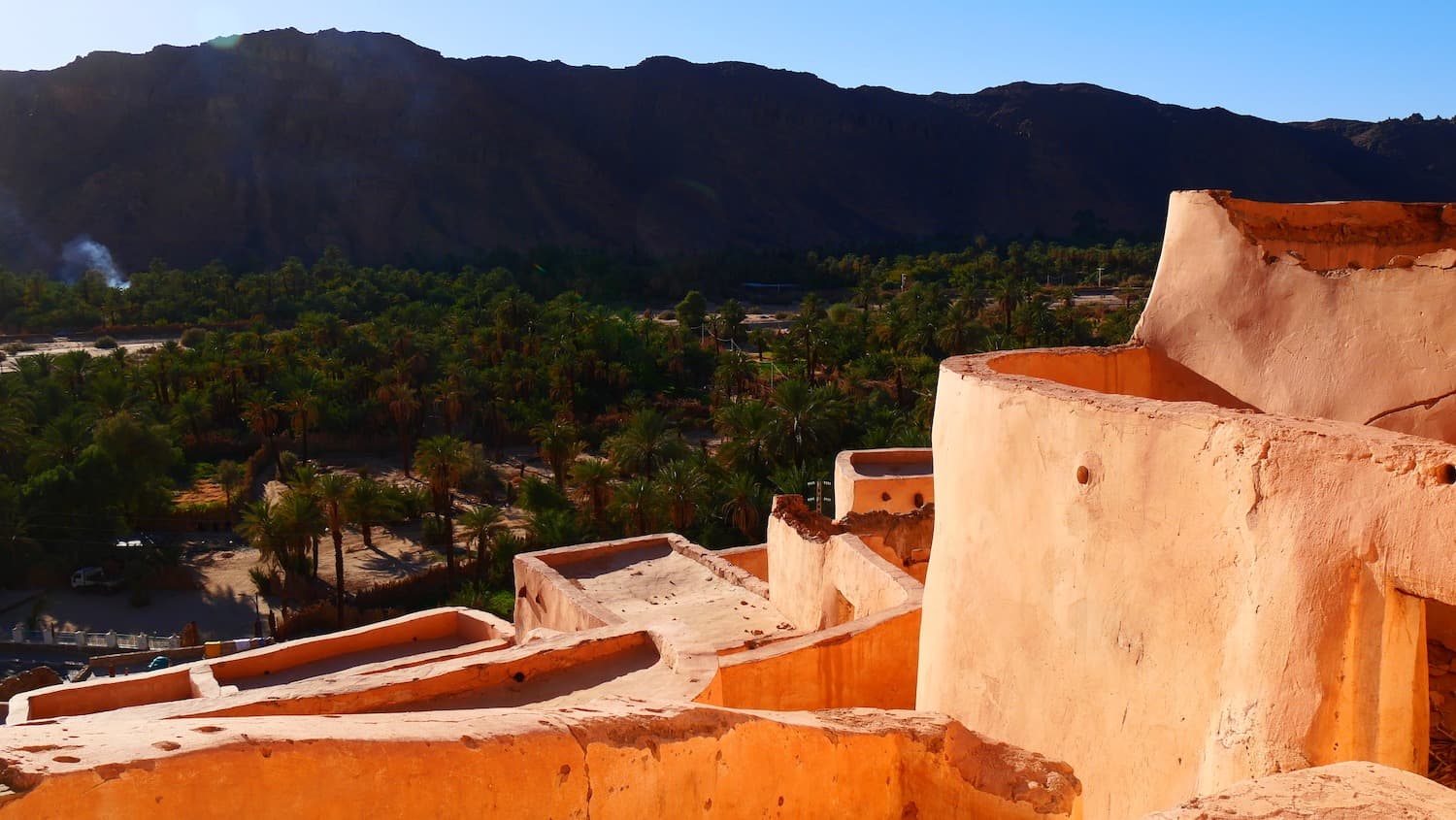
Paris > Algiers > Djanet
Departure from Paris for Alger, where you will be welcomed by the charm of the Algerian capital. After completing visa formalities at Alger airport, we will take a flight to Djanet.
Arrival in Djanet around 01:30 in the night of Day 1 to Day 2, you will be transferred to your hotel for a well-deserved night's rest. Enjoy the comfort and local hospitality to rest before the beginning of your Saharan adventure.
By default, we offer trips departing from Paris. However, you can take advantage of all flights to Algérie departing from a large number of European cities. International and domestic flights are not included in our offer, but we can help you organize them upon request.
Djanet > Imi n'Oumrat - Beginning of the Camel Trekking
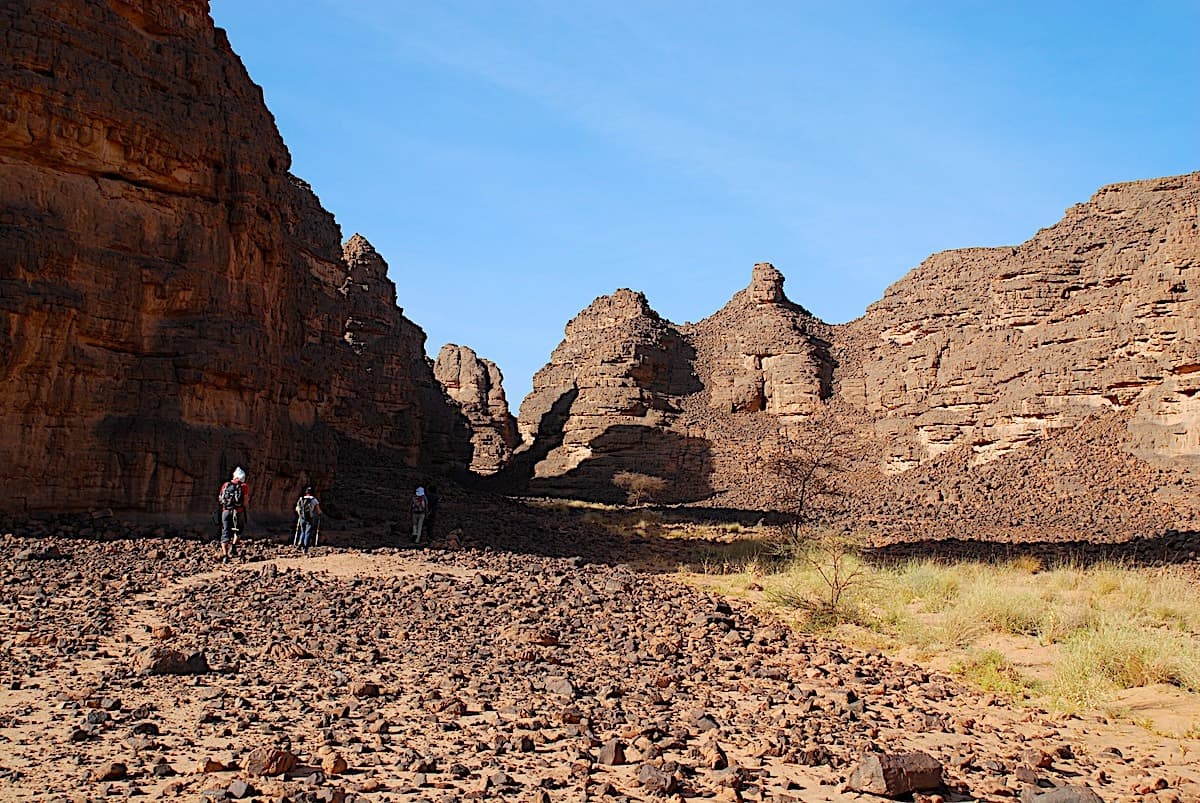
In the morning, we carry out a 4x4 transfer of approximately 30 km heading North. This journey presents us with some challenges, as the track we follow winds through the sandy bottom of the wadis and crosses small rocky thresholds. The route, although not easy, offers us spectacular views in the heart of the mountains. Each turn reveals new landscapes, from majestic rock formations to sandy valleys that seem to stretch endlessly. We finally join our caravan at Imi n'Oumrat.
After carefully loading the camels, we begin our trek. The layer of sandstone, which now overlies the granites and schists, guides us through breathtaking landscapes.
We walk for approximately 2 hours and 30 minutes before choosing the ideal location to set up our caravan and establish our first Saharan bivouac. As the sun begins to descend towards the horizon, we take advantage of the desert's tranquility to settle in and soak in the serenity of the place.
Imi n'Oumrat > Tagjouïsset
Imi n'Oumrat → Oued Tadjouïset
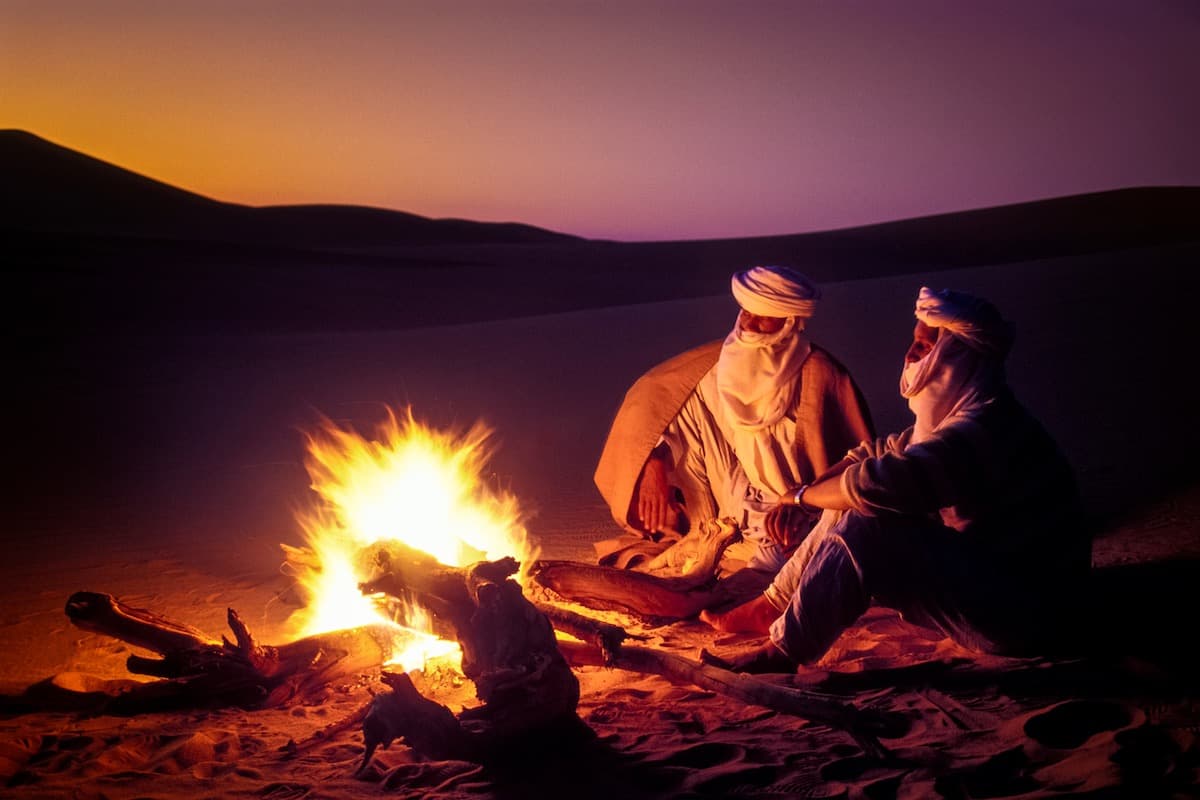
Dead wood is absent on the plateau, and the camel herders must take whatever they can find for their kitchen, reminding us of the logistical challenges of nomadic life. We go up the Wadi Wa Fararen, whose bed is cluttered with blocks rolled by past floods, testifying to the power of the elements in this desert landscape. We continue to evolve in the mountain zone that precedes the plateau, an environment where nature reveals its raw strength and beauty.
A first pass, particularly difficult for the camels, finally allows us to reach the magnificent wadi of Tadjouïset. This passage, though demanding, rewards us with breathtaking views and a sense of accomplishment. Each step brings us closer to discovering the hidden wonders of this region.
We establish our camp in the bottom of the wadi, near a guelta (Arabic) / aguelmam (Tamasheq), these precious water reserves that constitute oases of life in the aridity of the desert. These water points, often hidden in rocky crevices or nestled in fissures, are essential for the survival of caravans and local wildlife. Here, water, rare and precious, glistens in the sun, surrounded by sparse vegetation that contrasts with the mineral landscape around it. It is a place of rest and refreshment, where we can rejuvenate ourselves after a long day of walking, lulled by the silence of the desert and the soft lapping of water.
Tagjouïsset > Akba Assakao > Wan Teguedit
Oued Tadjouïset → Akba Assakao
We climb up the Tadjouïset wadi before reaching a vast rocky plateau that leads us into the Eméharaguélé wadi, then into the Aror wadi, which descends from the Assakao pass. We are at the foot of the imposing cliffs that guard access to the plateau. The wadi gradually narrows and becomes a tight gorge through which our caravan slowly climbs. The ascent is punctuated by the «Eh-éh-éh!» cries of the camel herders, shouts that excite the animals and reassure them at the same time.
Incredibly, given the difficulty of the passage, a few remnants of a vehicle track appear here and there. This is the track built by the French military in the 1950s to allow travel from Djanet to Ghat in 6x6 vehicles, without having to go around the Tassili plateau to the south. At that time, the Fezzan (Libya) was administered by French military authority, and this continued until 1956.
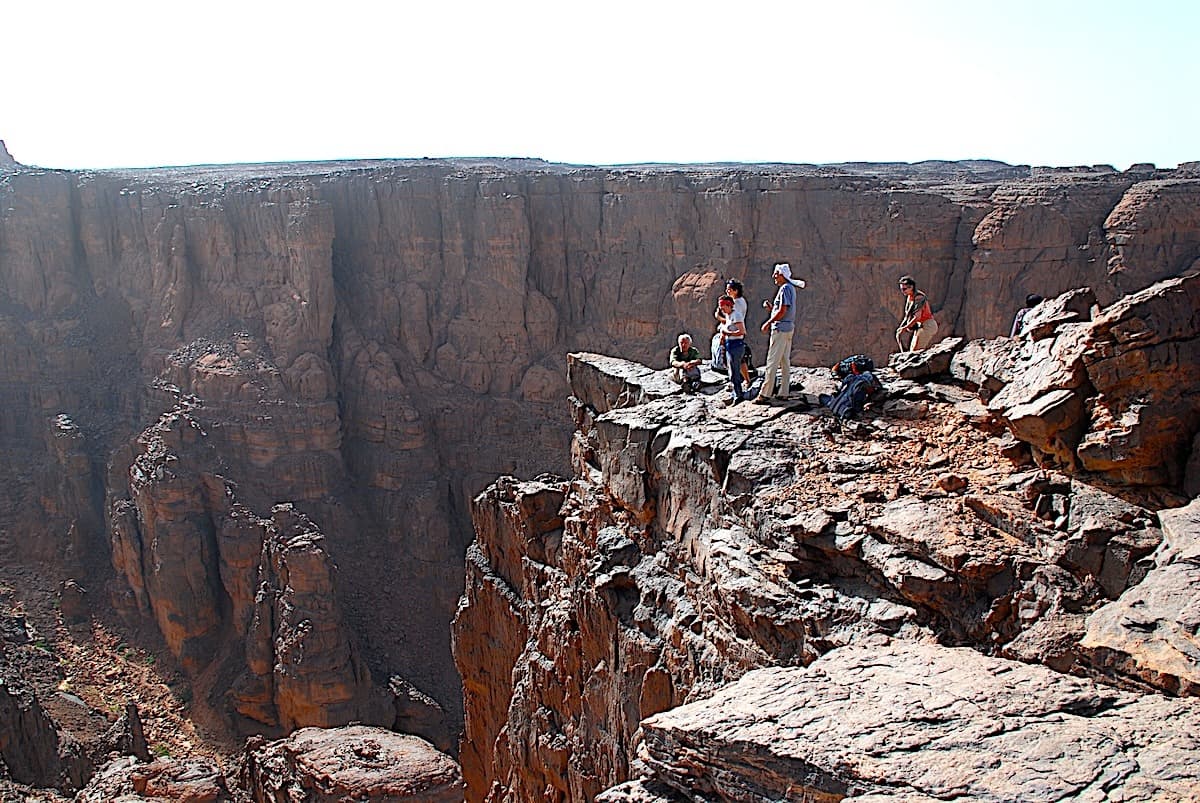
We finally escape the gorge by a ramp on the left to emerge suddenly at the Assakao pass (1670 m), with the dark immensity of the plateau before us that we cross toward the northeast. The view from this point is breathtaking, offering a panorama stretching as far as the eye can see over the desert expanses that extend before us.
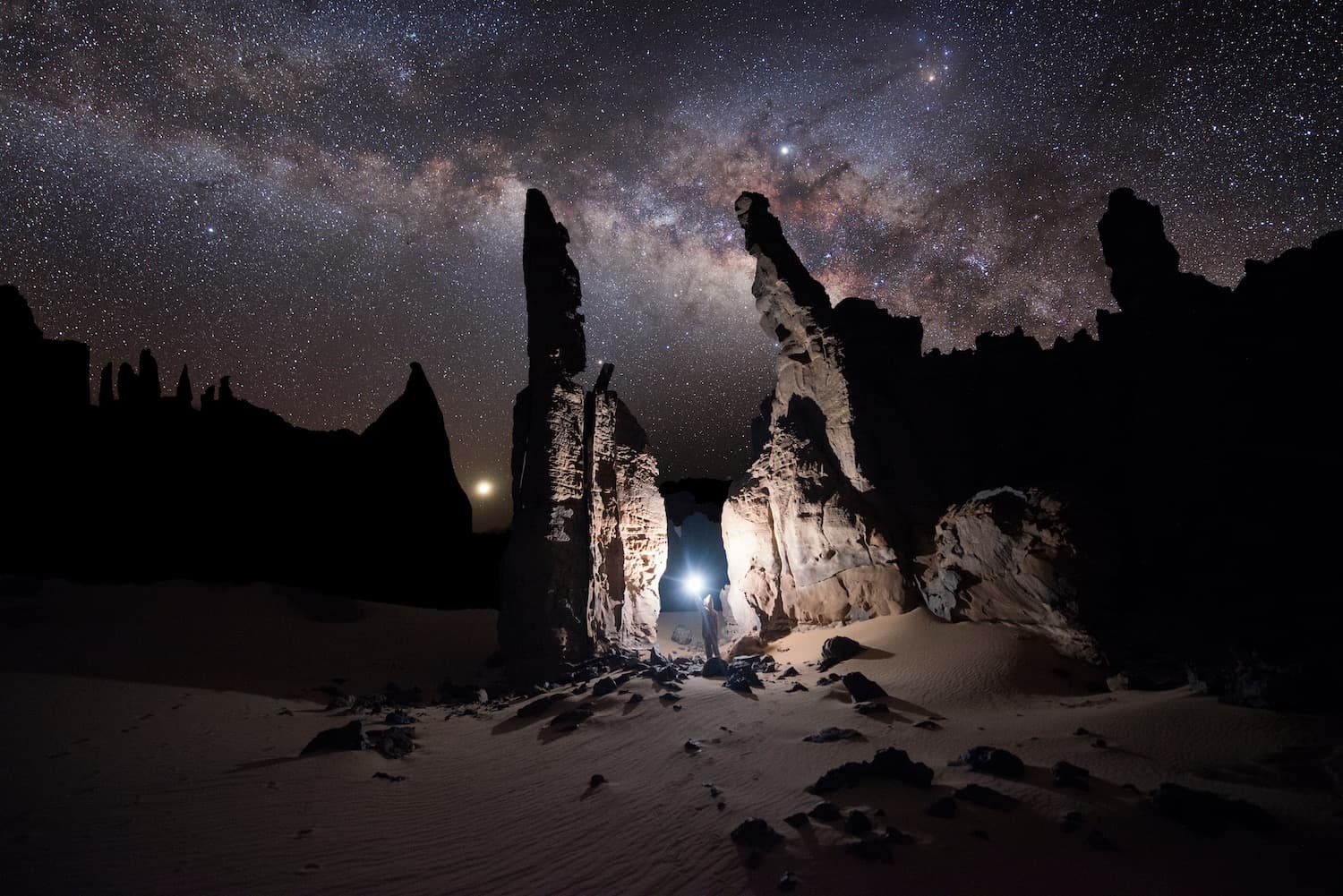
We begin a descent into a spectacular basin where a beautiful ensemble of rock towers stands, sculpted by erosion and time. These majestic geological formations, which seem to touch the sky, guide us towards the Amazak wadi. The landscape that unfolds before us is breathtaking, with interplays of light and shadow that animate the rock walls. Arriving at the Amazak wadi immerses us in a universe where nature reigns supreme, between imposing rocks and golden sands.
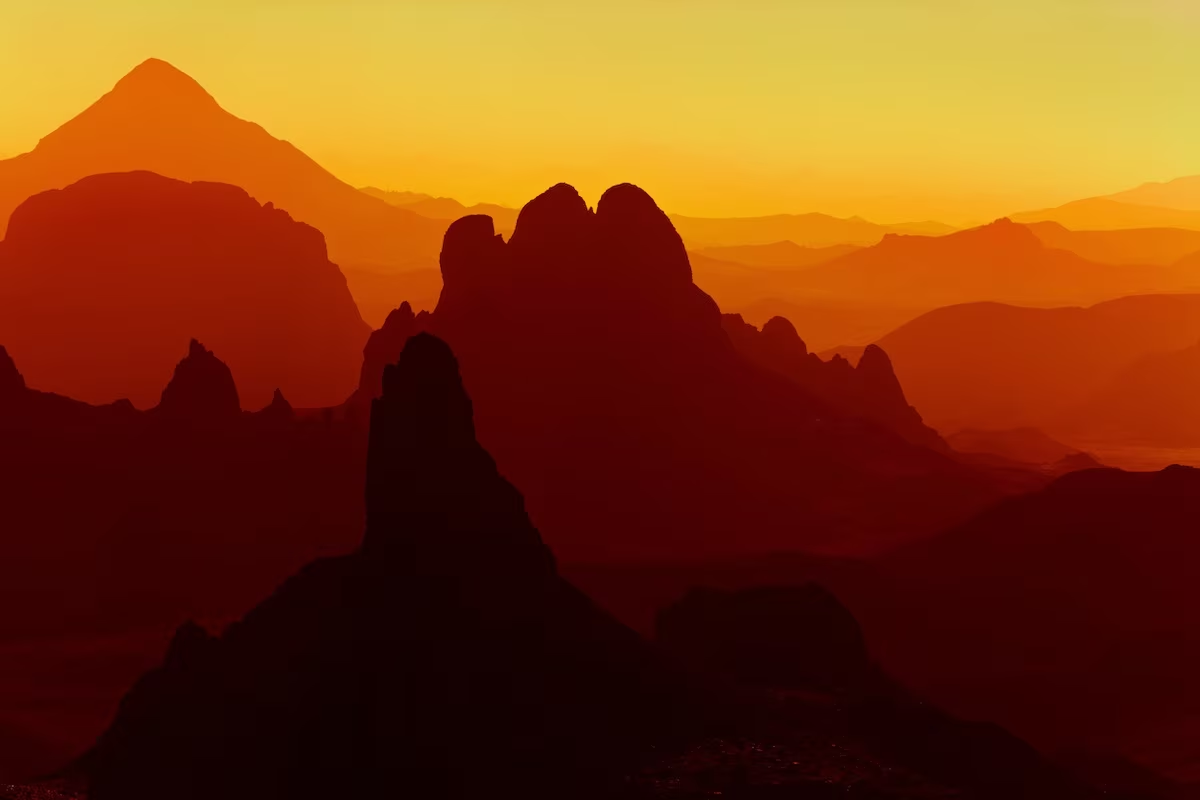
We end the day in the middle of our first stone forest, at Wan Teguedit ("The one of sand"), where we set up a magnificent bivouac at an altitude of 1580 meters. The rock formations surrounding us, sculpted by wind and time, create a magical and almost unreal atmosphere. As the sun begins to set, the stones take on golden hues, offering a breathtaking visual spectacle.
Wan Teguedit > Wan Tissoukaï > Ido
If there are any, our camel drivers go to an aguelmam (pond) to get water, an essential task to ensure our water supply for the coming days. Meanwhile, we climb the Tissoukaï dune, which overlooks our camp. The path through the rocks and sand offers us a breathtaking view of the desert expanses that surround us.
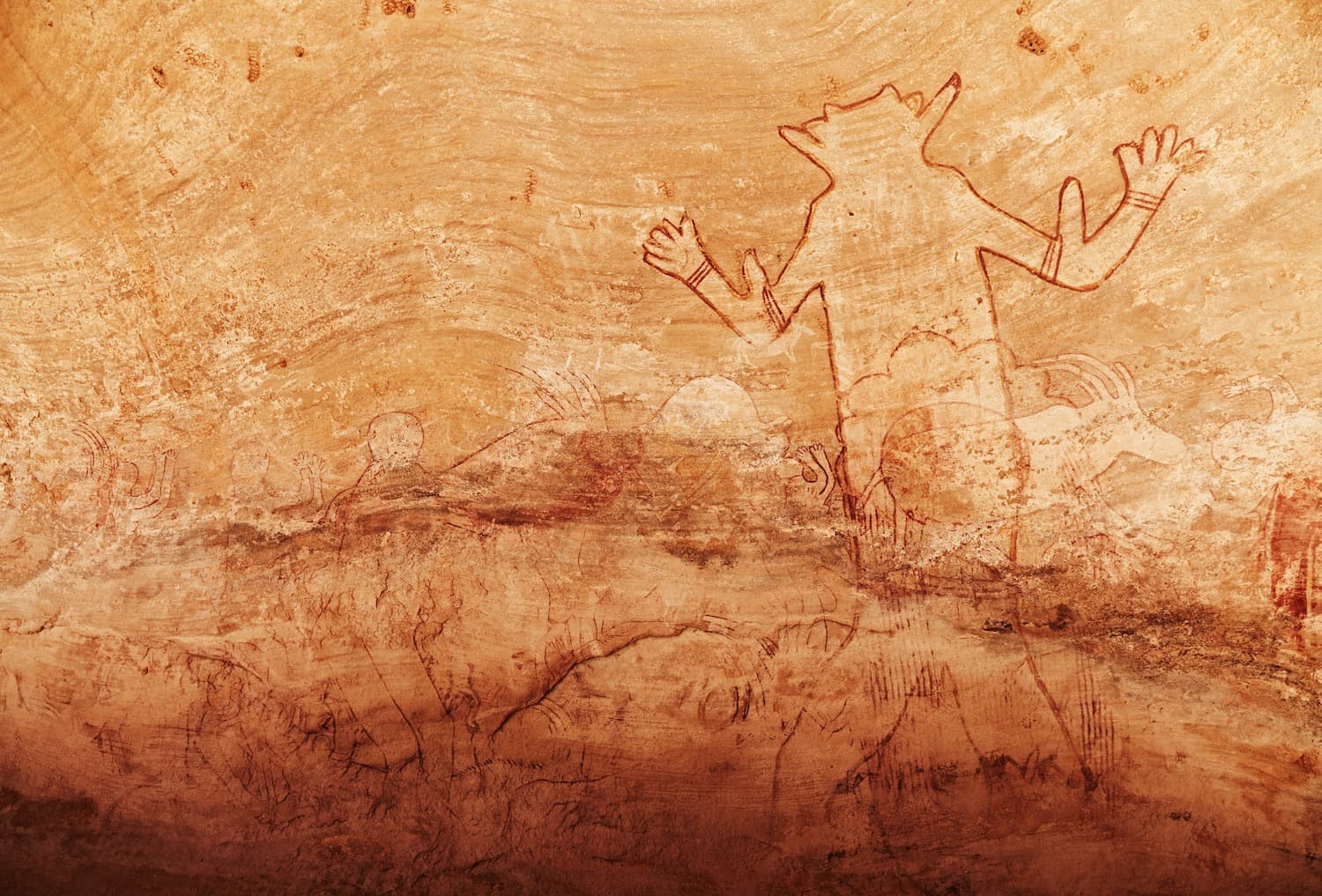
We then join our camel drivers in the Ido wadi to help them with this essential chore. The proximity of a few rock painting sites allows us to take the opportunity to visit them. These shelters, known as Wan Tissoukaï, transport us back in time by revealing the art and culture of the ancient peoples who once populated this region. The paintings, although discreet, testify to the historical and artistic richness of these now deserted lands.
The day continues by crossing a maze of rocky towers that are absolutely spectacular, where each stone tower seems to tell a thousand-year-old story. These geological formations, sculpted by wind and time, create a natural labyrinth that dazzles us with its beauty and mystery.
A little further on, we find the Ido wadi spreading out in a vast plain. This open landscape offers us a clear view of the horizon, where the sky blends with the earth in a harmony of warm colors and sand hues.
We set up our camp in a clear area, in the upper reaches of the Emi n'Kloukout wadi. This privileged location allows us to fully enjoy the tranquility of the desert and the beauty of the stars that are beginning to twinkle above us.
Ido > Tin Tekelt
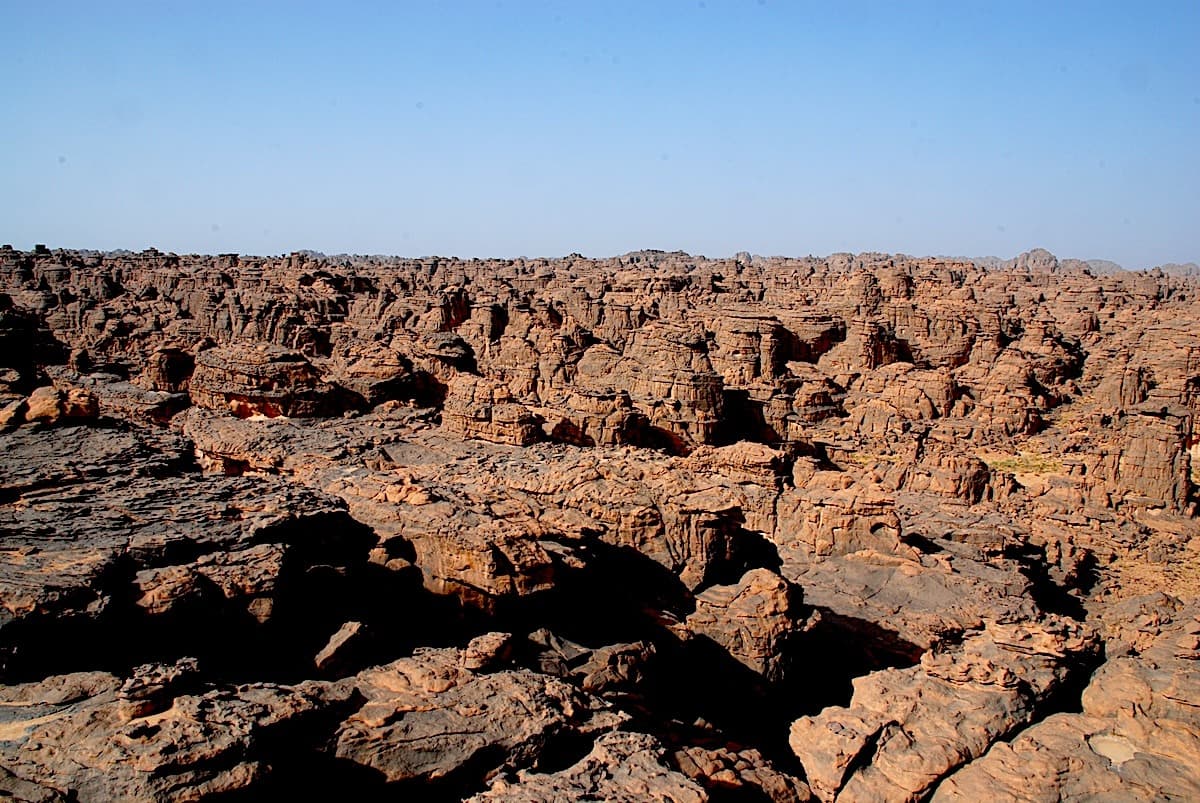
Heading South, then South-Southeast, after crossing a rocky plateau and the In Akatafa wadi, we descend into the In Tararit wadi where we find sand and stone forests. These formations, sculpted by erosion, envelop us in an almost mystical atmosphere, where nature and history are closely intertwined.
Before descending into the In Tararit wadi, we pass through the locality of Tan Ahaggar, where one of the episodes of the famous Battle of Assakao took place in 1920, between the Hoggar and Ajjer Tuaregs. It was the last war between the two parties, marking a historical turning point for the nomadic peoples of the region.
At Tebdjedj, we enter a veritable "avenue" bordered by bell towers or turrets. On a slab at the entrance to the avenue, we can see a curious erotic scene where several characters with enormous genitalia copulate with an animal, offering a fascinating glimpse into the art and customs of the era.
A superb pathway through a stone forest, reminiscent in some respects of Hindu temples, leads us to Tin Tekelt. Beneath a large portico, engraved hands are stained with milk and oil, offerings from a fertility ritual that testify to the spiritual practices of the ancient inhabitants.
We establish our bivouac in the tiset of Tin Tekelt, a vast plaza surrounded by sandstone needles.
Tin Tekelt > Tin Tazarift
After leaving the Tin Tekelt site, we venture deep into the narrow and spectacular gorges of this wadi, where every bend reveals a new geological wonder. We finally emerge into the wide valley of the wadi Tin Arasou ("One of the Calligonum comossum", a shrubby bush typical of the region). This open landscape, invaded by lush vegetation and ringed by imposing cliffs, offers a striking contrast with the narrow gorges we have just crossed.
After descending the Arasou wadi for a while, we abandon it to reach the Tiset d'Idehan n'Elias, a site where the tranquility of the desert is felt in an almost tangible way. Next, we reach the wadi Wan n' Asaqamar, where stands the tomb of a man from the Isaqamaren tribe, a place steeped in history and respect for local traditions.
We continue our exploration by visiting the stone villages of Tin Aboteka and Tin Tazarift, famous for their rock paintings. These petrified villages, though silent and abandoned, are full of traces of past life, notably abundant traces of Barbary sheep, reminding us that life persists even in the most arid environments.
The setting of our bivouac is once again remarkable, located at the confluence of winding paths that provide access to small secluded cirques. Strolling through this site is a magical enchantment, whether in the golden light of day or in the silvery softness of moonlight.
Tin Tazarift > Sefar
We visit today the "streets" mysterious of Tin Taferiest as well as the northern region of the Sefar site, where each step plunges us more deeply into the ancient history of this region. We then arrive in the famous Valley of the Amazons, so named by Henri Lhote because of its wealth of rock paintings. This emblematic site offers us a fascinating glimpse into past cultures, through works of art that have crossed the millennia.
Not far away, there is a permanent guelta, a vital water point in this arid desert, where we will perhaps be able to renew our water supply. Around this miniature oasis, a variety of vegetation flourishes, including reeds, oleanders and small tamarisks (azawa), adding a touch of greenery to this otherwise mineral landscape.
The afternoon is dedicated to the continuation of the visit to Sefar, a site particularly rich in paintings from the period known as the Round Heads. These prehistoric works of art offer us a window into the past, revealing the ways of life and beliefs of ancient peoples. The name Sefar comes from that of a quality of dates, which, once ripe, display a brown-red color. Close to the rock art site, there is the plateau called Sefar, covered with pebbles of the same color as these emblematic dates. This plateau gave its name to the region, a testimony to the deep connection between the landscape and local culture.
In late afternoon, we cross this desolate plateau before descending into the oued Ni Touhami, where the desert landscape envelops us with its tranquility and austere beauty.
Sefar > Tamghit
We continue our westward progression, crossing an area particularly rich in natural shelters. Among them, we discover Tin Eras n'Elias, In Itinen (chariot at galloping flight), and Tan Zoumaïtak, famous for its representations of a very beautiful ibex. Each shelter reveals to us a little more of the artistic and cultural heritage of the ancient peoples who once roamed these lands.
An easy climb through the rocks leads us to the edge of the impressive Tamghit canyon, whose depth exceeds 400 meters. This natural spectacle leaves us speechless, contemplating the vertical walls that plunge toward mysterious depths.
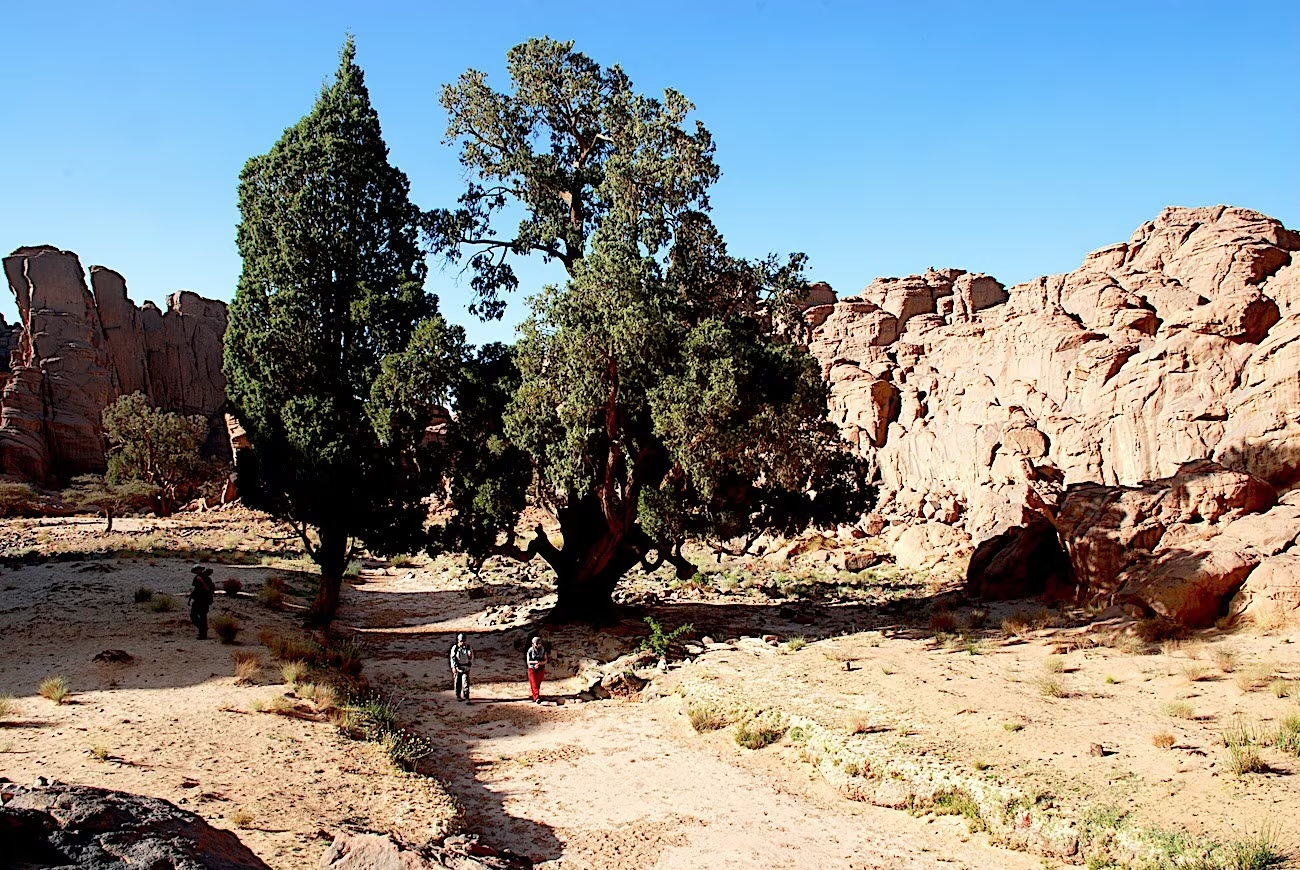
We soon enter the valley of cypresses, a unique place where the Duprez cypress (Cupressus dupreziana), called tarout in Tamahaq, thrives. This species, found only on the Tassili, is unfortunately endangered. Due to persistent drought, it can no longer regenerate naturally. Today, only about 250 specimens remain on the plateau, fifty of which are in the Tamghit valley, a poignant testimony to the fragility of our environment.
Our bivouac is established at the outlet of the valley, at Tin Mezouzine, a peaceful place where we can rest and soak in the wild beauty of the desert. The evening promises to be calm, under an infinite starry sky, perfect for reflecting on the full day and the richness of the landscapes we have crossed.
Tamghit > In Essou
We cross a vast dark plateau, where the immensity of the desert stretches as far as the eye can see, before reaching the In Esou wadi. This arid and mysterious landscape envelops us in an almost timeless atmosphere, where silence reigns supreme.
We visit a few rock shelters along our route, each revealing a small archaeological treasure or a trace of past civilizations. These stops allow us to immerse ourselves further in the rich and complex history of this region.
By late morning, we reach the In Esou guelta, a tiny but vital oasis in this hostile desert. The presence of water attracts a variety of wildlife, and the sparse vegetation surrounding it offers a striking contrast with the surrounding desert landscape.
In Essou > Jabbaren
We continue our southbound progression, where the landscape begins to open up, revealing an expanse that is always equally magnificent. Wide wadis wind through the plateau, creating a complex network of valleys and gorges that shape this desert landscape. Downstream, these watercourses narrow to form narrow and deep gorges, offering an impressive natural spectacle.
We arrive in the highest region of the plateau, where the altitude exceeds 1800 meters. We are now in the region of Jabbaren, nicknamed "the Giants" because of the imposing rock formations that dominate the landscape. Here, we will explore several rock shelters, including the famous shelter "with polychrome bovines." This site is renowned for its rock paintings representing bovines in varied and vibrant hues, offering a fascinating glimpse into the art and cultures that flourished in this region thousands of years ago.
Jabbaren
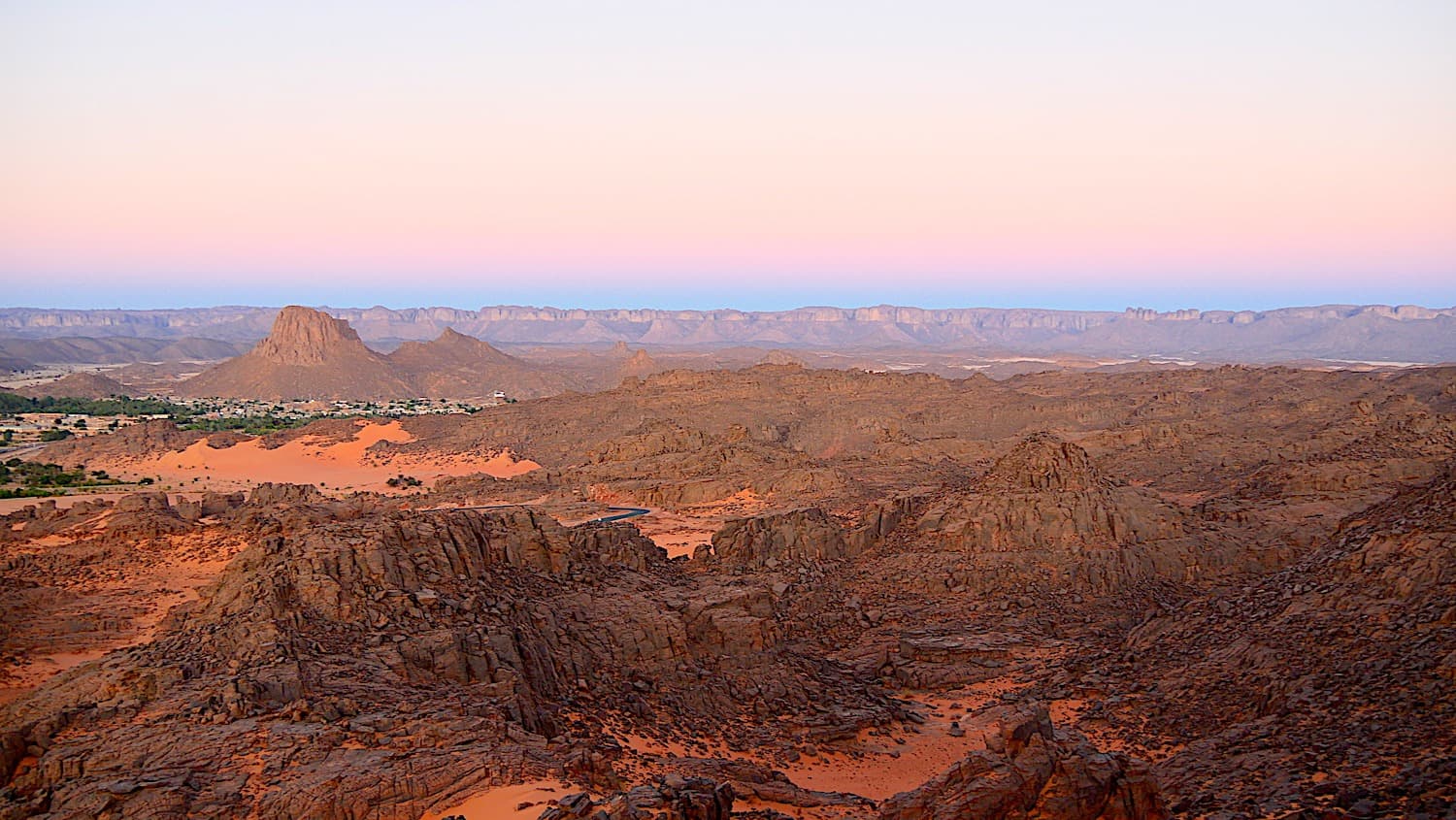
We arrive at the Jabbaren Pass, an emblematic location situated in the Tassili n'Ajjer region, renowned for its spectacular desert landscapes and unique rock formations. From this elevated point, we admire a magnificent view over the Admer erg, a vast expanse of sand dunes located southwest of Djanet. This contrasting landscape, where golden or pink dunes depending on the time of day meet dark rock formations, offers an unforgettable natural spectacle.
After a stop to refresh ourselves, we enjoy a well-deserved picnic at the evening bivouac, where we rest before continuing our adventures.
The afternoon is entirely devoted to visiting the rock paintings, which are a fascinating testimony to the ancient cultures that once inhabited this region. These works of art, preserved for millennia, offer us a unique window into the past and the ways of life of prehistoric peoples.

Jabbaren > Tefetest
We move on to Aounrhet, a remarkable site where we discover beautiful rock paintings. These works, engraved on rock walls, transport us through the ages, revealing traces of ancient cultures that flourished in this region. Along the way, magnificent viewpoints punctuate our approach to Tefetest, revealing breathtaking landscapes and nature preserved in all its splendor.
Our bivouac is set opposite the majestic Adjefou mountain, a place steeped in tranquility and wild beauty. As the sun begins to set, golden light envelops the landscape, creating a peaceful and almost mystical atmosphere. We spend the evening savoring this serenity, lulled by the silence of the desert and the soft whisper of wind through the rocks.
Tefetest > Oued Carana
We begin our descent through the Ijafen pass, a delicate passage for camels due to its steep slope and uneven terrain. The progression is slow and cautious, but we are rewarded with spectacular views of the desert landscapes that stretch as far as the eye can see.
We stop for a well-deserved picnic in the Carana wadi, a peaceful place where the murmur of water and the shade of acacia trees offer an oasis of tranquility.
After the meal and after thanking and greeting our team of camel herders for their support and expertise throughout our adventure, we head back to Djanet. We arrive in the early afternoon, and upon arrival, a nice shower awaits us to refresh ourselves after this long journey across the desert.
Refreshed, we then set out to discover the capital of the Ajjer. We explore its picturesque streets, where every corner reveals a piece of the rich local history, and we immerse ourselves in the lively atmosphere of its emblematic market. Here, Tuareg culture unfolds in all its splendor through vibrant colors, traditional fabrics and handcrafted objects.
After one last dinner, savoring local delicacies one last time, we head to the airport around 10:30 pm. It is with our minds filled with unforgettable memories of our Saharan adventure that we leave this land of contrasts and wonders.

Djanet > Algiers > Paris
We assist you with check-in in the middle of the Saharan night, under a starry sky that adds a magical touch to this stage of your journey. After check-in formalities, you board your flight which will take you to Algiers in the early morning.
Upon your arrival, you can continue your journey to Paris or other destinations.
Price per person
Indicative price per person, based on double room. Each trip is customized according to your preferences.
This trip can be tailored to your preferences
This itinerary provides an excellent foundation for discovery, but it can be fully customized. Our local advisors build each trip tailored to your budget, dates and preferences.
Not included
- Visa fees payable upon arrival on Algerian territory
- International flights and domestic flights to Djnet
- Insurance "Cancellation", "Repatriation" and "Travel Risks"
- Your personal expenses: all beverages during meals
- All costs incurred by any possible independent extended stay
Included
- Welcome and transfer to Djanet in the night of Day 1 to Day 2
- Hotel or guesthouse in Djanet on Double or Twin room basis
- 4x4 vehicle journey to reach the start of the camel trek
- Camel team with pack camels
- English-speaking Tuareg guide with extensive knowledge of the region
- All Saharan bivouac equipment except sleeping bag
- All logistics during the camel trek
- Full board throughout your stay with us
- Return route to come back to Djanet on day 14
- Room available in Djanet on D14
- Meals at the restaurant in Djanet according to your choice
- Transfer and assistance for Djanet Algiers flight
Practical Information
Registration is considered firm and final after payment of a deposit of 30% of the total price and acceptance of the specific terms of sale.
The balance must be paid no later than 45 days before the departure date.
See our specific terms of sale for full details.
In the event of cancellation by the traveller, the following fees apply:
- Plus de 60 jours avant le départ : 40 % du prix total (acompte retenu)
- Entre 60 et 30 jours avant le départ : 50 % du prix total
- Moins de 30 jours avant le départ : 100 % du prix total
We strongly recommend taking out cancellation insurance. See our specific terms of sale for full details.
The information below concerns travelers who are nationals of the European Economic Area (EEA), Switzerland, and Canada traveling to Algeria for a tourist stay. As entry rules may change, we recommend verifying this information with the official authorities before your departure.
Passport
To enter Algeria, your passport must be valid for at least six months after your date of entry into the country and have at least one blank page for immigration stamps.
The document must be in good condition (no damaged, torn, or altered pages).
Visa
Nationals of the European Economic Area, Switzerland, and Canada must be in possession of a valid visa to enter Algeria for a tourist stay. There is no visa exemption for these nationalities.
The visa must be obtained before departure, from the Algerian embassy or consulate responsible for your country of residence. It is recommended to apply several weeks in advance, as processing times may vary.
Documents generally required for a visa application include:
a valid passport with at least six months of remaining validity,
a completed and signed visa application form,
recent passport-sized photos complying with required standards,
a return flight ticket or booking,
proof of accommodation (hotel reservation or invitation),
proof of sufficient financial resources for the duration of your stay.
The authorized length of stay is generally 30 days, depending on the conditions mentioned on the visa issued.
Travel with children
Minors must be holders of their own valid passport covering the duration of their stay.
In some European countries, when a minor travels without one of their parents, an authorization to exit the territory may be required according to the regulations of their country of residence.
Health
No vaccination is officially required to enter Algeria for nationals of the EEA, Switzerland, and Canada. However, it is recommended to consult a doctor or vaccination center before departure and to ensure that basic vaccinations are up to date (diphtheria, tetanus, poliomyelitis, hepatitis A).
It is also advisable to take out international health insurance covering medical expenses and repatriation for the entire duration of your stay.
Other nationalities
Entry conditions may vary depending on nationality. Travelers concerned should inquire at the Algerian embassy or consulate of their country of residence.
To participate in our trips, it is strongly advised to have assistance-repatriation and foreign medical expenses insurance.
Your local agency encourages you to familiarize yourself with the specific policy developed with our partner CHAPKA ASSURANCES and AXA ASSISTANCE.
To subscribe to insurance, learn about coverage and rates, follow the link below.
CAP EXPLORER: The complete insurance solution designed for a worry-free trip!
Choose the plan that best suits you:
Explorer'Multirisque
Explorer'Annulation
Explorer'Assistance
Explorer' Complementary Credit Card
Specific to our trips, we strongly recommend subscribing to them.
If you choose to subscribe to one of these plans, the policy detailing all coverage and claims declaration procedures are available on the insurer's website.
Your local agency will be aware of this, but only the participant is responsible for complying with the claims declaration procedures. The participant must therefore keep this policy with them throughout their trip.
Chapka — Cap Explorer
Our insurance partnerTravel with peace of mind with our partner Chapka. Cancellation, repatriation, medical expenses, baggage… All the coverage for a worry-free trip.
Travel with peace of mind — I'll handle the insuranceFrequently asked questions
A tourist visa is required and must be requested from the consulate (consular fees apply, processing time 2-3 weeks). An invitation letter or accommodation certificate is required. Your passport must be valid for at least 6 months beyond your planned entry date. Conditions can be stringent. We strongly recommend verifying the rules applicable to your nationality with the Algerian consular authorities before booking your trip.
Go to the My Trips section to find all your projects.
You can send a message to your host directly from the Tea Lounge.
For a tailor-made quality trip, budget between 140 and 240 euros per day and per person, including accommodation, meals, internal transfers and English-speaking guide. International flights (350-700 euros return) are additional. The Algerian Sahara (Tassili, Hoggar) requires a specific budget.
Your documents are accessible in the Documents tab of your trip.
Absolutely. We adapt each itinerary to match your travel profile. For families, we prioritize relaxed paces, family-friendly accommodations, engaging and educational activities, and comfortable private transfers. Our local English-speaking guides know how to captivate children with age-appropriate stories and anecdotes.
It's simple. You exchange with our local team to define your wishes, budget and dates. You receive a detailed itinerary proposal within 48 hours. You refine every detail together until you have the perfect version. You confirm and set off with peace of mind. Your local agency remains available 7 days a week throughout your trip.
In case of emergency, contact your local agency immediately.
Payment is generally made in two installments.
Our agency is part of the Nomadays network, registered in France. You benefit from APST guarantee (Professional Association of Tourism Solidarity) which covers 100% of your funds. Secure payment, repatriation insurance included, and English-speaking assistance 24/7 on site throughout your stay.

Let's talk about your adventure — Great Saharan South
Pioneer of Algeria's great deserts, based in Ghardaïa / M'zab (puis Alger à partir de 2006)
The desert is not crossed with an itinerary alone. It demands listening, respect, and a certain inner availability.
— Louiza