
Although it is often reduced to its commercial dimension, Valentine's Day retains, everywhere on the planet, that particular fragrance of celebrations that speak to the heart. From one continent to another, it takes amazing forms: here we celebrate lovers, elsewhere we honor friends, sometimes even singles. An overview of Valentine's Day traditions around the world, between secular rites and more contemporary customs.
Table of contents
- Valentine's Day in Japan
- Valentine's Day in Thailand
- Valentine's Day in Colombia
- Valentine's Day in South Africa
- Valentine's Day in Vietnam
- Valentine's Day in the United States
- Valentine's Day in Brazil
Valentine's Day in Japan

In Japan, Valentine's Day is celebrated in two acts, separated by exactly one month. A peculiarity born in the 1950s when a Tokyo chocolatier, Morozoff, popularized the idea that on this date, it would be women who would give chocolates to men. An inversion of Western codes that became so established that it became an institution.
On February 14th, Japanese women therefore distribute coded gifts. Giri-choco, literally "courtesy chocolate," is addressed to colleagues, superiors or classmates — a social gesture, almost protocol. Honmei-choco, or "chocolate of destiny," is reserved for the one they love: often homemade, carefully wrapped, it carries a much more engaged romantic intention. More recently, tomo-choco ("friendship chocolate") has made its appearance among friends.
Then comes March 14th, named White Day. On this day, men are expected to deliver: they must respond to each gift received with a present worth two to three times more than the chocolates offered a month earlier. Jewelry, accessories, white biscuits or refined pastries: the sanbai gaeshi rule ("triple in return") requires a certain elegance.
For solitary souls, there is finally Black Day, April 14th. Imported from South Korea, this tradition brings singles together around a bowl of jajangmyeon, noodles in black bean sauce. A way to laugh at one's status rather than suffer from it.
Valentine's Day in Thailand
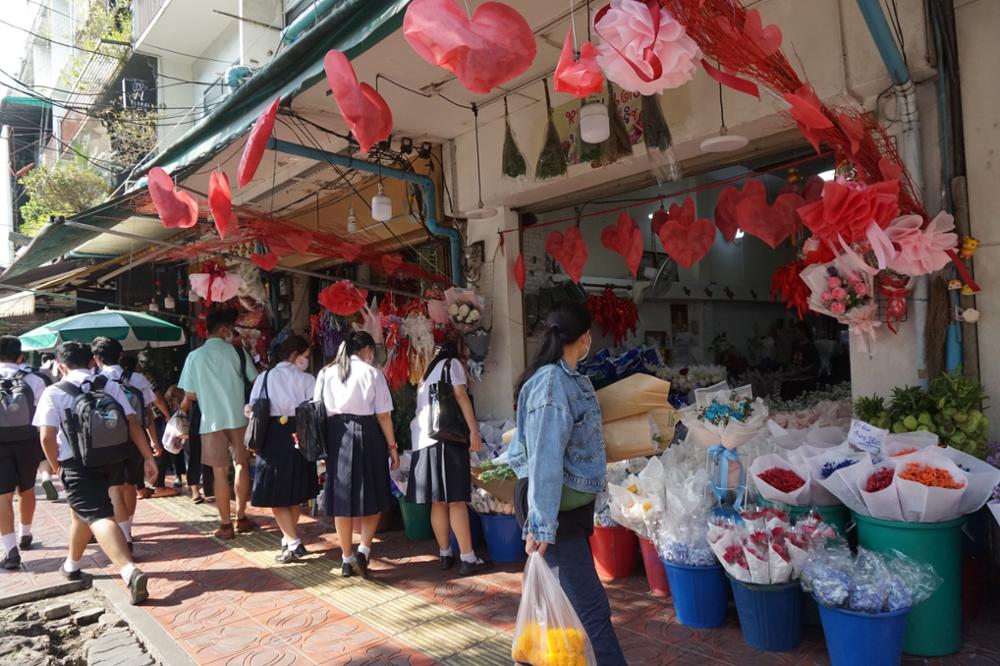
In Thailand, Valentine's Day has grafted onto Western customs while absorbing local codes. As elsewhere, flowers, chocolates and stuffed animals are exchanged, but it is in the language of roses that the custom takes on a particular dimension.
The number of flowers offered has a precise meaning here. A single rose and you declare to the other that they are unique. Eleven roses designate the one you cherish above all. Ninety-nine roses seal the promise of eternal love. One hundred and eight roses, finally, are equivalent to a proper marriage proposal — a number chosen for its Buddhist resonances, 108 being considered sacred in the region.
Moreover, February 14th is one of the most sought-after days of the year to get married in Thailand. In Bangkok or Chiang Mai, municipalities even organize collective ceremonies for dozens of couples, sometimes punctuated by original records: marriages on the back of elephants, in the sky or underwater.
Valentine's Day in Colombia
In Colombia, forget February 14th. The lovers' celebration takes place on the third Saturday of September, and it concerns not only couples. This day, called "El Día del Amor y de la Amistad" ("the day of love and friendship"), celebrates all affective bonds: love, friendships, family connections.
The date was chosen in September, a month traditionally calmer commercially, in order to stimulate the local economy — a peculiarity that Colombia shares with other Latin American countries, such as Bolivia or Paraguay.
At the heart of this celebration is a very popular custom: the "amigo secreto" ("secret friend"). Based on a drawing process, each person is assigned someone to whom they will give anonymous gifts throughout an entire week. Small notes slipped under a door, surprises left on a desk, discreet presents… The game ends beautifully when everyone reveals their identity, often around a shared meal.
Valentine's Day in South Africa
In South Africa, Valentine's Day is celebrated on February 14th in a decidedly festive atmosphere. With a summer climate during this period — the Southern Hemisphere being what it is — couples enjoy a romantic dinner on the beach, at Camps Bay or Durban, before joining friends to dance late into the night.
But it is in a custom inherited from Antiquity that the curiosity of this day is hidden: the Lupercalia. Born from a pre-Christian Roman festival celebrated in mid-February in honor of fertility, it survives here in a softened form. Some women, particularly young girls, pin to their sleeve a piece of paper bearing the name of their lover or the man they like. An assumed declaration, halfway between flirtation and superstition, which inspired the English expression "to wear one's heart on one's sleeve".
Valentine's Day in Vietnam
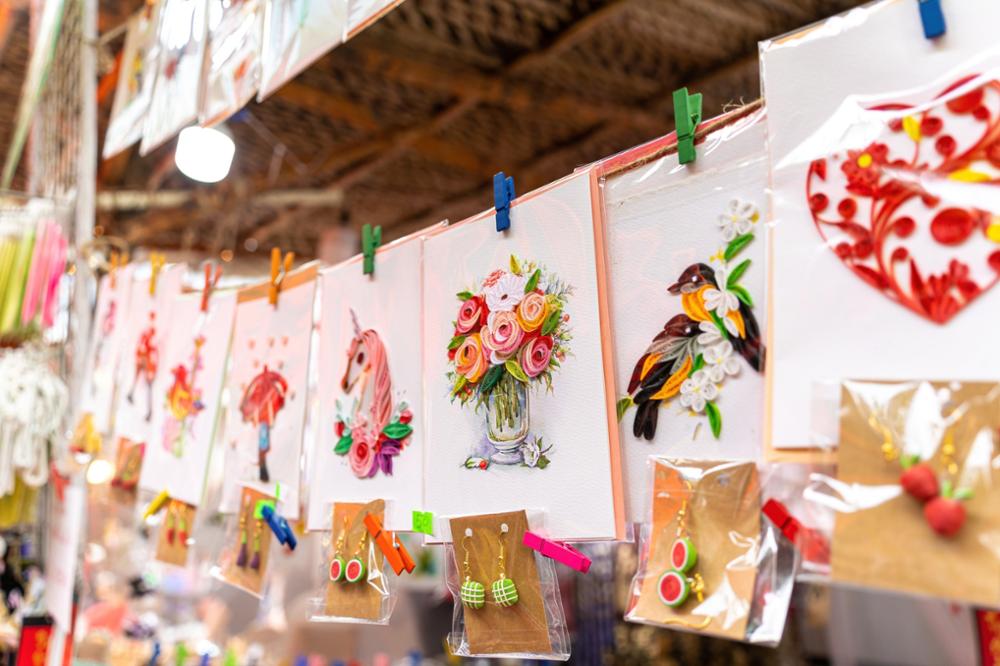
In Vietnam, Valentine's Day is a recent celebration, imported in the wake of economic opening in the 1990s. Adopted mainly by urban youth in Hanoi and Ho Chi Minh City, it is now part of everyday life: red roses, chocolates, candlelit dinners and declarations on social networks.
It is also a highly sought-after day to formalize a union, with February 14th being considered a lucky date. In some regions, couples even line up at civil registry offices first thing in the morning.
The most singular event takes place however in Hải Phòng, a port city located about a hundred kilometers east of Hanoi. Each year, the Việt-Tiệp Cultural and Friendship Palace hosts an amazing longest kiss contest. Hundreds of couples gather there to kiss for hours without interruption, under the watchful eye of a jury. Winners leave with cash prizes, gift vouchers and… a story to tell for a long time.
Valentine's Day in the United States

In the United States, Valentine's Day falls on February 14th, but extends well beyond the scope of couples. It is one of the most commercially active celebrations — behind Christmas and Halloween — with, according to the National Retail Federation, several tens of billions of dollars spent each year on cards, flowers, jewelry and chocolates.
The American spirit has made it an expanded celebration of affection, where friends, children, teachers and colleagues are also honored. In elementary schools, students exchange valentines — small decorated cards — ensuring that no classmate is forgotten, a rule of inclusion applied in the majority of schools.
The tradition of cards actually goes back to the 19th century: it was in the United States that Esther Howland, nicknamed the "mother of the American Valentine," launched in the 1840s the mass production of cards decorated with lace and ribbons. A tradition never challenged since.
Valentine's Day in Brazil
In Brazil, February 14th means nothing to lovers: at this time, the entire country vibrates to the rhythm of the Rio Carnival, and it would be quite difficult to impose a more intimate celebration in the midst of this excitement.
Brazilians therefore celebrate their version of Valentine's Day on June 12th, called Dia dos Namorados ("day of lovers"). This choice is no accident: the day before June 13th, the feast day of Saint Anthony of Padua, patron saint of the betrothed and blesser of unions in Brazil. The celebration thus fits into a still very vibrant popular Catholic tradition.
Concretely, couples share a one-on-one dinner and exchange flowers, chocolates or handwritten cards. But it is especially the simpatias, these small rituals of popular magic, that make this day fascinating. Some women immerse a statue of Saint Anthony in a glass of water, head down, until a suitor appears. Others place a rose in a container with a pinch of salt, which they use a few days later for their bath — a way to "attract" love. A mixture of faith, superstition and poetry that sums up the Brazilian spirit quite well.
Florine Dergelet