
Thailand is home to a fascinating but sometimes formidable fauna. From venomous snakes to giant centipedes, passing through deadly jellyfish, this tropical country harbors some of the world's most dangerous creatures. Although perilous encounters remain exceptional, knowing these species and adopting the right reflexes proves essential to safely enjoying your stay in the land of smiles.
Animals in Thailand: between myth and reality
Statistics reveal a reassuring reality: among millions of annual travelers, only about fifty serious cases involving wildlife are recorded. Urban areas present little risk, while rural and coastal regions require more vigilance.
Accidents mainly occur in two contexts:
- hiking in damp environments during nighttime
- water activities near coral reefs.
Mosquitoes paradoxically remain the most feared, being vectors of more or less serious diseases such as dengue fever.
In national parks, local guides know their environment perfectly and apply strict safety protocols. A respectful approach to wildlife generally suffices to avoid any inconvenience.
| Animal | Potential danger | Danger level | Where is it found? | What to do if you encounter it? |
|---|---|---|---|---|
| King cobra | Neurotoxic venom, territorial behavior | 🟥🟥🟥🟥🟥 | Forests, mangroves, mountains up to 2000 m | Keep your distance, back away slowly, do not provoke it |
| Banded krait | Neurotoxic venom, nocturnal activity | 🟥🟥🟥🟥⬜ | Wet areas, rice paddies, forest edges, low altitude | Use a flashlight, do not walk barefoot, check bedding |
| Green pit viper | Hemotoxic venom, rapid attack | 🟥🟥🟥⬜⬜ | Low branches, everywhere in Thailand, even in the city | Watch the vegetation, do not place hands without looking |
| Krait | Very powerful venom, nocturnal activity | 🟥🟥🟥🟥🟥 | Wet areas, sometimes in homes | Sleep with mosquito net, check clothes/shoes |
| Reticulated python | Constriction, rare attack | 🟥🟥⬜⬜⬜ | Rural areas, forests | Do not approach, report to authorities |
| Scorpions and spiders | Painful sting, rarely serious | 🟥⬜⬜⬜⬜ | Rural areas, woodlands, houses | Shake clothes, watch bedding and shoes |
| Mosquitoes | Disease transmission (dengue, malaria) | 🟥🟥⬜⬜⬜ | Everywhere, especially during rainy season | Repellent, mosquito net, long clothes |
| Box jellyfish | Deadly venom, anaphylactic shock | 🟥🟥🟥🟥🟥 | East coast, notably Koh Samui, Phangan, Tao | Avoid swimming outside protected areas, wear rash guard |
| Stonefish / Sea urchins / Stingrays / Corals | Painful or venomous wounds | 🟥🟥⬜⬜⬜ | Rocky areas and shallow reefs | Wear shoes, do not touch |
| Macaques / Stray dogs / Elephants / Buffaloes | Bites, attacks if provoked | 🟥🟥⬜⬜⬜ | Tourist areas, forests, countryside | Keep your distance, do not feed |
Venomous snakes to identify and avoid
Thailand is home to many snake species, some of which are venomous and potentially dangerous to humans. However, serious accidents are rare and can generally be avoided with a few simple precautions. Here are the main species to know if you travel in natural or rural areas.
🐍 Did you know? A Thai superstition about snakes
In Thailand, some believe that snakes can be the reincarnation of a deceased loved one, come to visit or transmit a message. It is also common to think that dreaming of a snake coiling around you announces the arrival of a new love. These beliefs reflect the spiritual bond that Thai people maintain with nature and animals.
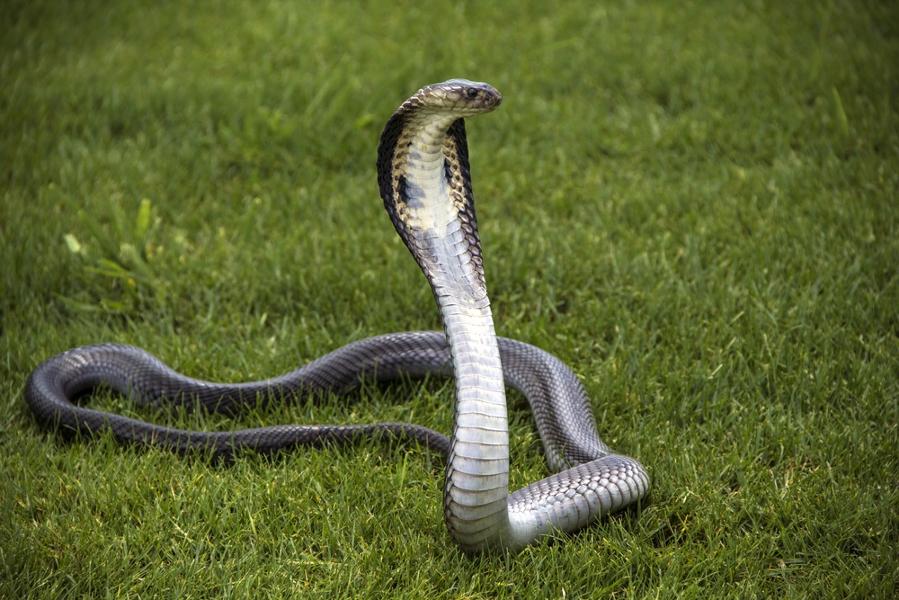
The king cobra (Ophiophagus hannah)

The world's largest venomous snake reigns over Thai forests with a length reaching up to 5.5 meters. Its coat, dotted with white or yellow transverse bands on a brown-greenish background, makes it easily recognizable.
A formidable predator, this solitary hunter stands out for its exceptional intelligence and ability to climb trees to hunt its prey. Its peculiarity? A marked preference for other snakes, hence its scientific name "Ophiophagus" meaning "snake eater".
The king cobra displays unique territorial behavior among South Asian snakes. Unlike its cousins that systematically flee, it can defend its territory by rearing up to 1.8 meters high, deploying its characteristic hood to impress intruders.
Where and when can you encounter it?
Mountainous zones up to 2,000 meters altitude also constitute its natural territory. Its presence extends from coastal mangroves to prairies adjacent to agricultural areas, with a marked preference for humid places.
The mating season, between January and April, represents a particularly active period. Males then fight in ritual combats to win females. The peak of mating occurs in February and March.
The snake shows more intense activity in the early hours of the day and late afternoon, when temperatures are moderate. During the monsoon, its mobility increases thanks to the abundance of prey and the lush vegetation that offers excellent cover.
What behavior should you adopt if you encounter it?
If you spot a cobra, keep your distance. Do not try to scare it or photograph it from too close. Here are the recommended gestures to follow in case of encounter or to avoid them:
- Back away slowly without sudden gestures over at least 5 meters to avoid any defensive reaction from the snake.
- Regularly tap your feet on the ground or with a walking stick during your hikes to signal your presence and give the snake time to move away.
- Favor cleared paths and avoid walking in tall grass where the snake can hide.
Steps to follow in case of a bite:
- Immediately contact 1669 or 199 in case of a bite to quickly receive the appropriate antivenom serum.
- Keep the bitten limb below heart level and limit movements to slow venom spread.
- Photograph the snake if possible to help rescue services identify it and administer the correct antivenom.
The banded krait (Bungarus fasciatus)

Nicknamed "the three-sided snake" in Thailand for its characteristic triangular section, this nocturnal snake is distinguished by its alternating yellow and black rings. Its venom, rich in neurotoxins, acts quickly on the nervous system.
Its discreet nature makes it particularly dangerous: you could step on it without seeing it in the dark. Unlike other snakes, the banded krait remains passive even when disturbed during the day, creating a false sense of security.
Where and when can you encounter the banded krait?
The banded krait frequents mainly marshy areas of the country, with a marked preference for rice paddy edges and water points. Its presence extends from coastal plains to hills, at a maximum altitude of 300 meters.
The months of March and April mark its mating period. The female then lays 4 to 14 eggs in natural cavities or under piles of decomposing vegetation.
It is regularly found in the central region of Thailand, notably around Bangkok and in the provinces of Chiang Mai and Kanchanaburi. Hikers must be extra vigilant at nightfall, when this reptile sets out to hunt in the undergrowth and cultivated areas.
What behavior should you adopt facing it?
- Use a powerful flashlight when moving around at night to spot its characteristic yellow and black rings.
- Avoid walking barefoot in damp areas, even near homes.
- Carefully examine your bedding before sleeping as this nocturnal hunter sometimes enters homes.
- When hiking, wear thick leather high-cut shoes to protect your ankles from bites.
- Maintain a minimum distance of 3 meters if you spot this snake, without trying to scare it.
- If bitten, stay calm and quickly reach the nearest hospital to receive the specific antivenom.
The green pit viper (Trimeresurus albolabris)

This formidable arboreal hunter is distinguished by its bright green coat which allows it to blend perfectly with lush vegetation. Its slender body measures up to 80 centimeters, with a characteristic triangular head adorned with a white lateral band.
Where can you observe the green pit viper in Thailand?
Particularly active at dusk and during the night, it favors the low branches of trees located between 2 and 3 meters from the ground. Its hunting technique relies on the element of surprise: motionless for hours, it strikes its prey within a radius of 30 centimeters with lightning speed.
It is present throughout the country, including in verdant urban areas.
What happens if the green pit viper bites us?
Its hemotoxic venom causes intense pain and severe bleeding. Although its venom is rarely fatal, medical care is necessary.
Avoid sudden movements and contact rescue services. Hikers must carefully watch the vegetation at eye level during night walks, especially after rain when it becomes more active hunting for prey.